
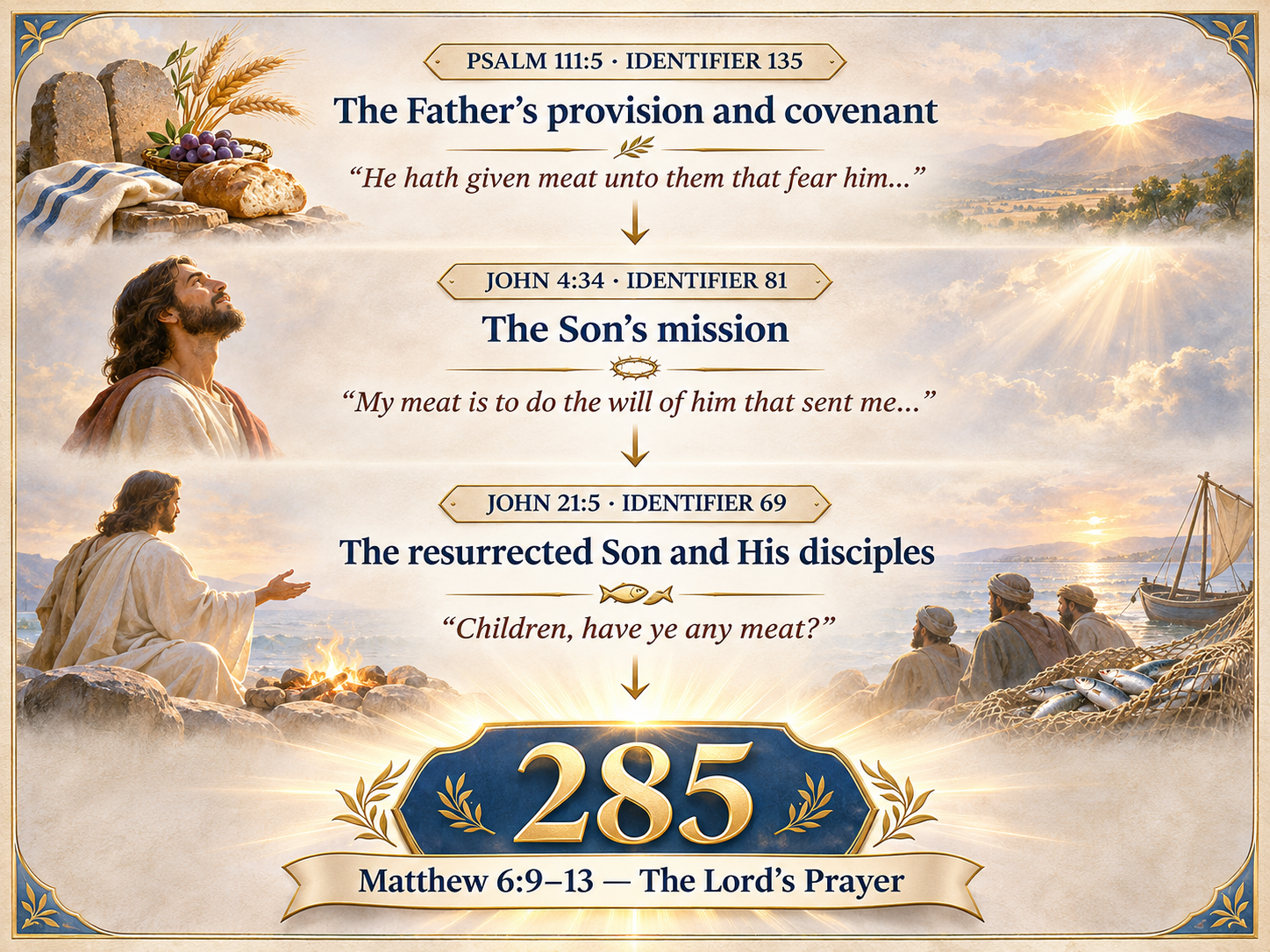
Abstract. This paper investigates a numerical and theological relationship among three biblical passages that use the English word meat in the King James Version: Psalm 111:5, John 4:34, and John 21:5. The passages concern God’s covenantal provision, Jesus Christ’s commitment to accomplishing the Father’s will, and the risen Christ’s provision for His disciples. Applying the Method of Verse Identification developed in The Lord’s Prayer: A Mathematician’s Creed, their identifiers are 135, 81, and 69. Their sum is 285, precisely the identifier of the Lord’s Prayer in Matthew 6:9–13. Furthermore, the original Hebrew and Greek words translated as meat have standard gematria values of 289, 943, and 1,084, producing a combined value of 2,316. This number satisfies several exact mathematical relationships, including φ(2316) = 8φ(153), φ(2316) = 4λ(2316), and 2316 = 8(285) + λ(285), where φ and λ are the Euler Totient and Carmichael Lambda functions, respectively. The study examines these identities using the Canon of Numeric Invariants and places them within the wider biblical themes of covenant, redemption, obedience, and sanctification. It proposes that the findings offer a coherent symbolic correspondence with the Lord’s Prayer as a proclamation of faith in the fulfillment of the Father’s will in His Son, Jesus Christ. The mathematical identities are exact; the theological significance attributed to them remains an interpretive proposal requiring careful evaluation.
Keywords: Biblical Mathematics; Psalm 111:5; John 4:34; John 21:5; Lord’s Prayer; 153; 285; 2316; gematria; Euler’s totient; Carmichael function; covenant; redemption.
1. Introduction
The Lord’s Prayer occupies a distinctive place in Christian worship. Taught by Jesus Christ in Matthew 6:9–13 and Luke 11:2–4, it brings together the acknowledgment of the Father, the holiness of His name, the coming of His kingdom, the fulfillment of His will, daily provision, forgiveness, and deliverance from evil.
In The Lord’s Prayer: A Mathematician’s Creed, Vanualailai and colleagues (2018) developed a framework of Biblical Mathematics through which the prayer is examined using verse identifiers, Hebrew gematria, Greek isopsephy, biblical numerology, and mathematical operations.
A central interpretation of that study is that the number 153, appearing in John 21:11, represents the fulfillment of the Father’s will in His Son, Jesus Christ. Within this framework, the Lord’s Prayer becomes a proclamation of faith in that fulfillment.
The present investigation arose from Psalm 111:5 (KJV):
“He hath given meat unto them that fear him: he will ever be mindful of his covenant.”
The verse connects God’s provision with His everlasting covenant. Its verse identifier, calculated as 19 + 111 + 5, is 135. Since the digits of 135 can be rearranged to form 153, the verse invited further consideration alongside John 4:34, where Jesus identifies His meat as accomplishing the Father’s will, and John 21:5, where the resurrected Jesus asks His disciples whether they have any meat shortly before the miraculous catch of 153 fish.
This led to an arithmetic result: the three verse identifiers sum to 285, precisely the identifier previously established for the Lord’s Prayer in Matthew 6:9–13. Subsequent examination of the original-language words yielded a second numerical result: their combined standard gematria is 2,316.
Three questions guide the study:
- What theological relationships can be established among Psalm 111:5, John 4:34, and John 21:5 within their biblical contexts?
- What exact mathematical relationships arise from their verse identifiers and original-language gematria?
- To what extent can these relationships support a coherent theological interpretation involving the Lord’s Prayer and 153?
The investigation proceeds from biblical context to mathematical calculation and then to theological interpretation.
2. Biblical Context: Three Expressions of Nourishment
2.1. Psalm 111:5 — The Father’s provision and everlasting covenant
Psalm 111 is a hymn of praise celebrating the LORD’s works, righteousness, compassion, faithfulness, and redemption. It is an alphabetic acrostic, composed of 22 successive Hebrew poetic lines corresponding to the letters of the Hebrew alphabet. The psalm belongs to a wider literary setting in which God’s saving acts are remembered and His people are encouraged to respond through reverence and obedience.
Psalm 111:5 declares:
“He hath given meat unto them that fear him: he will ever be mindful of his covenant.”
The verse comprises two closely related declarations. First, God provides food for those who fear Him. The provision is consistent with the biblical remembrance of God’s care for Israel, especially during the wilderness journey. Second, God remains mindful of His covenant. Divine provision is thus not presented merely as a momentary act of generosity: it belongs to the continuing relationship between the LORD and His covenant people.
The following verse strengthens this interpretation:
“He hath shewed his people the power of his works, that he may give them the heritage of the heathen.” (Psalm 111:6, KJV)
God’s power is exercised in fulfilling His promises. Psalm 111:9 later declares:
“He sent redemption unto his people: he hath commanded his covenant for ever: holy and reverend is his name.”
Thus, provision, inheritance, redemption, and covenant faithfulness are closely connected within Psalm 111.
The Hebrew word translated meat in verse 5 is טֶרֶף (ṭereph). Its semantic range includes prey and food, but here it is best understood as provision. Any connection with Jesus Christ must proceed through a Christian theological reading rather than a claim that the psalm directly names Him.
2.2. John 4:34 — The Son’s nourishment is the Father’s will
John 4 records Jesus’ encounter with the Samaritan woman. After speaking with her about living water and true worship, Jesus is encouraged by His disciples to eat. He responds:
“I have meat to eat that ye know not of.” (John 4:32, KJV)
When the disciples misunderstand Him, He explains:
“My meat is to do the will of him that sent me, and to finish his work.” (John 4:34, KJV)
The Greek word translated meat is βρῶμα (brōma), meaning food or nourishment. Unlike Psalm 111:5, where the context concerns material provision, Jesus uses food metaphorically to describe His commitment to accomplishing the Father’s mission.
The surrounding passage, John 4:35–38, speaks of fields ready for harvest. Jesus’ mission concerns the gathering of people into the life offered through Him. This theme is developed in John 6:
“For I came down from heaven, not to do mine own will, but the will of him that sent me.” (John 6:38, KJV)
Jesus explains that the Father’s will includes preserving those entrusted to Him and raising believers to everlasting life (John 6:39–40). In John 17:4, He declares that He has finished the work given to Him. On the cross, in John 19:30, He announces: “It is finished.” The related Greek verb forms express accomplishment or completion, though they are not identical words in identical grammatical forms.
The Son came to accomplish the Father’s will.
2.3. John 21:5 — The resurrected Son provides for His disciples
John 21 records an appearance of Jesus after the resurrection. The disciples have spent the night fishing without success. Jesus addresses them:
“Children, have ye any meat? They answered him, No.” (John 21:5, KJV)
The Greek word translated meat is προσφάγιον (prosphagion), referring to something eaten with bread, particularly fish. The word occurs only once in the Greek New Testament—a hapax legomenon. Its rarity is a verifiable lexical fact, although rarity alone does not establish deliberate numerical encoding.
Jesus directs the disciples to cast their net on the right side of the boat. They obey and obtain an abundant catch. John 21:11 records:
“Simon Peter went up, and drew the net to land full of great fishes, an hundred and fifty and three: and for all there were so many, yet was not the net broken.”
The precise number 153 has attracted theological and numerical interpretation throughout Christian history. Richard Bauckham (2002), for example, investigates how this number may contribute to the literary and theological unity of the Fourth Gospel. Other interpreters emphasize the extraordinary catch’s narrative function rather than a particular numerical symbolism.
The interpretation adopted in The Lord’s Prayer: A Mathematician’s Creed is that the 153 fish represent those given to the Son by the Father and that the unbroken net recalls Jesus’ promise not to lose those entrusted to Him. On this interpretation, 153 represents the fulfillment of the Father’s will in Jesus Christ.
The scene concludes with Jesus providing bread and fish to His disciples (John 21:12–13). Indeed, John 21:9 indicates that bread and fish were already prepared on the shore, before the disciples brought their own catch.
This completes a meaningful narrative progression. In John 4, Jesus’ food is to accomplish His Father’s will. In John 21, the resurrected Jesus provides food to His disciples after directing the miraculous catch. The second scene does not explicitly explain the first, but the two can be understood within John’s broader presentation of Jesus’ mission, obedience, resurrection, and continuing care.
2.4. The theological relationship among the three passages
The three passages present complementary dimensions of nourishment:
| Passage | Meaning of nourishment | Principal theological theme |
|---|---|---|
| Psalm 111:5 | Food provided by God | Covenant faithfulness |
| John 4:34 | Doing the Father’s will as spiritual nourishment | The Son’s obedience and mission |
| John 21:5 | Fish requested from the disciples, followed by miraculous provision | The risen Son’s provision and continuing mission |
The relationship is not based upon an identical Hebrew or Greek word. It is based upon a developing Christian theological reading of provision, obedience, and redemption: the Father provides for His covenant people; the Son finds His nourishment in fulfilling the Father’s will; and the resurrected Son demonstrates His continuing provision for His disciples.
3. The Method of Verse Identification
3.1. Definition
The Method of Verse Identification assigns a numerical identifier to a biblical verse by adding its book number, chapter number, and verse number:
I = B + C + V, where B is the book number, C the chapter number, and V the verse number.
The method uses the conventional 66-book Protestant ordering of the Bible. Accordingly, Psalms is Book 19, Matthew is Book 40, and John is Book 43. The cumulative identifier of a chosen set is the sum of its verse identifiers.
3.2. Identifiers of the three verses
| Biblical verse | Book number | Chapter | Verse | Identifier |
|---|---|---|---|---|
| Psalm 111:5 | 19 | 111 | 5 | 135 |
| John 4:34 | 43 | 4 | 34 | 81 |
| John 21:5 | 43 | 21 | 5 | 69 |
| Total | 105 | 136 | 44 | 285 |
135 + 81 + 69 = 285.
3.3. The identifier of the Lord’s Prayer
The Lord’s Prayer in Matthew occupies verses 9–13 of chapter 6:
| Verse | Identifier |
|---|---|
| Matthew 6:9 | 55 |
| Matthew 6:10 | 56 |
| Matthew 6:11 | 57 |
| Matthew 6:12 | 58 |
| Matthew 6:13 | 59 |
| Total | 285 |
Therefore,
I(Psalm 111:5) + I(John 4:34) + I(John 21:5) = I(Matthew 6:9–13) = 285.
This is the first principal mathematical result. The verses were selected on thematic grounds before their total was computed. This makes the result a noteworthy exploratory observation, but without comparison with other verse combinations it cannot establish statistically unusual or intentional encoding.
4. The Connection Between 135 and 153
Psalm 111:5 has identifier 135. Its decimal digit tuple is (1, 3, 5). Permuting the digits produces (1, 5, 3); encoding the latter in decimal notation gives 153:
135 → 153 (digit permutation).
The arrow denotes digit rearrangement, not arithmetic equality.
Within the framework of Vanualailai and colleagues (2018), 153 represents the fulfillment of the Father’s will in His Son, Jesus Christ. This invites attention because Psalm 111:5 concerns covenant faithfulness, John 4:34 concerns accomplishing the Father’s will, and John 21:11 records the 153 fish.
The number 153 is also the seventeenth triangular number:
153 = 1 + 2 + ··· + 17 = 17 × 18 / 2.
Jones (2008) associates 17 with victory and discusses the 153 fish in that context. Nevertheless, digit permutation depends on the numeral system selected. It is a secondary observation rather than an intrinsic invariant property of 135 and should not be treated as independent proof of a theological proposition.
5. Gematria of the Three Words Translated as “Meat”
5.1. Method
Hebrew gematria and Greek isopsephy assign conventional numerical values to letters and sum those values across a word. This study uses standard Hebrew final-letter values rather than elevated sofit values. Vowel marks and Greek accents do not contribute to the sums.
5.2. Psalm 111:5 — Ṭereph
Hebrew: טֶרֶף (ṭereph).
| Hebrew letter | Name | Value |
|---|---|---|
| ט | Tet | 9 |
| ר | Resh | 200 |
| ף | Final Pe (standard value) | 80 |
| Total | 289 |
Hence G(ṭereph) = 9 + 200 + 80 = 289. Under an alternative sofit convention assigning 800 to final Pe, the result would instead be 1009. For the present research the standard value 289 is used consistently.
5.3. John 4:34 — Brōma
Greek: βρῶμα (brōma).
| Greek letter | Name | Value |
|---|---|---|
| β | Beta | 2 |
| ρ | Rho | 100 |
| ω | Omega | 800 |
| μ | Mu | 40 |
| α | Alpha | 1 |
| Total | 943 |
Hence G(brōma) = 2 + 100 + 800 + 40 + 1 = 943.
5.4. John 21:5 — Prosphagion
Greek: προσφάγιον (prosphagion).
| Greek letter | Name | Value |
|---|---|---|
| π | Pi | 80 |
| ρ | Rho | 100 |
| ο | Omicron | 70 |
| σ | Sigma | 200 |
| φ | Phi | 500 |
| α | Alpha | 1 |
| γ | Gamma | 3 |
| ι | Iota | 10 |
| ο | Omicron | 70 |
| ν | Nu | 50 |
| Total | 1,084 |
Hence G(prosphagion) = 1,084.
5.5. Combined gematria
289 + 943 + 1,084 = 2,316.
| Passage | Verse identifier | Gematria of “meat” |
|---|---|---|
| Psalm 111:5 | 135 | 289 |
| John 4:34 | 81 | 943 |
| John 21:5 | 69 | 1,084 |
| Total | 285 | 2,316 |
The two columns result from different operations: one uses verse locations and the other uses letter values in specified original-language spellings. The calculations are exact under the declared conventions; they are not statistically independent, since both are computed from the same selected passages.
6. Mathematical Relationships Among 153, 285, and 2,316
6.1. Prime factorizations
153 = 3² × 17; 285 = 3 × 5 × 19; 2,316 = 2² × 3 × 193.
6.2. Euler’s totient function
Euler’s totient, φ(n), counts positive integers not exceeding n that are relatively prime to n (that is, share no prime factor with it).
For our three numbers:
φ(153) = 96; φ(285) = 144; φ(2316) = 768.
Consequently,
φ(2316) = 8φ(153) = 8 × 96 = 768.
This is the second principal mathematical result. The combined gematria has an eightfold totient relationship with 153, which already occupies a central place in our reading of John 21:11.
6.3. Carmichael’s lambda function
Carmichael’s function, λ(n), is the smallest positive exponent m such that a raised to m leaves remainder 1 upon division by n for every integer a relatively prime to n. In other words, it measures an aspect of periodicity in modular arithmetic.
Here,
λ(153) = 48; λ(285) = 36; λ(2316) = 192.
We therefore have
φ(285) / λ(285) = 144 / 36 = 4,
φ(2316) / λ(2316) = 768 / 192 = 4.
Both numbers satisfy φ(n) = 4λ(n).
A further relation is λ(2316) = 2φ(153). Hence,
φ(2316) = 8φ(153), while λ(2316) = 2φ(153).
Dividing these expressions recovers the common ratio 8 / 2 = 4.
6.4. The identity involving 285, 8, and 36
Ordinary division yields
2,316 = 8 × 285 + 36.
Since λ(285) = 36, we obtain
2,316 = 8 × 285 + λ(285).
Thus, the combined gematria can be written as eight times the Lord’s Prayer identifier plus that identifier’s Carmichael lambda.
6.5. Additional mathematical properties
| Property | 285 | 2,316 |
|---|---|---|
| Prime factorization | 3 × 5 × 19 | 2² × 3 × 193 |
| Euler totient φ | 144 | 768 |
| Carmichael lambda λ | 36 | 192 |
| Divisor sum σ | 480 | 5,432 |
| Divisor count τ | 8 | 12 |
| Aliquot sum | 195 | 3,116 |
| Radical | 285 | 1,158 |
| Totient / lambda ratio | 4 | 4 |
The two numbers share three distinct prime factors in their factorizations (three each), but not the same sets of prime factors; their greatest common divisor is 3. The number 285 is sphenic, meaning a product of exactly three distinct prime factors, whereas 2316 is not sphenic because of its repeated factor 2.
If S(n) counts sphenic integers not exceeding n, the attached numerical study further records S(285) = 30 and S(2316) = 360. Consequently S(2316) = 12S(285). This is an auxiliary counting relationship, not one of the primary invariant operations in our Canon.
7. Theological Interpretation Within the Canon of Numeric Invariants
The Canon assigns symbolic interpretive domains to certain mathematical functions. These are proposed theological analogies, not mathematical definitions or logical implications of the number theory.
7.1. Euler’s totient and the faithful remnant
The Canon associates φ(n) with the faithful remnant and consecration. Integers relatively prime to n provide a possible image of those set apart within a larger whole, recalling Romans 11:5 and its remnant chosen by grace.
Within this scheme, φ(2316) = 8φ(153) may be reflected upon in relation to the faithful community symbolized by 153 and a recurring practice of prayer. This does not mean that a totient literally counts believers or measures election; it is an interpretive analogy.
7.2. Eight and the renewal of prayer
Jones (2008) associates eight with a new beginning. In The Lord’s Prayer: A Mathematician’s Creed, the Greek gematria of τὸ δίκτυον (“the net”) in John 21:11 is calculated as 370 + 854 = 1224, yielding the exact relationship 1224 = 8 × 153.
The book subsequently develops this into a proposed pattern of eight daily prayer times. This is a specific devotional interpretation within Biblical Mathematics and not an explicit instruction from John 21.
The present study introduces a second eightfold relationship, φ(2316) = 8φ(153). The first relates a phrase’s gematria directly to 153; the second relates the totient of a combined gematria to the totient of 153. Their common factor eight is mathematically exact and may be considered as a supplementary symbolic association with renewal and sanctification.
7.3. Thirty-six and deliverance from evil
The result 2316 = 8(285) + 36 contains 36, associated by Jones with the adversary or enemy. The same number is λ(285). This offers a possible reflection alongside Matthew 6:13:
“And lead us not into temptation, but deliver us from evil…”
The biblical basis for seeking deliverance is the prayer itself. A Carmichael lambda value has no intrinsic moral meaning, and the occurrence of 36 alone does not demonstrate a connection with spiritual adversaries.
7.4. The common ratio of four
Both numbers satisfy φ(n) = 4λ(n). Within our Canon, φ is associated with consecration, while λ is associated with sovereignty and ordered cycles. Jones associates four with the earth and material creation, a possible symbolic parallel to “Thy will be done in earth, as it is in heaven” (Matthew 6:10).
Such a parallel remains tentative: the ratio four is not unique to this pair of numbers and cannot establish encoded biblical intention.
8. The Lord’s Prayer as a Theological Synthesis
The central question is not whether several exact numerical relationships exist—they do—but why the three underlying passages may be meaningfully associated with the Lord’s Prayer.
8.1. The Father’s covenant
Psalm 111:5 establishes God’s faithful provision and His remembrance of His covenant forever. The Lord’s Prayer begins by acknowledging the Father and the holiness of His name. Christian worship thus begins with recognition of God’s character, faithfulness, and sovereignty.
8.2. Fulfillment of the Father’s will
John 4:34 identifies Jesus’ mission as accomplishing the Father’s will. The Lord’s Prayer teaches believers to say, “Thy will be done in earth, as it is in heaven.” Our earlier research reads these words as a proclamation of faith in the Son’s accomplishment of the Father’s redemptive purpose, particularly in light of John 6:38–40.
8.3. The Father’s provision and the Bread of Life
Psalm 111:5 concerns food given by God; John 21:5–13 portrays the risen Jesus giving His disciples fish and bread; and Matthew 6:11 asks for daily bread. John 6:35 further presents Jesus as the Bread of Life. The immediate meaning of daily bread concerns material dependence; the wider Christian reading connects divine provision with the life offered in Christ. These related meanings should not be treated as identical.
8.4. The covenant of the Redeemer
Isaiah 59:20–21 announces a Redeemer and declares God’s covenant involving His Spirit and words remaining with His people. The Lord’s Prayer: A Mathematician’s Creed interprets the Lord’s Prayer as associated with this covenant. That offers a theological rationale for considering Psalm 111:5’s everlasting covenant alongside the prayer, although the association is not explicitly made by the psalmist.
8.5. Sanctification and the transformed life
Psalm 111 is followed by Psalm 112, a companion acrostic portraying the person who fears the LORD. Qualities celebrated in God—righteousness, compassion, faithfulness—are reflected in the conduct of the righteous. The Lord’s Prayer likewise asks believers not only to acknowledge God’s will but to live according to it, most clearly when seeking forgiveness while undertaking to forgive others.
The wider theological sequence may therefore be expressed as:
The Father’s covenant faithfulness → the Son’s fulfillment of the Father’s will → the continuing transformation of believers through faith and obedience.
9. Methodological Considerations and Limitations
Biblical Mathematics is most credible when its mathematical statements are transparent and reproducible and are distinguished from theological interpretation.
First, the arithmetic findings are exact. The verse totals, gematria sums, prime factorizations, and mathematical invariant identities can be checked independently under the stated conventions.
Second, the theological relationship is interpretive. The passages share themes of nourishment, provision, obedience, covenant, and Jesus’ mission, but the Hebrew and Greek words are not identical, and the biblical authors do not explicitly cross-reference all three texts.
Third, claims of intentional encoding remain unproven. Verse identifiers depend on later chapter-and-verse divisions and a particular canonical order. Gematria depends on selected spellings and letter-value conventions; many verse collections can share a sum; and relationships observed after selecting the texts may reflect exploratory selection bias. A symbolic meaning assigned to an invariant does not follow from the invariant’s mathematical definition.
Future work should specify selection criteria in advance, examine comparison sets of passages, record exactly which Hebrew and Greek textual forms are used, and investigate how often equivalent relationships arise by chance. Such tests would sharpen the argument without diminishing the value of its reproducible mathematical observations.
10. Conclusion
The investigation began with a straightforward observation: Psalm 111:5, John 4:34, and John 21:5 all use the word meat in the KJV. In their distinct contexts, the verses concern God’s covenantal provision, Jesus’ determination to do the Father’s will, and the resurrected Jesus’ provision for His disciples before the miraculous catch of 153 fish.
Applying two different mathematical methods to the three selected verses yielded two exact totals:
Verse identifiers: 135 + 81 + 69 = 285.
Original-language word gematria: 289 + 943 + 1084 = 2316.
The first total matches the identifier of the Lord’s Prayer in Matthew 6:9–13. The second satisfies the identities:
φ(2316) = 8φ(153); φ(2316) = 4λ(2316); 2316 = 8(285) + λ(285).
The results are mathematically exact, but their theological significance remains proposed rather than demonstrated. Their potential interest lies in their association with passages connected independently through recognizable biblical themes.
The strongest conclusion is therefore theological. Psalm 111:5 celebrates the Father’s everlasting covenant; John 4:34 identifies the Son’s purpose as fulfilling the Father’s will; and John 21:5–13 presents the risen Son providing for His disciples after directing the extraordinary gathering of fish.
When these passages are read alongside the Lord’s Prayer, they draw attention to the Father’s faithfulness, the Son’s obedience, divine provision, redemption, and the believer’s transformation. The Lord’s Prayer acknowledges the Father whose covenant endures, proclaims faith in the Son who fulfills His redemptive will, and calls believers to continuing dependence, obedience, forgiveness, and sanctification.
The mathematical relationships do not replace the biblical message. Within the proposed framework of Biblical Mathematics, they provide additional structures through which that message may be contemplated, tested, and communicated.
References
Bauckham, R. (2002). The 153 fish and the unity of the Fourth Gospel. Neotestamentica, 36(1–2).
Jones, S. E. (2008). The Biblical Meaning of Numbers from One to Forty. God’s Kingdom Ministries.
Keener, C. S. (2003). The Gospel of John: A Commentary. Hendrickson.
Oakman, D. E. (2017). The political meaning of a cipher—John 21:11. Biblical Theology Bulletin, 47(2). https://doi.org/10.1177/0146107917697904
Vanualailai, J., Tomasi, E., Vanualailai, P., & Takala, J. (2018). The Lord’s Prayer: A Mathematician’s Creed. Suva, Fiji.
Canon of Numeric Invariants with Theological Interpretations. Team 153 research reference, updated version 2.
Primary biblical text: King James Version (KJV), especially Psalm 111:5–9; John 4:31–38; John 6:35–40; John 17:4; John 19:30; John 21:5–13; Matthew 6:9–13; Luke 11:2–4; and Isaiah 59:20–21.

