
Biblical Mathematics is a Christ-centered discipline in which, beginning from the axiom that Jesus Christ came in the flesh, defined mathematical methods are applied to Scripture and its numerical structures, and the results are accepted only if they remain consistent with that axiom and lead toward obedience to God.
This approach aims to highlight the internal coherence of the Bible. In particular, it supports the view that the Lord’s Prayer functions as a succinct and theologically concentrated summary of the Gospel of Jesus Christ, gathering into brief form many of the central themes of Jesus’ teaching and, more broadly, of the biblical message.
This page contains the structure of Biblical Mathematics:
- Axiom
- Definition
- Framework
- The 4 Methods of Biblical Mathematics (Method of Verse Identifier, Alphanumeric Method, Biblical Numerology and Canon of Numeric Invariants).

Axiom 1:1 Jesus Christ came in the flesh
1 John 4:1-3: Beloved, believe not every spirit, but try the spirits whether they are of God: because many false prophets are gone out into the world. 2 Hereby know ye the Spirit of God: Every spirit that confesseth that Jesus Christ is come in the flesh is of God: 3 And every spirit that confesseth not that Jesus Christ is come in the flesh is not of God: and this is that spirit of antichrist, whereof ye have heard that it should come; and even now already is it in the world.
Definition
Biblical Mathematics is the disciplined application of defined mathematical methods to the text, structure, and numerical features of Scripture, under ordinary mathematical reasoning and Axiom 1.1, in order to derive and evaluate results that are scripturally coherent and directed toward obedience to God.
Framework
The framework (see figure below) gives Biblical Mathematics both its doctrinal boundary and its intended spiritual outcome. Axiom 1.1 supplies the christological center of the framework, ensuring that acceptable results do not contradict the incarnation or the character of God revealed in Scripture. Deuteronomy 29:29 supplies the intended end of the framework, namely that what is revealed should lead to faithful obedience rather than mere curiosity or speculative numerology. Accordingly, a proposed mathematical result is not accepted simply because it is numerically interesting; it must also be scripturally coherent, consistent with Axiom 1.1, and spiritually edifying in the sense of Deuteronomy 29:29. In this way, the framework serves as a necessary filter that separates meaningful results from arbitrary or nonsensical ones.

Fig. 1:1 Let be a proposed result of Biblical Mathematics, such as a definition, lemma, theorem, corollary, or conjecture. The result is acceptable only if it is numerically sound, consistent with Axiom 1.1 (“Jesus Christ came in the flesh,” in the sense of 1 John 4), and directed toward the revealed end of Deuteronomy 29:29, namely obedience to God. Any result falling outside these conditions is rejected. This figure therefore functions as the governing filter of Biblical Mathematics.
Deuteronomy 29:29 The secret things belong unto the Lord our God: but those things which are revealed belong unto us and to our children for ever, that we may do all the words of this law.
The Four Main Methods of Biblical Mathematics
1. Method of Verse Identification
Let a verse in the Bible be identified by its canonical location ( 𝐵 , 𝐶 , 𝑉 ) , where 𝐵 is the book number, 𝐶 the chapter number, and 𝑉 the verse number. The verse identifier of that verse is defined by
I( 𝐵 , 𝐶 , 𝑉 ) = 𝐵 + 𝐶 + 𝑉
More generally, if 𝑄 is a set of verses, then the identifier of 𝑄 is the sum of the identifiers of all verses in 𝑄 . This identifier is not necessarily unique, but it provides a simple and useful numerical label for structural comparison.
For example, the identifier of the Lord’s Prayer in the Gospel of Luke is 168:
| Book | Chapter | Verse | Sum |
| 42 | 11 | 2 | 55 |
| 42 | 11 | 3 | 56 |
| 42 | 11 | 4 | 57 |
| 168 |
Similarly, the identifier of the Lord’s Prayer in the Gospel of Matthew is 285.
| Book | Chapter | Verse | Sum |
| 40 | 6 | 9 | 55 |
| 40 | 6 | 10 | 56 |
| 40 | 6 | 11 | 57 |
| 40 | 6 | 12 | 58 |
| 40 | 6 | 13 | 59 |
| 285 |
2. The Alphanumeric Method
The second method in Biblical Mathematics is the use of well-known standard value of each Hebrew and Greek letter. The alphanumeric code of assigning a numerical value to a word, name, or phrase based on its letters is known as Gematria. Traditional Jewish Gematria focuses on the Hebrew language and is often used for interpreting Jewish texts, especially the Torah. The Greek alphabet, like the Hebrew, also has historical associations with numerical values. This system is known as Isopsephy in Greek. The assignment of numerical values to Greek letters allows for the practice of gematria with Greek words, which was used in various ancient Greek documents and inscriptions.
The following table, showing the Jewish Gematria and the Greek Isopsephy, is sourced from the website The Construction of the Menorah and the Bible.
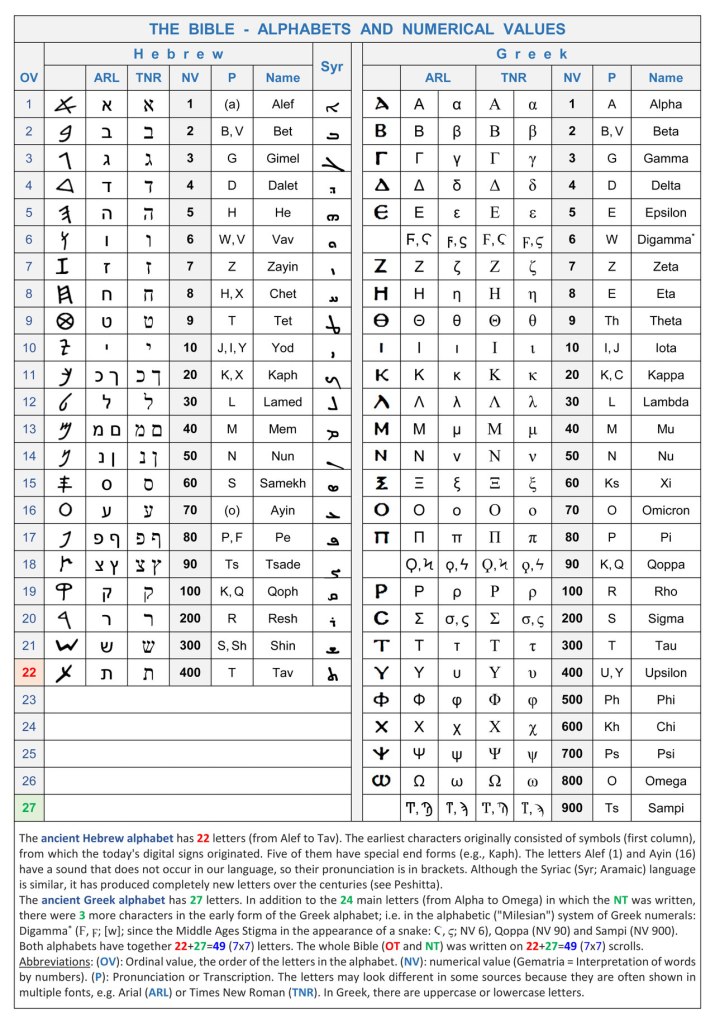
Definition (Method of the Gematria & Isopsephy)
The Method of Gematria (applied to the Hebrew alphabet) & Isopsephy (applied to the Greek alphabet) assigns a numerical value to each letter of a Hebrew or Greek word and then adds those values together. The total is called the gematria or isopsephy of the word, phrase, or verse.
If is made up of letters , then its gematria or isopsephy is
where is the numerical value of the letter lk.
If two biblical expressions have the same gematria or isopsephy, this may point to a possible relationship between them. However, such a relationship is meaningful only if it is supported by scriptural context and by the framework of Biblical Mathematics.
Example (666)
One natural starting point for the Method of Isopsephy is Revelation 13:18, where the reader is expressly invited to calculate a number: “Let him that hath understanding count the number of the beast.” In the Greek manuscript tradition, given by
ὧδε ἡ σοφία ἐστίν. ὁ ἔχων τὸν νοῦν ψηφισάτω τὸν ἀριθμὸν τοῦ θηρίου· ἀριθμὸς γὰρ ἀνθρώπου ἐστί, καὶ ὁ ἀριθμὸς αὐτοῦ χξϛ,
the number 666 is represented by the numeral letters χξϛ, where χ = 600, ξ = 60, and ϛ = 6, so that χξϛ = 666. This is a notable feature of the verse, because it shows that numerical calculation is not being imposed upon the text from outside; rather, the text itself calls for it. For this reason, the Greek, isopsephy— provides a natural and legitimate point of departure for Biblical Mathematics, since it treats letters and words not only as carriers of meaning, but also as bearers of numerical value.
Example (153)
Simple
Both the New and Old Testaments have several words and expressions that carry the equivalent value of 153. For example, the expression “the Passover” in Hebrew is הַפֶּסַח. The value of each letter is: ה = 5, פ = 80, ס = 60, ח = 8. Hence, the sum is 153.
Mixture of both Advanced Mathematics and Gematria or Isopsephy
The Hebrew phrase ישוע המשיח (read Yeshua HaMashiach) means “Jesus the Messiah“. Its value is 749, as shown below:
“ישוע” (Yeshua): י (Yod) = 10; ש (Shin) = 300; ו (Vav) = 6; ע (Ayin) = 70.
Hence, the sum is 10 + 300 + 6 + 70 = 386.
“המשיח” (HaMashiach): ה (He) = 5; מ (Mem) = 40; ש (Shin) = 300; י (Yod) = 10; ח (Chet) = 8.
Hence, the sum is 5 + 40 + 300 + 10 + 8 = 363.
Adding both sums together: 386 (Yeshua) + 363 (HaMashiach) = 749.
It is interesting that an estimation of the Prime Pi function at 749 is 135, a permutation of the numeral form of 153 referred to in John 21:11:
So Simon Peter climbed back into the boat and dragged the net ashore. It was full of large fish, 153, but even with so many the net was not torn.
It is also intriguing that another permutation of the digits of 153 is the isopsephy of the 7-letter word “ἰάσπιδι” (iaspidi), which means “jasper”, that describes the man who “sat on the throne” in Revelation 4:2-3 (KJV):
2 And immediately I was in the spirit: and, behold, a throne was set in heaven, and one sat on the throne. 3 And he that sat was to look upon like a jasper and a sardine stone: and there was a rainbow round about the throne, in sight like unto an emerald.
Using the standard alphabetic numeration of the Greek alphabet ( ἰ=10, ά=1, σ=200, π=80, ι=10, δ=4, ι=10 ), we find that the numerical value of “ἰάσπιδι” is 315. Hence, the one who sat on a throne is associated with the number 315. So, does 315 defines the radiant glory of God the Father’s sovereign presence?
Our book, The Lord’s Prayer: A Mathematician’s Creed, is all about an interpretation of John 21:11 and the number 153. In our Biblical Mathematics framework, the number 153 is not about a mere fish count. In John 21, Jesus speaks of “meat,” and in John 4:34 He says, “My meat is to do the will of him that sent me.” The Father’s will is defined precisely in John 6:39–40, 44 and John 17:1–2: that is, the Father gives those He has chosen to the Son, the Son loses none of them, and those who see and believe receive eternal life. The 153 fishes therefore represent those given by the Father to the Son, and the unbroken net signifies that none are lost. The resurrection breakfast scene becomes an allegory of Christ having completed the Father’s saving will. Hence, the number 153 represents the fulfillment of the will of the Father in His Son, Jesus Christ. And because the Lord’s Prayer is the foremost proclamation of faith in that fulfilled will, the number 153 and the Lord’s Prayer are inseparably linked.
Indeed, the astonishing discovery about the number 153 is that it uncovers the daily prayer times of the Lord’s Prayer. The 6 permutations of {1, 5, 3}, namely, {1,3,5}, {1,5,3}, {3,1,5}, {3,5,1}, {5,1,3}, {5,3,1} produce the numerals in the following set:{135, 153, 315, 351, 513, 531}. The sum is 1988. There are 16 divisors of 1988, given in the set {1, 2, 3, 6, 9, 18, 27, 37, 54, 74, 111, 222, 333, 666, 999, 1998}. The sum is is 4560. Therefore, the arithmetic mean of the divisors is 4560/16=285. But as shown above in the second table, the number 285 is the identifier for the Lord’s Prayer in the Gospel of Matthew.
In our book, we argued that Jesus Christ died at precisely 3.15pm and His chest was pierced at precisely 5.31pm before Sabbath. Based on these, the time-equivalents of {135, 153, 315, 351, 513, 531} are therefore the elements of the following set {1.35pm, 1.53pm, 3.15pm, 3.51pm, 5.13pm, 5.31pm}. According to the Bible, Jesus Christ hung on the cross from 9am and was taken down before Sabbath. Therefore, in the 12-hour format, the only possible times with the digits {1,5,3} are in the set:
{10.35am, 10.53am, 1.35pm, 1.53pm, 3.15pm, 3.51pm, 5.13pm, 5.31pm}
These therefore are the eight daily prayer times of the Lord’s Prayer.
Richard Bauckham’s 2002 paper The 153 Fish and the Unity of the Fourth Gospel in the journal “Neotestamentica” marked a notable point in the discussion of gematria within biblical scholarship. Bauckham, a respected New Testament scholar, suggested that numerical techniques, including gematria, were more prevalent in biblical texts than previously acknowledged by mainstream scholarship:
NT scholars have rarely taken seriously the use of numerical techniques of literary composition by NT authors, but the evidence is mounting that such techniques were used in biblical and related literature. Three such techniques have been identified: (1) The best known is gematria, involving Hebrew or Greek letters. (In Hebrew and Greek the letters of the alphabet also serve as numerals, and so every word has a numerical value which is the sum of the numerical values of its letters.) (2) Another technique is the measurement of sections by counting the syllables or words. (3) The number of occurrences of a particular word within a literary work (or section of one) may be significant. Such techniques can be combined.
Bauckham’s work contributed to a broader recognition and discussion of these methods within academic circles. It suggested a more complex and nuanced understanding of the composition of biblical texts, proposing that authors might have employed these methods as part of their literary and theological expression.
Note though that traditional historical-critical methods and literary analysis remain the predominant tools for biblical interpretation in academic settings. Gematria and related techniques are often viewed more as a part of the history of interpretation or as ancillary to the main methods of textual analysis.
3. Biblical Numerology
Biblical Numerology is the interpretive study of the possible meaning or significance of a number on the basis of its repeated occurrence, thematic association, or prominent use in Scripture. Some numbers appear explicitly in the biblical text; these may be called biblical numbers. Over time, several writers have sought to study such numbers systematically. Ivan Panin (1855–1942) is widely associated with the numerical study of Scripture, especially its structural patterns, while notable studies on the symbolic meaning of numbers were produced by E. W. Bullinger (1837–1913) and Ed F. Vallowe (1919–2002). A more recent and accessible treatment is Stephen E. Jones’ The Biblical Meaning of Numbers from One to Forty (2008), which builds on earlier work by Bullinger and Vallowe. In the present work, when we refer to biblical numbers, we shall generally mean those numbers defined and expounded in Jones’ 2008 publication.
Biblical Numerology, as used here, does not assign meanings to numbers arbitrarily, but seeks meanings that arise from Scripture itself through repeated biblical usage and theological coherence.
4. Canon of Numeric Invariants
This fourth method may be called the Canon of Numeric Invariants. It is a rule-governed set of mathematical invariants used to read the internal structure of a verse-total or passage-total. In retrospect, this is a method that I had been using implicitly or unknowingly whenever I examined divisors, sums of divisors, aliquot sums, or related structural features of a number. It now deserves to be stated explicitly as a distinct method within Biblical Mathematics.
The word canon is appropriate because this method is not a loose collection of numerical curiosities. It is a bounded and disciplined set of mathematical principles that guides interpretation in a responsible way. In other words, it provides a standard rule-set for reading the architecture of a biblical number.
Where the Method of Verse Identification gives a passage-total, and the Alphanumeric Method studies the numerical values of letters and words, the Canon of Numeric Invariants studies the internal mathematical structure of the number itself. It asks: once a total has been obtained, what does the structure of that total reveal?
Definition
The Canon of Numeric Invariants is the method of interpreting a biblical number or passage-total by means of its stable mathematical invariants—such as its divisors, divisor sum, totient, aliquot sum, means, radical, prime count, and related functions—each read within a carefully defined theological domain.
Why this method matters
This method is important because two passages may share not only the same total, but also a deeper structural profile. A number may carry an internal witness through its divisors, its remnant through its totient, its fullness through its sum of divisors, its evaluative portrait through its aliquot sum, and its divine rhythm through its Carmichael lambda. In this way, Biblical Mathematics moves beyond simple equality of totals and begins to read the architecture of the total.
This method is therefore especially useful when:
- a verse-total has already been identified,
- one wishes to examine the internal structure of that total,
- one wishes to compare two totals structurally,
- or one wishes to confirm whether a thematic interpretation is supported by the number’s deeper mathematical form.
The following invariants form the canon.
1. Divisor Set
D(n), the set of all positive divisors of n, reads witness-structure / order.
These are the structural “witnesses” that lawfully compose n; they are the supports that can enter the whole evenly. This invariant is used to read the internal architecture of a passage-total.
2. Euler’s Totient
φ(n), the number of integers less than or equal to n that are co-prime to n, reads remnant theory / consecration.
It may be interpreted as the faithful remnant—those set apart within the whole; purity of devotion; the elect within Israel; or the Church within the world.
3. Sum of Divisors
σ(n), the sum of all positive divisors of n, reads fullness / blessing / bridge.
It represents fullness and total accounting: the whole together with all its lawful supports. Often it functions as a bridge-number, where the internal structure of a passage opens into a thematically aligned signature such as deliverance, prayer, or covenant.
4. Divisor Count
τ(n), the number of positive divisors of n, reads measure / structure / body unity.
It measures structural scope: how many distinct supports are present. It can signify diversity-in-unity—many members, one body—and the measured completeness of an assembly.
5. Aliquot Sum
s(n) = σ(n) − n, the sum of the proper divisors of n, reads evaluation / judgment / support-without-self.
This is “support without the self”: what the structure contributes apart from the number itself. It is especially useful for reading deficiency, perfection, or abundance, and can signal grace-as-excess or lack-as-need in a passage’s numeric portrait.
6. Arithmetic Mean of Divisors
A(n) = σ(n) / τ(n), the arithmetic mean of the divisors of n, reads center-of-witness / justice.
It is the balance point of the divisor community. Often it serves as a signal-number that frames discernment, measured equity, or justice across the whole.
7. Geometric Mean of Divisors
G(n) = √n, the geometric mean of the divisor pairs of n, reads balance / center.
It is the middle that holds the paired witnesses together. In Christological readings, it may symbolize Christ at the center, the one who holds all things together.
8. Harmonic Mean of Divisors
H(n) = n·τ(n) / σ(n), the harmonic mean of the divisors of n, reads mercy toward the least.
Because the harmonic mean gives greater weight to the smaller divisors, it may be read as a numeric icon of mercy toward the lowly—the principle that the last shall be first.
9. Carmichael Lambda
λ(n), the exponent of the multiplicative group modulo n, reads sovereign order / periodicity.
This invariant is especially useful for reading divine rhythm: God’s ordering of cycles, seasons, jubilees, and recurring patterns of governance.
10. Radical
rad(n), the product of the distinct prime factors of n, reads purity / refining.
It distills the number to its foundational primes. It may therefore be read as an icon of refining—the removal of mixture in order to see what is fundamental.
11. Prime Count
π(n), the number of primes less than or equal to n, reads divine initiative / new beginnings.
It marks moments of newness, covenantal intervention, fresh beginnings, or divine initiative.
12. Composite Count
C(n) = n − π(n) − 1, the number of composite integers less than n, reads human multiplicity.
It may be interpreted as the crowded field of human mixture and complexity—the many-layered condition of the fallen world against which covenant order and divine initiative stand out more clearly.
13. Digit Signature / Anagram Operator (Auxiliary)
Perm10(n), the set of integers formed by permuting the base-10 digits of n, reads secondary witness / signature confirmation.
This is an auxiliary, base-10-dependent marker used to confirm an interpretation already supported by the primary invariants. It must not drive the interpretation. Rather, it serves as a secondary confirming witness through resonant digit signatures or anagrams, for example 531 → 153.
Interpretive principle
The Canon of Numeric Invariants must be used with restraint and under the larger framework of Biblical Mathematics. The number does not replace the text. The text remains primary. The role of the canon is to examine the internal structure of a biblically meaningful total and ask whether that structure corroborates a theme already present in the passage.
Thus, the proper order is:
- begin with the text,
- identify the verse-total or passage-total,
- examine its mathematical invariants,
- interpret them within their defined theological domains,
- and treat digit signatures only as secondary confirmation.
Relationship to the other methods
The four methods of Biblical Mathematics may now be stated as follows:
- Method of Verse Identification — identifies a verse or group of verses by book number, chapter number, and verse number.
- Alphanumeric Method — studies the numerical values of Hebrew and Greek letters and words.
- Biblical Numerology — interprets numbers in light of their established biblical meanings.
- Canon of Numeric Invariants — studies the internal mathematical structure of a verse-total or passage-total through its stable invariants.
Concluding note
The Canon of Numeric Invariants is therefore a genuinely distinct method. It does not ask only, “What is the total?” It also asks, “What is the structure of the total?” In that sense, it extends Biblical Mathematics from identification to architectural interpretation.
[1] I. Panin. The Structure of the Bible: A Proof of the Verbal Inspiration of Scripture, Gospel of Christ Print, 1891. [2] E. W. Bullinger. Number in Scripture: Its Supernatural Design and Spiritual Significance, 4th Ed., Eyre & Spottiswoode, London, 1921. [3] Ed F. Vallowe, Biblical Mathematics: Keys to Scripture Numerics, Ed F. Evangelist Society, 1984 [4] S. E. Jones. The Biblical Meaning of Numbers from One to Forty, God’s Kingdom Ministries, Minnesota, USA, 2008.
Dr. Jito Vanualailai

