“Her House Leads to Death”:Proverbs 7 and the Lord’s Prayer

Abstract

This article explores the theological and spiritual significance of Proverbs 7 in light of Luke 11:2–4, the Lord’s Prayer, and the apocalyptic imagery of Revelation 17–18. Through symbolic interpretation and numerical linkage (identifier sum 1107 for Proverbs 7 and 168 for Luke 11:2–4), we uncover a deeper harmony between wisdom literature, Christ’s model prayer, and prophetic eschatology. The seductive figure of the adulterous woman in Proverbs 7 is interpreted as an archetype of worldly temptations—any pursuit, desire, or ambition disconnected from love and reverence for God. Revelation amplifies this warning, revealing the adulterous woman as “Babylon the Great,” who deceives the nations. We argue that the Lord’s Prayer offers not only protection against overt sin but also spiritual clarity to rightly order all things. Proverbs 7, Luke 11, and Revelation 17–18 together form a unified biblical warning: true wisdom requires both discernment and devotion to avoid the subtle seductions that lead to spiritual ruin.


1. Introduction

The Book of Proverbs, particularly chapter 7, provides a gripping moral narrative about a young man’s seduction by an adulterous woman. At face value, it is a lesson on sexual purity and moral discipline. However, when read in the broader biblical and theological context, the chapter serves as a spiritual allegory—illustrating how seductive forces in the world can lead even the well-meaning into spiritual ruin.

Curiously, the total identifier sum of Proverbs 7’s 27 verses is 1107, whose divisors sum to 1680. This figure is exactly 168 × 10, with 168 being the identifier of Luke 11:2–4, the passage where Jesus teaches the Lord’s Prayer. Could this be a mere coincidence, or is there a deeper, Spirit-ordained link between these texts? This article contends that Proverbs 7 reveals the nature of temptation, the Lord’s Prayer provides the means of resistance, and Revelation reveals the global scope and judgment of such seduction.


2. Proverbs 7: Wisdom’s Warning

2.1 Literary Overview

Proverbs 7 is structured as a father’s impassioned plea to his son. The first five verses urge the internalization of wisdom: “Bind them on your fingers; write them on the tablet of your heart” (v.3). The remaining verses depict a vivid story of seduction, culminating in the ominous verdict: “Her house is the way to Sheol, going down to the chambers of death” (v.27).

2.2 The Adulterous Woman as Allegory

While historically interpreted as a literal warning against adultery, the adulterous woman also serves as a symbol of any worldly desire or attraction that tempts the believer away from fidelity to God. Her dress, speech, and cunning become metaphors for seductive ideologies, career ambitions, materialism, fame, or even religious pride—all of which may “look good” but ultimately corrupt the soul.


3. Luke 11: The Lord’s Prayer as Protection

3.1 Structural Summary

In Luke 11:2–4, Jesus teaches His disciples to pray with six petitions. Central to our discussion are:

  • “Lead us not into temptation”
  • “Deliver us from evil”

These are not passive requests, but active cries for divine intervention against the very dynamics depicted in Proverbs 7. Where Proverbs reveals the seduction, Luke 11 offers the shield.

3.2 Numerical Linkage: 1107 and 168

The sum of verse identifiers in Proverbs 7 is 1107. Its divisors are [1, 3, 9, 27, 41, 123, 369, 1107]. The total sum of divisors is 1680 = 168 × 10, implying that the full weight of Proverbs 7’s warning is counterbalanced by the spiritual fullness found in Luke 11’s prayer.

📜 TEXTUAL & THEMATIC CONTRAST

ThemeProverbs 7Luke 11:2–4 (The Lord’s Prayer)
Moral TrajectoryThe path of moral failure (lust, seduction, death)The path of spiritual alignment (submission, daily provision, forgiveness, protection)
Key ActionA naive young man follows a seductressA disciple asks how to pray and is given a model of divine connection
End Result“Her house is the way to Sheol” (v.27)“Deliver us from evil” (Luke 11:4)

4. Revelation 17–18: The Adulterous Woman Revealed

4.1 The Woman on the Beast

Revelation 17 introduces a woman riding a scarlet beast, described as “Babylon the Great, the Mother of Prostitutes and of Earth’s Abominations.” She is clothed in purple and scarlet, adorned with gold, and holds a golden cup filled with abominations. She is drunk with the blood of the saints. This figure represents not merely individual temptation, but a global system of seduction that fuses religious apostasy, economic greed, and political corruption.

4.2 Connection to Proverbs 7

Just as the young man is lured to destruction in Proverbs 7, so too the kings and merchants of the earth are deceived by Babylon’s luxuries and adulteries (Rev. 18:3). The same pattern is evident:

  • Flattery and appearance mask death
  • Deception precedes judgment
  • Spiritual adultery leads to downfall

The adulterous woman of Proverbs becomes the great prostitute of Revelation. What begins as personal folly ends as a cosmic rebellion.

🕯️ From Proverbs 7 to Revelation 17: A Consistent Warning

Proverbs 7Revelation 17–18
Adulterous woman lures the young man with seductive speech and appearanceThe great prostitute sits on a scarlet beast, arrayed in purple and scarlet, holding a golden cup full of abominations (Rev. 17:1–5)
“With persuasive words she led him astray…” (Prov. 7:21)“By her sorcery all nations were deceived…” (Rev. 18:23)
“Her house is the way to Sheol…” (Prov. 7:27)“She is drunk with the blood of the saints” and her end is utter destruction (Rev. 17:6, 18:21)

5. Theological Implications

5.1 Temptation Redefined

Temptation is most dangerous when it is attractive, persuasive, and religiously acceptable. Proverbs 7 teaches that evil often appears desirable. Revelation confirms that this dynamic scales to entire nations.

5.2 Ambition without Love

Even good things like ambition or ministry, when pursued without love, prayer, or humility, become idols. Paul writes, “If I have not love, I am nothing” (1 Cor. 13:2). The warning of Proverbs 7 and Revelation 17 is not against desire itself, but desire disconnected from God.

5.3 The Role of Prayer in Spiritual Fidelity

The Lord’s Prayer realigns our hearts with God:

  • “Your kingdom come” opposes Babylon’s empire
  • “Give us this day” restrains greedy ambition
  • “Forgive us” fosters humility
  • “Deliver us” invokes protection from the spiritual seductress

Prayer is spiritual fidelity in action.


6. Conclusion: A Unified Biblical Warning

The adulterous woman in Proverbs 7 warns the individual.
The Lord’s Prayer in Luke 11 equips the believer.
The prostitute Babylon in Revelation 17–18 reveals the danger at global scale.

Together, they form a complete theology of temptation, resistance, and judgment.

Wisdom without prayer is brittle.
Prayer without wisdom is blind.
Without both, the soul is vulnerable to seduction.


The Lord’s Prayer is the Net of God

Introduction

In the tapestry of divine revelation, Scripture interweaves image, number, and word with masterful precision. One such interlacing appears between Psalm 66:11, the Lord’s Prayer, and the miraculous catch of fish in John 21:11. This exposition uncovers a hidden structure of divine refinement and redemption, revealed through a remarkable numerical harmony anchored in Psalm 66:11, the identifier 168, and the total structure of Psalm 77.


1. Psalm 66:11 — The Net of Refinement

“Thou broughtest us into the net; thou laidst affliction upon our loins.”
Psalm 66:11

This verse encapsulates the experience of trial under God’s hand. The Hebrew gematria of its two key phrases provides a gateway into its spiritual significance:

PhraseHebrewGematria
“Thou broughtest us”הֲבֵאתָ֥נוּ464
“into the net”בַמְּצוּדָ֑ה147
Total611

The sum, 611, has four divisors: Divisors of 611=[1,13,47,611].

Arithmetic Mean=(1+13+47+611)/4=672/4=168


2. 168 — The Identifier of the Lord’s Prayer in Luke

According to the system of biblical identifiers (Book + Chapter + Verse):

VerseIdentifier
Luke 11:242 + 11 + 2 = 55
Luke 11:342 + 11 + 3 = 56
Luke 11:442 + 11 + 4 = 57
Total168

This identifies Luke 11:2–4, the concise form of the Lord’s Prayer, with the number 168.


3. Spiritual Insight: Into the Net of Prayer

The equivalence between:

  • The mean of the divisors of 611 (from Psalm 66:11), and
  • The identifier of the Lord’s Prayer in Luke,

is theologically profound:

To be brought “into the net” (Psalm 66:11) is to enter a divine pattern of discipline, refinement, and sanctification—and the very act of praying the Lord’s Prayer aligns the soul with this divine process.

This net is not one of condemnation, but of formation, drawing us into obedience and trust.


4. John 21:11 — The Net of Redemption

“Simon Peter climbed aboard and dragged the net ashore. It was full of large fish, 153, but even with so many the net was not torn.”
John 21:11

This verse reveals the net of grace, cast at the command of the risen Christ. It draws in 153 fish, symbolizing the fullness of the elect.

Together, Psalm 66:11 and John 21:11 create a unified narrative:

  • Psalm 66:11: Net of testing and discipline
  • John 21:11: Net of redemption and wholeness

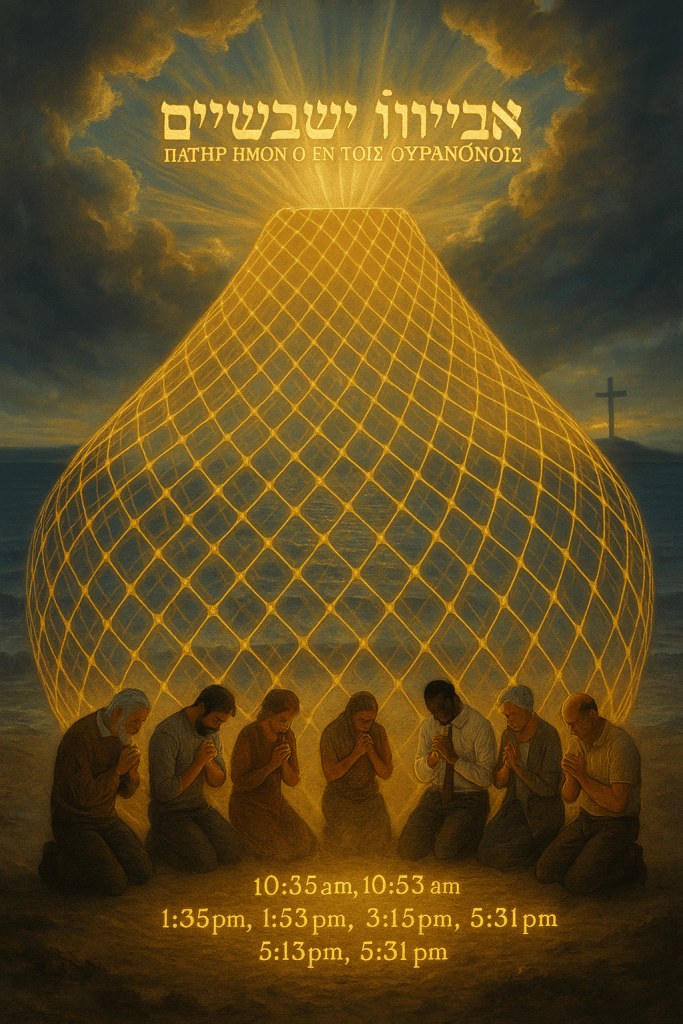
5. The 8 Times of the Lord’s Prayer

From the permutations of 153 arise 6 spiritually significant numbers, which define 8 daily prayer times:

10:35 am, 10:53 am, 1:35 pm, 1:53 pm, 3:15 pm, 3:51 pm, 5:13 pm, 5:31 pm

These times serve as a spiritual entry into the net—a practice of daily discipline, surrender, and divine alignment.


6. The 2130 Revelation: Psalm 66:11 and Psalm 77

The Hebrew gematria of Psalm 66:11 totals 2130.

Psalm 66:11 — Word-by-Word Gematria Breakdown

#Hebrew WordTranslationGematria
1הֲבֵאתָ֥נוּ“You brought us”464
2בַמְּצוּדָ֑ה“into the net/prison”147
3שַׂ֖מְתָּ“You laid”740
4מוּעָקָ֣ה“burden”221
5בְמָתְנֵֽינוּ׃“on our loins”558
TOTAL2130

Surprisingly, the total of all verse identifiers in Psalm 77 also equals 2130.

ReferenceDescriptionValue
Psalm 66:11Gematria of the full verse2130
Psalm 77Sum of all verse identifiers (20 verses)2130

✨ Interpretation:

Psalm 66:11 describes the act of entering the net, while Psalm 77 is a spiritual map of what happens inside that net:

  • A descent into doubt (vv.1–9),
  • A decision to remember God’s faithfulness (vv.10–12),
  • A resurgence of praise grounded in redemptive history (vv.13–20).

This numerical unity teaches us that:

To enter the net (2130) is to enter the journey of Psalm 77—moving from affliction to assurance, and from despair to divine remembrance.

🔄 2. Psalm 77 — What Happens in the Net

This psalm maps the interior journey of the soul inside the net:

VersesPhaseDescription
1–3Crying OutDesperation and sleepless anguish
4–6QuestioningHas God forgotten? Why so silent?
7–9Crisis of FaithDoubting God’s mercy and covenant
10–12Turn to RemembranceActively choosing to recall God’s deeds
13–20Restoration of TrustAwe-filled meditation on the Exodus: “Your path led through the sea…”

It is the process of spiritual purification — the fire in the furnace, the pressure in the cocoon. The Psalm ends not with escape, but with reoriented faith.

🌅 3. Psalm 66:12 — What Happens After the Net

“You let people ride over our heads; we went through fire and water, but you brought us to a place of abundance.”

This is the glorious exit — a movement from:

  • Oppression to elevation
  • Trial to transformation
  • Narrowness to abundance

The Net was never the end — it was the threshold.
The end is abundance (רְוָיָה – revayah) — spiritually, emotionally, and covenantally.


Conclusion: Into the Net of the Kingdom

To pray the Lord’s Prayer is to enter God’s net—not of punishment, but of preparation and transformation.

  • Psalm 66:11 shows the entry into divine testing.
  • John 21:11 shows the redemptive purpose of that net.
  • Psalm 77 provides the spiritual anatomy of life inside the net.
  • Identifier 168 and total 2130 are the divine seals of this mystery.

The Lord’s Prayer is the net of God.
It refines, gathers, delivers—and fills the soul with remembrance of His mighty acts.

To pray at the 8 sacred times is to consciously step into God’s redemptive process and say, with full surrender:

Thy will be done.”

✅ Yes — praying the Lord’s Prayer at the 8 designated times draws us into the divine net, not to destroy us, but to:

  • Refine us like silver (Psalm 66:10),
  • Catch us for eternal life (John 21:11),
  • And prepare us to receive God’s abundance (Psalm 66:12).

“You brought us to a place of abundance.”

The Hidden Structure of Redemption in Isaiah 53: A Mathematical Revelation of the Lord’s Prayer

Preface and Scholarly Disclaimer

This paper explores Isaiah 53 through the lens of biblical mathematics, uncovering a numerical pattern that points symbolically to the redemptive structure of the Lord’s Prayer. It is important to state from the outset that this study is not intended as a polemic or an attempt to supersede traditional Jewish interpretations of Isaiah 53. In Judaism, this chapter has long been understood to refer to the collective suffering and vindication of the nation of Israel—a view held with deep reverence and supported by many rabbinic authorities.

The present analysis is offered from within a Christian theological framework, using mathematical symbolism to reflect on how the chapter might encode the fullness, frequency, and form of divine redemption. The use of numerical structures—such as identifiers and divisor sums—is grounded in the historical traditions of gematria and sacred number, which are common to both Jewish and Christian mystical thought. The results are not presented as proof texts or doctrinal claims, but as contemplative insights that may enrich our understanding of the spiritual unity underlying Scripture.

It is the hope of the author that readers of all faiths will receive this exploration in the spirit of intellectual curiosity and respectful engagement, recognizing that Scripture, like number, contains layers of depth that reward reverent reflection.


Abstract

Isaiah 53 stands as one of the most profound prophetic passages in the Hebrew Bible, presenting the mysterious figure of the “Suffering Servant.” While traditionally interpreted theologically, this paper explores its numerical structure through biblical mathematics. We reveal that the chapter’s identifiers and divisor structure mathematically encode the number 153—associated with divine fullness and the Lord’s Prayer—and show that Isaiah 53 contains embedded numerical patterns corresponding to the fullness, frequency, and form of divine redemption. The conclusion is that the Lord’s Prayer is the spiritual fulfillment of the Suffering Servant’s work, mathematically and theologically.


1. Introduction

Isaiah 53 is often referred to as the “Gospel in the Old Testament” due to its intense focus on the themes of suffering, substitution, and ultimate vindication. For Christians, it prefigures the passion and atonement of Jesus Christ; for Jews, it captures Israel’s suffering on behalf of the nations. But beyond these interpretations lies a deeper dimension—one unveiled through sacred number.

In this study, we investigate the numerical structure of Isaiah 53 and demonstrate how it encodes the number 153, the biblical number of divine fullness, grace, and redemptive harvest. We show that the sum of identifiers and the sum of divisors both converge to affirm that the redemptive pattern of Isaiah 53 is mathematically fulfilled in the Lord’s Prayer.


2. The Identifier Structure of Isaiah 53

Let us begin by assigning each verse in Isaiah 53 a numerical identifier. The method is simple:

Identifier = Book Number + Chapter Number + Verse Number

Isaiah is the 23rd book of the Bible. Isaiah 53 contains 12 verses, so the identifiers range from:

23 + 53 + 1 = 77
to
23 + 53 + 12 = 88

Thus, the identifiers are 77, 78, …, 88.

Total sum of identifiers
77+78+79+80+81+82+83+84+85+86+87+88=990

So the total identifier sum for Isaiah 53 is: 990.


3. The Sum of the Divisors of 990

Let us now examine the number 990. It has 24 divisors, namely,

[1, 2, 3, 5, 6, 9, 10, 11, 15, 18, 22, 30, 33, 45, 55, 66, 90, 99, 110, 165, 198, 330, 495, 990]

Then the sum of the divisors is 2808 = 351 x 8.

Why is this significant?

  • The digits of 351 are in the set {3,5,1}, a permutation of which is the 3-tuple (1,5,3), which can be written “1 5 3”, mathematically called the one-line notation. On its own, it is simply a list of digits arranged in order. However, because we can agree on a mathematical rule—namely, that each position represents a power of 10—we can convert the list “1 5 3” into the number 153.
  • The set {153, 315, 513, 135, 351, 531} defines the 8 sacred Lord’s Prayer times from The Lord’s Prayer: A Mathematician’s Creed: 10:35 am, 10:53 am, 1:35 pm, 1:53 pm, 3:15 pm, 3:51 pm, 5:13 pm, 5:31 pm

Thus:

2808 encodes 8 manifestations of 153, in the form 351 × 8


4. Theological Implication: The Lord’s Prayer Fulfilled in Isaiah 53

The synthesis of these observations leads to a powerful conclusion:

Isaiah 53 is the prophetic song of the Suffering Servant. Its identifier structure (990) and summative pattern (2808 = 351 × 8) encode:

  • The form of divine redemption: 153
  • The frequency of divine prayer: 8 times daily
  • The fullness of redemptive intercession: 2808

And what prayer fulfills this redemptive structure?

The Lord’s Prayer, given by the Suffering Servant, who embodies Isaiah 53 and reveals the rhythm of divine communion.


5. Conclusion

Isaiah 53 mathematically encodes the fullness, frequency, and form of divine redemption as revealed through the Lord’s Prayer—the spiritual fulfillment of the Suffering Servant’s work.

The identifier total (990) and the sum of its divisors (2808 = 351 × 8) both point decisively to the redemptive number 153 and its sacred structure in the Lord’s Prayer.

In this light, Isaiah 53 becomes not only a prophetic witness of Christ’s redemptive mission but also a numerical prelude to the Prayer that saves.

In the Image of God: A Trinitarian Revelation through the Number 111

Introduction

From the opening pages of Scripture, we encounter a profound mystery: God said, “Let us make man in our image, after our likeness” (Genesis 1:26). The deliberate use of the plural “us” and “our” has long invited theological reflection. For Christians, this plural unity anticipates the revelation of the Trinity: one God in three persons. This article explores the extraordinary convergence of biblical language, numerical structure, and Trinitarian theology, showing how the number 111 unveils a conclusive mathematical reflection of divine plurality within unity.

1. The Creation Statement: Genesis 1:26-27

“Then God said, ‘Let us make man in our image, after our likeness…’ So God created man in his own image, in the image of God he created him; male and female he created them.” (Genesis 1:26-27)

Here, the plural form of speech coexists with singular creative action. The Creator is referred to as “God” (Elohim), a grammatically plural noun that governs singular verbs. This textual pattern mirrors a divine unity that is not indivisible simplicity but harmonious multiplicity: one essence, three persons.

2. The Gematria of Identity: בני אל חי = 111

In Hosea 1:10, the prophetic promise of restoration declares:

“…it shall be said to them, ‘You are children of the living God.'”

The Hebrew expression b’nei El Chai (בני אל חי) has a gematria value of 111:

  • בני (b’nei) = 2 + 50 + 10 = 62
  • אל (El) = 1 + 30 = 31
  • חי (Chai) = 8 + 10 = 18
  • Total: 62 + 31 + 18 = 111

This number embodies the identity “Children of the Living God” and symbolically reflects the Trinitarian unity:

1 + 1 + 1 = 3

Yet, each “1” retains individuality, while the sum indicates perfect unity — the very concept behind the Trinity: three persons, one God.

3. From Creation to Adoption: Identifiers and Their Arc

Using the biblical verse identifier system (Book # + Chapter # + Verse #), the identifiers of Genesis 1:26 (28), Genesis 1:27 (29), Hosea 1:10 (39), and Romans 9:26 (80) create a narrative arc:

ThemeReferenceIdentifierCumulative
CreationGenesis 1:262828
CreationGenesis 1:272957
RestorationHosea 1:103996
AdoptionRomans 9:2680176

This arc (28 → 176) symbolizes humanity’s movement from origin, through rejection, to restored sonship. The final sum, 176, matches the number of verses in Psalm 119, the longest chapter in Scripture and a declaration of love for God’s Word — the very instrument of covenant identity.

4. Romans 9:26 and the Fulfillment of Hosea

“In the very place where it was said to them, ‘You are not my people,’ there they will be called ‘sons of the living God.'” (Romans 9:26)

Paul quotes Hosea to affirm that both Jews and Gentiles are now unified as one covenant family. The children of God are those brought into divine sonship through Christ, sealed by the Holy Spirit. The Trinitarian act of adoption is complete: the Father calls, the Son redeems, and the Spirit confirms.

5. Mathematical Proof of Trinitarian Unity

Mathematically, 111 = 1 + 1 + 1. Each “1” maintains distinction. Their unity in the number “3” echoes theological creeds:

  • One God in Three Persons
  • Three in One and One in Three

This numerical structure is not a man-made symbol but embedded in the very language and revelation of Scripture. The gematria 111 in Hosea 1:10 links identity (children of God) to divine structure (Elohim, plural yet one).

6. Radical 22: The Numerical Seal of Sonship

The final cumulative identifier in this arc, 176, holds an additional mathematical signature:

  • Its prime factorization is:
    176 = 2⁴ × 11
  • The radical (product of its distinct prime factors) is: rad(176) = 2 × 11 = 22

According to The Biblical Meaning of Numbers from One to Forty by Dr. Stephen E. Jones, the number 22 symbolizes:

  • Sonship
  • Sons of Light
  • The full revelation of God’s Word (since there are 22 letters in the Hebrew alphabet)

This hidden dimension confirms the prophetic journey from Genesis 1:26 to Romans 9:26:

Those made in the image of God, once declared “not my people,” are now mathematically and spiritually confirmed as sons of light, bearing the number of Sonship: 22.

Thus, the radical of 176 does not merely point to numerical structure — it seals the journey of identity. The number 22 affirms that those restored in Christ are no longer outsiders but bear the divine imprint as adopted sons of the Living God.

Conclusion: The Image Restored

Genesis 1:26-27 begins with the image of God in humanity, a reflection of divine plurality-in-unity. Hosea 1:10 and Romans 9:26 reveal how this image is restored and elevated: through adoption as children of the living God. The number 111 serves not merely as a gematria curiosity but as a mathematical testimony to the Trinitarian nature of God — and to our identity in Him.

In this, we behold the elegance of divine logic: theology harmonizing with arithmetic, Scripture unfolding as both word and number, and God revealing Himself as One, yet Three, in whose image we are lovingly made and eternally known.

Apologetics and the Limits of Worldview Cross-Talk

Abstract This paper explores the philosophical and theological limits of apologetics when engaging with naturalistic and secular worldviews, as well as with other religious systems that, while also believing in the supernatural, operate from fundamentally different assumptions. It argues that while Christian apologetics can clarify, defend, and illuminate faith for the believer and seeker, it is ultimately ineffective at persuading those whose frameworks categorically exclude or redefine the nature of divine revelation and salvation. The paper concludes that Christian, non-Christian religious, and secular worldviews are so incommensurable in their foundational assumptions that cross-persuasive dialogue is largely futile. Rather than attempting to “win” debates within foreign epistemological systems, Christian apologetics is better positioned as an internal clarifying tool, a witness to faith, and a bridge for those already wrestling with existential questions beyond the empirical realm.

1. Introduction Apologetics, from the Greek apologia, refers to the reasoned defense of the Christian faith. Rooted in biblical exhortations such as 1 Peter 3:15, which instructs believers to “always be ready to give a defense to everyone who asks you a reason for the hope that is in you, with gentleness and respect,” Christian apologetics is originally envisioned not as an aggressive or unsolicited enterprise, but as a responsive and humble articulation of faith. This scriptural foundation suggests that apologetics is most appropriate when answering genuine inquiry, rather than confronting those who have not asked but may only have offered an opposing view. However, in an increasingly pluralistic context that includes both secular naturalism and diverse religious traditions, the effectiveness and appropriateness of apologetics as a tool for persuasion are under renewed scrutiny.

2. The Naturalistic Worldview: Assumptions and Boundaries The naturalistic worldview is grounded in materialism, empiricism, and methodological skepticism. It holds that only that which is observable, testable, and repeatable can be known. Supernatural claims, by definition, lie outside this frame and are treated as non-evidentiary or mythological. From this perspective, religious events such as Jesus’ crucifixion and resurrection carry no epistemic weight.

3. The Christian Worldview: Revelation and Transcendence In contrast, Christianity is founded upon divine revelation, personal encounter, and the historical claim of God entering human history in the person of Jesus Christ. It presupposes the existence of a metaphysical realm and the possibility of miracles, fulfilled prophecy, and divine intervention. It also holds that salvation is unique to the person and work of Christ.

4. Incommensurability of Worldviews The paper argues that naturalism, Christianity, and other religious worldviews (e.g., Islam, Hinduism, Buddhism) are not merely differing opinions but operate from fundamentally incompatible epistemological and metaphysical systems. Naturalism excludes the supernatural; Christianity hinges on a personal, incarnate God; other religions often accept the supernatural but define God, truth, and salvation differently. Therefore, debating within one paradigm using the terms and expectations of another is like comparing apples, oranges, and bananas.

5. Historical Responses to Competing Worldviews Early Christians acknowledged the apparent foolishness of the cross (1 Cor. 1:18) and responded by redefining power, wisdom, and sacrifice through the lens of divine revelation. To both the Jewish and Greco-Roman mind, the crucifixion was either a stumbling block or folly: Jews expected a triumphant messianic deliverer, not a humiliated and executed criminal; Greeks prized rational philosophy and heroic virtue, not apparent weakness and shame. However, early Christians turned this perception on its head by proclaiming that true power was revealed in Jesus’ voluntary self-sacrifice, true wisdom in God’s mysterious plan to redeem through suffering, and true glory in the resurrection that followed apparent defeat. The cross, once a symbol of shame, was reframed as the ultimate sign of divine love and victory, encapsulating a new vision of what it means to triumph—not through domination, but through redemptive suffering. Apologists such as Justin Martyr and Origen engaged not only with naturalistic critiques but also with pagan and Jewish objections. However, their most compelling arguments were aimed not at converting skeptics, but at articulating the reasonableness of faith to those already open to it.

6. The True Role of Apologetics Rather than striving to ‘prove’ the Christian faith to those unwilling to consider the supernatural or to those committed to alternative supernatural frameworks, apologetics serves best in three roles:

  • Clarifying doctrine and addressing doubt within the Church.
  • Strengthening believers intellectually.
  • Serving as a bridge to seekers already questioning the limits of naturalism or the sufficiency of other religious systems.

7. Conclusion While engaging secular and religious viewpoints with humility and intellectual rigor is important, Christian apologetics should resist the temptation to validate the faith using tools of a worldview that denies or redefines its central claims. Faith in the Christian story begins not with empirical proof or religious synthesis, but with the acknowledgment that the natural is not all there is, and that divine revelation has occurred uniquely in Christ. Apologetics is therefore less a weapon of conquest and more a light for those already seeking the transcendent.