Faith Is Not the End of Reason

Faith, Reason, and Psalm 19

Faith Is Not the End of Reason

A Christian Response to Sam Harris’ The End of Faith through Psalm 19

Abstract

Sam Harris’ The End of Faith: Religion, Terror, and the Future of Reason argues that religious faith, especially when insulated from criticism, is dangerous to civilization, rational inquiry, and moral progress. Harris criticizes not only religious extremism but also religious moderation, arguing that moderate religion gives social protection to beliefs that lack evidential grounding. This paper offers a courteous Christian response. It accepts Harris’ concern that irrational, violent, and unexamined religion can be destructive. However, it argues that biblical faith, rightly understood, is not belief without light, reason, or moral accountability. Psalm 19 provides a profound biblical model: God speaks through creation, clarifies His will through Scripture, and calls the human heart to repentance and cleansing. Thus, Psalm 19 does not end conversation; it begins a deeper one. Christian faith is not the abandonment of reason, but a response to revelation, culminating in humility, self-examination, and prayer.

1. Introduction

Sam Harris’ The End of Faith is one of the defining texts of the so-called New Atheist movement. Published in 2004, the book concerns organized religion, the clash between religious faith and rational thought, and the problem of intolerance associated with religious fundamentalism. The Wikipedia summary of the book confirms that Harris began writing it after the September 11 attacks and that it is a broad critique of religious belief, not merely of religious extremism. 1

Harris’ official page for the book states the argument even more sharply: he regards religion itself, not only its extremist distortions, as central to the justification and reward of terrorism. The same page says Harris views even moderate religion as dangerous because it helps preserve the idea that certain propositions may be believed without evidence. 2

This paper does not respond by caricaturing Harris. His concerns deserve serious attention. Religious people have at times used sacred texts to justify violence, oppression, arrogance, and resistance to correction. A Christian response must therefore begin with intellectual honesty: bad religion exists, and the Bible itself condemns it.

However, the question is whether Harris has rightly understood biblical faith itself. Psalm 19 suggests that he has not. Psalm 19 presents faith not as the rejection of reason, but as the act of hearing God’s witness in creation, receiving God’s moral instruction in Scripture, and submitting oneself to divine cleansing.

2. Harris’ Main Argument

According to the Wikipedia synopsis, The End of Faith opens with the image of a suicide bomber and proceeds to call for an end to special respect or tolerance for religious belief systems that Harris describes as “uncontaminated by evidence.” The synopsis also says Harris is critical of religious moderation because, in his view, moderation creates the social context in which religious violence cannot be adequately opposed. 1

Harris’ Concern Summary
Faith and evidence Religious faith permits belief without sufficient evidence.
Belief and action Beliefs are not private abstractions; they shape behavior.
Moderation Religious moderation protects the category of faith from criticism.
Scripture and morality Sacred texts may be used to justify violence or moral backwardness.
Reason and civilization Human survival requires reason, evidence, and honest criticism.

These claims should not be dismissed casually. Christians should agree that belief matters. Ideas shape action. Bad theology can lead to bad conduct. Scripture itself warns that false prophets, corrupt teachers, and hypocritical religious leaders can damage communities.

The Christian disagreement is not with Harris’ desire for truth, moral seriousness, and accountability. The disagreement is with his definition of faith.

3. The Problem with Defining Faith as “Belief without Evidence”

Harris’ critique depends heavily on defining faith as belief without adequate evidence. Once faith is defined that way, it becomes easy to portray it as irrational. But biblical faith is not merely believing something because there is no evidence. Biblical faith is trustful response to God’s self-disclosure.

“The heavens declare the glory of God;
And the firmament shows His handiwork.”

Psalm 19:1

The psalmist begins with creation. The heavens, the sky, the sun, day and night, order and beauty — these are presented as witnesses. They do not speak in ordinary human language, yet they communicate. Their “voice” goes throughout the earth.

In simple terms, Psalm 19 says: creation is not silent. The world is not meaningless noise. It bears witness to glory, order, power, and wisdom.

This does not mean that creation alone gives the full gospel. Creation does not tell us the name of Jesus, the meaning of the cross, or the words of the Lord’s Prayer. But creation gives the first movement of faith: attentiveness. It invites the human mind to look, wonder, and ask.

Thus, Psalm 19 does not begin by closing inquiry. It begins by opening the eyes.

4. Psalm 19 as a Theology of Revelation

Psalm 19 has a clear threefold structure:

Section Verses Form of Revelation Human Response
Creation 1–6 God speaks through the heavens Wonder and recognition
Scripture 7–11 God speaks through His Word Wisdom, joy, warning, obedience
Prayer 12–14 God exposes the heart Confession, cleansing, humility

This structure is important for a Christian response to Harris. Psalm 19 does not say, “Believe without thinking.” It says, “Listen carefully.”

Creation → Scripture → Conscience → Prayer

That is not irrationality. It is ordered spiritual reasoning.

5. Creation: A Public Witness, Not a Private Fantasy

Psalm 19:1–6 presents creation as a universal witness. The heavens declare God’s glory. Day after day pours forth speech. Night after night reveals knowledge. The sun rises and moves across the sky, and nothing is hidden from its heat.

This directly challenges Harris’ claim that faith is necessarily detached from evidence. Psalm 19 does not point first to a private mystical feeling. It points to the public world.

“Their line has gone out through all the earth,
And their words to the end of the world.
In them He has set a tabernacle for the sun.”

Psalm 19:4

The psalmist is not saying that the sky is God. Nor is he saying that the sun is divine. In fact, the line “In them He has set a tabernacle for the sun” makes the opposite point. The sun is not a god; it is a servant within God’s ordered creation.

Creation is therefore a witness, not an idol. It points beyond itself.

For the Christian, this means that faith is not born from the refusal to observe the world. It is born, in part, from observing the world deeply enough to see that beauty, order, intelligibility, and life ask for more than a purely mechanical description.

Science can describe many mechanisms of the heavens. Psalm 19 asks a deeper question: why is there a cosmos whose order can be described at all?

6. Scripture: Not a Weapon for Pride, but Light for the Soul

Harris is concerned that sacred texts can be morally dangerous. That concern cannot be ignored. Scripture has been misused. People have quoted the Bible while acting against the spirit of Christ.

But Psalm 19 gives a test for the proper reception of Scripture. The Word of God is described as perfect, sure, right, pure, clean, true, and righteous. Its effects are also named.

Description of God’s Word Effect
Perfect Converts or restores the soul
Sure Makes wise the simple
Right Rejoices the heart
Pure Enlightens the eyes
Clean Endures forever
True and righteous Warns and rewards the servant

This is crucial. Scripture, rightly received, does not produce cruelty, arrogance, or irrational violence. It restores the soul. It gives wisdom. It brings joy. It enlightens the eyes. It warns the servant.

Therefore, the Christian answer to misuse of Scripture is not to abandon Scripture, but to recover its proper purpose: transformation into holiness, humility, justice, mercy, and truth.

Bad religion uses Scripture to control others. Psalm 19 receives Scripture as light that first judges the reader.

7. The Heart: Psalm 19 Rejects Religious Arrogance

Psalm 19 ends in a surprising way. After the grandeur of the heavens and the beauty of God’s law, the psalmist does not say, “Now I can condemn everyone else.” Instead, he says:

“Who can understand his errors?
Cleanse me from secret faults.”

Psalm 19:12

This is perhaps the strongest answer to Harris. The greatest danger in religion is not faith itself, but presumptuous faith: faith without humility, faith without repentance, faith without self-judgment.

Psalm 19 directly confronts that danger:

“Keep back Your servant also from presumptuous sins;
Let them not have dominion over me.”

Psalm 19:13

Presumptuous sins are proud sins. They are deliberate, high-handed sins. They occur when a person claims confidence while refusing correction.

Much harmful religion begins there.

Psalm 19 therefore does not defend fanaticism. It exposes it. A truly biblical person does not merely ask whether the world is wrong; he asks whether his own heart is wrong.

“Let the words of my mouth and the meditation of my heart
Be acceptable in Your sight,
O LORD, my strength and my Redeemer.”

Psalm 19:14

The psalmist submits both speech and thought to God. That is not a conversation stopper. That is the purification of conversation.

8. Faith and Hearing: The Significance of Psalm 19

Within the biblical-number framework used in The Biblical Meaning of Numbers from One to Forty, the number 19 is associated with “faith and hearing.” The explanation emphasizes that the number 19 includes both God’s voice and the human faith-response: God speaks first, and the human being responds.

Psalm 19 is therefore a faith-and-hearing psalm.
God speaks through the heavens. God speaks through His Word. The servant hears and responds in prayer.

This is beautiful because Psalm 19 is not only about faith and hearing; it is itself the nineteenth psalm. The number and the theme harmonize.

In the language of this project:

Psalm 19 is a faith-and-hearing psalm.
It teaches that faith is not a leap into darkness.
Faith is the human response to the God who has already spoken.

This is a direct answer to Harris’ definition of faith. Biblical faith is not belief without witness. It is hearing, receiving, trusting, and obeying the divine witness.

9. The Lord’s Prayer as the Christian Form of Reasonable Faith

Psalm 19 ends with prayer, and that prayer naturally prepares the way for the Lord’s Prayer.

Psalm 19 The Lord’s Prayer
Cleanse me from secret faults. Forgive us our trespasses.
Keep back Your servant from presumptuous sins. Lead us not into temptation.
Let my words and meditation be acceptable. Deliver us from evil.

The movement is the same. The human being recognizes God’s holiness, confesses dependence, asks for forgiveness, and seeks deliverance from evil.

In The Lord’s Prayer: A Mathematician’s Creed, the Lord’s Prayer is presented as the foremost proclamation of faith in the fulfillment of the will of the Father in His Son, Jesus Christ. The book states that the Lord’s Prayer is not merely a devotional formula, but a deep reservoir of central Christian messages and a means of sanctification.

If Christian faith is expressed most centrally in the prayer Jesus taught, then its core is not violence, coercion, or irrational pride. Its core is Fatherhood, holiness, kingdom, divine will, daily dependence, forgiveness, mercy, temptation resisted, and deliverance from evil.

That is not the end of civilization. That is the renewal of the human person.

10. The Bible Already Critiques Bad Religion

One weakness in Harris’ broad critique is that it can sound as if religion has no internal resources for self-criticism. But the Bible is full of internal critique.

The prophets rebuke corrupt worship. Jesus rebukes hypocritical religious leaders. Paul warns against loveless knowledge. John warns believers to test the spirits. James warns that faith without works is dead.

Psalm 19 belongs to this same internal critique. It teaches that the person who truly hears God must not become proud. He must become clean.

False Religion Biblical Faith
Protects pride Produces humility
Uses Scripture to dominate others Receives Scripture as light for the soul
Avoids self-examination Prays, “Cleanse me”
Defends violence or hatred Seeks deliverance from evil
Silences questions Brings words and thoughts before God

Therefore, a Christian can agree with Harris that irrational and violent religion is dangerous, while still rejecting his conclusion that faith itself is the problem.

The deeper problem is sin — including religious sin.

11. Reason Is Necessary, but Not Sufficient

Harris rightly values reason, evidence, and open inquiry. Christians should value them too. The created world is intelligible because it is created by the rational God. The human mind is valuable because humans are made in the image of God.

But reason alone cannot cleanse the human heart.

Reason can expose contradictions.
Reason can test claims.
Reason can improve public discourse.
Reason can help restrain fanaticism.

But reason cannot, by itself, forgive sin, heal guilt, conquer pride, or redeem the soul.

Psalm 19 agrees that humans need light. But it says we need more than intellectual light. We need moral and spiritual cleansing.

That is why the psalm does not end with astronomy or even theology. It ends with prayer.

12. A Courteous Response to Harris

Dr. Harris is right to warn against religion that is irrational, violent, arrogant, or protected from criticism. Christians should share that concern. But Psalm 19 shows that biblical faith, rightly understood, is not belief without evidence or a refusal to think. It begins with the public witness of creation, receives the moral clarity of God’s Word, and ends in humble self-examination before God. The true believer does not silence inquiry; he asks God to purify even his words and thoughts.

This response does not deny the existence of bad religion. It denies that bad religion is the essence of biblical faith.

Psalm 19 does not create the fanatic Harris fears. It creates the humble worshiper who prays:

“Cleanse me.”
“Keep me back from presumptuous sins.”
“Let my words and thoughts be acceptable.”

That is not a threat to reason. It is reason brought under holiness.

13. Conclusion

Sam Harris’ The End of Faith raises important concerns about violence, extremism, and the danger of beliefs that are shielded from scrutiny. His critique is strongest when directed at religion that refuses correction, glorifies violence, or hides from evidence.

But Psalm 19 presents a very different vision of faith. Faith is not blind. Faith hears. Faith sees. Faith receives. Faith repents. Faith prays.

The heavens declare.
The Word enlightens.
The heart confesses.
The mouth is purified.
The servant trusts the LORD as strength and Redeemer.

Therefore, the Christian answer to The End of Faith is not the end of reason. It is the restoration of faith as hearing: hearing creation’s witness, hearing Scripture’s wisdom, and hearing God’s call to repentance and redemption.

Psalm 19 answers Harris not by shouting him down, but by inviting him — and all of us — to look again:

Look at the heavens.
Listen to the Word.
Examine the heart.
Seek cleansing.
Then speak.

References

  1. “The End of Faith,” Wikipedia, accessed July 2026. https://en.wikipedia.org/wiki/The_End_of_Faith
  2. Sam Harris, “The End of Faith,” official book page, accessed July 2026. https://www.samharris.org/books/the-end-of-faith
  3. WorldCat entry for Sam Harris, The End of Faith: Religion, Terror, and the Future of Reason. https://search.worldcat.org/oclc/62265386
  4. Jito Vanualailai, Eroni Tomasi, Paulo Vanualailai, and Jope Takala, The Lord’s Prayer: A Mathematician’s Creed.
  5. Stephen E. Jones, The Biblical Meaning of Numbers from One to Forty, God’s Kingdom Ministries, 2008.

Suggested keywords: Psalm 19, Sam Harris, The End of Faith, faith and reason, Christian apologetics, biblical faith, creation and revelation, Lord’s Prayer, faith and hearing, biblical mathematics.

Apologetics and the Limits of Worldview Cross-Talk

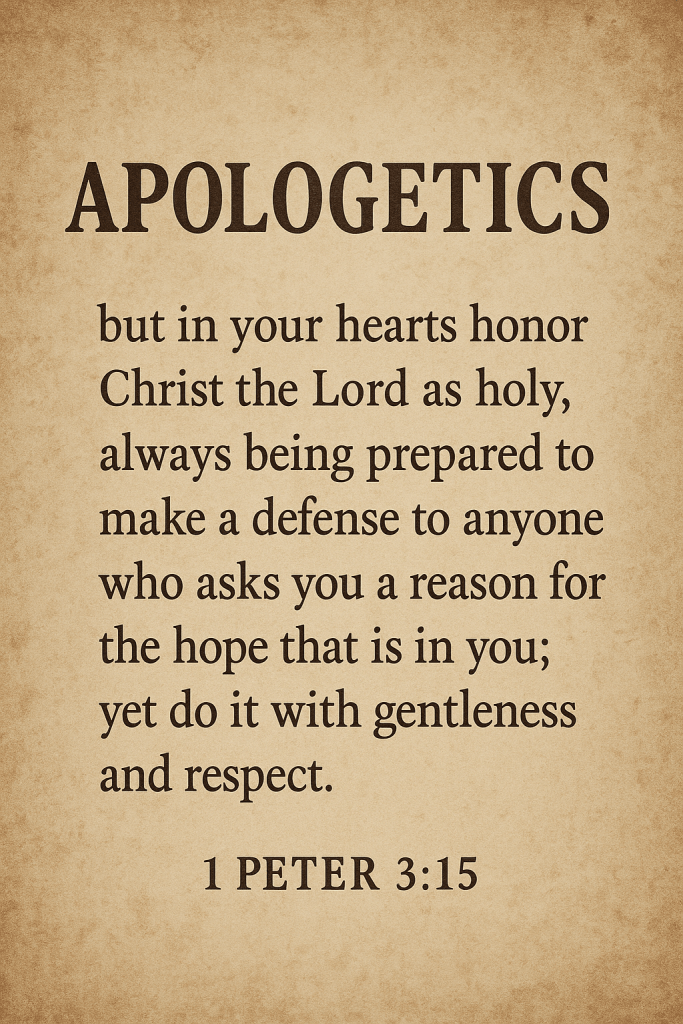
Apologetics is a field of study within theology and philosophy that involves the reasoned defense of a belief system—most commonly, Christianity. The term comes from the Greek word apologia (ἀπολογία), which means “a defense” or “a speech in defense.” It is famously used in 1 Peter 3:15, where believers are instructed to:

“Always be ready to give a defense (apologia) to everyone who asks you a reason for the hope that is in you, with gentleness and respect.”

Keywords: Apologetics, Naturalism, Worldview, Christianity, Faith, Epistemology, Revelation, Secularism, Interreligious Dialogue

Abstract This paper explores the philosophical and theological limits of apologetics when engaging with naturalistic and secular worldviews, as well as with other religious systems that, while also believing in the supernatural, operate from fundamentally different assumptions. It argues that while Christian apologetics can clarify, defend, and illuminate faith for the believer and seeker, it is ultimately ineffective at persuading those whose frameworks categorically exclude or redefine the nature of divine revelation and salvation. The paper concludes that Christian, non-Christian religious, and secular worldviews are so incommensurable in their foundational assumptions that cross-persuasive dialogue is largely futile. Rather than attempting to “win” debates within foreign epistemological systems, Christian apologetics is better positioned as an internal clarifying tool, a witness to faith, and a bridge for those already wrestling with existential questions beyond the empirical realm.

1. Introduction Apologetics, from the Greek apologia, refers to the reasoned defense of the Christian faith. Rooted in biblical exhortations such as 1 Peter 3:15, which instructs believers to “always be ready to give a defense to everyone who asks you a reason for the hope that is in you, with gentleness and respect,” Christian apologetics is originally envisioned not as an aggressive or unsolicited enterprise, but as a responsive and humble articulation of faith. This scriptural foundation suggests that apologetics is most appropriate when answering genuine inquiry, rather than confronting those who have not asked  but may only have offered an opposing view. However, in an increasingly pluralistic context that includes both secular naturalism and diverse religious traditions, the effectiveness and appropriateness of apologetics as a tool for persuasion are under renewed scrutiny.

2. The Naturalistic Worldview: Assumptions and Boundaries The naturalistic worldview is grounded in materialism, empiricism, and methodological skepticism. It holds that only that which is observable, testable, and repeatable can be known. Supernatural claims, by definition, lie outside this frame and are treated as non-evidentiary or mythological. From this perspective, religious events such as Jesus’ crucifixion and resurrection carry no epistemic weight.

3. The Christian Worldview: Revelation and Transcendence In contrast, Christianity is founded upon divine revelation, personal encounter, and the historical claim of God entering human history in the person of Jesus Christ. It presupposes the existence of a metaphysical realm and the possibility of miracles, fulfilled prophecy, and divine intervention. It also holds that salvation is unique to the person and work of Christ.

4. Incommensurability of Worldviews The paper argues that naturalism, Christianity, and other religious worldviews (e.g., Islam, Hinduism, Buddhism) are not merely differing opinions but operate from fundamentally incompatible epistemological and metaphysical systems. Naturalism excludes the supernatural; Christianity hinges on a personal, incarnate God; other religions often accept the supernatural but define God, truth, and salvation differently. Therefore, debating within one paradigm using the terms and expectations of another is like comparing apples, oranges, and bananas.

5. Historical Responses to Competing Worldviews Early Christians acknowledged the apparent foolishness of the cross (1 Cor. 1:18) and responded by redefining power, wisdom, and sacrifice through the lens of divine revelation. To both the Jewish and Greco-Roman mind, the crucifixion was either a stumbling block or folly: Jews expected a triumphant messianic deliverer, not a humiliated and executed criminal; Greeks prized rational philosophy and heroic virtue, not apparent weakness and shame. However, early Christians turned this perception on its head by proclaiming that true power was revealed in Jesus’ voluntary self-sacrifice, true wisdom in God’s mysterious plan to redeem through suffering, and true glory in the resurrection that followed apparent defeat. The cross, once a symbol of shame, was reframed as the ultimate sign of divine love and victory, encapsulating a new vision of what it means to triumph—not through domination, but through redemptive suffering. Apologists such as Justin Martyr and Origen engaged not only with naturalistic critiques but also with pagan and Jewish objections. However, their most compelling arguments were aimed not at converting skeptics, but at articulating the reasonableness of faith to those already open to it.

6. The True Role of Apologetics Rather than striving to ‘prove’ the Christian faith to those unwilling to consider the supernatural or to those committed to alternative supernatural frameworks, apologetics serves best in three roles:

  • Clarifying doctrine and addressing doubt within the Church.
  • Strengthening believers intellectually.
  • Serving as a bridge to seekers already questioning the limits of naturalism or the sufficiency of other religious systems.

7. Conclusion While engaging secular and religious viewpoints with humility and intellectual rigor is important, Christian apologetics should resist the temptation to validate the faith using tools of a worldview that denies or redefines its central claims. Faith in the Christian story begins not with empirical proof or religious synthesis, but with the acknowledgment that the natural is not all there is, and that divine revelation has occurred uniquely in Christ. Apologetics is therefore less a weapon of conquest and more a light for those already seeking the transcendent.

Carried on Eagles’ Wings, Gathered in the Unbroken Net

Exodus 19:4, John 21:11, and the Theological Significance of the 153 Fishes

Abstract

This article argues that Exodus 19:4 provides a profound Old Testament foundation for understanding the significance of John 21:11 and the 153 fishes. Exodus 19:4 declares that God bore Israel “on eagles’ wings” and brought them unto Himself. John 21:11, in turn, presents the risen Christ gathering 153 great fishes into an unbroken net and bringing them to shore. Read canonically, the two passages share a common theological pattern: divine initiative, deliverance, gathering, covenant nearness, and preservation.

From the perspective of Biblical Mathematics, the Hebrew gematria of Exodus 19:4 is 4934. Its aliquot sum is 2470, whose divisor-mean is 315, which by digit permutation points to 153. This does not replace exegesis; rather, it corroborates the textual claim that the God who carried Israel to Himself at Sinai is the same God who, in Christ, gathers the redeemed and brings them safely to the Father.

1. Introduction

Exodus 19 is one of the great covenant chapters of the Old Testament. It stands between Israel’s deliverance from Egypt and the giving of the Law at Sinai. Before God gives commandments, He first reminds Israel of grace:

“Ye have seen what I did unto the Egyptians, and how I bare you on eagles’ wings, and brought you unto myself.”
— Exodus 19:4, KJV

This verse is foundational because it reveals the order of redemption. God does not first give Israel the Law and then deliver them. Rather, He first delivers them, carries them, and brings them to Himself. Covenant obedience follows divine rescue.

John 21:11, on the other hand, occurs after the death and resurrection of Jesus Christ. The disciples have fished all night and caught nothing. At daybreak, the risen Jesus stands on the shore and commands them to cast the net on the right side of the ship. They obey, and the result is astonishing:

“Simon Peter went up, and drew the net to land full of great fishes, an hundred and fifty and three: and for all there were so many, yet was not the net broken.”
— John 21:11, KJV

The explicit mention of 153 fishes has long invited theological reflection. In the framework of Biblical Mathematics, 153 is not arbitrary. It represents the fulfilment of the will of the Father in His Son, Jesus Christ. The present article proposes that Exodus 19:4 is an important Old Testament precursor to John 21:11, for both passages reveal the same divine movement: God gathers His people, preserves them, and brings them to Himself.

2. Exodus 19:4 in Its Covenant Context

Exodus 19 begins with Israel arriving at Mount Sinai after leaving Egypt. The people have passed through the Red Sea, survived the wilderness, and reached the mountain of God. In Exodus 19:4, God interprets the entire Exodus event for Israel.

The verse contains four movements:

Phrase Theological Meaning
“Ye have seen what I did unto the Egyptians” God judged the oppressor.
“I bare you” Israel did not save itself; God carried Israel.
“on eagles’ wings” God’s deliverance was strong, protective, and gracious.
“and brought you unto myself” The goal of redemption was covenant nearness to God.

The most important phrase is the final one: “brought you unto myself.” God’s purpose was not merely to remove Israel from Egypt. His purpose was to bring Israel into communion with Himself.

Therefore, Exodus 19:4 is not only about escape from slavery. It is about divine possession, covenant identity, and sacred nearness. This is confirmed by the verses that follow:

“Now therefore, if ye will obey my voice indeed, and keep my covenant, then ye shall be a peculiar treasure unto me above all people…”
— Exodus 19:5, KJV

“And ye shall be unto me a kingdom of priests, and an holy nation.”
— Exodus 19:6, KJV

Thus, Exodus 19:4 is the gateway to Israel’s covenant vocation. God carries Israel so that Israel may become His treasured people, His priestly kingdom, and His holy nation.

3. John 21:11 in Its Resurrection Context

John 21 occurs after the resurrection of Jesus. The disciples return to fishing, but their labour produces nothing. This detail is important. Without the command of Christ, their effort is fruitless.

When Jesus speaks, the sea yields abundance. The net is filled with 153 great fishes. Yet, despite the abundance, the net does not break.

Feature Theological Meaning
The disciples catch nothing by themselves Human effort without Christ is insufficient.
Jesus commands the casting of the net Divine initiative produces the harvest.
The fishes are gathered The redeemed are drawn together.
The number is explicitly 153 The catch is not random but symbolically marked.
The net does not break Those gathered are preserved.
The fish are brought to land, where Jesus stands The redeemed are brought safely to Christ.

In Exodus 19:4, God says, “I brought you unto myself.” In John 21:11, the net full of 153 fishes is drawn to shore, where the risen Christ stands. The movement is strikingly similar. The people of God are brought to God; the fishes are brought to Christ.

This is the theological bridge between Exodus 19 and John 21.

4. From Sinai to the Shore: The Shared Pattern

Exodus 19:4 and John 21:11 are separated by covenant history, genre, language, and setting. Yet their theological structure is deeply aligned.

Exodus 19:4 John 21:11 Shared Theology
Israel is delivered from Egypt The fishes are gathered from the sea Divine rescue
God bears Israel on eagles’ wings The net carries the fishes Divine support
Israel is brought to God The fishes are brought to Jesus Covenant nearness
Israel becomes a treasured people The 153 fishes signify those given to the Son Chosen people
God preserves Israel through the wilderness The net does not break Preservation
Israel is called to priestly vocation The disciples are recommissioned for mission Witness and ministry

The connection is not forced. Both passages are about God’s saving initiative. Both passages involve a people who are unable to secure themselves. Both passages end with nearness to God.

Exodus 19:4 is therefore a foundational Old Testament pattern of what John 21:11 reveals after the resurrection: God’s people are not self-gathered, self-carried, or self-preserved. They are carried by divine grace.

5. The Christological Fulfilment

From a Christian perspective, Exodus 19:4 is not merely an ancient memory of Israel’s past. It becomes part of the larger biblical pattern fulfilled in Christ.

In Exodus, God says:

“I bare you on eagles’ wings, and brought you unto myself.”

In the Gospel, Jesus says:

“No man cometh unto the Father, but by me.”
— John 14:6, KJV

The movement toward God is now mediated through Christ. The Father brings His people to Himself through the Son. In John 21, the risen Christ stands on the shore as the centre of gathering. The 153 fishes are brought to Him.

This means that John 21:11 may be read as a resurrection fulfilment of the Exodus pattern. The God who carried Israel through the wilderness now gathers the redeemed through the risen Christ. The shore becomes, symbolically, a new Sinai: a place of encounter, recognition, provision, and commissioning.

Immediately after the miraculous catch, Jesus feeds the disciples and then restores Peter with the threefold command: “Feed my lambs,” “Feed my sheep,” and “Feed my sheep.” Thus, the gathered catch leads to pastoral mission. As Exodus 19:6 calls Israel to be a kingdom of priests, John 21 recommissions the disciples to care for Christ’s flock.

The Exodus covenant and the resurrection mission meet in this shared pattern: those whom God gathers are also those whom God sends.

6. The Numeric Corroboration from Exodus 19:4

The Hebrew text of Exodus 19:4 has a total gematria of:

4934

The Hebrew consonantal text of Exodus 19:4 used for the gematria calculation is:

אתם ראיתם אשר עשיתי למצרים ואשא אתכם על כנפי נשרים ואבא אתכם אלי

Heb. Translit. Trans. Gem.
אתם attem ye / you 441
ראיתם re’item have seen 651
אשר asher what / that 501
עשיתי asiti I did 790
למצרים le-Mitzrayim to the Egyptians 410
ואשא va-essa and I carried 308
אתכם etchem you 461
על al upon / on 100
כנפי kanfei wings of 160
נשרים nesharim eagles 600
ואבא va-avi and I brought 10
אתכם etchem you 461
אלי elai unto Myself 41
Total Gematria 4,934

Using the Canon of Numeric Invariants, we examine the internal structure of this passage-total.

The divisors of 4934 are:

D(4934) = {1, 2, 2467, 4934}

Thus:

σ(4934) = 1 + 2 + 2467 + 4934 = 7404

The aliquot sum is:

s(4934) = σ(4934) − 4934 = 7404 − 4934 = 2470

This is significant because the aliquot sum represents “support without the self.” The verse itself says precisely that Israel was supported by God. Israel did not bear itself; God bore Israel. Thus, the first canonical invariant agrees beautifully with the plain textual meaning.

Now consider the divisors of 2470:

D(2470) = {1, 2, 5, 10, 13, 19, 26, 38, 65, 95, 130, 190, 247, 494, 1235, 2470}

There are 16 divisors, and their sum is:

σ(2470) = 5040

Therefore, the arithmetic mean of the divisors is:

A(2470) = σ(2470) / τ(2470) = 5040 / 16 = 315

Within the Canon, the arithmetic mean of divisors represents the “center-of-witness.” Therefore, the support-structure of Exodus 19:4 has a center-of-witness equal to 315.

Finally, by the Digit Permutation Method:

315 → 153

That is, the digit tuple:

(3, 1, 5)

is permuted to:

(1, 5, 3)

and then encoded as the base-10 number:

153

Thus the full canonical chain is:

4934 → 2470 → 315 → 153

This is a remarkable result. The Hebrew gematria of Exodus 19:4 leads, through canonical invariants, to the signature number of John 21:11.

7. Theological Meaning of the Chain

The numeric chain must be interpreted carefully. It does not replace the plain meaning of the text. Rather, it corroborates the meaning already present in the text.

The plain text says:

God carried Israel and brought Israel to Himself.

The canonical chain says:

Number Operation Canonical Meaning Theological Reading
4934 Hebrew gematria of Exodus 19:4 Passage-total The whole verse concerns divine carrying.
2470 Aliquot sum of 4934 Support without the self Israel is supported by God, not by itself.
315 Arithmetic mean of divisors of 2470 Center-of-witness The support-structure has a hidden witness-centre.
153 Digit permutation of 315 Signature confirmation The verse points to the fulfilment pattern of John 21:11.

The theological conclusion is therefore not that Exodus 19:4 “predicts” John 21:11 in a narrow literal sense. Rather, Exodus 19:4 establishes the redemptive pattern that John 21:11 completes in Christ.

Exodus says: God carries His people and brings them to Himself.

John says: The risen Christ gathers the 153 and brings them safely to shore.

The Canon confirms: The internal numeric structure of Exodus 19:4 points toward 153.

8. Exodus 19, John 21, and the Lord’s Prayer

This connection also strengthens the place of the Lord’s Prayer in the wider framework. In the Lord’s Prayer, believers pray:

“Our Father which art in heaven…”

This opening immediately places the believer in the posture of being brought near to God. The prayer is not addressed to a distant force but to the Father. It is covenantal, relational, and communal.

Exodus 19:4 says that God brought Israel to Himself. John 21:11 shows the risen Christ gathering the 153. The Lord’s Prayer gives the gathered people their common voice:

“Our Father…”

Thus, we may see a threefold pattern:

Passage Divine Action Covenant Meaning
Exodus 19:4 God carries Israel to Himself The formation of the covenant people.
John 21:11 Christ gathers the 153 in the unbroken net The preservation of those given to the Son.
The Lord’s Prayer The gathered people address God as Father The prayer of covenant nearness.

This is why the Lord’s Prayer belongs naturally in the same theological field as Exodus 19:4 and John 21:11. The God who brings His people to Himself also gives them the prayer by which they acknowledge Him as Father.

9. The Importance of Exodus 19 for Understanding 153

Exodus 19 is important for John 21:11 because it gives the Old Testament covenant pattern behind the 153 fishes.

Without Exodus 19, John 21:11 may appear only as a miracle of abundance. With Exodus 19, it becomes more than abundance. It becomes covenant gathering.

The 153 fishes are not merely caught. They are gathered, preserved, and brought to Christ. This echoes Israel being carried, preserved, and brought to God.

Therefore, Exodus 19 helps us understand that the 153 fishes signify more than numerical curiosity. They represent a people whom God gathers by grace, preserves by divine power, and brings into covenant nearness through Christ.

10. Conclusion

Exodus 19:4 and John 21:11 belong together because they share the same theological architecture.

In Exodus 19:4, God says:

“I bare you on eagles’ wings, and brought you unto myself.”

In John 21:11, the risen Christ gathers 153 fishes into an unbroken net and brings them to shore.

The first is the covenant pattern. The second is the resurrection fulfilment.

The Hebrew gematria of Exodus 19:4, through the Canon of Numeric Invariants, yields the chain:

4934 → 2470 → 315 → 153

This confirms, rather than creates, the theological link. The text governs; the numbers corroborate.

Final Claim: Exodus 19:4 is the Old Testament declaration of divine carrying: God bears His people and brings them to Himself. John 21:11 is the resurrection sign of divine gathering: Christ gathers the 153 and brings them safely to Himself. The numeric path from 4934 to 153 confirms that the God of Sinai and the risen Christ on the shore are united in one redemptive purpose: to gather, preserve, and bring the chosen people of God into covenant communion with the Father.

Thus, the 153 fishes are not an isolated mystery. They are the Christological fulfilment of an ancient covenant movement already announced at Sinai:

“I bore you on eagles’ wings, and brought you unto myself.”

Psalm 55:17 and the 153 Prayer Rhythm

Abstract

This article examines Psalm 55:17 as a biblical and mathematical witness to the 153-based Lord’s Prayer rhythm. Psalm 55 is a Davidic lament arising from distress, betrayal, and the collapse of trusted fellowship. At its centre stands Psalm 55:17: “Evening, and morning, and at noon, will I pray, and cry aloud: and he shall hear my voice.” The verse contains both a rhythm of daily prayer and an assurance of divine hearing. Using Hebrew gematria, Psalm 55:17 yields the total 1884. Its Euler totient is φ(1884)=624\varphi(1884)=624. This same number is also the sum of the divisors of 315, that is, σ(315)=624\sigma(315)=624. Since 315 points by digit signature to 153 and also appears as 3:15 pm, one of the prescribed Lord’s Prayer times, the verse provides a remarkable bridge between David’s daily prayer rhythm and the 153 prayer-time pattern. The result is not merely that Psalm 55:17 corroborates daily prayer; rather, it answers the devotional question directly: the one who prays within this rhythm may receive the assurance, “he shall hear my voice.”


1. Introduction: The Context of Psalm 55

Psalm 55 is one of the most emotionally intense psalms of David. It is not simply a general prayer for help against enemies. Its deepest wound is betrayal. David is surrounded by hostility, violence, deceit, and oppression, but the most painful blow comes from someone close to him:

For it was not an enemy that reproached me; then I could have borne it…But it was thou, a man mine equal, my guide, and mine acquaintance.”
— Psalm 55:12–13, KJV

The historical background is not explicitly identified in the psalm. However, the language naturally fits the period of Absalom’s rebellion, especially the betrayal of Ahithophel, David’s trusted counsellor who sided with Absalom. Whether or not this is the exact historical setting, the literary and theological context is clear: Psalm 55 is a lament of the righteous person who has been wounded by covenant betrayal.

The psalm moves through fear, trembling, a desire to flee, grief over violence in the city, anguish over betrayal, and finally renewed trust in God. At the centre of this movement stands Psalm 55:17:

“Evening, and morning, and at noon, will I pray, and cry aloud: and he shall hear my voice.”

This verse is crucial because it gives both the practice and the promise. The practice is ordered daily prayer: evening, morning, and noon. The promise is divine hearing: “he shall hear my voice.”

Therefore, Psalm 55:17 does not merely describe David’s prayer habit. It gives a theological assurance: the prayer of the faithful sufferer is heard by God.


2. The Pertinent Question

The question that arises within the 153 Lord’s Prayer framework is:

If I pray the Lord’s Prayer eight times a day at the prescribed 153 prayer times, will God hear my voice?

This question is not about using mathematics to force a divine response. It is not a mechanical view of prayer. Rather, it asks whether Scripture provides a witness that disciplined daily prayer, offered in faith, is heard by God.

Psalm 55:17 appears to answer this question with great clarity:


“Evening, and morning, and at noon, will I pray”\text{“Evening, and morning, and at noon, will I pray”}

and then:“and he shall hear my voice.”\text{“and he shall hear my voice.”}

The discovery is that the Hebrew gematria and numeric invariants of Psalm 55:17 lead directly to the 315–153 prayer-time structure.


3. The Hebrew Gematria of Psalm 55:17

Using the Hebrew text of Psalm 55:17, the gematria is as follows.

Extended Gematria Table — Psalm 55:17

#HebrewTransliterationTranslationGematria
1עֶ֤רֶבʿerevevening272
2וָבֹ֣קֶרvā-bōqerand morning308
3וְ֭צָהֳרַיִםwe-ṣāhŏrayimand noon351
4אָשִׂ֣יחָהʾāśîḥāhI will pray / meditate324
5וְאֶהֱמֶ֑הwe-ʾehĕmehand cry aloud57
6וַיִּשְׁמַ֥עwayyišmaʿand he shall hear426
7קוֹלִֽי׃qōlîmy voice146
Total1884

Thus:

Gematria(Psalm 55:17)=1884\boxed{\text{Gematria}(Psalm\ 55{:}17)=1884}

This number, 1884, is the numerical body of the verse. Since the verse itself concerns prayer rhythm and divine hearing, we now examine the inner structure of 1884.


4. Euler’s Totient of 1884

First, factor 1884:1884=22×3×1571884 = 2^2 \times 3 \times 157

Therefore:φ(1884)=1884(112)(113)(11157)\varphi(1884) = 1884 \left(1-\frac12\right) \left(1-\frac13\right) \left(1-\frac{1}{157}\right)=18841223156157= 1884 \cdot \frac12 \cdot \frac23 \cdot \frac{156}{157}=624= 624

Hence:φ(1884)=624\boxed{\varphi(1884)=624}

Within the Canon of Numeric Invariants, Euler’s totient φ(n)\varphi(n) belongs to the interpretive domain of remnant theory and consecration: the faithful remnant, those set apart within the whole, and the consecrated community within the world.

This fits Psalm 55:17 well. David is surrounded by betrayal and violence, yet he remains set apart as a praying voice. His response to distress is not revenge, but consecrated prayer.


5. The Bridge to 315

The next step is the astonishing bridge:


624=σ(315)624=\sigma(315)

The divisors of 315 are:


D(315)={1,3,5,7,9,15,21,35,45,63,105,315}D(315)=\{1,3,5,7,9,15,21,35,45,63,105,315\}

Their sum is:

1+3+5+7+9+15+21+35+45+63+105+315=6241+3+5+7+9+15+21+35+45+63+105+315=624

Therefore:σ(315)=624\boxed{\sigma(315)=624}

Combining the two results gives:


φ(1884)=σ(315)=624\boxed{\varphi(1884)=\sigma(315)=624}

This is the mathematical heart of the discovery.

In the Canon of Numeric Invariants, σ(n)\sigma(n), the sum of divisors, belongs to the domain of fullness, blessing, and bridge. It represents the whole together with its lawful supports and may function as a bridge-number, where the internal structure of a passage opens into a thematically aligned signature.

Thus, the consecration number of Psalm 55:17 bridges to 315:


18846243151884 \rightarrow 624 \rightarrow 315


6. The Numeral 315 and the 153 Signature

The number 315 points directly to the number 153:


315153by the digit-permutation (3,1,5)(1,5,3).315 \to 153 \quad\text{by the digit-permutation }(3,1,5)\mapsto(1,5,3).

That is, 315 points to 153 through the digit-permutation that sends the decimal digit tuple (3,1,5)(3,1,5) to (1,5,3)(1,5,3), which is then encoded as the base-10 number 153153.

In the Canon of Numeric Invariants, this kind of digit signature is a secondary witness. It confirms an interpretation already supported by stronger invariants; it does not replace the textual meaning or become the primary basis of interpretation.

Here, the primary link is not merely the rearrangement of digits. The primary link is:
φ(1884)=σ(315)=624\varphi(1884)=\sigma(315)=624

The digit signature then confirms that 315 belongs to the 153 family.

This matters because in our book, The Lord’s Prayer: A Mathematician’s Creed, 153 is interpreted as the number representing the fulfillment of the will of the Father in His Son, Jesus Christ. The same work also presents the Lord’s Prayer as the foremost proclamation of faith in that fulfillment.

Therefore, the movement from Psalm 55:17 to 315 and then to 153 is not merely numerical. It is theological: Davidic prayer is being linked to the Christ-centred fulfillment of the Father’s will.


7. The numeral 315 as a Prescribed Lord’s Prayer Time

The connection becomes even stronger because 315 is not only a digit-signature of 153. It is also one of the prescribed Lord’s Prayer times: 3:15 pm.

The prescribed prayer-time set is:

{10.35 am, 10.53 am, 1.35 pm, 1.53 pm, 3.15 pm, 3.51 pm, 5.13 pm, 5.31 pm}

These times are presented in The Lord’s Prayer: A Mathematician’s Creed as part of the daily time-dependent prayer pattern derived from the permutations of 153.

Thus, the full chain is:

Psalm 55:17→1884→φ(1884)=624→σ(315)=624→315→153→Lord’s Prayer prayer times

Psalm 55:17 therefore does not merely speak of daily prayer in general. Its internal numeric structure opens into the 153 Lord’s Prayer rhythm.


8. The Desired Outcome: “He Shall Hear My Voice”

We now return to the opening question:

If I pray the Lord’s Prayer eight times a day at the prescribed 153 prayer times, will God hear my voice?

Psalm 55:17 answers:


“and he shall hear my voice.”\boxed{\text{“and he shall hear my voice.”}}

This is the desired outcome.

The verse contains the rhythm:


Evening+Morning+Noon\text{Evening} + \text{Morning} + \text{Noon}

It contains the act:

I will pray and cry aloud\text{I will pray and cry aloud}

And it contains the assurance:

He shall hear my voice\text{He shall hear my voice}

The numerical structure then links this verse to the 153-based Lord’s Prayer times:
18846243151531884 \rightarrow 624 \rightarrow 315 \rightarrow 153

Therefore, Psalm 55:17 becomes a remarkable Davidic witness that the voice praying within the 153 rhythm is heard by God.


9. Theological Interpretation

The significance of this result is not that mathematics overrides Scripture. Rather, Scripture speaks first. Psalm 55:17 already declares that God hears the praying voice. The mathematics then reveals that this particular verse is structurally connected to the 315–153 Lord’s Prayer pattern.

The result may be stated in three layers:

LayerMeaning
Textual layerPsalm 55:17 teaches ordered daily prayer and divine hearing
Mathematical layer18846243151531884 \rightarrow 624 \rightarrow 315 \rightarrow 153
Theological layerThe Lord’s Prayer rhythm is received as a faithful voice before God

This is why the result does more than corroborate the text. It answers a specific devotional question raised by the Lord’s Prayer framework.

The believer asks:

If I pray the Lord’s Prayer at the prescribed 153 times, will God hear me?

Psalm 55:17 answers:

“He shall hear my voice.”


10. Not Mechanical Repetition, but Faithful Prayer

A necessary caution must be added. This result should not be interpreted as mechanical prayer. The prescribed times do not force God’s hand. Prayer is not a formula for controlling God.

Psalm 55:17 is covenantal, not mechanical. David prays because he trusts God. Likewise, praying the Lord’s Prayer at the prescribed times is an act of faith, obedience, remembrance, and consecration. It is the believer returning again and again to the Father through the words taught by the Son.

This agrees with the broader Lord’s Prayer framework, where the Lord’s Prayer is treated as a proclamation of faith, a means of sanctification, and a covenantal prayer grounded in Jesus Christ.


11. Formal Statement of the Result

Proposition.
Let GG be the Hebrew gematria total of Psalm 55:17. Then:

G=1884G=1884and:

φ(G)=624.\varphi(G)=624.

But:σ(315)=624.\sigma(315)=624.

Therefore:φ(1884)=σ(315).\varphi(1884)=\sigma(315).

Since 315 is both a digit-signature of 153 and one of the prescribed Lord’s Prayer times, Psalm 55:17 is numerically linked to the 153 prayer-time pattern. Since the text of Psalm 55:17 explicitly says, “and he shall hear my voice,” the verse provides a biblical-mathematical witness that the voice praying within the 153 Lord’s Prayer rhythm is heard by God.


12. Conclusion

Psalm 55 arises from one of the deepest forms of human suffering: betrayal by a trusted companion. Yet David’s response is not despair. He prays:

Evening, and morning, and at noon…”

And he receives assurance:

and he shall hear my voice.

The Hebrew gematria of this verse is 1884. Its Euler totient is 624. That same number is the sum of the divisors of 315. The number 315 points to 153 and appears as 3:15 pm, one of the prescribed Lord’s Prayer times. Thus:

1884624315153\boxed{ 1884 \rightarrow 624 \rightarrow 315 \rightarrow 153 }

The astonishing conclusion is:

Psalm 55:17 confirms that God hears the voice of the one who prays within the 153 Lord’s Prayer rhythm.

The text gives the promise. The numbers reveal the bridge. The Lord’s Prayer gives the Christ-centred fulfillment. And the believer receives the assurance:

He shall hear my voice.\boxed{\text{He shall hear my voice.}}

The New Kingdom Has Come: The Four Gospels and the Seven Great Questions of the Kingdom of God

Introduction

The Kingdom of God stands at the center of the teaching of Jesus Christ. From the beginning of His ministry to His death and resurrection, and even in His appearances after rising from the dead, Jesus revealed that God was doing something new, powerful, and saving.

It is not unreasonable therefore to ask seven (7) very simple and important questions:

  • What is this Kingdom?
  • Why does it exist?
  • How does it come and operate?
  • Who belongs to it?
  • Where is it found?
  • When does it come?
  • And what sort of people and life does it produce?

These are not small questions. They help us understand the whole message of Jesus.

This paper is purely canonical. Its only authority is the Bible. We will not depend on mathematics or outside writers here. We will simply listen carefully to the four Gospels and let Scripture speak.

The order of our study will be:

What → Why → How → Who → Where → When → What life

This order is helpful because it moves from the nature of the Kingdom, to its purpose, to its operation, to its people, to its place, to its timing, and finally to the kind of life it creates.

Before answering these seven questions, it is helpful to place together the main Kingdom-themed parables and figures of speech in the four Gospels.


Kingdom-Themed Parables in the Four Gospels

Kingdom Parables in the Gospel of Matthew

#ParableReferenceThemeCommonly accepted meaning
1New Cloth on an Old GarmentMatthew 9:16Newness of Jesus’ workJesus’ ministry is not a mere patch on old forms; His coming brings something new that cannot simply be added superficially to the old order.
2New Wine in Old WineskinsMatthew 9:17New covenant and renewalThe life and power of the Kingdom require fitting forms; the gospel cannot be contained by rigid old structures unchanged by Christ.
3The SowerMatthew 13:3–9, 18–23Reception of the wordThe same word of God produces different results depending on the condition of the heart; true fruitfulness marks genuine reception.
4The Mustard SeedMatthew 13:31–32Small beginnings, great growthThe Kingdom may begin in humble ways, yet it grows into something large and far-reaching under God’s power.
5The LeavenMatthew 13:33Hidden transforming powerThe Kingdom works quietly from within, spreading and transforming more than first appears.
6The Hidden TreasureMatthew 13:44Supreme value of the KingdomThe Kingdom of heaven is worth joyful total sacrifice; when one truly sees its worth, everything else becomes secondary.
7The Pearl of Great PriceMatthew 13:45–46Ultimate worthLike the hidden treasure, this teaches that the Kingdom is of incomparable value and worth giving up all to obtain.
8The Marriage of the King’s Son / Wedding BanquetMatthew 22:1–14Invitation, response, and readinessGod graciously invites many into His Kingdom, but invitation must be received rightly; outward inclusion alone is not enough.

Kingdom Parables in the Gospel of Mark

#ParableReferenceThemeCommonly accepted meaning
1New Cloth on an Old GarmentMark 2:21Newness of Jesus’ workJesus’ mission is not a mere patch on the old order; His coming brings a new reality that cannot simply be added to unchanged forms.
2New Wine in Old WineskinsMark 2:22New covenant and renewalThe life and power of God’s Kingdom require receptivity and renewal; the gospel cannot be contained in rigid old structures left untouched by Christ.
3The SowerMark 4:3–9, 14–20Reception of the wordThe word of God produces differing results depending on the condition of the heart; true reception is shown by fruitfulness.
4The Lamp on a StandMark 4:21–22Revelation and manifestationThe truth of the Kingdom is not meant to remain hidden forever; what God reveals in Christ is destined to be brought to light.
5The Seed Growing SecretlyMark 4:26–29Hidden growth of the KingdomGod’s Kingdom grows quietly and mysteriously by divine power until the time of harvest.
6The Mustard SeedMark 4:30–32Small beginnings, great growthThe Kingdom may begin in humble form, yet it grows into something great and far-reaching under God’s power.

Kingdom Parables in the Gospel of Luke

#ParableReferenceThemeCommonly accepted meaning
1New Cloth on an Old GarmentLuke 5:36Newness of Jesus’ workJesus is not merely patching the old order; He brings a new messianic reality.
2New Wine in Old WineskinsLuke 5:37–39New covenant and renewalThe Kingdom requires receptivity and cannot be contained in unchanged structures.
3The SowerLuke 8:5–15Reception of the wordThe Kingdom word bears fruit only where it is truly received, held fast, and persevered in.
4The Lamp on a StandLuke 8:16–18Revelation and manifestationThe mystery of the Kingdom is not meant to remain hidden forever; what God reveals will be brought to light.
5The Mustard SeedLuke 13:18–19Small beginnings, great growthThe Kingdom may begin very small, yet it grows into something large and sheltering.
6The LeavenLuke 13:20–21Hidden inward transformationThe Kingdom works quietly from within, permeating and transforming more than first appears.
7The Great BanquetLuke 14:16–24Invitation and inclusionGod’s Kingdom invitation is graciously extended, and when the expected guests refuse, others are brought in.
8The Minas / PoundsLuke 19:11–27Delayed Kingdom and accountabilityThe Kingdom does not appear in full immediately; in the meantime, servants must remain faithful until the king returns.

Kingdom-Themed Figures of Speech in the Gospel of John

John’s Gospel contains fewer formal story parables than the other three Gospels, but it does contain several important figures of speech that reveal the life and reality of the Kingdom.

#Figure of speechReferenceThemeCommonly accepted meaning
1The New Birth / Birth from Above / The WindJohn 3:3–8Entrance into God’s reignNo one can see or enter the Kingdom of God without being born from above, by water and Spirit.
2The Harvest / Sower and ReaperJohn 4:35–38Mission and ingatheringThe fields are already ripe; God’s saving work is gathering people now.
3The Good Shepherd / DoorJohn 10:1–18One flock under one ShepherdJesus is the true Shepherd and gate of salvation who gathers, protects, and gives life to His flock.
4The Grain of WheatJohn 12:24Life through deathFruitfulness comes through Jesus’ death; the Kingdom advances through sacrificial self-giving.
5The True Vine and the BranchesJohn 15:1–8Abiding life and fruitfulnessLife in God’s reign is union with Christ, from whom all true fruitfulness comes.

A brief observation

Even before we begin answering the seven questions, these passages already show a rich and united picture.

Matthew gives the broad structure of the Kingdom.

Mark emphasizes hiddenness, revelation, and growth.

Luke highlights welcome, fellowship, and stewardship.

John reveals the inward life of the Kingdom in new birth, one flock, life through death, and abiding fruitfulness.

We now turn to the seven questions.


1. What is the New Kingdom?

The New Kingdom is God’s new saving rule in Jesus Christ.

In Matthew, Jesus shows that something new has come. The old cannot simply continue unchanged. New cloth cannot be put on an old garment without trouble. New wine cannot remain in old wineskins. The Kingdom is a new order of God’s action.

In Mark, the Kingdom is hidden at first, but then revealed. It does not always come in ways that men expect. The seed grows, and people “know not how.” The lamp is not meant to remain hidden forever.

In Luke, the Kingdom appears as a welcoming and restoring fellowship. It is not only power; it is also invitation, banquet, joy, and mercy.

In John, the Kingdom is life from above. Jesus says:

“Verily, verily, I say unto thee, Except a man be born again, he cannot see the kingdom of God.”
John 3:3

So the Kingdom is not merely an outward arrangement. It is a new divine life centered in Christ.

Taken together, the four Gospels teach that the New Kingdom is God’s new saving order in Christ: hidden at first, then revealed, gathering people into fellowship, and giving them life from above.


2. Why does it exist?

The Kingdom exists to fulfill the Father’s saving will through the Son.

Jesus did not come only to speak beautiful words. He came to do the will of the Father. The Kingdom exists because God purposes to save, gather, feed, restore, and transform a people in Christ.

Matthew shows that the Kingdom fulfills the Father’s saving purpose.

Mark shows that it reveals God’s power, not human strength.

Luke shows that it restores the needy and includes the outsider.

John shows that it gives the life of the Son to His people.

Jesus says:

“For the Son of man is come to seek and to save that which was lost.”
Luke 19:10

And again:

“I am come that they might have life, and that they might have it more abundantly.”
John 10:10

So the Kingdom exists because the Father wills to reveal His rule in the Son, gather the lost, restore the broken, and give life.


3. How does it come and operate?

The Kingdom comes by Christ’s word, the Spirit’s work, and God’s hidden yet certain power.

It does not come by human force. It does not come by politics. It does not come by outward structure alone.

In Matthew, the Kingdom begins with Christ’s initiative, is received through the word, grows like seed, works like leaven, and is valued above all things.

In Mark, the Kingdom’s operation is especially clear. The seed grows secretly. The Kingdom works by divine power even when men do not fully understand it.

In Luke, the Kingdom operates through invitation, inclusion, table fellowship, and faithful stewardship.

In John, it comes through new birth, harvest, shepherding, life through death, and abiding in Christ.

Jesus says:

“The kingdom of God cometh not with observation.”
Luke 17:20

And in John:

“Without me ye can do nothing.”
John 15:5

So the Kingdom comes and operates by the call of Christ, the hearing of faith, the new birth of the Spirit, hidden divine growth, the gathering of the flock, and abiding union with Christ.


4. Who belongs to it?

Those who belong to the Kingdom are the chosen, the repentant, the obedient, the poor in spirit, the born-again, the gathered flock, and those who abide in Christ.

Matthew emphasizes readiness, humility, repentance, and true entry.

Mark emphasizes hearing and obedience.

Luke emphasizes the poor, the overlooked, the outsider, and the humble.

John emphasizes new birth and abiding.

Jesus says:

“Blessed are the poor in spirit: for theirs is the kingdom of heaven.”
Matthew 5:3

And again:

“My sheep hear my voice, and I know them, and they follow me.”
John 10:27

And again:

“I tell you, this man went down to his house justified rather than the other.”
Luke 18:14

So the Kingdom belongs not to the proud or self-satisfied, but to those whom God calls and changes: the chosen, obedient, penitent, Spirit-born, included, and abiding people of God.


5. Where is it found?

The Kingdom is found in Christ, in His gathered people, in the life of the Spirit, in fellowship with the risen Lord, and finally in the new creation.

Matthew points us to Christ, to the gathered people, and finally to the everlasting Kingdom.

Mark points us to the place where Christ is recognized and obeyed.

Luke points us to the table, the fellowship of the gathered, and the field of mission.

John points us to union with Christ, one flock under one Shepherd, and abiding communion.

Jesus says:

“For, behold, the kingdom of God is within you.”
Luke 17:21

And He also teaches us to pray:

“Our Father which art in heaven, Hallowed be thy name. Thy kingdom come.”
Matthew 6:9–10

So the Kingdom is found where Christ is present and obeyed, where His people are gathered and fed, where His flock is shepherded, where His life is shared, and finally in the new heaven and new earth.


6. When does it come?

The Kingdom has already come in Christ, is active now, and will be fully revealed at the end.

This is one of the greatest truths of the Gospels. The Kingdom is both already and not yet.

In Matthew, it is already present in Jesus, but still awaits final fulfillment.

In Mark, it may be present before people even recognize it.

In Luke, it is inaugurated now but unfolds through a time of mission and stewardship before the end.

In John, it begins now through new birth and abiding life, but still awaits fullness.

Jesus says:

“The time is fulfilled, and the kingdom of God is at hand: repent ye, and believe the gospel.”
Mark 1:15

Yet He also teaches us to keep praying:

“Thy kingdom come.”
Matthew 6:10

So the Kingdom comes hiddenly in Christ’s presence, decisively in His ministry, cross, and resurrection, presently in the life of the Church, and finally in open glory.


7. What sort of people and life does it produce?

The Kingdom produces a new kind of people: humble, receptive, obedient, fed by Christ, sent in service, cruciform in spirit, and fruitful in life.

Matthew shows people who value the Kingdom above all things.

Mark shows people who listen and obey.

Luke shows people who are humble, welcoming, fed, faithful, and sent.

John shows people who are reborn, shepherded, abiding, and fruit-bearing.

Jesus says:

“By this is my Father glorified, that ye bear much fruit; so shall ye be my disciples.”
John 15:8

The Kingdom does not only save people from judgment. It also forms them into a new people.

So Kingdom life is:

  • repentant,
  • teachable,
  • obedient,
  • dependent on grace,
  • welcoming to others,
  • faithful in stewardship,
  • shaped by the cross,
  • and fruitful in Christ.

Conclusion

The four Gospels speak with one voice, even though each has its own emphasis.

Matthew gives the broad framework.

Mark shows the hidden power and revelation of the Kingdom.

Luke shows its welcome, fellowship, and mission.

John shows its inner life in union with Christ.

Together they teach that the New Kingdom is God’s saving rule in His Son. It is already present, though not yet complete. It is entered by grace, received through faith, revealed by Christ, nourished in fellowship, and lived out in obedience, humility, and fruitfulness.

The Christian life, then, is not only about waiting for heaven. It is about entering, living in, and bearing witness to the Kingdom of God now, while waiting for its final glory.


Gospel synthesis table

QuestionMatthewMarkLukeJohnFinal synthesized summary
1. What is the New Kingdom?The new messianic order of God’s saving rule; the New-Exodus Kingdom.A hidden-yet-revealed divine reality, disclosed by the presence and word of the King.A gathered, hospitable, restorative fellowship under God’s reign.Life from above in Christ: new birth, one flock, life through death, abiding fruitfulness.God’s new saving order in Christ: hidden then revealed, gathered into fellowship, and lived as life from above.
2. Why does it exist?To fulfill the Father’s saving will in the Son.To show that true increase comes from Christ’s initiative, not human effort.To restore, include, feed, and entrust a people with stewardship in the meantime.To reproduce the life of the Son in His people and gather them into one flock.To fulfill the Father’s will in the Son by revealing Christ’s rule, gathering the chosen, restoring them, and reproducing His life in them.
3. How does it come and operate?By Christ’s new initiative, right reception of the word, hidden divine growth, total valuation, and true entry.Through revelation, obedient response, sovereign increase, and disproportionate growth from small beginnings.Through invitation, inclusion, meal-fellowship, and faithful stewardship during the delay.By new birth, harvest through Christ’s word, gathering into one flock, life through death, and abiding union.By Christ’s revealing word, obedient response, divine ingathering, table fellowship, life through death, and abiding union.
4. Who belongs to it?Those chosen by the Father, given to the Son, penitent, cruciform, and ready for true entry.Those who recognize and obey the risen Lord when He speaks.The poor, overlooked, outsiders, and gathered guests who become a sent and stewarding people.Those born from above, gathered by the Shepherd, abiding in Christ, and bearing fruit.The chosen, obedient, penitent, Spirit-born, included, abiding, commissioned people of God.
5. Where is it found?In Christ, in the gathered people, in transformed life, and finally in the new Jerusalem.Where Christ is present, recognized, and obeyed; where His word creates abundance.At the table, in fellowship, in the widened community, and in the field of mission.In union with Christ, in one flock under one Shepherd, in abiding communion.Where Christ is recognized and obeyed, where His people are gathered and fed, where His flock is shepherded, where His life is shared, and finally in the new Jerusalem.
6. When does it come?Already inaugurated in Christ, not yet consummated in fullness.It may already be present before it is recognized; it comes hiddenly, then is disclosed.Inaugurated now, but unfolding through an interval of mission before final consummation.Begun now in new birth and abiding life; deepened through time; completed finally in fullness.Hiddenly in Christ’s presence, decisively in resurrection, presently in mission and abiding life, and finally in consummation.
7. What sort of people and life does it produce?A receptive, transformed, surrendered, penitent, cruciform people who prize the Kingdom above all.An alert, responsive, obedient people whose fruitfulness depends wholly on the Lord’s word.A fed, inclusive, humble, stewarding, sent people who live between resurrection and consummation.A reborn, gathered, shepherded, cruciform, abiding, fruit-bearing people.A receptive, reborn, cruciform, gathered, fed, shepherding, stewarding, fruit-bearing people.

Matthew gives the framework, Mark the mode, Luke the communal shape, and John the inner life of the New Kingdom.