
Abstract
Psalm 84 is a song of longing for the dwelling place of God. Its opening three verses move from delight in the Lord’s tabernacles, to the soul crying out for the living God, and finally to the image of the sparrow and swallow finding a home near the altar. Using the Method of Verse Identification, the identifiers of Psalm 84:1–3 are 104, 105, and 106, giving the exact sum 315. The digits of 315 can be permuted to form 153. Within the biblical-mathematical framework developed in The Lord’s Prayer: A Mathematician’s Creed, 153 is associated with the fulfilment of the will of the Father in the Son and with the unbroken net of John 21:11. This paper therefore proposes a cautious theological reading: the 315 → 153 digit signature acts as a secondary numerical witness to the central theme already present in Psalm 84:1–3—the soul seeking, finding, and dwelling near God.
1. Introduction: Longing for the Divine Presence
Psalm 84 is one of the most beautiful songs of longing in the Psalter. The psalmist does not merely desire a sacred building. He longs for the presence of the living God. The movement of the opening verses is intimate and progressive: first the dwelling place, then the courts, then the altar itself.
“How amiable are thy tabernacles, O LORD of hosts! My soul longeth, yea, even fainteth for the courts of the LORD: my heart and my flesh crieth out for the living God.”
— Psalm 84:1–2, KJV
Verse 3 then gives the longing a tender image. Even the small birds have found what the psalmist desires—a home close to the altar of God.
“Yea, the sparrow hath found an house, and the swallow a nest for herself, where she may lay her young, even thine altars, O LORD of hosts, my King, and my God.”
— Psalm 84:3, KJV
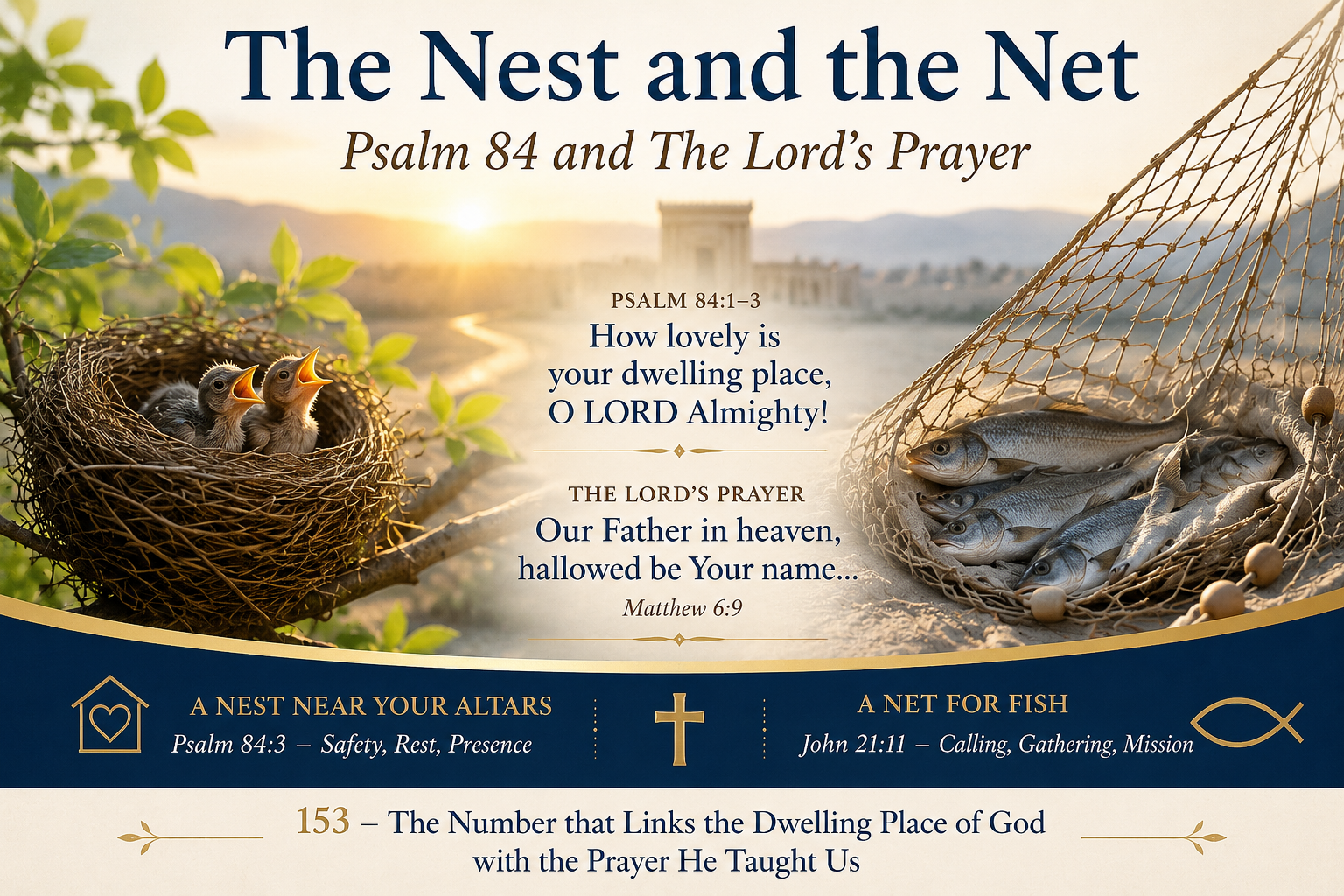
The Nest and the Net: Psalm 84 and the Lord’s Prayer.
2. Psalm 84 in Its Biblical Context
Psalm 84 is attributed to the sons of Korah, a Levitical guild associated with temple worship and sacred song. It is commonly understood as a pilgrimage or Zion psalm: the speaker longs to reach the sanctuary, and verses 5–7 picture worshippers whose hearts are set on the journey to Zion.
The psalm is therefore about more than geography. Jerusalem and the temple become the focal point of communion with God. The pilgrim is blessed not simply because he has arrived at a particular place, but because his journey is toward the One who dwells there.
| Verses | Movement | Theme |
|---|---|---|
| 1–4 | Longing and dwelling | The soul yearns for God’s house and altar. |
| 5–7 | Pilgrimage | Those whose hearts are set on Zion grow in strength. |
| 8–9 | Prayer | The pilgrim asks God to hear and look upon His anointed. |
| 10–12 | Confession and trust | One day in God’s courts is better than a thousand elsewhere. |
3. The Verse Identifiers of Psalm 84:1–3
The Method of Verse Identification assigns to a biblical verse the quantity I = B + C + V, where B is the book number, C the chapter number, and V the verse number. Psalms is the 19th book of the Bible.
| Verse | Identifier Calculation | Identifier | Cumulative Sum |
|---|---|---|---|
| Psalm 84:1 | 19 + 84 + 1 | 104 | 104 |
| Psalm 84:2 | 19 + 84 + 2 | 105 | 209 |
| Psalm 84:3 | 19 + 84 + 3 | 106 | 315 |
Thus, precisely at the end of the verse in which the swallow finds its nest at the altar, the cumulative identifier reaches 315.
4. From 315 to 153: A Digit-Permutation Signature
The relationship between 315 and 153 should be stated carefully. The two numbers are not arithmetically equal. Rather, their decimal numerals contain the same three digits in a different order.
Mathematically, the arrow denotes a digit-rearrangement transformation: write 315 in decimal form, permute the digit tuple (3,1,5) to (1,5,3), and then re-encode that tuple as the decimal numeral 153.
In the Canon of Numeric Invariants, digit permutation is an auxiliary or secondary witness. It can confirm a theological relationship already supported by the biblical text and stronger mathematical structures, but it should not create the interpretation by itself.
This caution is important. Psalm 84:1–3 already has a coherent theological theme before any arithmetic is introduced: longing for God, movement toward His courts, and finally finding a home at His altar. The 315 → 153 signature is meaningful because it resonates with that existing theme of gathering and dwelling.
5. Why 153 Matters in the Biblical-Mathematical Framework
John 21 records the risen Jesus directing the disciples to cast their net, after which Simon Peter draws it ashore “full of great fishes, an hundred and fifty and three.” The same verse emphasizes that although the fish were many, the net was not broken.
“Simon Peter went up, and drew the net to land full of great fishes, an hundred and fifty and three: and for all there were so many, yet was not the net broken.”
— John 21:11, KJV
In The Lord’s Prayer: A Mathematician’s Creed, the number 153 is interpreted as representing the fulfilment of the will of the Father in His Son, Jesus Christ. The book connects John 21 with John 6:39–40: the Son is to lose nothing of what the Father has given Him, but to raise it up at the last day. The unbroken net therefore becomes, within that framework, an image of preservation and gathering.
153: the fulfilment of the will of the Father in the Son.
The unbroken net: those gathered to Christ are preserved without loss.
The same work also associates 153 with the Lord’s Prayer, arguing that the prayer is a proclamation of faith in this fulfilment and linking the digit-permutation pattern of 153 with a daily rhythm of prayer.
6. The Nest and the Net
We can now see why the numerical result in Psalm 84 is suggestive. Psalm 84:3 gives us a nest; John 21:11 gives us a net. The images are different, but the spiritual movement is similar.
| Psalm 84:1–3 | John 21:11 / 153 Framework |
|---|---|
| The soul longs for God’s dwelling place. | The fish are gathered toward the risen Christ. |
| Heart and flesh cry for the living God. | The disciples obey the word of Jesus and cast the net. |
| The bird finds a home near the altar. | The gathered catch is brought safely to Christ. |
| 315 | 153 |
The theological connection is therefore not that a bird is a fish, or that a nest is literally a fishing net. Rather, both passages present a movement toward secure nearness to God. Psalm 84 gives the image of dwelling; John 21 gives the image of gathering and preservation.
The nest says: here the creature finds its home near God.
The net says: here the gathered are brought safely to Christ.
7. The Lord’s Prayer as a Prayer of Dwelling
The Lord’s Prayer begins with relationship: “Our Father.” It then turns the heart toward the Father’s name, Kingdom and will before moving to daily bread, forgiveness, moral guidance and deliverance. It is therefore naturally at home beside Psalm 84, where the worshipper’s deepest desire is simply to be near God.
| Psalm 84 | The Lord’s Prayer |
|---|---|
| “How amiable are thy tabernacles…” | “Our Father which art in heaven…” |
| “My soul longeth…” | “Thy kingdom come.” |
| “My heart and my flesh crieth out…” | “Thy will be done…” |
| “The swallow [finds] a nest…” | “Give us this day our daily bread.” |
The relationship is not one of word-for-word correspondence. It is one of spiritual orientation. Both passages turn the whole person toward God and teach dependence upon Him.
8. A Theological Proposition
Proposition. The cumulative identifier 315 of Psalm 84:1–3, whose decimal digits can be permuted to form 153, functions as a secondary numerical witness to the textual theme of the passage: the soul moves toward God, finds a dwelling near His altar, and rests in His presence. Within the 153-framework of John 21 and the Lord’s Prayer, this resonates with gathering, preservation, and fulfilment in Christ.
This proposition deliberately gives priority to Scripture. The biblical text supplies the theology; the numerical signature supplies an additional pattern. This is consistent with the Canon of Numeric Invariants, which treats the digit-signature or permutation operator as confirmatory rather than primary.
9. Pastoral Reflection: Making a Home in Prayer
Psalm 84 does not present the believer as a conqueror standing at a distance from God. It presents the believer as a pilgrim who longs for home. The sparrow and swallow are small creatures. Their strength is not the point. Their nearness is.
That is a helpful way to understand prayer. Prayer is not primarily an attempt to master circumstances. It is a return to the presence of the Father. The Lord’s Prayer gives that return a simple and enduring form.
Psalm 84 gives us the nest: a home near the altar.
John 21 gives us the net: a gathered people brought safely to Christ.
The Lord’s Prayer gives us the daily language: “Our Father.”
10. Conclusion
Psalm 84 begins with longing and arrives, by verse 3, at home. The soul desires the courts of the Lord; the heart and flesh cry out for the living God; the swallow finds a nest at the altar. At exactly this point, the cumulative verse identifier is:
Through digit permutation, 315 may be encoded as 153:
In the biblical-mathematical framework, 153 recalls the great catch of John 21:11, the unbroken net, the fulfilment of the will of the Father in the Son, and the Lord’s Prayer as a proclamation of faith in that fulfilment. The numerical relationship does not replace the meaning of Psalm 84. Rather, it beautifully echoes it.
The soul of Psalm 84 does not merely visit the sanctuary.
It longs to dwell there.
The bird finds its nest.
The gathered catch is held in the net.
And the believer learns to say, again and again:
“Our Father…”
References
- The Holy Bible, King James Version.
- Vanualailai, Jito, Eroni Tomasi, Paulo Vanualailai, and Jope Takala. The Lord’s Prayer: A Mathematician’s Creed. Suva, Fiji, 2018.
- Jones, Stephen E. The Biblical Meaning of Numbers from One to Forty. God’s Kingdom Ministries, 2008.
- Canon of Numeric Invariants with Theological Interpretations.
- Digit Permutation Method.


