God’s Blessings Through the Lord’s Prayer and the Last Supper

Introduction

From the earliest pages of Scripture, God is revealed as a God of blessing. In creation, He blessed Adam and Eve (Genesis 1:28); in covenant, He blessed Abraham and his descendants (Genesis 12:2–3); in worship, He commanded Aaron to bless the people with His name (Numbers 6:24–26). Blessings are not peripheral but central to God’s purpose for His people.

When Christ came, He gave two lasting ordinances to His disciples: the Lord’s Prayer and the Lord’s Supper. According to Ernest Findlay Scott (“The Lord’s Prayer: Its Character, Purpose, and Interpretation,” 1951), these are the “two poles” of Christianity, containing the essence of what Jesus taught and accomplished.

The Prayer teaches us how to ask for blessings; the Supper assures us they are secured in His Cross.

In this article, we will explore how the blessings of God are (1) defined in Scripture, (2) prayed for in the Lord’s Prayer, and (3) fulfilled in the Lord’s Supper. Together, these two gifts of Christ shape the entire rhythm of Christian life.


1. The Scope of God’s Blessings

God’s blessings are not limited to material prosperity, though this is included. They are comprehensive and holistic, touching every dimension of life.

  1. 🕊️ Spiritual Blessings (Eph. 1:3; Rom. 5:1)
    • These include forgiveness of sins, peace with God, joy in the Holy Spirit, and adoption as children of God. The greatest spiritual blessing is reconciliation with the Father through Christ.
  2. 🍞 Material Provision (Deut. 28:1–14; Matt. 6:11)
    • God promises to supply daily needs — bread, water, health, fruitful labor, and prosperity. Material blessings remind us of God’s care for our physical lives.
  3. 🤝 Relational Blessings (Ps. 128:1–6; Prov. 3:3–4)
    • God blesses families with love, children with fruitfulness, and communities with favor and harmony. These blessings nurture covenant relationships among His people.
  4. ❤️ Inner Security (Jer. 17:7–8; Phil. 4:6–7)
    • This is the peace of heart and mind that comes from trusting God. Even in trials, the believer is anchored, like a tree planted by streams of water.
  5. 🌟 Guidance & Wisdom (Prov. 9:10; James 1:5)
    • God blesses those who seek His will with discernment and clarity. Wisdom is not merely knowledge but a Spirit-filled ability to walk in righteousness.
  6. 🙌 Beatitude Blessings (Matt. 5:3–12)
    • Jesus pronounced blessings on the poor in spirit, the meek, the merciful, the pure, the peacemakers, and those who suffer for righteousness. These blessings are paradoxical: they often come through weakness and suffering.
  7. 🛡️ Covenant Protection (Deut. 28:7; Matt. 6:13)
    • God blesses His people with deliverance from enemies, safety in times of danger, and victory over evil powers. This is part of His covenant loyalty.
  8. 👑 Eternal Blessings (John 3:16; Rev. 21:3–4)
    • The ultimate blessing is eternal life in the Kingdom of God — resurrection, immortality, and fellowship with God forever.

2. Conditions for Receiving Blessings

The Bible also makes clear that blessings are conditional upon faith, obedience, and covenant alignment:

  1. Obedience to God’s Word
    • “If you fully obey the Lord your God and carefully follow all his commands… all these blessings will come on you and accompany you” (Deut. 28:1–2).
    • Blessings are tied to walking in God’s ways.
  2. Fear of the Lord (reverence and awe)
    • “Blessed is the man who fears the Lord, who greatly delights in his commandments” (Psalm 112:1).
    • Reverence leads to wisdom and security.
  3. Trust and Faith in God
    • “Blessed is the man who trusts in the Lord, whose confidence is in him” (Jeremiah 17:7).
    • Faith brings stability and fruitfulness.
  4. Purity and Righteousness
    • Jesus’ Beatitudes (Matthew 5:3–12) show that humility, mercy, purity, peacemaking, and enduring persecution are conditions for blessing.
  5. Prayer and Dependence on God
    • The Lord’s Prayer teaches us to ask daily for bread, forgiveness, and deliverance. Brant Pitre (“The Lord’s Prayer and the New Exodus”, 2006) explains this as part of the “New Exodus”: God blesses when His people call upon Him in dependence and covenant loyalty.

Blessings are therefore not automatic; they flow from a heart aligned with God’s will, and from lives shaped by Christ.

Here is a clear Table of Blessings and Conditions from Scripture:


BlessingConstitutes (What It Is)Condition (Requirement)Scripture
Spiritual BlessingsForgiveness of sins, peace with God, joy, eternal salvationFaith in Christ, repentance, obedience to His WordEph. 1:3; Rom. 5:1; Acts 3:19
Material ProvisionDaily bread, health, fruitful harvest, prosperity, protectionObedience to God’s commands; seeking first His kingdomDeut. 28:1–14; Matt. 6:33
Relational BlessingsStrong families, fruitful children, harmony, favor with othersFear of the Lord, walking in righteousnessPsalm 128:1–6; Prov. 3:3–4
Inner SecurityPeace, stability, strength in trialsTrust and confidence in GodJer. 17:7–8; Phil. 4:6–7
Guidance & WisdomGod’s direction in life, discernment, clarityReverence (fear) of the Lord, prayer, dependenceProv. 9:10; James 1:5
Beatitude BlessingsComfort, inheritance, mercy, vision of God, sonshipHumility, meekness, mercy, purity, peacemaking, endurance under persecutionMatt. 5:3–12
Covenant ProtectionVictory over enemies, safety, deliverance from evilCovenant loyalty, prayer (Lord’s Prayer as dependence)Deut. 28:7; Matt. 6:13
Eternal BlessingsResurrection, eternal life, dwelling with God in the New JerusalemPerseverance in faith, overcoming trials, belonging to ChristJohn 3:16; Rev. 21:3–4

3. The Lord’s Prayer: Asking for the Blessings

The Lord’s Prayer (Matt. 6:9–13) is not merely a set of words but a comprehensive petition that sums up all of Jesus’ teaching. Each line corresponds to a category of blessing:

  • Our Father, who art in heaven 🛡️🤝
    • We are adopted children in covenant, under His protection and family care.
  • Hallowed be Thy Name 🕊️
    • We align ourselves with His holiness, seeking the spiritual blessing of sanctification and communion.
  • Thy Kingdom come 👑
    • We long for the fullness of eternal blessing, the reign of God on earth as in heaven.
  • Thy will be done on earth as it is in heaven 🌟
    • We ask for wisdom to walk in His will, for divine guidance in our daily steps.
  • Give us this day our daily bread 🍞
    • A direct request for provision: food, health, work, and sustenance.
  • Forgive us our trespasses… 🕊️🤝
    • We receive spiritual forgiveness and relational healing as we extend it to others.
  • Lead us not into temptation ❤️
    • A prayer for inner security and strength against weakness and sin.
  • Deliver us from evil 🛡️
    • A cry for covenant protection from the evil one and all spiritual enemies.
  • For thine is the kingdom, and the power, and the glory… 🙌
    • The Beatitude blessings are gathered in praise: joy, hope, and endurance in suffering.

In praying the Lord’s Prayer, we are in fact praying for the fullness of God’s covenant blessings.

Petition in the Lord’s PrayerBlessing it CoversExplanation
“Our Father, who art in heaven”Covenant Protection & Relational BlessingsWe enter God’s family, acknowledging His fatherhood — the basis of protection, provision, and healthy relationships.
“Hallowed be Thy Name”Spiritual BlessingsWe revere His holiness, aligning our hearts for forgiveness, sanctification, and joy in the Spirit.
“Thy Kingdom come”Eternal BlessingsWe long for God’s reign and the new creation, praying for eternal life in the restored Kingdom.
“Thy will be done on earth as it is in heaven”Guidance & WisdomSubmitting to God’s will brings clarity, discernment, and divine direction in all things.
“Give us this day our daily bread”Material ProvisionA direct request for daily needs — food, health, prosperity, and physical sustenance.
“Forgive us our trespasses, as we forgive those who trespass against us”Spiritual Blessings & Relational BlessingsForgiveness restores us to God and reconciles us with others, bringing peace and healing in relationships.
“Lead us not into temptation”Inner SecurityGod gives strength and stability in trials, protecting us from falling into sin.
“But deliver us from evil”Covenant ProtectionGod shields us from the evil one, granting victory over enemies and spiritual safety.
Doxology: “For thine is the kingdom, and the power, and the glory forever”Beatitude BlessingsPraise unites us with the Kingdom vision of Christ, lifting us to endurance, mercy, purity, and joy.

3. The Last Supper: Receiving the Blessings

The Last Supper (Luke 22:19–20; 1 Cor. 11:23–26) is the sacrament that seals the blessings prayed for in the Lord’s Prayer. What we ask in prayer, we receive in Christ’s body and blood:

  • 🕊️ Spiritual Blessings – His blood poured out for forgiveness secures our peace with God.
  • 🍞 Material Provision – In the bread of life, we taste God’s provision not only for the body but for the soul.
  • 🤝 Relational Blessings – At the Table, divisions are healed; we are one body in one cup.
  • ❤️ Inner Security – The command “Do this in remembrance of me” gives assurance of His abiding presence.
  • 🌟 Guidance & Wisdom – The Supper teaches us to live as Christ lived: in obedience, sacrifice, and love.
  • 🙌 Beatitude Blessings – To eat and drink is to share in His suffering and anticipate His Kingdom glory.
  • 🛡️ Covenant Protection – His blood is the new covenant, the ultimate Passover protection from death and judgment.
  • 👑 Eternal Blessings – The Supper anticipates the great wedding feast of the Lamb (Rev. 19:9).

Thus, the Last Supper is not simply a memorial but a covenantal act in which God’s blessings are received, sealed, and anticipated.

BlessingHow the Last Supper Fulfills It
Spiritual BlessingsForgiveness of sins through the blood of the New Covenant (Matthew 26:28).
Material ProvisionBread and wine symbolize God’s ongoing provision, “daily bread” now fulfilled in Christ Himself (John 6:35).
Relational BlessingsShared table fellowship creates unity — one body, one cup (1 Corinthians 10:16–17).
Inner SecurityChrist promises His abiding presence: “Do this in remembrance of me” — reassurance in times of trial.
Guidance & WisdomThe Supper calls us to live by His will, modeling self-sacrifice and love.
Beatitude BlessingsThose who share His sufferings will share His Kingdom blessings (Luke 22:29–30).
Covenant ProtectionParticipation in Christ’s sacrifice secures protection from judgment (like the Passover lamb in Exodus 12).
Eternal BlessingsThe Supper anticipates the wedding feast of the Lamb (Revelation 19:9).

4. Prayer and Supper: Two Poles of the Same Covenant

The Lord’s Prayer and the Lord’s Supper are inseparable:

  • The Prayer lifts our petitions to the Father.
  • The Supper reveals that those petitions are answered in Christ’s sacrifice.
  • The Prayer is our daily rhythm of dependence.
  • The Supper is our covenant anchor in His once-for-all work.

As Scott observed:

  • We cannot rightly say the Prayer without remembering the Cross.
  • We cannot celebrate the Supper without meaning to live the way of Jesus.

Scott is correct that the Lord’s Prayer and the Lord’s Supper are inseparable:

  • We cannot rightly say the Prayer without remembering the Cross.
    • When we ask for forgiveness, daily bread, deliverance from evil — all are possible only because of the sacrifice remembered in the Supper.
  • We cannot celebrate the Supper without following Jesus’ way of life.
    • To eat His body and drink His blood is to commit to living out the obedience, forgiveness, and kingdom-focus expressed in the Lord’s Prayer.

In other words:

  • The Prayer teaches us what to ask for.
  • The Supper assures us that God has already given it in Christ.

5. The Last Supper as the Covenant of Blessing

The biblical pattern is clear: God’s blessings always flow through covenant.

  • In the Old Testament, blessings were tied to obedience to the Law (Deut. 28).
  • In the New Testament, blessings are tied to the New Covenant in Christ’s blood (Luke 22:20).

At the Last Supper, Jesus enacted this covenant — guaranteeing all the blessings of God to those who partake in Him.

The Prayer points forward; the Supper points backward. Together, they hold the Church in the present — living daily in God’s blessings.


Conclusion

In His wisdom, Jesus gave His Church two enduring gifts: the Lord’s Prayer and the Lord’s Supper. One teaches us to ask for blessings, the other seals them in covenant. One shapes our petitions, the other embodies God’s provision. Together, they form the rhythm of Christian life — prayer and sacrament, request and fulfillment, promise and assurance.

To pray the Lord’s Prayer and to partake of the Lord’s Supper is to live fully in the covenant blessings of God: forgiveness, provision, peace, protection, and eternal life. In these two ordinances, Jesus has given us everything.

“Her House Leads to Death”:Proverbs 7 and the Lord’s Prayer

Abstract

This article explores the theological and spiritual significance of Proverbs 7 in light of Luke 11:2–4, the Lord’s Prayer, and the apocalyptic imagery of Revelation 17–18. Through symbolic interpretation and numerical linkage (identifier sum 1107 for Proverbs 7 and 168 for Luke 11:2–4), we uncover a deeper harmony between wisdom literature, Christ’s model prayer, and prophetic eschatology. The seductive figure of the adulterous woman in Proverbs 7 is interpreted as an archetype of worldly temptations—any pursuit, desire, or ambition disconnected from love and reverence for God. Revelation amplifies this warning, revealing the adulterous woman as “Babylon the Great,” who deceives the nations. We argue that the Lord’s Prayer offers not only protection against overt sin but also spiritual clarity to rightly order all things. Proverbs 7, Luke 11, and Revelation 17–18 together form a unified biblical warning: true wisdom requires both discernment and devotion to avoid the subtle seductions that lead to spiritual ruin.


1. Introduction

The Book of Proverbs, particularly chapter 7, provides a gripping moral narrative about a young man’s seduction by an adulterous woman. At face value, it is a lesson on sexual purity and moral discipline. However, when read in the broader biblical and theological context, the chapter serves as a spiritual allegory—illustrating how seductive forces in the world can lead even the well-meaning into spiritual ruin.

Curiously, the total identifier sum of Proverbs 7’s 27 verses is 1107, whose divisors sum to 1680. This figure is exactly 168 × 10, with 168 being the identifier of Luke 11:2–4, the passage where Jesus teaches the Lord’s Prayer. Could this be a mere coincidence, or is there a deeper, Spirit-ordained link between these texts? This article contends that Proverbs 7 reveals the nature of temptation, the Lord’s Prayer provides the means of resistance, and Revelation reveals the global scope and judgment of such seduction.


2. Proverbs 7: Wisdom’s Warning

2.1 Literary Overview

Proverbs 7 is structured as a father’s impassioned plea to his son. The first five verses urge the internalization of wisdom: “Bind them on your fingers; write them on the tablet of your heart” (v.3). The remaining verses depict a vivid story of seduction, culminating in the ominous verdict: “Her house is the way to Sheol, going down to the chambers of death” (v.27).

2.2 The Adulterous Woman as Allegory

While historically interpreted as a literal warning against adultery, the adulterous woman also serves as a symbol of any worldly desire or attraction that tempts the believer away from fidelity to God. Her dress, speech, and cunning become metaphors for seductive ideologies, career ambitions, materialism, fame, or even religious pride—all of which may “look good” but ultimately corrupt the soul.


3. Luke 11: The Lord’s Prayer as Protection

3.1 Structural Summary

In Luke 11:2–4, Jesus teaches His disciples to pray with six petitions. Central to our discussion are:

  • “Lead us not into temptation”
  • “Deliver us from evil”

These are not passive requests, but active cries for divine intervention against the very dynamics depicted in Proverbs 7. Where Proverbs reveals the seduction, Luke 11 offers the shield.

3.2 Numerical Linkage: 1107 and 168

The sum of verse identifiers in Proverbs 7 is 1107. Its divisors are [1, 3, 9, 27, 41, 123, 369, 1107]. The total sum of divisors is 1680 = 168 × 10, implying that the full weight of Proverbs 7’s warning is counterbalanced by the spiritual fullness found in Luke 11’s prayer.

📜 TEXTUAL & THEMATIC CONTRAST

ThemeProverbs 7Luke 11:2–4 (The Lord’s Prayer)
Moral TrajectoryThe path of moral failure (lust, seduction, death)The path of spiritual alignment (submission, daily provision, forgiveness, protection)
Key ActionA naive young man follows a seductressA disciple asks how to pray and is given a model of divine connection
End Result“Her house is the way to Sheol” (v.27)“Deliver us from evil” (Luke 11:4)

4. Revelation 17–18: The Adulterous Woman Revealed

4.1 The Woman on the Beast

Revelation 17 introduces a woman riding a scarlet beast, described as “Babylon the Great, the Mother of Prostitutes and of Earth’s Abominations.” She is clothed in purple and scarlet, adorned with gold, and holds a golden cup filled with abominations. She is drunk with the blood of the saints. This figure represents not merely individual temptation, but a global system of seduction that fuses religious apostasy, economic greed, and political corruption.

4.2 Connection to Proverbs 7

Just as the young man is lured to destruction in Proverbs 7, so too the kings and merchants of the earth are deceived by Babylon’s luxuries and adulteries (Rev. 18:3). The same pattern is evident:

  • Flattery and appearance mask death
  • Deception precedes judgment
  • Spiritual adultery leads to downfall

The adulterous woman of Proverbs becomes the great prostitute of Revelation. What begins as personal folly ends as a cosmic rebellion.

🕯️ From Proverbs 7 to Revelation 17: A Consistent Warning

Proverbs 7Revelation 17–18
Adulterous woman lures the young man with seductive speech and appearanceThe great prostitute sits on a scarlet beast, arrayed in purple and scarlet, holding a golden cup full of abominations (Rev. 17:1–5)
“With persuasive words she led him astray…” (Prov. 7:21)“By her sorcery all nations were deceived…” (Rev. 18:23)
“Her house is the way to Sheol…” (Prov. 7:27)“She is drunk with the blood of the saints” and her end is utter destruction (Rev. 17:6, 18:21)

5. Theological Implications

5.1 Temptation Redefined

Temptation is most dangerous when it is attractive, persuasive, and religiously acceptable. Proverbs 7 teaches that evil often appears desirable. Revelation confirms that this dynamic scales to entire nations.

5.2 Ambition without Love

Even good things like ambition or ministry, when pursued without love, prayer, or humility, become idols. Paul writes, “If I have not love, I am nothing” (1 Cor. 13:2). The warning of Proverbs 7 and Revelation 17 is not against desire itself, but desire disconnected from God.

5.3 The Role of Prayer in Spiritual Fidelity

The Lord’s Prayer realigns our hearts with God:

  • “Your kingdom come” opposes Babylon’s empire
  • “Give us this day” restrains greedy ambition
  • “Forgive us” fosters humility
  • “Deliver us” invokes protection from the spiritual seductress

Prayer is spiritual fidelity in action.


6. Conclusion: A Unified Biblical Warning

The adulterous woman in Proverbs 7 warns the individual.
The Lord’s Prayer in Luke 11 equips the believer.
The prostitute Babylon in Revelation 17–18 reveals the danger at global scale.

Together, they form a complete theology of temptation, resistance, and judgment.

Wisdom without prayer is brittle.
Prayer without wisdom is blind.
Without both, the soul is vulnerable to seduction.


A Theological Reflection on Psalm 79:10 and the Numbers 108 and 153

🙏 Introduction

The Lord’s Prayer stands as the most beloved and unifying prayer across all of Christianity. Reverently recited by Christians of every denomination, it encapsulates a sacred rhythm—anchoring believers in God’s will, provision, forgiveness, and protection. Yet, beneath its surface lies a remarkable numerical structure centered on the number 153—a number that also appears in the Gospel of John as the measure of the miraculous catch of fish, often symbolizing the fullness of redemption.

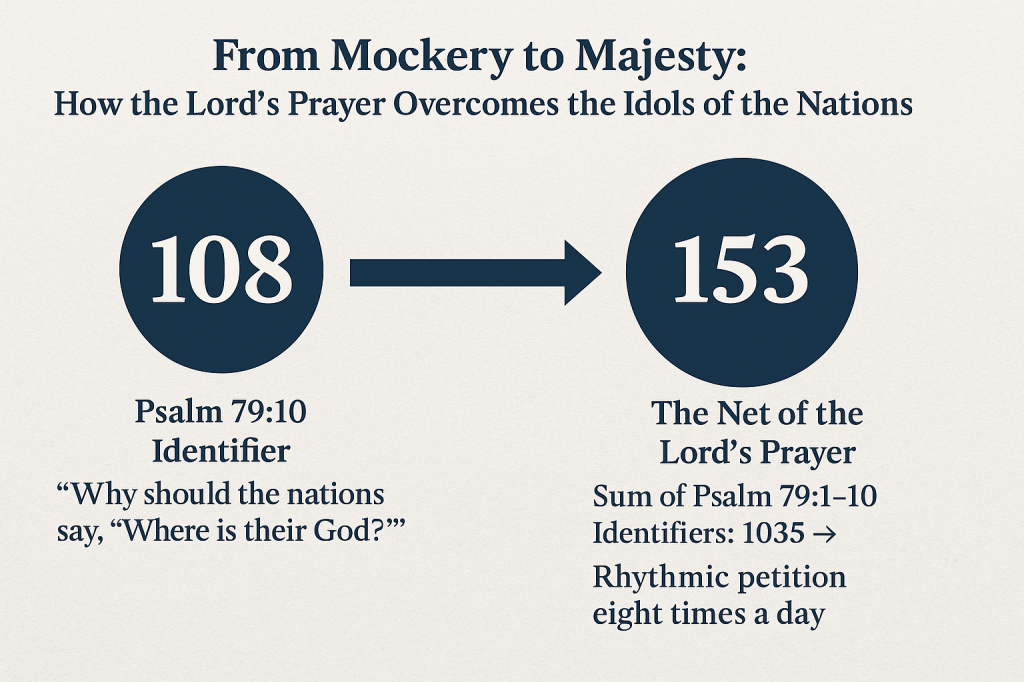
A fascinating interplay emerges when we consider Psalm 79:10, a verse of lament from ancient Israel. Its numerical identifier is 108, a number deeply revered in other spiritual traditions, particularly Hinduism and Buddhism. But rather than creating conflict, this juxtaposition offers an invitation: to explore how prayer—specifically, the Lord’s Prayer—becomes a faithful answer to the world’s deepest cries.


📖 Psalm 79:10 – A Cry for Justice

“Why should the nations say, ‘Where is their God?’ Let the avenging of the outpoured blood of your servants be known among the nations before our eyes.”
— Psalm 79:10

Psalm 79 is a communal lament composed during a time of great national distress. It reflects the grief of God’s people after the desecration of Jerusalem and the suffering of the innocent. In verse 10, the psalmist asks a poignant question: Why should the nations mock the silence of God?

Using the biblical method of calculating verse identifiers (Book + Chapter + Verse), Psalm 79:10 receives an identifier of:

19(BookofPsalms)+79(Chapter)+10(Verse)=108


🕉️ The Number 108 – Revered in Global Traditions

The number 108 holds deep spiritual significance in many Eastern traditions:

  • In Hinduism, it represents the 108 names of deities and is found in prayer beads (mala) used for chanting.
  • In Buddhism, it symbolizes the 108 afflictions of the human mind that practitioners seek to overcome through purification.
  • In Jainism, it denotes the 108 attributes of the enlightened beings.

For many, 108 is a symbol of spiritual wholeness and cosmic order. From a Christian perspective, however, the meaning of 108 invites a different reflection: not a condemnation of others’ beliefs, but a contemplation of what true fullness means, and where it is ultimately found.


🔢 The Response Hidden in the Numbers: 1035 and 153

While verse 10 stands out with its identifier 108, something extraordinary emerges when we calculate the cumulative identifiers of Psalm 79:1–10. That is, if we sum the identifiers of each verse from verse 1 to 10, we get:

99+100+101+…+108=103599 + 100 + 101 + … + 108 = 1035

The number 1035, when its digits are rearranged, contains 1–5–3: a clear allusion to 153, a number rich with theological meaning in Christian thought.


🎣 The Number 153 – The Net of Redemption

  • In John 21:11, after the Resurrection, the disciples catch 153 fish in a net that does not break. Early Christian interpreters saw this as a symbol of the totality of humanity gathered into God’s Kingdom.
  • Mathematically, 153 = 17 × 9, where 17 is the sum of the first 7 natural numbers (symbolizing divine order), and 9 represents spiritual completion.

In our own theological framework, 153 also encodes the 8 prayer times of the Lord’s Prayer (10:35, 10:53, 1:35, etc.), forming a sacred rhythm for daily communion with God.


🔁 From Mockery to Prayer: A Theological Arc

Psalm 79:10 begins with a question from the nations:

“Where is their God?”

This is not just a rhetorical question—it represents the longing of the world for a visible, just, and active God.

The answer comes not in thunder or force, but in the quiet power of prayer—the structured, faithful cry of God’s people. The cumulative sum of verses 1–10, totaling 1035, encodes 153, the number of the Lord’s Prayer. The implication is profound:

The mocking of the nations (108) is answered by the persistent prayer of God’s people (153).


🤝 Interfaith Sensitivity and Christian Testimony

In honoring this insight, we must approach it with humility and grace. While Christians believe that the fullness of spiritual truth is found in Jesus Christ, this belief does not diminish the sincerity, moral integrity, or spiritual longing of those from other faiths. Rather, we affirm that:

  • The number 108, as honored in other traditions, reflects a deep and beautiful search for divine connection.
  • In Christian theology, the number 153 becomes our symbol of divine response—a net cast by Christ to gather all who seek truth, hope, and redemption.

Thus, instead of condemnation, we offer an invitation—to consider that the rhythms of prayer, culminating in the Lord’s Prayer, answer the universal cry for justice, mercy, and spiritual completeness.


📊 Summary Table

ConceptValueInterpretation
Psalm 79:10 Identifier108Symbol of the nations’ question and longing
Cumulative Identifiers (v1–10)1035Encodes 153—the prayerful rhythm of divine presence
Christian Symbolism153The Net of Redemption; the Lord’s Prayer; divine fullness
Theological Insight108 → 153The cry of the nations is answered by the prayer of the faithful

🌍 Conclusion

In the tension between the nations’ mockery and God’s apparent silence, Psalm 79 gives voice to both anguish and hope. Hidden within its structure, however, is a revelation: the number 108, though honored in other traditions, becomes in this psalm the cry of the world. The response is found not in retaliation, but in the Lord’s Prayer, encoded in the number 153, the sum of accumulated cries and the rhythm of redemptive hope.

In this way, the Lord’s Prayer becomes not only the response of Israel—but the response of the Church—to the cry of the world. It is an act of love, rooted in faith, and extended in humility.

The Lord’s Prayer: A Spiritual Bridge from Judgment to Praise

1. Introduction

In the biblical narrative, God is not indifferent to injustice. Psalm 75 is a vivid declaration of divine judgment against prideful, oppressive, and paranoid rulers. Psalm 95, on the other hand, is a communal invitation to joyful worship and reverent obedience.

This paper contends that the Lord’s Prayer, embedded within the very fabric of Scripture, functions as the theological and numerical bridge between these two psalms. It facilitates the cry for justice and the praise of deliverance. The mathematical structure of these psalms affirms the Lord’s Prayer as a divine key.


2. Psalm 75: The Judgment of the Proud

Psalm 75 announces God as the ultimate judge who “puts down one, and sets up another” (v.7). The psalm speaks directly to arrogant and power-obsessed individuals: “Lift not up your horn on high: speak not with a stiff neck” (v.5). It offers assurance to the oppressed that justice will be served.

  • Total Identifier of Psalm 75: 995
    Computed as the sum of verse identifiers (Book 19 + Chapter 75 + Verse Number)
  • Divisors of 995: [1, 5, 199, 995]
    Geometric Mean ≈ 31.54 → digits: 3, 1, 5 → permutation of 153

This reveals that divine judgment in Psalm 75 is numerically tethered to the number 153, long recognized as a symbolic number of fullness, divine order, and the Lord’s Prayer itself.


3. Psalm 95: The Praise of the Delivered

Psalm 95 represents the spiritual condition of a community that has witnessed the fall of injustice. It begins with a call to thanksgiving and ends with a sober reminder not to repeat the errors of rebellion. It is the natural response after God has fulfilled the promise declared in Psalm 75.

  • Total Identifier of Psalm 95: 1320
  • Divisors of 1320: 32 in total
    Sum of Divisors: 4320 → Arithmetic Mean = 4320 / 32 = 135 → another permutation of 153

Again, we see the numerical resonance with 153, suggesting a hidden unity with Psalm 75 and a full-circle return to divine order through worship.


4. Theological Function of the Lord’s Prayer

The Lord’s Prayer operates on two planes simultaneously:

  1. As Petition for Judgment and Deliverance
    • “Thy kingdom come, Thy will be done on earth as it is in heaven” (Matthew 6:10) aligns with the themes of Psalm 75.
    • “Deliver us from evil” speaks directly to the plea against oppressive and paranoid leadership.
  2. As Praise for Redemption and Rest
    • “Give us this day our daily bread” and “Forgive us our trespasses” echo the spirit of Psalm 95—communal thanksgiving, humility, and worship.

These dual functions mirror the movement from Psalm 75 to Psalm 95, confirming the Lord’s Prayer as a spiritual bridge.


5. The Mystery of 153 and the Net of Prayer

The number 153 is most famously associated with John 21:11, the miraculous catch of fish. It symbolizes fullness, the gathering of the elect, and the net of divine calling.

In the framework discussed:

  • Psalm 75’s Geometric Mean (31.5) → 153
  • Psalm 95’s Arithmetic Mean (135) → 153

These findings show that the Lord’s Prayer, encoded in 153, is the sanctified net through which the justice of Psalm 75 is drawn into the praise of Psalm 95.


6. Conclusion: Sanctifying Time and Order through the Lord’s Prayer

The Lord’s Prayer is more than a petition; it is the divine engine that moves history from oppression to order, from sorrow to song. The numerical revelations encoded in Psalms 75 and 95 are not random coincidences but holy signatures of the spiritual transformation initiated by this prayer.

Thus, whether confronting the horns of the wicked or entering the rest of the righteous, we are called to pray:

“Thy kingdom come, Thy will be done… For Thine is the kingdom, and the power, and the glory forever. Amen.”

🙏 Theological Implication

The Lord’s Prayer can and should be:

  • Prayed during times of oppression as a petition for righteous judgment (Psalm 75).
  • Prayed after vindication as a song of thanks and renewed worship (Psalm 95).

It becomes the spiritual Net of 153:

  • Gathering the humble,
  • Separating the wicked,
  • Restoring the soul,
  • And sanctifying the time and the people.

The Lord’s Prayer is the Net of God

Introduction

In the tapestry of divine revelation, Scripture interweaves image, number, and word with masterful precision. One such interlacing appears between Psalm 66:11, the Lord’s Prayer, and the miraculous catch of fish in John 21:11. This exposition uncovers a hidden structure of divine refinement and redemption, revealed through a remarkable numerical harmony anchored in Psalm 66:11, the identifier 168, and the total structure of Psalm 77.


1. Psalm 66:11 — The Net of Refinement

“Thou broughtest us into the net; thou laidst affliction upon our loins.”
Psalm 66:11

This verse encapsulates the experience of trial under God’s hand. The Hebrew gematria of its two key phrases provides a gateway into its spiritual significance:

PhraseHebrewGematria
“Thou broughtest us”הֲבֵאתָ֥נוּ464
“into the net”בַמְּצוּדָ֑ה147
Total611

The sum, 611, has four divisors: Divisors of 611=[1,13,47,611].

Arithmetic Mean=(1+13+47+611)/4=672/4=168


2. 168 — The Identifier of the Lord’s Prayer in Luke

According to the system of biblical identifiers (Book + Chapter + Verse):

VerseIdentifier
Luke 11:242 + 11 + 2 = 55
Luke 11:342 + 11 + 3 = 56
Luke 11:442 + 11 + 4 = 57
Total168

This identifies Luke 11:2–4, the concise form of the Lord’s Prayer, with the number 168.


3. Spiritual Insight: Into the Net of Prayer

The equivalence between:

  • The mean of the divisors of 611 (from Psalm 66:11), and
  • The identifier of the Lord’s Prayer in Luke,

is theologically profound:

To be brought “into the net” (Psalm 66:11) is to enter a divine pattern of discipline, refinement, and sanctification—and the very act of praying the Lord’s Prayer aligns the soul with this divine process.

This net is not one of condemnation, but of formation, drawing us into obedience and trust.


4. John 21:11 — The Net of Redemption

“Simon Peter climbed aboard and dragged the net ashore. It was full of large fish, 153, but even with so many the net was not torn.”
John 21:11

This verse reveals the net of grace, cast at the command of the risen Christ. It draws in 153 fish, symbolizing the fullness of the elect.

Together, Psalm 66:11 and John 21:11 create a unified narrative:

  • Psalm 66:11: Net of testing and discipline
  • John 21:11: Net of redemption and wholeness

5. The 8 Times of the Lord’s Prayer

From the permutations of 153 arise 6 spiritually significant numbers, which define 8 daily prayer times:

10:35 am, 10:53 am, 1:35 pm, 1:53 pm, 3:15 pm, 3:51 pm, 5:13 pm, 5:31 pm

These times serve as a spiritual entry into the net—a practice of daily discipline, surrender, and divine alignment.


6. The 2130 Revelation: Psalm 66:11 and Psalm 77

The Hebrew gematria of Psalm 66:11 totals 2130.

Psalm 66:11 — Word-by-Word Gematria Breakdown

#Hebrew WordTranslationGematria
1הֲבֵאתָ֥נוּ“You brought us”464
2בַמְּצוּדָ֑ה“into the net/prison”147
3שַׂ֖מְתָּ“You laid”740
4מוּעָקָ֣ה“burden”221
5בְמָתְנֵֽינוּ׃“on our loins”558
TOTAL2130

Surprisingly, the total of all verse identifiers in Psalm 77 also equals 2130.

ReferenceDescriptionValue
Psalm 66:11Gematria of the full verse2130
Psalm 77Sum of all verse identifiers (20 verses)2130

✨ Interpretation:

Psalm 66:11 describes the act of entering the net, while Psalm 77 is a spiritual map of what happens inside that net:

  • A descent into doubt (vv.1–9),
  • A decision to remember God’s faithfulness (vv.10–12),
  • A resurgence of praise grounded in redemptive history (vv.13–20).

This numerical unity teaches us that:

To enter the net (2130) is to enter the journey of Psalm 77—moving from affliction to assurance, and from despair to divine remembrance.

🔄 2. Psalm 77 — What Happens in the Net

This psalm maps the interior journey of the soul inside the net:

VersesPhaseDescription
1–3Crying OutDesperation and sleepless anguish
4–6QuestioningHas God forgotten? Why so silent?
7–9Crisis of FaithDoubting God’s mercy and covenant
10–12Turn to RemembranceActively choosing to recall God’s deeds
13–20Restoration of TrustAwe-filled meditation on the Exodus: “Your path led through the sea…”

It is the process of spiritual purification — the fire in the furnace, the pressure in the cocoon. The Psalm ends not with escape, but with reoriented faith.

🌅 3. Psalm 66:12 — What Happens After the Net

“You let people ride over our heads; we went through fire and water, but you brought us to a place of abundance.”

This is the glorious exit — a movement from:

  • Oppression to elevation
  • Trial to transformation
  • Narrowness to abundance

The Net was never the end — it was the threshold.
The end is abundance (רְוָיָה – revayah) — spiritually, emotionally, and covenantally.


Conclusion: Into the Net of the Kingdom

To pray the Lord’s Prayer is to enter God’s net—not of punishment, but of preparation and transformation.

  • Psalm 66:11 shows the entry into divine testing.
  • John 21:11 shows the redemptive purpose of that net.
  • Psalm 77 provides the spiritual anatomy of life inside the net.
  • Identifier 168 and total 2130 are the divine seals of this mystery.

The Lord’s Prayer is the net of God.
It refines, gathers, delivers—and fills the soul with remembrance of His mighty acts.

To pray at the 8 sacred times is to consciously step into God’s redemptive process and say, with full surrender:

Thy will be done.”

✅ Yes — praying the Lord’s Prayer at the 8 designated times draws us into the divine net, not to destroy us, but to:

  • Refine us like silver (Psalm 66:10),
  • Catch us for eternal life (John 21:11),
  • And prepare us to receive God’s abundance (Psalm 66:12).

“You brought us to a place of abundance.”