Apologetics and the Limits of Worldview Cross-Talk

Apologetics is a field of study within theology and philosophy that involves the reasoned defense of a belief system—most commonly, Christianity. The term comes from the Greek word apologia (ἀπολογία), which means “a defense” or “a speech in defense.” It is famously used in 1 Peter 3:15, where believers are instructed to:

“Always be ready to give a defense (apologia) to everyone who asks you a reason for the hope that is in you, with gentleness and respect.”

Keywords: Apologetics, Naturalism, Worldview, Christianity, Faith, Epistemology, Revelation, Secularism, Interreligious Dialogue

Abstract This paper explores the philosophical and theological limits of apologetics when engaging with naturalistic and secular worldviews, as well as with other religious systems that, while also believing in the supernatural, operate from fundamentally different assumptions. It argues that while Christian apologetics can clarify, defend, and illuminate faith for the believer and seeker, it is ultimately ineffective at persuading those whose frameworks categorically exclude or redefine the nature of divine revelation and salvation. The paper concludes that Christian, non-Christian religious, and secular worldviews are so incommensurable in their foundational assumptions that cross-persuasive dialogue is largely futile. Rather than attempting to “win” debates within foreign epistemological systems, Christian apologetics is better positioned as an internal clarifying tool, a witness to faith, and a bridge for those already wrestling with existential questions beyond the empirical realm.

1. Introduction Apologetics, from the Greek apologia, refers to the reasoned defense of the Christian faith. Rooted in biblical exhortations such as 1 Peter 3:15, which instructs believers to “always be ready to give a defense to everyone who asks you a reason for the hope that is in you, with gentleness and respect,” Christian apologetics is originally envisioned not as an aggressive or unsolicited enterprise, but as a responsive and humble articulation of faith. This scriptural foundation suggests that apologetics is most appropriate when answering genuine inquiry, rather than confronting those who have not asked  but may only have offered an opposing view. However, in an increasingly pluralistic context that includes both secular naturalism and diverse religious traditions, the effectiveness and appropriateness of apologetics as a tool for persuasion are under renewed scrutiny.

2. The Naturalistic Worldview: Assumptions and Boundaries The naturalistic worldview is grounded in materialism, empiricism, and methodological skepticism. It holds that only that which is observable, testable, and repeatable can be known. Supernatural claims, by definition, lie outside this frame and are treated as non-evidentiary or mythological. From this perspective, religious events such as Jesus’ crucifixion and resurrection carry no epistemic weight.

3. The Christian Worldview: Revelation and Transcendence In contrast, Christianity is founded upon divine revelation, personal encounter, and the historical claim of God entering human history in the person of Jesus Christ. It presupposes the existence of a metaphysical realm and the possibility of miracles, fulfilled prophecy, and divine intervention. It also holds that salvation is unique to the person and work of Christ.

4. Incommensurability of Worldviews The paper argues that naturalism, Christianity, and other religious worldviews (e.g., Islam, Hinduism, Buddhism) are not merely differing opinions but operate from fundamentally incompatible epistemological and metaphysical systems. Naturalism excludes the supernatural; Christianity hinges on a personal, incarnate God; other religions often accept the supernatural but define God, truth, and salvation differently. Therefore, debating within one paradigm using the terms and expectations of another is like comparing apples, oranges, and bananas.

5. Historical Responses to Competing Worldviews Early Christians acknowledged the apparent foolishness of the cross (1 Cor. 1:18) and responded by redefining power, wisdom, and sacrifice through the lens of divine revelation. To both the Jewish and Greco-Roman mind, the crucifixion was either a stumbling block or folly: Jews expected a triumphant messianic deliverer, not a humiliated and executed criminal; Greeks prized rational philosophy and heroic virtue, not apparent weakness and shame. However, early Christians turned this perception on its head by proclaiming that true power was revealed in Jesus’ voluntary self-sacrifice, true wisdom in God’s mysterious plan to redeem through suffering, and true glory in the resurrection that followed apparent defeat. The cross, once a symbol of shame, was reframed as the ultimate sign of divine love and victory, encapsulating a new vision of what it means to triumph—not through domination, but through redemptive suffering. Apologists such as Justin Martyr and Origen engaged not only with naturalistic critiques but also with pagan and Jewish objections. However, their most compelling arguments were aimed not at converting skeptics, but at articulating the reasonableness of faith to those already open to it.

6. The True Role of Apologetics Rather than striving to ‘prove’ the Christian faith to those unwilling to consider the supernatural or to those committed to alternative supernatural frameworks, apologetics serves best in three roles:

  • Clarifying doctrine and addressing doubt within the Church.
  • Strengthening believers intellectually.
  • Serving as a bridge to seekers already questioning the limits of naturalism or the sufficiency of other religious systems.

7. Conclusion While engaging secular and religious viewpoints with humility and intellectual rigor is important, Christian apologetics should resist the temptation to validate the faith using tools of a worldview that denies or redefines its central claims. Faith in the Christian story begins not with empirical proof or religious synthesis, but with the acknowledgment that the natural is not all there is, and that divine revelation has occurred uniquely in Christ. Apologetics is therefore less a weapon of conquest and more a light for those already seeking the transcendent.

From the Ark to the Prayer

From the Ark to the Prayer

Ark-Thanksgiving Worship and the Lord’s Prayer as the Worship of God’s Gathered People

Main thesis: The Ark-thanksgiving psalm is an Old Covenant worship-text of God’s gathered people. The Lord’s Prayer is the New Covenant prayer of God’s gathered people.

Abstract

This paper argues that the thanksgiving psalm delivered by David to Asaph in 1 Chronicles 16:8–36 may be read typologically as an Old Covenant worship-text of God’s gathered people, while the Lord’s Prayer may be understood as the New Covenant prayer of God’s gathered people. The argument is not that the Chronicler directly anticipates the Lord’s Prayer in a predictive manner, nor that the Lord’s Prayer merely repeats 1 Chronicles 16. Rather, the claim is that both texts share a deep covenantal and liturgical pattern: the sanctification of God’s name, the proclamation of God’s reign, the ordering of the earth under God’s will, the remembrance of divine provision, the appeal to mercy, the plea for deliverance, and the movement toward doxology.

In the Ark-thanksgiving psalm, Israel is gathered before the Ark of the Covenant, the visible sign of God’s covenant presence. In the Lord’s Prayer, believers are gathered by Christ before the Father in a prayer that begins with the corporate address, “Our Father.” Thus, Ark-thanksgiving worship and the Lord’s Prayer belong to a larger biblical movement: God gathers a people to Himself, forms them by worship, and sends them into the world as witnesses of His name, kingdom, mercy, and glory.

Keywords: Ark of the Covenant; Asaph; David; 1 Chronicles 16; Lord’s Prayer; Old Covenant; New Covenant; gathered people; covenant worship; biblical theology; typology; thanksgiving; doxology.

1. Introduction

The movement from the Ark of the Covenant to the Lord’s Prayer is a movement from visible covenant symbol to spoken covenant prayer. In the Old Covenant, the Ark stood at the centre of Israel’s worship as a sign of God’s holy presence, covenant faithfulness, mercy, and kingly rule. In the New Covenant, the Lord’s Prayer stands at the centre of Christian devotion as the prayer taught by Jesus Christ to His disciples.

The Ark gathered Israel before the Lord. The Lord’s Prayer gathers believers before the Father.

Central claim: The Ark-thanksgiving psalm is an Old Covenant worship-text of God’s gathered people; the Lord’s Prayer is the New Covenant prayer of God’s gathered people.

The relationship is best understood typologically. A typological reading does not erase the original meaning of the Old Testament text. Rather, it honours the Old Testament text in its own setting, while also asking how the same theological pattern reaches its fullness in Christ.

The thanksgiving psalm in 1 Chronicles 16:8–36 is introduced at a crucial moment in Israel’s worship history. David brings the Ark to Jerusalem, appoints Levites to minister before it, and delivers a psalm of thanksgiving into the hand of Asaph and his brethren.1 This psalm gathers Israel around remembrance, praise, covenant, mission, kingship, salvation, and doxology.

The Lord’s Prayer, taught by Jesus in the Gospels, gathers His disciples around the Father’s name, kingdom, will, provision, forgiveness, deliverance, and glory.2

2. The Ark as Covenant Presence and Worship Centre

The Ark of the Covenant was one of the most sacred objects in Israel’s worship. It signified the presence of the Lord among His people. In Exodus, the Lord promised to meet His people at the mercy seat, above the Ark, between the cherubim.3 The Ark therefore was not merely a religious artifact. It was a covenant sign. It testified that Israel’s God was holy, present, merciful, and enthroned.

The Ark was also connected to the covenant law. The tablets of the covenant were placed inside it, reminding Israel that the life of God’s people was to be ordered by God’s word. Later biblical tradition also associates the Ark with manna and Aaron’s rod, symbols of divine provision and priestly authority.4

The Ark gathered several theological themes into one sacred centre: law, provision, priesthood, mercy, holiness, and presence.

When David brought the Ark to Jerusalem, the event carried both spiritual and national significance. It gathered the tribes around a renewed centre of worship. It also marked a movement toward the centralization of worship in Jerusalem, which would later be developed in the temple built by Solomon.

This is the setting of 1 Chronicles 16. David does not merely bring the Ark into Jerusalem; he orders worship around it. He appoints Levites to minister before the Ark, to give thanks, to praise, and to remember the Lord. Among these ministers, Asaph is named as chief.5 The thanksgiving psalm that follows is therefore not casual poetry. It is liturgical theology.

3. Asaph and the Ministry of Gathered Worship

Asaph’s role is significant. He is not simply a musician in the modern sense. He is a Levitical worship leader, associated with sacred song, thanksgiving, and prophetic worship. In 1 Chronicles 16:4–5, Asaph appears within the group appointed to minister before the Ark. In 1 Chronicles 16:7, David delivers the thanksgiving psalm into the hand of Asaph and his brethren.

The name Asaph is commonly associated with the Hebrew root meaning “to gather,” “to collect,” or “to assemble.” This meaning resonates deeply with his function: Asaph gathers worship. He gathers the people’s memory. He gathers praise before the Ark. He gathers Israel’s covenant identity into song.

This gathering motif becomes even more important when compared with the Lord’s Prayer. The Lord’s Prayer begins not with “my Father,” but with “Our Father.” It is not merely a private devotional formula. It is a communal prayer. It gathers disciples into one voice before one Father.

Thus, Asaph’s ministry before the Ark and the Lord’s Prayer share a common theological function: they gather God’s people before God.

4. The Ark-Thanksgiving Psalm: Structure and Themes

The thanksgiving psalm in 1 Chronicles 16:8–36 has a rich structure. It is also a composite text, drawing on material associated with Psalms 105, 96, and 106.6 This itself is significant. The Chronicler presents Davidic worship as a gathered form of praise, drawing together covenant remembrance, universal proclamation, and thanksgiving for mercy.

Scripture Callout — Thanksgiving and Proclamation

“Give thanks unto the LORD, call upon his name, make known his deeds among the people.”
— 1 Chronicles 16:8, KJV

The opening establishes three worship movements: thanksgiving, invocation, and proclamation. Israel gives thanks to the Lord, calls upon His name, and makes His deeds known. Worship begins with God and then moves outward in witness.

Scripture Callout — God’s Holy Name

“Glory ye in his holy name: let the heart of them rejoice that seek the LORD.”
— 1 Chronicles 16:10, KJV

God’s name is central. His name is not a mere label. It represents His revealed character, covenant faithfulness, and holy identity.

Scripture Callout — Continual Seeking

“Seek the LORD and his strength, seek his face continually.”
— 1 Chronicles 16:11, KJV

This is the language of continual dependence. Israel is not gathered merely to celebrate a past event. Israel is gathered to seek the Lord continually.

Scripture Callout — Covenant Memory

“Be ye mindful always of his covenant; the word which he commanded to a thousand generations.”
— 1 Chronicles 16:15, KJV

Worship is covenant memory. Israel must remember what God has promised, what God has done, and who God has called them to be.

Scripture Callout — Witness to the Nations

“Declare his glory among the heathen; his marvellous works among all nations.”
— 1 Chronicles 16:24, KJV

Ark-centred worship does not become inward-looking nationalism. The God who dwells among Israel is also to be declared among the nations. The gathered people become a witnessing people.

Scripture Callout — The LORD Reigns

“Let the heavens be glad, and let the earth rejoice: and let men say among the nations, The LORD reigneth.”
— 1 Chronicles 16:31, KJV

This is kingdom language. The Lord reigns. The nations must know it. The earth must rejoice. The heavens must be glad.

Scripture Callout — Salvation, Gathering, and Deliverance

“Save us, O God of our salvation, and gather us together, and deliver us from the heathen…”
— 1 Chronicles 16:35, KJV

Here the gathering motif becomes explicit. The people gathered before the Ark ask God to gather them. They ask for salvation and deliverance. The worship of the gathered people is also the prayer of a people still in need of rescue.

Scripture Callout — Doxology

“Blessed be the LORD God of Israel for ever and ever.”
— 1 Chronicles 16:36, KJV

5. The Lord’s Prayer: The New Covenant Pattern of Gathered Prayer

The Lord’s Prayer is brief, but it contains a complete theology of worship.

Scripture Callout — The Lord’s Prayer

“When ye pray, say, Our Father which art in heaven, Hallowed be thy name. Thy kingdom come. Thy will be done, as in heaven, so in earth. Give us day by day our daily bread. And forgive us our sins; for we also forgive every one that is indebted to us. And lead us not into temptation; but deliver us from evil.”
— Luke 11:2–4, KJV

The prayer begins with address: “Our Father.” This is already covenantal and communal. The God addressed is Father, and the people praying are gathered into a shared filial identity.

The next petition is: “Hallowed be thy name.” Here the Lord’s Prayer aligns closely with the Ark-thanksgiving psalm. Both begin by centring worship on God’s name.

The prayer continues: “Thy kingdom come.” This corresponds to the proclamation in 1 Chronicles 16:31: “The LORD reigneth.” Both texts confess that the world must be brought under the rule of God.

Then: “Thy will be done, as in heaven, so in earth.” This corresponds to the cosmic scope of 1 Chronicles 16. The heavens, the earth, the sea, the fields, and the trees are all summoned to rejoice before the Lord.

Then: “Give us day by day our daily bread.” The gathered people depend on God for provision. This recalls Israel’s wilderness memory, where God provided manna.

Then: “Forgive us our sins.” The Ark was linked to mercy and atonement. The Lord’s Prayer brings that mercy into the daily life of the praying community.

Finally: “Lead us not into temptation; but deliver us from evil.” This petition strongly resembles the cry of 1 Chronicles 16:35: “Save us… gather us together, and deliver us…”

6. Shared Theological Signature

The Ark-thanksgiving psalm and the Lord’s Prayer share a recognizable worship pattern. This may be called the Lord’s Prayer signature, not in a mathematical sense here, but in a theological and liturgical sense. The signature is the pattern of worship that centres on God’s name, reign, will, provision, mercy, deliverance, and glory.

Ark-Thanksgiving Worship Lord’s Prayer Shared Theme
“Call upon his name” and “Glory ye in his holy name” “Hallowed be thy name” God’s holy name
“The LORD reigneth” “Thy kingdom come” God’s kingdom
Heaven and earth rejoice before the Lord “Thy will be done… in earth” Earth ordered under God
Remembrance of God’s covenant works “Give us day by day our daily bread” Divine provision
“His mercy endureth for ever” “Forgive us our sins” Mercy and forgiveness
“Save us… gather us… deliver us” “Deliver us from evil” Salvation and deliverance
“Blessed be the LORD… for ever and ever” “For thine is the kingdom, and the power, and the glory, for ever” Eternal doxology

This pattern is too rich to ignore. It suggests that the Lord’s Prayer does not appear as an isolated devotional text. It stands in continuity with Israel’s covenant worship. Jesus does not abolish Israel’s worship grammar; He fulfils and perfects it.

7. From Ark to Christ

A Christian theological reading must ask how the Ark is fulfilled in Christ. The Ark contained or was associated with the law, manna, priesthood, mercy, and divine presence. In the New Testament, these themes converge in Jesus Christ.

Ark Theme Fulfilment in Christ
Law Christ fulfils the law.
Manna Christ is the bread of life.
Priesthood Christ is the great High Priest.
Mercy seat Christ is the place of mercy and atonement.
God’s presence Christ is Emmanuel, God with us.

Therefore, the movement from the Ark to the Lord’s Prayer is ultimately a movement from symbol to fulfilment. The Ark gathered Israel around the covenant presence of God. Christ embodies the covenant presence of God. The Lord’s Prayer is taught by Christ so that the gathered people may approach the Father through the Son.

The Lord’s Prayer may be understood as the New Covenant counterpart of Ark-shaped worship. It is not an object carried by priests. It is a prayer carried on the lips of believers.

8. The Gathering Motif and the People of God

The gathering motif is central to the argument.

The Ark gathers Israel.
Asaph gathers worship.
The thanksgiving psalm asks God to gather His people.
The Lord’s Prayer gathers disciples into the words “Our Father.”

This movement is deeply biblical. God’s saving work is not merely the rescue of isolated individuals. God forms a people. He gathers a community. He calls them to remember, worship, obey, and witness.

In 1 Chronicles 16, the gathered people stand before the Ark and remember the covenant. In the Lord’s Prayer, the gathered people stand before the Father and pray for the kingdom. In both cases, worship forms identity.

The phrase “Our Father” is therefore profoundly important. It means that the Lord’s Prayer is not only a personal prayer; it is an ecclesial prayer. It is the prayer of the gathered body of Christ.

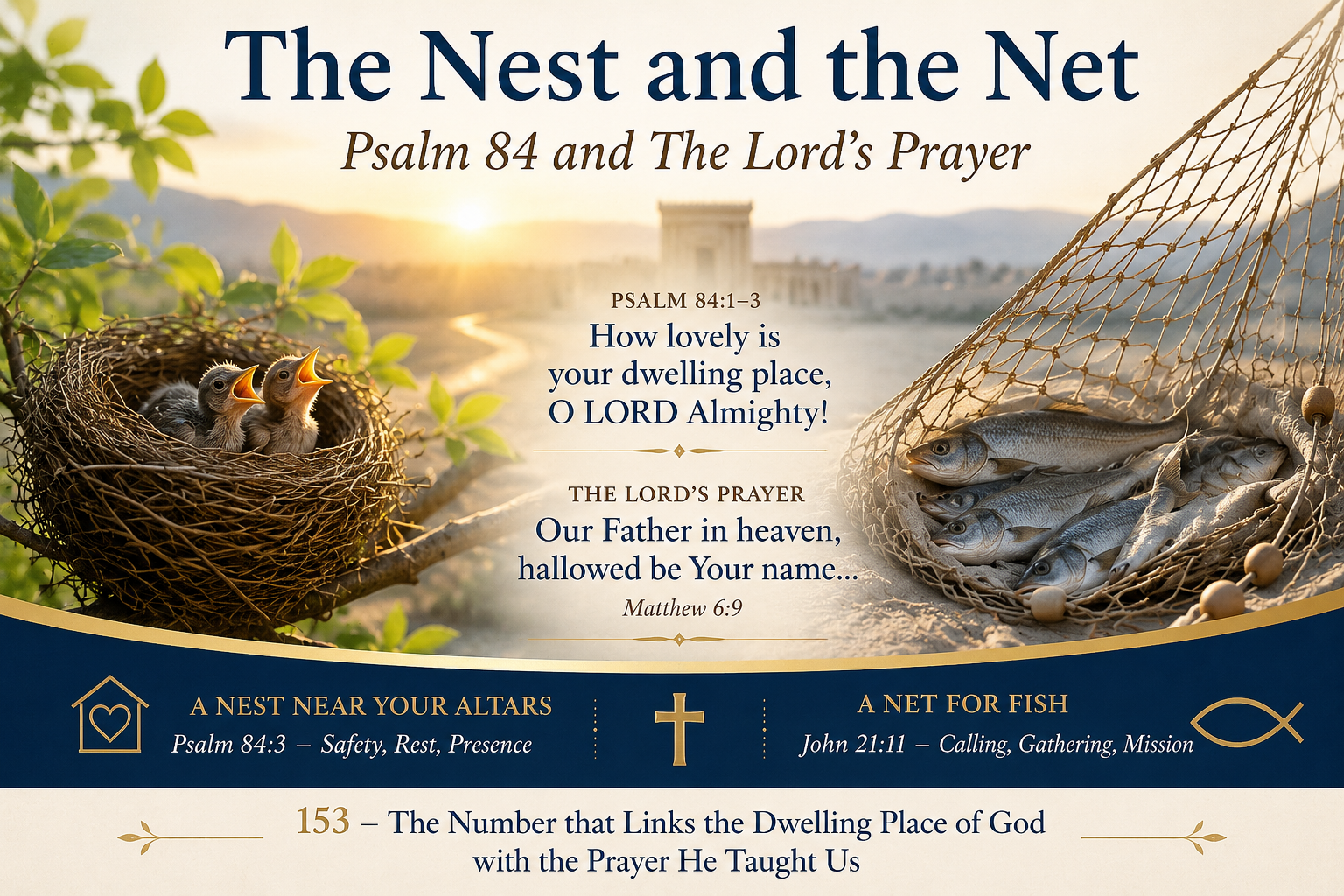
This connects beautifully with the Christian interpretation of John 21:11. The gathered fish in the unbroken net have often been read as a sign of the gathered people brought to Christ. Within the broader theological framework of the Lord’s Prayer, the gathered people are those who are brought to the Son and taught to pray to the Father.7

9. Mission: From Israel to the Nations

Another strong connection between the Ark-thanksgiving psalm and the Lord’s Prayer is mission.

Scripture Callout — Mission to the Nations

“Declare his glory among the heathen; his marvellous works among all nations.”
— 1 Chronicles 16:24, KJV

This is not a narrow worship text. It is outward-facing. Israel’s worship is meant to become witness. The nations must hear of God’s glory and works.

The Lord’s Prayer also has a missionary horizon. The petition “Thy kingdom come” is not limited to the interior life of the believer. It concerns the reign of God over the world. To pray “Thy kingdom come” is to pray for all earthly powers, communities, nations, and peoples to be brought under the righteous rule of God.

10. Mercy, Forgiveness, and Deliverance

The Ark-thanksgiving psalm climaxes in the confession:

Scripture Callout — Enduring Mercy

“O give thanks unto the LORD; for he is good; for his mercy endureth for ever.”
— 1 Chronicles 16:34, KJV

The Lord’s Prayer contains the petition: “Forgive us our sins.” These are not identical phrases, but they stand in the same theological world. The gathered people cannot stand before God without mercy.

The petition for deliverance also connects the texts. 1 Chronicles 16:35 prays, “Save us… gather us together, and deliver us.” The Lord’s Prayer prays, “Deliver us from evil.” Both prayers are realistic about the human condition.

11. Doxology and the End of Worship

The Ark-thanksgiving psalm ends:

Scripture Callout — Eternal Blessing

“Blessed be the LORD God of Israel for ever and ever.”
— 1 Chronicles 16:36, KJV

In Matthew’s doxological tradition, the Lord’s Prayer ends:

Scripture Callout — Kingdom, Power, and Glory

“For thine is the kingdom, and the power, and the glory, for ever. Amen.”
— Matthew 6:13, KJV

Both endings return everything to God. Worship begins with God’s name and ends with God’s glory. This is the proper shape of covenant prayer.

12. Theological Implications

First, the Lord’s Prayer should be read as covenant worship, not merely as private devotion.

Its opening word “Our” places the believer within the gathered people of God.

Second, Old Covenant worship finds fulfilment, not cancellation, in Christ.

The Ark-thanksgiving psalm is not discarded. Its worship pattern is fulfilled and transformed in the prayer taught by Jesus.

Third, Christian prayer is Ark-shaped in its theology.

It approaches God’s presence, honours God’s name, submits to God’s reign, depends on God’s provision, seeks God’s mercy, asks for God’s deliverance, and ends in God’s glory.

Fourth, the gathered people are a missionary people.

The Ark-thanksgiving psalm declares God’s glory among the nations. The Lord’s Prayer seeks the coming of God’s kingdom.

Fifth, the Lord’s Prayer is a unifying prayer.

Christians across traditions, cultures, and nations may pray it together. It gathers the Church in one voice.

13. Conclusion

The Ark-thanksgiving psalm and the Lord’s Prayer are separated by covenantal history, literary genre, and canonical location. Yet they are united by a deep worship pattern.

The Ark-thanksgiving psalm gathers Israel before the Ark of the Covenant. It calls the people to give thanks, call upon the Lord’s name, remember His covenant, declare His glory among the nations, proclaim His reign, seek His salvation, ask for gathering and deliverance, and bless Him forever.

The Lord’s Prayer gathers believers before the Father. It hallows His name, seeks His kingdom, submits to His will on earth, asks for daily bread, seeks forgiveness, asks for deliverance from evil, and ends in eternal doxology.

Therefore:

The Ark-thanksgiving psalm may be understood as an Old Covenant worship-text of God’s gathered people.

The Lord’s Prayer may be understood as the New Covenant prayer of God’s gathered people.

The theological movement is clear:

The Ark gathered Israel before God’s covenant presence.
Asaph gathered Israel’s thanksgiving before the Ark.
Christ gathers His disciples before the Father through the Lord’s Prayer.

Thus, the Lord’s Prayer is not merely a model of individual devotion. It is the New Covenant voice of the gathered people of God. It is the prayer of those who have been gathered by the Son, brought near to the Father, and taught to seek the kingdom, mercy, deliverance, and glory of God.


Footnotes

1. 1 Chronicles 16:7 introduces the thanksgiving psalm as a text David delivered “into the hand of Asaph and his brethren.” The wider context places this event after the Ark had been brought to Jerusalem and Levites had been appointed to minister before it.

2. Luke 11:2–4 and Matthew 6:9–13 preserve the Lord’s Prayer in two canonical forms.

3. Exodus 25:22. The Ark’s mercy seat is the place where the Lord says He will meet with Moses and speak with him.

4. Hebrews 9:4 refers to the golden pot of manna, Aaron’s rod that budded, and the tables of the covenant.

5. 1 Chronicles 16:4–5. Asaph is named among those appointed to minister before the Ark, and verse 5 calls him “the chief.”

6. The thanksgiving psalm in 1 Chronicles 16:8–36 is commonly recognized as a composite psalm: 1 Chronicles 16:8–22 corresponds closely to Psalm 105:1–15; 1 Chronicles 16:23–33 echoes Psalm 96; and 1 Chronicles 16:34–36 corresponds to Psalm 106:1, 47–48.

7. In the broader Lord’s Prayer framework, John 21:11 and the 153 fishes may be read as representing those gathered and brought to Jesus, with the Lord’s Prayer understood as the prayer of the gathered people before the Father through the Son.

“Deliver Me” and “Deliver Us”

“Deliver Me” and “Deliver Us”

Psalm 70, the Lord’s Prayer, and the Mathematics of Human Need

Abstract

Psalm 70 is one of the shortest prayers in the Psalter. It is urgent, simple, and deeply human. David cries, “Make haste, O God, to deliver me,” and ends with the confession, “I am poor and needy.” When the verse identifiers of Psalm 70 are calculated using the Method of Verse Identification, the five verses give the total 460. The sum of the divisors of 460 is 1008, and 1008 = 168 × 6. Since 168 is the verse identifier of the Lord’s Prayer in Luke 11:2–4, and since the number 6 is traditionally associated with man, this paper proposes a simple theological reading: the fullness of Psalm 70 points to the Lord’s Prayer for man. Psalm 70 cries, “Deliver me”; the Lord’s Prayer completes the cry: “Deliver us from evil.”

Keywords: Psalm 70; Lord’s Prayer; biblical mathematics; verse identifier; sum of divisors; deliverance; prayer; David; Jesus Christ

1. Introduction

Psalm 70 is a very short psalm. It has only five verses. Yet its spiritual force is great. It is a prayer for immediate help. The psalmist does not speak in long explanations. He simply cries out to God:

“Make haste, O God, to deliver me; make haste to help me, O LORD.”

— Psalm 70:1, KJV

The psalm ends with the same urgency:

“But I am poor and needy: make haste unto me, O God: thou art my help and my deliverer; O LORD, make no tarrying.”

— Psalm 70:5, KJV

The whole psalm can be summarized in one simple cry:

Lord, help me quickly.
Lord, deliver me.
Lord, do not delay.

This paper explores a striking numerical relationship between Psalm 70 and the Lord’s Prayer. Using the Method of Verse Identification, the identifiers of Psalm 70 sum to 460. The sum of the divisors of 460 is 1008, which factors as:

1008 = 168 × 6

This is significant because 168 is the verse identifier of the Lord’s Prayer in Luke 11:2–4, while 6 represents man. Thus, the divisor fullness of Psalm 70 points to the Lord’s Prayer as the prayer given for human need.

Main thesis: Psalm 70 is the cry of needy man for deliverance; the Lord’s Prayer is the Christ-given completion of that cry.

2. Psalm 70 in Context

Psalm 70 is attributed to David and is described in its heading as a psalm “to bring to remembrance.” This phrase suggests a prayer brought before God so that God may act in mercy and deliverance.

Psalm 70 is also closely related to Psalm 40:13–17. In fact, Psalm 70 is almost a shortened form of that portion of Psalm 40. Psalm 40 begins with testimony:

“I waited patiently for the LORD.”

Psalm 70, however, is more urgent:

“Make haste, O God.”

Psalm 70 also follows Psalm 69, one of the great psalms of suffering, reproach, enemies, shame, and hope. Psalm 69 is long and intense. Psalm 70 is short and compressed. Yet both carry the same world of distress and trust. In Psalm 69, the suffering is described in depth. In Psalm 70, the sufferer has only enough strength to cry, “Help me.”

Psalm 70 then leads naturally into Psalm 71, where the theme of trust continues:

“In thee, O LORD, do I put my trust: let me never be put to confusion.”

— Psalm 71:1, KJV

Thus, Psalm 70 stands as a bridge between suffering and trust. It is the prayer of someone in danger, yet still looking to God.

3. The Textual Movement of Psalm 70

Psalm 70 has a simple structure:

Verse Theme Summary
Psalm 70:1 Cry for help “Make haste, O God, to deliver me.”
Psalm 70:2 Enemies seeking harm Let those who seek my soul be ashamed.
Psalm 70:3 Mockers Let those who say “Aha, aha” be turned back.
Psalm 70:4 The faithful Let those who seek God rejoice.
Psalm 70:5 Humble dependence “I am poor and needy.”

The movement is very clear. The psalmist is surrounded by enemies and mockers, but he does not take revenge into his own hands. Instead, he turns to God. His final confession is not of personal strength, but of need:

“I am poor and needy.”

This is the heart of true prayer. Prayer begins when the soul admits that it cannot save itself.

4. Method: Verse Identification

The Method of Verse Identification assigns to a verse an identifier:

I = B + C + V

where B is the book number, C is the chapter number, and V is the verse number.

Since Psalms is the 19th book of the Bible, the identifier of Psalm 70:1 is:

19 + 70 + 1 = 90

Applying this to all five verses gives the following table.

Table 1. Verse Identifiers of Psalm 70

Verse KJV Text Identifier
Psalm 70:1 Make haste, O God, to deliver me; make haste to help me, O LORD. 90
Psalm 70:2 Let them be ashamed and confounded that seek after my soul: let them be turned backward, and put to confusion, that desire my hurt. 91
Psalm 70:3 Let them be turned back for a reward of their shame that say, Aha, aha. 92
Psalm 70:4 Let all those that seek thee rejoice and be glad in thee: and let such as love thy salvation say continually, Let God be magnified. 93
Psalm 70:5 But I am poor and needy: make haste unto me, O God: thou art my help and my deliverer; O LORD, make no tarrying. 94
Total 460

Thus, the total identifier of Psalm 70 is:

90 + 91 + 92 + 93 + 94 = 460

So we set:

n = 460

5. The Divisor Structure of 460

The prime factorization of 460 is:

460 = 22 × 5 × 23

The divisors of 460 are:

D(460) = {1, 2, 4, 5, 10, 20, 23, 46, 92, 115, 230, 460}

Their sum is:

σ(460) = 1 + 2 + 4 + 5 + 10 + 20 + 23 + 46 + 92 + 115 + 230 + 460

Therefore:

σ(460) = 1008

But:

1008 = 168 × 6

This is the main mathematical finding:

σ(460) = 1008 = 168 × 6

6. Why the Number 168 Matters

The number 168 is the verse identifier of the Lord’s Prayer in Luke 11:2–4.

Verse Identifier
Luke 11:2 42 + 11 + 2 = 55
Luke 11:3 42 + 11 + 3 = 56
Luke 11:4 42 + 11 + 4 = 57
Total 168

Thus:

55 + 56 + 57 = 168

The Lord’s Prayer in Luke is short, simple, and direct. It includes the cry:

“And lead us not into temptation; but deliver us from evil.”

— Luke 11:4, KJV

This is the direct theological bridge to Psalm 70. Psalm 70 opens with:

“Deliver me.”

The Lord’s Prayer teaches:

“Deliver us from evil.”

Psalm 70 is the personal cry.
The Lord’s Prayer is the communal prayer.

Psalm 70 says: Lord, deliver me.
The Lord’s Prayer says: Father, deliver us.

7. Why the Multiplier 6 Matters

In biblical numerology, the number 6 is associated with man. This is consistent with the creation account, where man is created on the sixth day.

Thus:

1008 = 168 × 6

may be read theologically as:

Lord’s Prayer × Man

Or more simply:

The Lord’s Prayer for man

This is deeply fitting, because Psalm 70 is one of the most human prayers in the Psalter. It does not come from a place of power. It comes from weakness. It comes from need. It comes from danger. It comes from a soul that knows it needs God.

The final verse says:

“I am poor and needy.”

That is man before God. And the Lord’s Prayer is the prayer Jesus gave to such man.

8. The Canonical Meaning of the Sum of Divisors

In the Canon of Numeric Invariants, the sum of divisors, written as σ(n), represents fullness, blessing, and bridge. It gathers the whole number together with all its lawful supports.

This is important. Psalm 70 itself has the identifier total 460. But when we examine its full divisor structure, the result is 1008, and this fullness opens into:

168 × 6

Therefore, Psalm 70 does not merely stand alone as a short distress prayer. Its internal mathematical structure points beyond itself. It becomes a bridge to the Lord’s Prayer.

Theological reading: The fullness of Psalm 70 points to the prayer Jesus gave for human need.

Psalm 70 is the cry.
The Lord’s Prayer is the form.
Psalm 70 is the urgent need.
The Lord’s Prayer is the Christ-given answer.

9. A Secondary Witness: The Arithmetic Mean

There is also a second mathematical witness.

The number 460 has 12 divisors:

τ(460) = 12

Since:

σ(460) = 1008

the arithmetic mean of the divisors is:

A(460) = 1008 ÷ 12 = 84

But:

2 × 84 = 168

Thus, the arithmetic mean of the divisors of Psalm 70’s identifier total points again to the Lord’s Prayer:

2A(460) = 168

This is elegant. The Lord’s Prayer appears not only through the sum of divisors, but also through the center of the divisor community.

At the center of the full witness of Psalm 70, the Lord’s Prayer is quietly present.

10. “Deliver Me” and “Deliver Us”

The clearest theological relationship is the movement from “me” to “us.”

Psalm 70 The Lord’s Prayer
“Deliver me.” “Deliver us from evil.”
Personal distress Communal prayer
David cries as one suffering person Jesus teaches His disciples to pray as one family
“I am poor and needy” “Our Father”

David prays as one suffering person. Jesus teaches His disciples to pray as one family. The “me” of Psalm 70 is not erased. It is gathered into the “us” of the Lord’s Prayer.

This is how Christian prayer works. We come to God personally, but not selfishly. We pray as individuals, but we are never alone. We are members of the Body of Christ. Therefore, my cry becomes part of our cry.

Psalm 70 is David’s emergency prayer.
The Lord’s Prayer is the Church’s daily prayer.

Psalm 70 says: Lord, help me.
The Lord’s Prayer teaches: Our Father, help us.

11. Christological Reading

Psalm 70 is not usually treated as a direct prophecy of Jesus in the same explicit way as Psalm 22, Psalm 69, or Psalm 110. However, from a Christian perspective, it may be read typologically.

David is the suffering anointed king. Jesus is the greater Son of David. Therefore, David’s righteous suffering often becomes a pattern that points forward to Christ.

Psalm 70 Theme Christological Fulfilment
The righteous sufferer is opposed Jesus was opposed by His enemies.
The sufferer is mocked Jesus was mocked during His Passion.
The sufferer is poor and needy Jesus humbled Himself and took the form of a servant.
The sufferer trusts God as helper and deliverer Jesus entrusted Himself fully to the Father.
God is to be magnified Through the death and resurrection of Christ, the Father is glorified.

The deepest connection is humility. Psalm 70:5 says:

“I am poor and needy.”

Christ, though Lord of all, entered fully into human weakness. He did not merely observe human need from a distance. He entered it. He carried it. He prayed from within it.

In this light, Psalm 70 prepares the heart for the Lord’s Prayer. For only the poor and needy can truly say:

“Our Father…”

12. The Lord’s Prayer as the Completion of Psalm 70

The Lord’s Prayer does not cancel Psalm 70. It completes it.

Psalm 70 Teaches Us to Cry Honestly The Lord’s Prayer Teaches Us to Cry Faithfully
Lord, deliver me. Our Father.
Lord, help me. Give us.
Lord, do not delay. Forgive us.
I am poor and needy. Lead us not into temptation; deliver us from evil.

Psalm 70 is urgent, but the Lord’s Prayer is complete. Psalm 70 arises from distress, but the Lord’s Prayer places distress inside the Kingdom of God.

This is very important. When Jesus teaches us to pray, He does not begin with our enemies. He begins with the Father:

“Our Father which art in heaven…”

This means that our need is real, but it is not ultimate. Our enemies are real, but they are not sovereign. Our distress is real, but it is not the first word. The first word is Father.

Psalm 70 cries for help.
The Lord’s Prayer teaches us where help comes from.

13. Theological Proposition

Proposition. The divisor fullness of the Psalm 70 identifier total, 460, yields 1008 = 168 × 6, indicating that the urgent prayer of needy man in Psalm 70 is mathematically and theologically bridged to the Lord’s Prayer in Luke 11:2–4, the Christ-given prayer for humanity.

This proposition has three parts:

  1. The mathematical result is exact:
    σ(460) = 1008 = 168 × 6
  2. The theological meaning is coherent: Psalm 70 is the prayer of needy man; 6 represents man; 168 identifies the Lord’s Prayer in Luke.
  3. The textual bridge is clear: Psalm 70 says, “Deliver me”; the Lord’s Prayer says, “Deliver us from evil.”

14. Pastoral Application

This discovery is not only mathematical. It is pastoral.

Many times, believers do not know what to pray. Suffering can make prayer short. Fear can make prayer simple. Pain can reduce our words.

Psalm 70 gives permission for such prayer. It teaches us that a short prayer can still be faithful:

“Make haste, O God.”

But the Lord’s Prayer gives shape to that cry. It teaches us to bring our urgent need into the prayer Jesus Himself gave us.

So when we feel poor and needy, we may pray:

Lord, deliver me.

Then we may continue:

Our Father, deliver us from evil.

This is the movement from fear into faith, from isolation into communion, from David’s cry into Christ’s prayer.

15. Conclusion

Psalm 70 is short, but it is not small. It contains the cry of humanity in distress:

“I am poor and needy.”

When the verse identifiers of Psalm 70 are summed, they give 460. When the divisor fullness of 460 is calculated, the result is:

1008 = 168 × 6

Since 168 identifies the Lord’s Prayer in Luke 11:2–4, and 6 represents man, the theological message is simple and beautiful:

Psalm 70 points to the Lord’s Prayer for man.

Psalm 70 cries:

“Deliver me.”

The Lord’s Prayer completes the cry:

“Deliver us from evil.”

Thus, the urgent personal prayer of David is gathered into the universal prayer of Jesus. The lonely “me” becomes part of the redeemed “us.” The cry of the poor and needy becomes the prayer of the children of the Father.

Psalm 70 is man crying for deliverance.
The Lord’s Prayer is Christ teaching man how to pray.

And in that movement, we see grace.

References

  • The Holy Bible, King James Version.
  • Vanualailai, Jito, Eroni Tomasi, Paulo Vanualailai, and Jope Takala. The Lord’s Prayer: A Mathematician’s Creed. Suva, Fiji, 2018.
  • Jones, Stephen E. The Biblical Meaning of Numbers from One to Forty. God’s Kingdom Ministries, 2008.
  • Canon of Numeric Invariants with Theological Interpretations.

The Enemy Within, the Enemy Without, and the Healing Prayer

The Enemy Within, the Enemy Without, and the Healing Prayer

A Biblical-Mathematical Reading of Psalm 69

Central insight: Psalm 69 contains two kinds of enemies: the enemy within and the enemy without. Psalm 69:19–20 sits at the intersection of both. Its verse-identifier sum is 215, and φ(215)=168, pointing to the Lord’s Prayer in Luke 11:2–4.

Abstract

Psalm 69 is one of the most powerful lament psalms in the Bible. Traditionally attributed to David, it contains confession, suffering, reproach, hatred, prayer, judgment, praise, and restoration. This article proposes a simple three-part reading of Psalm 69. First, some verses describe the enemy within: sin, foolishness, shame, sorrow, brokenness, and spiritual exhaustion. Second, other verses describe the enemy without: real people who hate, mock, accuse, reject, and persecute the psalmist. Third, the psalm ends in praise and restoration.

A key insight arises in Psalm 69:19–20. These two verses belong to both enemy categories. They describe the inner wound caused by outer enemies. Mathematically, if A is the set of verses describing the enemy within and B is the set of verses describing the enemy without, then Psalm 69:19–20 form the intersection A ∩ B. Their verse identifiers are 107 and 108, giving a sum of 215. Remarkably, φ(215)=168, where 168 is the verse identifier of the Lord’s Prayer in Luke 11:2–4. This suggests, within the framework of biblical mathematics, that the Lord’s Prayer answers the deepest wound of Psalm 69: the place where external reproach becomes internal brokenness.

From the Christian perspective, Psalm 69 is also deeply Christological. It is quoted or echoed several times in the New Testament in relation to Jesus Christ, especially His zeal, rejection, thirst, suffering, and crucifixion. Thus Psalm 69 may be read as David’s prayer, the prayer of every wounded believer, and prophetically as the suffering prayer fulfilled in Christ.

Keywords: Psalm 69; Biblical Mathematics; verse identifier; Lord’s Prayer; Euler totient; repentance; lament; David; Christological interpretation; 168; 153.

Back to top ↑

1. Introduction

Psalm 69 begins with a cry of desperation:

“Save me, O God; for the waters are come in unto my soul.”
Psalm 69:1, KJV

This is not a shallow prayer. It is a prayer from the depths. David feels as if he is drowning. He is surrounded by enemies, mocked by people, rejected by his own community, and broken in heart. Yet Psalm 69 is not only about outward persecution. It is also about inward self-examination. David does not simply blame other people. He also says:

“O God, thou knowest my foolishness; and my sins are not hid from thee.”
Psalm 69:5, KJV

This makes Psalm 69 spiritually powerful. The psalmist recognizes two kinds of enemies. The first is inside him: sin, foolishness, shame, sorrow, and heaviness. The second is outside him: people who hate him without cause, mock him, and persecute him.

This article develops a simple but structured reading of Psalm 69 using the Method of Verse Identification. The analysis shows that the psalm can be grouped into three categories:

  1. Enemy Within;
  2. Enemy Without;
  3. Praise and Restoration.

The most important discovery is that Psalm 69:19–20 belong to both the first and second categories. They form a mathematical and theological intersection. They are the place where the wound outside enters the heart inside.

The result is striking. The identifier-sum of Psalm 69:19–20 is 215. The Euler totient of 215 is 168:

φ(215)=168

In our framework, 168 is the identifier of the Lord’s Prayer in Luke 11:2–4. This points to a beautiful theological interpretation: the Lord’s Prayer is the healing answer to the deepest wound in Psalm 69.

Back to top ↑

2. Psalm 69 in Context

Psalm 69 is traditionally attributed to David. The superscription reads:

“To the chief Musician upon Shoshannim, A Psalm of David.”

The word “Shoshannim” likely refers to a tune or musical setting, often understood as “lilies.” This means Psalm 69 was not only a private prayer. It was also given for worship.

The psalm may reflect several moments in David’s life. It may fit the time of persecution by Saul, betrayal by others, political shame, family rejection, or public humiliation. The exact historical event is not named. This allows the psalm to speak more broadly. It becomes the prayer of anyone who suffers inwardly and outwardly before God.

From the Christian perspective, Psalm 69 is also one of the great messianic psalms. Several verses are used in the New Testament in relation to Jesus Christ.

Psalm 69 verse KJV phrase New Testament connection
Psalm 69:4 “They that hate me without a cause” Echoed in John 15:25
Psalm 69:9 “The zeal of thine house hath eaten me up” Applied to Jesus in John 2:17
Psalm 69:21 “in my thirst they gave me vinegar to drink” Fulfilled in the crucifixion narratives
Psalm 69:25 “Let their habitation be desolate” Applied to Judas in Acts 1:20

Thus Psalm 69 has at least three levels of meaning: David’s prayer, the prayer of the wounded believer, and the suffering prayer fulfilled in Jesus Christ.

Back to top ↑

3. Methodology: The Method of Verse Identification

The method used in this article is the Method of Verse Identification. For any verse, the verse identifier is defined as:

I = B + C + V

where:

  • B is the book number;
  • C is the chapter number;
  • V is the verse number.

Since Psalms is the 19th book of the Bible, every verse in Psalm 69 has identifier:

I(v)=19+69+v=88+v

For example:

I(20)=19+69+20=108

This means Psalm 69:20 has verse identifier 108.

The purpose of the method is not to replace ordinary biblical interpretation. Rather, it gives a numerical structure that may confirm or illuminate a theological pattern already visible in the text.

Back to top ↑

4. The Three Categories of Psalm 69

4.1 Category 1: The Enemy Within

The “enemy within” refers to the inward struggle of the psalmist: sin, foolishness, shame, sorrow, weariness, brokenness, and spiritual helplessness.

A = {1, 2, 3, 5, 6, 10, 11, 19, 20, 29}

Verse KJV key text Identifier Cumulative sum
1“the waters are come in unto my soul”8989
2“I sink in deep mire”90179
3“I am weary of my crying”91270
5“my sins are not hid from thee”93363
6“let not them that wait on thee… be ashamed for my sake”94457
10“I wept, and chastened my soul with fasting”98555
11“I made sackcloth also my garment”99654
19“my reproach, and my shame, and my dishonour”107761
20“Reproach hath broken my heart”108869
29“I am poor and sorrowful”117986

Sum of Enemy Within: S(A)=986

4.2 Category 2: The Enemy Without

The “enemy without” refers to real people who oppose the psalmist. They hate him, mock him, accuse him, reject him, and persecute him.

B = {4, 7, 8, 9, 12, 14, 18, 19, 20, 21, 22, 23, 24, 25, 26, 27, 28}

Verse KJV key text Identifier Cumulative sum
4“They that hate me without a cause”9292
7“for thy sake I have borne reproach”95187
8“I am become a stranger unto my brethren”96283
9“The zeal of thine house hath eaten me up”97380
12“They that sit in the gate speak against me”100480
14“let me be delivered from them that hate me”102582
18“deliver me because of mine enemies”106688
19“mine adversaries are all before thee”107795
20“I looked for some to take pity, but there was none”108903
21“in my thirst they gave me vinegar to drink”1091012
22“Let their table become a snare”1101122
23“Let their eyes be darkened”1111233
24“Pour out thine indignation upon them”1121345
25“Let their habitation be desolate”1131458
26“they persecute him whom thou hast smitten”1141572
27“Add iniquity unto their iniquity”1151687
28“Let them be blotted out of the book of the living”1161803

Sum of Enemy Without: S(B)=1803

4.3 Category 3: Praise and Restoration

The third category contains the verses that turn the psalm toward mercy, salvation, praise, and restoration.

P = {13, 15, 16, 17, 30, 31, 32, 33, 34, 35, 36}

Verse KJV key text Identifier Cumulative sum
13“my prayer is unto thee, O LORD, in an acceptable time”101101
15“Let not the waterflood overflow me”103204
16“thy lovingkindness is good”104308
17“hide not thy face from thy servant”105413
30“I will praise the name of God with a song”118531
31“This also shall please the LORD”119650
32“The humble shall see this, and be glad”120770
33“the LORD heareth the poor”121891
34“Let the heaven and earth praise him”1221013
35“God will save Zion”1231136
36“they that love his name shall dwell therein”1241260

Sum of Praise and Restoration: S(P)=1260

Back to top ↑

5. The Intersection: Psalm 69:19–20

The most important structural feature is that Psalm 69:19–20 belong to both enemy categories.

They are part of the Enemy Within because they describe shame, dishonour, brokenness, heaviness, and loneliness.

They are also part of the Enemy Without because they mention adversaries, reproach, abandonment, and lack of comforters.

A ∩ B = {19, 20}

“Thou hast known my reproach, and my shame, and my dishonour: mine adversaries are all before thee.”
Psalm 69:19, KJV

“Reproach hath broken my heart; and I am full of heaviness: and I looked for some to take pity, but there was none; and for comforters, but I found none.”
Psalm 69:20, KJV

Verse Identifier calculation Identifier
Psalm 69:19 19 + 69 + 19 107
Psalm 69:20 19 + 69 + 20 108
Total 215

Interpretation: Psalm 69:19–20 is the place where outer reproach becomes inner brokenness.

Back to top ↑

6. The Totient Result: φ(215)=168

We now calculate the Euler totient of 215.

215 = 5 × 43

φ(215) = φ(5)φ(43)

φ(5)=4,   φ(43)=42

φ(215)=4×42=168

This is profound because 168 is the verse identifier of the Lord’s Prayer in Luke 11:2–4.

Verse Identifier calculation Identifier
Luke 11:2 42 + 11 + 2 55
Luke 11:3 42 + 11 + 3 56
Luke 11:4 42 + 11 + 4 57
Total 168

Therefore, the intersection of the two enemy categories in Psalm 69 points, through Euler’s totient, to the Lord’s Prayer.

Back to top ↑

7. Theological Interpretation

The result may be interpreted simply.

Psalm 69:19–20 is the wound. It is the place where external reproach becomes internal brokenness.

The enemies outside have spoken, mocked, rejected, and wounded the psalmist. But the damage is no longer outside only. It has entered the heart:

“Reproach hath broken my heart…”

This is why the intersection is so meaningful. It is not merely mathematical. It is deeply human. It describes what happens when outside hostility becomes inward pain.

Yet the number 215, which identifies this overlap, has Euler totient 168. In the Canon of Numeric Invariants, the Euler totient may be read in the domain of remnant, consecration, and those set apart within the whole. Therefore, φ(215)=168 suggests that God preserves a consecrated remnant even inside the wound.

And 168 points to the Lord’s Prayer.

This means that the Lord’s Prayer may be read as God’s answer to the deepest wound of Psalm 69.

The Lord’s Prayer says:

“Forgive us our sins…”
Luke 11:4, KJV

This addresses the enemy within.

It also says:

“And lead us not into temptation; but deliver us from evil.”
Luke 11:4, KJV

This addresses the enemy without.

Psalm 69 theme Lord’s Prayer response
Sin and foolishness within “Forgive us our sins”
Shame and brokenness “Our Father”
Enemies and evil without “Deliver us from evil”
Need for mercy “Give us day by day our daily bread”
Prayer in acceptable time The Lord’s Prayer as the appointed prayer
Restoration of Zion “Thy kingdom come”

Therefore, Psalm 69 and the Lord’s Prayer are spiritually connected. Psalm 69 diagnoses the wound. The Lord’s Prayer gives the healing pattern.

Back to top ↑

8. Christological Reading

From the Christian perspective, Psalm 69 is fulfilled in Jesus Christ.

David could confess his own sins:

“my sins are not hid from thee.”

But Jesus had no personal sin. Therefore, when Psalm 69 is read Christologically, the sin language must be understood representatively. Jesus stands with sinners and bears the burden of human sin.

The external enemy language applies directly and strongly to Jesus. He was hated without cause. He bore reproach. He was mocked. He thirsted. He was given vinegar. He was abandoned. His heart was pierced by the suffering of the cross.

“They gave me also gall for my meat; and in my thirst they gave me vinegar to drink.”
Psalm 69:21, KJV

Psalm 69:21 is especially clear. It is fulfilled in the Passion narratives. Jesus’ suffering is therefore the fullest expression of Psalm 69.

But there is a further connection. Psalm 69:20 says:

“Reproach hath broken my heart…”

On the cross, Jesus carries the full wound of humanity: the sin within and the evil without. He bears the burden of the sinner and the violence of the enemy. In Him, the two enemies meet.

And what did Jesus teach His followers to pray?

The Lord’s Prayer.

Thus, the prayer that points numerically from the wound of Psalm 69 is the prayer taught by the wounded Redeemer Himself.

Back to top ↑

9. The Full Mathematical Structure

The categories may now be summarized as follows.

Region Meaning Verses Identifier-sum
A \ B Pure Enemy Within 1, 2, 3, 5, 6, 10, 11, 29 771
A ∩ B Inner wound caused by outer enemies 19, 20 215
B \ A Pure Enemy Without 4, 7, 8, 9, 12, 14, 18, 21–28 1588
P Praise and Restoration 13, 15, 16, 17, 30–36 1260
Total Psalm 69 3834

S(A ∪ B) = S(A) + S(B) − S(A ∩ B)

S(A ∪ B) = 986 + 1803 − 215 = 2574

S(A ∪ B) + S(P) = 2574 + 1260 = 3834

This agrees with the direct sum of all 36 verse identifiers:

Σv=136(88+v)=3834

So the structure is mathematically consistent.

Back to top ↑

10. Discussion

This reading gives Psalm 69 a clear spiritual movement.

  1. The psalmist faces the enemy within. He does not hide his foolishness or sin from God.
  2. The psalmist brings before God the enemy without. He does not deny that real people are hurting him.
  3. The psalmist reaches the deepest wound, where the outer enemy has broken the inner heart.
  4. The psalmist turns to God in prayer, praise, and restoration.

This is the pattern of true spiritual healing. A person must not ignore the sin within. A person must also not pretend that external evil is unreal. Both must be brought before God.

The Lord’s Prayer answers both.

Enemy Within

“Forgive us…”

Enemy Without

“Deliver us…”

That is why the result φ(215)=168 is so theologically beautiful. The number 215 identifies the wound. The number 168 identifies the prayer.

Wound → Lord’s Prayer

Back to top ↑

11. Conclusion

Psalm 69 is a profound prayer of suffering, repentance, and restoration. It shows that human suffering often comes from two directions. There is an enemy within: sin, foolishness, shame, sorrow, and brokenness. There is also an enemy without: hatred, mockery, persecution, rejection, and cruelty.

Psalm 69:19–20 form the intersection of these two realities. They describe the inner wound caused by outer enemies. Their identifier-sum is 215. The Euler totient of 215 is 168, which is the identifier of the Lord’s Prayer in Luke 11:2–4.

This suggests that the Lord’s Prayer is the biblical-mathematical answer to the deepest wound in Psalm 69. It is the prayer that holds together forgiveness and deliverance, repentance and protection, inward healing and outward rescue.

From the Christian perspective, the reading becomes even deeper. Psalm 69 is fulfilled in Jesus Christ, the righteous sufferer. He bore reproach, thirst, rejection, and the violence of enemies. He also bore the sins of humanity. In Him, the enemy within and the enemy without meet at the cross.

And from Him comes the prayer:

“Our Father…”

Therefore, Psalm 69 leads us to the Lord’s Prayer. The wound leads to the healing prayer. The broken heart leads to the Father. The cry from the deep waters leads to the Redeemer.

References

  • The Holy Bible, King James Version.
  • Vanualailai, J., Tomasi, E., Vanualailai, P., and Takala, J. The Lord’s Prayer: A Mathematician’s Creed.
  • Jones, Stephen E. The Biblical Meaning of Numbers from One to Forty. God’s Kingdom Ministries, 2008.
  • Canon of Numeric Invariants with Theological Interpretations.

End of article

When Bitter Words Become Arrows

Psalm 64, Divine Vindication, and the 153 Signature

Abstract

Psalm 64 speaks to a painful human experience: the suffering caused by secret plots, false accusations, destructive speech, and hidden hostility. Many people around the world know this experience deeply. They may not be attacked by swords or armies, but they are wounded by words, whispers, gossip, slander, and schemes. Psalm 64 gives such people a prayer. It teaches them to bring their fear, pain, and confusion before God. It also gives them hope that hidden evil is not hidden from God. From a Christian perspective, Psalm 64 also points forward to Jesus Christ, who suffered under false accusation, secret plotting, mockery, and unjust condemnation. Yet God vindicated Him through the resurrection. The paper ends with a numerical interpretation of Psalm 64 using the verse-identifier method. The total identifier of Psalm 64 is 885, and the prime-counting function gives π(885)=153. This result is significant because 153 is understood as the number that points to the fulfillment of the will of the Father in His Son, Jesus Christ. Thus, Psalm 64 becomes not only a cry against hidden enemies, but also a witness to God’s final vindication of the righteous in Christ.

Keywords: Psalm 64; David; slander; hidden enemies; divine vindication; Jesus Christ; resurrection; verse identifier; 153; prime-counting function.

1. Introduction

There are times when a person suffers not because of open violence, but because of hidden words. A rumour can wound. A whisper can destroy trust. A false accusation can damage a reputation. A secret meeting can plan harm. A bitter tongue can become sharper than a sword.

Psalm 64 speaks directly to this kind of pain.

“Hear my voice, O God, in my prayer: preserve my life from fear of the enemy.”
Psalm 64:1, KJV

David is afraid, but he does not pretend otherwise. He does not hide his fear. He brings it to God. This is one of the great gifts of the Psalms: they teach us how to pray honestly. A faithful person does not have to pretend to be strong all the time. A faithful person may say, “Lord, I am afraid. Preserve my life.”

This Psalm is especially important because millions of people around the world face Psalm 64 situations. They face hidden opposition in families, workplaces, churches, communities, governments, and institutions. Sometimes the battle is not visible. Sometimes the weapons are not physical. Sometimes the arrows are words.

Psalm 64 gives such people a prayer, a theology, and a hope.

Its message is clear: God sees what is hidden. God hears what is whispered. God knows what is planned in secret. And God is able to vindicate the righteous.

2. The Context of Psalm 64

The title of the Psalm says:

“To the chief Musician, A Psalm of David.”

No specific historical event is given. This means that Psalm 64 may be connected to several moments in David’s life. David often faced enemies. He was pursued by Saul. He was misunderstood. He was betrayed. He was surrounded at times by political danger and personal hostility.

But Psalm 64 is not mainly about battlefield warfare. It is about secret hostility.

“Hide me from the secret counsel of the wicked; from the insurrection of the workers of iniquity.”
Psalm 64:2, KJV

The phrase “secret counsel” is very important. The danger comes from hidden planning. The enemies are not merely angry; they are organized. They speak together. They plan together. They encourage one another in evil.

“Who whet their tongue like a sword, and bend their bows to shoot their arrows, even bitter words.”
Psalm 64:3, KJV

Here, words are described as weapons. The tongue is like a sword. Bitter words are like arrows.

This is very true to life. Words can cut. Words can pierce. Words can travel from one person to another like arrows flying through the air. Once released, they can be difficult to stop.

Psalm 64 therefore belongs to the family of lament Psalms. A lament Psalm is a prayer from distress. It is not a prayer of despair, but a prayer of trust under pressure. David complains to God, but he does not abandon God. He suffers, but he still prays.

3. The Structure of Psalm 64

Psalm 64 has a clear movement. First, David asks God to hear and preserve him. Second, David describes the wicked and their secret ways. Third, God acts. Fourth, the righteous rejoice.

Section Verses Main Idea
Prayer for protection 1–2 David asks God to preserve him from fear and hidden enemies.
Description of the wicked 3–6 The enemies use words like weapons and plan secretly.
Divine reversal 7–8 God suddenly acts against them. Their own tongue becomes their downfall.
Public witness and joy 9–10 People fear God, declare His work, and the righteous rejoice.

The turning point is verse 7:

“But God shall shoot at them with an arrow; suddenly shall they be wounded.”
Psalm 64:7, KJV

The words “But God” are powerful. They change everything.

The wicked shoot arrows of bitter words. But God shoots His own arrow. The wicked act secretly. But God acts decisively. The wicked think no one sees them. But God sees.

This is the great reversal of Psalm 64.

4. The Theology of Hidden Evil

Psalm 64 teaches that evil is not always public. Some evil is hidden. Some evil is polite on the surface but destructive underneath. Some evil is planned in private rooms. Some evil works through carefully chosen words.

The wicked in Psalm 64 say:

“Who shall see them?”
Psalm 64:5, KJV

This is the spiritual mistake of the wicked. They think secrecy means safety. They think that because people do not see, God does not see. But the Bible teaches the opposite. God sees the heart. God hears the tongue. God knows the hidden counsel.

Psalm 64:6 says:

“They search out iniquities; they accomplish a diligent search: both the inward thought of every one of them, and the heart, is deep.”
Psalm 64:6, KJV

This verse shows that evil can be deliberate. The enemies do not fall into sin accidentally. They “search out” iniquities. They plan carefully. Their hearts are deep, but not in a holy way. Their hearts are deep in hidden schemes.

Yet the Psalm does not tell the righteous person to retaliate. David does not say, “I will shoot back.” He says, “Hear my voice, O God.”

Psalm 64 teaches the righteous to bring their case to God. It does not teach passivity in the face of injustice, but it does teach that final vindication belongs to God. The righteous may speak truth, seek justice, and protect themselves, but they must not become like the wicked. They must not use the same weapons of bitterness, deceit, and revenge.

5. The Pastoral Meaning of Psalm 64

Psalm 64 is deeply pastoral. It speaks to people who have been wounded by hidden words.

  • It speaks to the person falsely accused.
  • It speaks to the person betrayed by friends.
  • It speaks to the leader undermined by secret counsel.
  • It speaks to the believer mocked for doing right.
  • It speaks to the family member hurt by gossip.
  • It speaks to the worker damaged by office politics.
  • It speaks to the servant of God who feels surrounded by unseen hostility.

The comfort of Psalm 64 is not that pain is imaginary. The pain is real. David does not minimize it. He calls the words “bitter.” He calls the plots “secret counsel.” He calls the enemies “workers of iniquity.”

But the greater comfort is this: God is more real than the enemy.

The hidden counsel of the wicked is not stronger than the counsel of God. The bitter words of men are not stronger than the word of the Lord. The arrows of slander are not stronger than the arrow of divine justice.

“The righteous shall be glad in the LORD, and shall trust in him; and all the upright in heart shall glory.”
Psalm 64:10, KJV

The Psalm begins with fear, but it ends with gladness. It begins with danger, but it ends with trust. It begins with secret counsel, but it ends with public glory.

6. Psalm 64 and Jesus Christ

From a Christian perspective, Psalm 64 may be read as a Davidic Psalm that also points forward to Jesus Christ.

This does not mean that Psalm 64 is an explicit prophecy in the same direct way as some other Messianic Psalms. Rather, it is typological. David, the righteous sufferer and anointed king, becomes a pattern that is fulfilled more deeply in Christ.

Jesus also faced secret counsel.

The religious leaders plotted against Him. False witnesses spoke against Him. He was mocked. He was accused. He was condemned by words before He was nailed to the cross.

Psalm 64:3 says:

“Who whet their tongue like a sword, and bend their bows to shoot their arrows, even bitter words.”
Psalm 64:3, KJV

This was fulfilled in spirit during the Passion of Christ. The enemies of Jesus did not merely use nails and wood. They used accusations. They used mockery. They used public shame. They used the tongue.

Yet Jesus did not retaliate. He entrusted Himself to the Father.

In this way, Jesus is the perfect righteous sufferer of Psalm 64. He stands at the centre of the Psalm’s deepest meaning. He shows us how to suffer without becoming evil. He shows us how to trust the Father when human courts fail. He shows us that God’s vindication may come after the darkest hour.

The resurrection is the great “But God” of history.

Human beings plotted. Human beings accused. Human beings condemned. Human beings crucified. But God raised Jesus from the dead.

This is the Christian hope inside Psalm 64. The wicked may appear to win for a time, but they do not have the final word. The Father vindicates the Son. And because believers are joined to Christ, they too may trust the Father for final vindication.

7. Psalm 64 and the Lord’s Prayer

Psalm 64 also resonates deeply with the Lord’s Prayer.

When we pray, “Deliver us from evil,” we are praying the heart of Psalm 64. We are asking the Father to preserve us from visible and invisible evil, from open attacks and hidden schemes, from the enemy outside us and the fear inside us.

David prays, “Preserve my life from fear of the enemy.” This is close to the spirit of the Lord’s Prayer. We are not only asking God to remove danger. We are asking Him to preserve our hearts from fear.

Fear can become its own prison. The enemy may attack the body, the name, the reputation, or the work, but fear attacks the soul.

The Lord’s Prayer teaches us to bring everything back to the Father:

“Our Father which art in heaven.”

Psalm 64 teaches the same movement. David does not begin with the enemy. He begins with God:

“Hear my voice, O God.”

This is the proper order of faith. The enemy may be real, but God must be first. The danger may be serious, but prayer must be deeper. The wound may be painful, but the Father is still near.

8. Ethical Response: How Should the Righteous Live?

Psalm 64 gives a clear ethical lesson. The righteous must not become what they suffer.

  • If they are wounded by bitter words, they must not become bitter people.
  • If they are attacked by secret counsel, they must not build their own secret revenge.
  • If they are falsely accused, they must still love truth.
  • If they are afraid, they must pray.

This is not easy. Psalm 64 does not pretend that it is easy. But it shows the path of faith.

The righteous person may say:

Lord, hear my voice.
Lord, preserve my life.
Lord, hide me from wicked counsel.
Lord, expose what is hidden.
Lord, judge rightly.
Lord, keep my heart upright.

This is a holy way to suffer. It is the way of David. More importantly, it is the way of Christ.

9. Conclusion: From Fear to Gladness

Psalm 64 is a Psalm for all who have been wounded by hidden hostility and bitter words. It teaches that God is not blind to secret evil. It teaches that words matter. It teaches that slander is serious. It teaches that God can reverse the plans of the wicked. It teaches that the righteous can trust in the Lord even when they are afraid.

The Psalm begins with a cry:

“Hear my voice, O God.”

It ends with rejoicing:

“The righteous shall be glad in the LORD.”

This is the journey of faith. We begin with fear, but we do not end there. We begin with the enemy, but we do not end with the enemy. We begin with hidden counsel, but we end with the revealed work of God.

For Christians, the deepest fulfilment of this journey is found in Jesus Christ. He was surrounded by secret plots and bitter words. He was condemned unjustly. Yet He was vindicated by the Father. Therefore, Psalm 64 is not only David’s prayer. It is also a Christ-shaped prayer for all who suffer unjustly and wait for God’s vindication.

10. Final Numerical Interpretation

Using the verse-identifier method, each verse is identified by the sum:

I = B + C + V

For Psalm 64, the book is Psalms, which is Book 19. Therefore, for each verse of Psalm 64:

I = 19 + 64 + V = 83 + V

Since Psalm 64 has 10 verses, the identifiers are:

Verse Identifier
Psalm 64:1 19 + 64 + 1 = 84
Psalm 64:2 19 + 64 + 2 = 85
Psalm 64:3 19 + 64 + 3 = 86
Psalm 64:4 19 + 64 + 4 = 87
Psalm 64:5 19 + 64 + 5 = 88
Psalm 64:6 19 + 64 + 6 = 89
Psalm 64:7 19 + 64 + 7 = 90
Psalm 64:8 19 + 64 + 8 = 91
Psalm 64:9 19 + 64 + 9 = 92
Psalm 64:10 19 + 64 + 10 = 93

Thus the total identifier sum is:

84 + 85 + 86 + 87 + 88 + 89 + 90 + 91 + 92 + 93 = 885

So Psalm 64 has the total identifier:

885

Now we apply the prime-counting function. The prime-counting function π(n) counts the number of prime numbers less than or equal to n.

For Psalm 64:

π(885) = 153

This means that there are exactly 153 prime numbers less than or equal to 885.

Equivalently, the 153rd prime is 883, and the next prime is 887. Since 885 lies between them, the number of primes up to 885 is exactly 153:

883 ≤ 885 < 887

Therefore:

π(885) = 153

This is a remarkable result.

Psalm 64 is a Psalm about hidden enemies, bitter words, secret plots, and divine vindication. Its total verse-identifier is 885. When this total is passed through the prime-counting function, it gives 153.

In the theology of biblical mathematics, 153 points to the fulfillment of the will of the Father in His Son, Jesus Christ. It is the number of the unbroken net in John 21:11. It speaks of those gathered to Christ, kept by Christ, and not lost by Christ. It points to the completed work of the Son and the vindicating will of the Father.

Thus the numerical result may be interpreted as follows:

Psalm 64 gives voice to the righteous who suffer from hidden evil and bitter words. But the final structure of the Psalm points to 153, the signature of the Father’s fulfilled will in Christ. Therefore, the Psalm’s numerical witness agrees with its theological message: the righteous may suffer under secret plots, but God will vindicate them; and the fullest vindication is found in Jesus Christ, whom the Father raised from the dead.

In simple words:

The enemies of the righteous may speak bitter words in secret, but God has the final word in Christ.

Psalm 64 total identifier = 885
π(885) = 153

The Psalm of hidden arrows ends by pointing to the number of Christ’s fulfilled victory.

“`