A Means to Fix Our Eyes on Jesus, the Author and Perfecter of Our Faith

Hebrews 12:1-4 give us the reasons to persevere in our fight against sin:

Therefore, since we are surrounded by such a great cloud of witnesses, let us throw off everything that weighs us down and the sins that so easily distract us and with perseverance run the race that lies ahead of us, with our eyes fixed on Jesus, the author and perfecter of our faith. For the sake of the joy that lay before him, he endured the cross, ignoring its shame, and is now seated at the right hand of the throne of God.

Reflect on how he endured such great hostility from sinners so that you may not grow weary and lose heart. In your struggle against sin, you have not yet resisted to the point of shedding your blood.

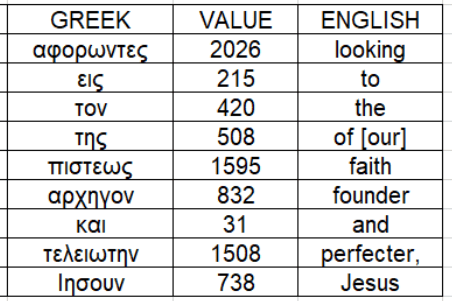
Verse 2 tells us how to persevere, and that is, by having our “eyes fixed on Jesus, the author and perfecter of our faith.” In the Greek version (Greek NT: Scrivener’s Textus Receptus 1894) the first 9 words correspond to “with our eyes fixed on Jesus, the author and perfecter of our faith.”

The total value is 7873, which is the 994th prime number. There are 167 prime numbers less than or equal to 994. The divisors of 167, which is also a prime number, are {1, 167}. Hence, the sum of divisors is 168, which is the identifier of the Lord’s Prayer in the Gospel of Luke.

SUMMARY: The Lord’s Prayer is a means to fix our eyes on Jesus, the author and the perfecter (finisher) of our faith.

Waiting on the Lord

In Psalm 27:14, we read: Wait on the LORD be of good courage and he shall strengthen thine heart wait I say on the LORD.

The value of each word is given in the table below (Hebrew and translation source: Biblehub)

HebrewEnglishValue
1קַוֵּ֗ה
qaw-wêh,
Wait111
2אֶל־
’el-
on31
3יְה֫וָ֥ה
Yah-weh
Yahweh26
4חֲ֭זַק
ḥă-zaq
Be of good courage115
5וְיַאֲמֵ֣ץ
wə-ya-’ă-mêṣ
and He shall strengthen147
6לִבֶּ֑ךָ
lib-be-ḵā;
your heart52
7וְ֝קַוֵּ֗ה
wə-qaw-wêh,
and Wait I say117
8אֶל־
’el-
on31
9יְהוָֽה׃
Yah-weh.
Yahweh26

From Barnes Notes on the Bible, we read:

Wait on the Lord – This is the sum of all the instruction in the psalm; the main lesson which the psalm is designed to convey. The object is to induce others, from the experience of the psalmist, to trust in the Lord; to rely upon Him; to come to Him in trouble and danger; to wait for His interposition when all other resources fail. Compare Psalm 25:3.

Albert Barnes (1798-1870),  a Presbyterian minister who produced a number of valuable commentaries on the Bible. He wrote Old Testament commentaries on Job, Psalms, Isaiah, and Daniel, and a complete set on the New Testament.

The expression “Wait on Yahweh” gives the sum 111+21+26=168, which is the identifier of the Lord’s Prayer in the Gospel of Luke.

CONCLUSION: When we pray the Lord’s Prayer, we are placing our trust in the Lord, relying upon Him, coming to Him in trouble and danger, and waiting for His interposition when all other resources fail.

Discussions

The Lord’s Prayer and Psalm 27:14 share a profound spiritual connection through their emphasis on trust in God and the seeking of His guidance and strength.

  1. Dependence on God: The Lord’s Prayer begins with “Our Father in heaven,” which immediately establishes a relationship of dependence and trust in God, similar to Psalm 25:14’s encouragement to “wait on the LORD” and rely on His timing and wisdom.
  2. Seeking Guidance: In the Lord’s Prayer, we ask for God’s will to be done on earth as it is in heaven, reflecting a desire for divine guidance in our lives. This mirrors the sentiment in Psalm 27:14, where waiting on the Lord implies a trust in His guidance and decisions for our lives.
  3. Courage and Strength: Psalm 27:14 mentions being of good courage and that the Lord shall strengthen the heart. This idea of seeking strength from God is inherent in the Lord’s Prayer, especially in the plea “lead us not into temptation, but deliver us from evil,” which acknowledges our need for God’s strength to face life’s challenges.
  4. Patience and Faith: Both passages call for patience and faith in God’s timing and plan. The Lord’s Prayer, with its focus on daily sustenance and forgiveness, teaches us to live day by day under God’s care, while Psalm 27:14 emphasizes the importance of waiting for God’s intervention and support.
  5. Spiritual Intimacy: The Lord’s Prayer is a model for intimate communication with God, and Psalm 27:14 also encourages a personal, trusting relationship with the Lord, highlighting the importance of a close, personal connection with God in the life of a believer.

In essence, both the Lord’s Prayer and Psalm 27:14 guide believers towards a life centered on trust in God, seeking His guidance, and relying on His strength and timing.

The Prayer For Unity Points to the Prayer Of Unity, The Lord’s Prayer, to Unite Future Believers

Jesus Christ foresaw denominationalism. The Center of the Study of Global Christianity at Gordon-Conwell Theology Seminary estimates that there are about 45,000 denominations in the world today. This is a staggering figure!

In John 17:20-26, we read about the heartfelt prayer by Jesus Christ for future believers to be united. It is Jesus’ Prayer for Unity.

Jesus Prays for All Believers (NIV)

20 “My prayer is not for them alone. I pray also for those who will believe in me through their message, 21 that all of them may be one, Father, just as you are in me and I am in you. May they also be in us so that the world may believe that you have sent me. 22 I have given them the glory that you gave me, that they may be one as we are one— 23 I in them and you in me—so that they may be brought to complete unity. Then the world will know that you sent me and have loved them even as you have loved me.

24 “Father, I want those you have given me to be with me where I am, and to see my glory, the glory you have given me because you loved me before the creation of the world.

25 “Righteous Father, though the world does not know you, I know you, and they know that you have sent me. 26 I have made you known to them, and will continue to make you known in order that the love you have for me may be in them and that I myself may be in them.”

The identifier of John 17:20-26 is 581.

Book#Chapter#Verse#Sum
John 17:2043172080
John 17:2143172181
John 17:2243172282
John 17:2343172383
John 17:24 43 172484
John 17:25 43 172585
John 17:26 43 172686
581
The identifier of John 17:20-26 is 581

The number 581 has 4 divisors, namely, {1, 7, 83, 581}. The sum of the divisors is 672, so that the arithmetic mean is 672/4=168, the Lord’s Prayer in the Gospel of Luke. The Arithmetic Mean is telling us that the central message of unity in John 17:20-26 is pointing to the Lord’s Prayer as the vehicle of unity.

CONCLUSION: The Prayer of Unity in Christianity is the Lord’s Prayer.

Quoting D. Timms, “Living the Lord’s Prayer”, 2008

Surely God did not intend the abundant life to be drab, boring, empty, or tedious. We harbor deep suspicious that something deeper and vaster lies beyond our daily routines.

Many of us share the deep yearning to explore the spiritual realm more fully. We want to know the deep interior of God.

A SHARED HUNGER pages 15-18)

For centuries Christian men and women have desired a deeper walk with Christ.

For two thousand years various Christian mystics and devout believers have advocated a range of pathways to a deeper relationships with God. They shared our hunger for the holy.

If we summarize [the] saints of the past, we develop quite a catalog of possible pathways [to God]. We draw nearer to God through:

Seriousness, obedience, and humility;

Spiritual disciplines of silence, solitude, fasting, study, and more;

Encountering the love of God;

Sharing the sufferings of Christ;

Crossing metaphorical bridges and entering metaphorical castles;

Enduring the purging work of God in our lives;

Praying the Scriptures;

Studying the Scriptures;

Spiritual gifts and revivalism;

Devotion to the body of Christ;

Meditative prayer and social engagement;

Belovedness and brokeness.

The vast array of insights [by the saints, and great and influential thinkers of the past] inspire, but also confuse us. Every tidbit of wisdom sounds good and right, but without a fixed point of reference we become rudderless in a sea of generic spirituality. Our hearts resonate with those who have walked close to God, but we lack the experience or wisdom to accurately access their advice.

Nevertheless, a fixed reference point does exist – in Scripture. We find a ready-made summary not in the saints or scholars of the past, but in Christ himself.

THE LORD”S PRAYER (pages 20-21)

Jesus lays out what we commonly call the Lord’s Prayer, and in it He provides the greatest Christian teaching of the centuries on spiritual formation.

[In the prayer], He outlines life-giving attitudes and paradigms. We also encounter a prayer that does not seek to get God’s attention but to give our attention to Him.

The Prayer functions less as a chant and more as a challenge [because] memorizing ten short lines poses little difficulty of most of us [but] the concepts and insights have the capacity to remold our lives entirely. Overstatement? Exaggeration? Not at all. Indeed, this prayer offers a simple framework that steers us through all the suggestions of the ages and into the very intimacy with Christ that hearts desire. It reveals the building blocks for authentic spiritual formation.

SPIRITUAL FORMATION (pages 21-23)

Will Hernandez provides a helpful definition. He describes spiritual formation as “the process of being with Christ in order to become like Christ and consequently live for Christ.” His succinct definition captures three vital elements.

Being with Christ;

Becoming like Christ;

Living for Christ.

Spiritual formation is not one or even two of these three elements. True formation, as modeled by Jesus and reflected in the [Lord’s] Prayer, incorporates some measure of all three parts of the definition. Spiritual formation remains incomplete when it becomes fixated on meditation (“being with”). But it also fails when it focuses entirely on character adjustment or behavior modification (“becoming like”). Similarly, the process falters it simply means busyness in the kingdom (“living for”).

The teaching contains in the Lord’s Prayer catapults us toward complete transformation. While we soak up the wisdom of godly men and men throughout Christian history, they would certainly defer to the wisdom of Christ expressed in the Prayer.

Ultimately, the Lord’s Prayer reveals more about how to live than how to pray.

David Timms teaches New Testament and Theology and serves as the Dean of the Faculty of Theology and of the School of Christian Leadership at William Jessup University in northern California. Australian by birth, David has been a church planter, pastor, and trainer of pastors for over thirty years. He publishes a blog Because of Grace, that shares his reflections on Christian leadership and spiritual formation. He and his wife, Kim, have three sons and live in Rocklin, California.