
The Gate, the Door, and the Way
Psalm 87 is one of the shortest yet most universal visions in the Psalter. Zion is the city specially loved by YHWH, but the astonishing purpose of that election is revealed when nations formerly outside Israel—even historical enemies such as Egypt, Babylon, and Philistia—are counted by God as though they had been born in Zion. At the center of this vision stands Psalm 87:2: “The LORD loveth the gates of Zion more than all the dwellings of Jacob.” This paper proposes that the emphasis on the gates is theologically significant: the gate is the threshold where the outsider may become an insider.
Within the framework of Biblical Mathematics, Psalm 87:2 has verse identifier 108. The Hebrew clause “The LORD loveth the gates of Zion” has standard gematria 770, exactly equal to the sum of the identifiers of all seven verses of Psalm 87. Remarkably, the number of divisors of 770 is τ(770)=16, associated with Love, while the arithmetic mean of its divisors is A(770)=108, returning directly to the identifier of Psalm 87:2.
The Gospel of John then provides an extraordinary Christological development. In John 10:9 Jesus declares, “I am the door.” Its Greek isopsephy is 1391; the arithmetic mean of its divisors is 378, and 378 has exactly 16 divisors and Euler totient 108. Later, John 14:6 gives “I am the way,” whose Greek isopsephy is 1225. Combining Door and Way gives 2616, for which the number of divisors is τ(2616)=16 and, most strikingly, the Carmichael lambda is λ(2616)=108.
1. Introduction
Psalm 87 contains only seven verses, yet its theological horizon extends to the nations of the world. It begins with Zion, the holy city of God, and ends with life flowing from that city.
The pivotal declaration comes in verse 2:
Psalm 87:2, KJV
At first reading, the statement seems simply to affirm God’s special choice of Zion. Yet the following verses produce an unexpected turn. Egypt, Babylon, Philistia, Tyre, and Cush are named, and God declares concerning people originating among these nations:
Again:
And finally:
The astonishing message is therefore not merely that Zion is privileged. It is that people who were outside Zion can become people of Zion.
Psalm 87 appears to make the gate the place where alienation may become belonging. The Gospel of John deepens this imagery when Jesus says, “I am the door,” and later, “I am the way.” Thus, in the canonical Christian reading, Psalm 87 gives us the Gate, John 10 gives us the Door, and John 14 gives us the Way.
2. Methodological Framework
The numerical analysis follows the framework of Biblical Mathematics developed in The Lord’s Prayer: A Mathematician’s Creed. In that framework, the identifier of a verse is defined by
where B is the biblical book number, C the chapter number, and V the verse number. The study also employs the Canon of Numeric Invariants with Theological Interpretations, particularly the arithmetic mean of divisors A(n), Euler’s totient φ(n), number of divisors τ(n), sum of divisors σ(n), radical rad(n), and Carmichael lambda λ(n).
The adopted biblical-number meanings used in this study include:
| Number | Meaning |
|---|---|
| 6 | Man |
| 14 | Deliverance / Release |
| 16 | Love |
| 18 | Oppression / Bondage |
| 36 | Adversary / Enemy |
3. Psalm 87: The Nations at the Gates of Zion
Psalm 87 belongs among the Korahite Zion psalms. Its opening verses establish Zion as the specially chosen dwelling of God. Then the horizon suddenly expands. Rahab—an ancient poetic designation for Egypt—is named together with Babylon, Philistia, Tyre, and Cush.
These are not merely geographical curiosities. Egypt and Babylon in particular stand in biblical memory as archetypal places of Israel’s bondage and exile. Philistia repeatedly functions as Israel’s adversary. Yet Psalm 87 does not culminate in their annihilation. God instead declares:
The enemy may become a citizen. The foreigner may acquire a new birthplace. The outsider may receive a new identity.
The New Testament expresses the same theological movement in different language: “no more strangers and foreigners, but fellowcitizens with the saints” (Ephesians 2:19), and “when we were enemies, we were reconciled to God by the death of his Son” (Romans 5:10).
Psalm 87’s astonishing hope is therefore not merely the defeat of the enemy. It is the transformation of the enemy into one who belongs.
4. Psalm 87:2 and the Number 108
Since Psalms is the nineteenth book of the Bible,
The identifiers of all seven verses are:
| Verse | Identifier |
|---|---|
| Psalm 87:1 | 107 |
| Psalm 87:2 | 108 |
| Psalm 87:3 | 109 |
| Psalm 87:4 | 110 |
| Psalm 87:5 | 111 |
| Psalm 87:6 | 112 |
| Psalm 87:7 | 113 |
| Total | 770 |
Now consider the Hebrew opening clause of Psalm 87:2:
“The LORD loveth the gates of Zion.”
| Hebrew | Meaning | Gematria |
|---|---|---|
| אֹהֵב | loveth | 8 |
| יְהוָה | YHWH | 26 |
| שַׁעֲרֵי | gates of | 580 |
| צִיּוֹן | Zion | 156 |
| Total | 770 | |
Gematria of “The LORD loveth the gates of Zion” = 770
Sum of all Psalm 87 verse identifiers = 770
5. Love Produces the Threshold
Factorizing 770 gives:
Therefore, the number of divisors of 770 is:
The sum of the divisors of 770 is:
Hence, the arithmetic mean of the divisors of 770 is:
But 108 is exactly the identifier of Psalm 87:2. Within the Canon, the arithmetic mean of the divisors, denoted by A(n), is interpreted as the Center-of-Witness. Thus the center-of-witness of the Hebrew declaration “The LORD loveth the gates of Zion” returns exactly to the identifier of the verse in which the declaration occurs.
6. Inside 108: Man, Enemy, and Bondage
The prime factorization is:
The radical of 108, meaning the product of its distinct prime factors, is:
Two further invariants are the Euler totient and the Carmichael lambda:
| Invariant | Value | Associated Meaning |
|---|---|---|
| Euler totient, φ(108) | 36 | Adversary / Enemy |
| Carmichael lambda, λ(108) | 18 | Oppression / Bondage |
| Radical, rad(108) | 6 | Man |
These meanings correspond strikingly with the nations introduced immediately after the gate verse: Egypt, Babylon, and Philistia. Yet Psalm 87 does not leave this man outside. He encounters the gate God loves, and God declares: “This man was born there.”
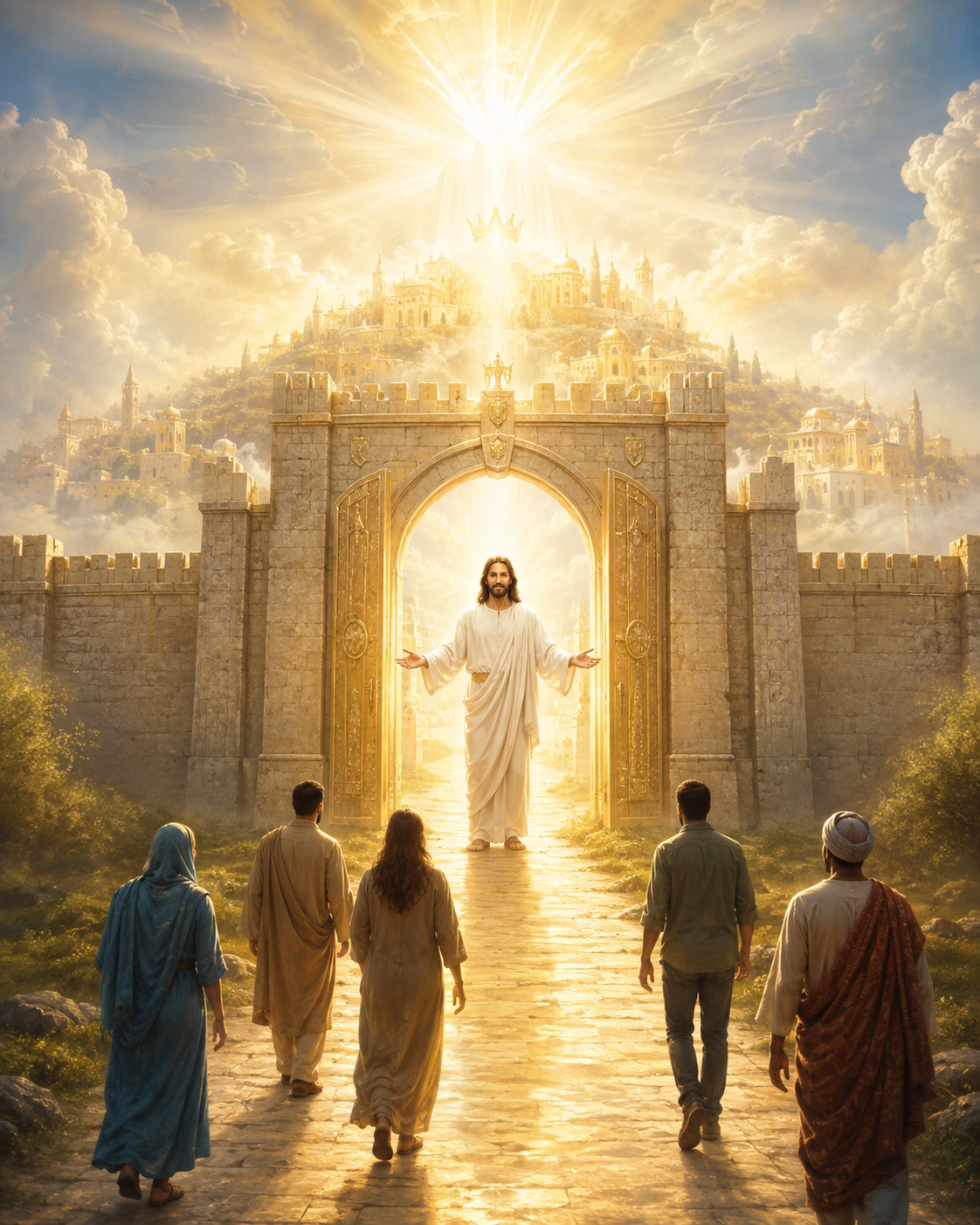
7. The Gate of Zion and the Door of Christ
Psalm 87 does not explicitly name Jesus Christ and should not be presented as a direct messianic prophecy in the same manner as Psalms 2, 22, or 110. Yet the Gospel of John offers a striking Christian canonical interpretation of the imagery.
John 10:9, KJV
Psalm 87 gives:
John 10 gives:
Both move from entry to life. Psalm 87 therefore asks implicitly: How does the outsider enter Zion? John’s Gospel supplies the Christian answer: through Christ.
8. “I Am the Door”: 1391
The Greek expression in John 10:9 is:
“I am the door.”
| Greek | Value |
|---|---|
| ἐγώ | 808 |
| εἰμι | 65 |
| ἡ | 8 |
| θύρα | 510 |
| Total | 1391 |
Factorizing:
Therefore, the sum of the divisors of 1391 and the number of divisors of 1391 are:
Number of divisors: τ(1391) = 4
Hence, the arithmetic mean of the divisors of 1391 is:
Now, the number of divisors of 378 is:
And the Euler totient of 378 is:
9. Deliverance Through the Threshold
The sum of the divisors of 1391 gives another remarkable result:
Since 14 is associated with Deliverance / Release, the divisor fullness of “I am the Door” may be read within the adopted framework as:
And the words immediately following Jesus’ declaration are: “by me if any man enter in, he shall be saved.”
10. After the Door Comes the Way
John 14:6, KJV
John is Book 43. Therefore:
| Verse | Identifier | Christological Image |
|---|---|---|
| John 10:9 | 62 | Door |
| John 14:6 | 63 | Way |
Door → Way
The Door precedes the Way both canonically and numerically. The remarkable point is that the Door and the Way are not different agents. They are the same Person.
11. “I Am the Way”: 1225
“I am the way.”
| Greek | Value |
|---|---|
| ἐγώ | 808 |
| εἰμι | 65 |
| ἡ | 8 |
| ὁδός | 344 |
| Total | 1225 |
Combining the two declarations:
Door + Way
12. Door + Way = 2616
Factorizing:
The number of divisors of 2616 is:
For the Carmichael lambda of 2616, which in the Canon represents Sovereign Order / Periodicity:
Since the Carmichael lambda values of 8, 3, and 109 are:
we obtain the Carmichael lambda of 2616:
Within the Canon, Carmichael lambda represents Sovereign Order / Periodicity. Thus the sovereign-order invariant of Door + Way is exactly 108—the identifier of Psalm 87:2.
13. The Shared Signature: Love and 108
| Psalm 87:2 | John 10:9 + John 14:6 |
|---|---|
| “The LORD loveth the gates of Zion” | “I am the Door” + “I am the Way” |
| Gematria = 770 | Isopsephy = 2616 |
| Number of divisors: τ(770)=16 | Number of divisors: τ(2616)=16 |
| 16 = Love | 16 = Love |
| Arithmetic mean of divisors: A(770)=108 | Carmichael lambda: λ(2616)=108 |
The Gate of Zion and Christ as Door-and-Way independently converge upon the same two numbers. Within the proposed framework, this is not a simple digit coincidence; both are produced by primary arithmetic invariants.
14. A Secondary Observation: 109
Because:
the prime factor 109 is responsible for the appearance of 108 under the Carmichael lambda:
But the verse identifier of Psalm 87:3 is:
Psalm 87:3 immediately follows the beloved Gate verse:
This observation should remain secondary, but mathematically it is exact and reinforces the close structural association between the Gate and the City of God.
15. The Meaning of 108 Is Not Changed
Psalm 87 does not require abandonment of earlier interpretations associated with 108. Rather, it adds a crucial contextual meaning. The number retains its associations with the outsider, adversary, bondage, and fallen humanity. In particular, its Euler totient, Carmichael lambda, and radical are:
Carmichael lambda: λ(108)=18 = Bondage
Radical: rad(108)=6 = Man
But Psalm 87 tells us what God does with such a person. The enemy approaches the threshold. The threshold is enveloped in divine love. The enemy is offered entry.
16. “Any Man”: The Universality of the Invitation
John 10:9 contains an expression of extraordinary breadth:
The Christian claim is therefore simultaneously exclusive and universal. It is exclusive because Christ says, “I am the Door.” Yet it is universal because He says “any man” may enter.
No ethnicity is named. No nationality is privileged. No human being is excluded from approaching the Door. From the Christian theological perspective, existing social or religious identities do not themselves constitute the Door; yet every person is included in the scope of “any man.”
This is precisely the universality anticipated in Psalm 87. Egypt may enter. Babylon may enter. Philistia may enter. Tyre may enter. Cush may enter. The former enemy is not told that the gate is permanently closed. He is offered a new birthplace.
17. Is Jesus God in Psalm 87?
This question requires theological precision. Psalm 87 itself does not explicitly identify Jesus. Therefore it would exceed the text to claim that Psalm 87 alone proves Christ’s deity.
The stronger Christian canonical argument is cumulative:
- YHWH specially loves the gates of Zion.
- Those gates mark the threshold by which outsiders become members of God’s people.
- Jesus declares Himself to be “the Door.”
- Entry through Him results in salvation.
- Jesus subsequently declares Himself to be “the Way.”
- The Way leads to the Father.
Elsewhere John’s Gospel explicitly identifies Christ in divine terms: “the Word was God” (John 1:1), while Thomas confesses to Jesus, “My Lord and my God” (John 20:28).
Jesus does not merely show humanity where the gate is.
He declares: “I AM THE DOOR.”
18. From Enemy to Fellow Citizen
Psalm 87 provides the beginning and destination:
Romans 5 provides the transformation:
Ephesians 2 provides the new legal identity:
John provides the Person through whom the movement occurs:
19. The Central Theological Result
Within Biblical Mathematics, this theology is accompanied by an unusually coherent numerical structure. The table below shows the number of divisors, the arithmetic mean of divisors, and the Carmichael lambda explicitly before their symbols are used:
| Psalm 87 Gate | Christ: Door + Way |
|---|---|
| 770 | 2616 |
| Number of divisors: τ = 16 | Number of divisors: τ = 16 |
| LOVE | LOVE |
| Arithmetic mean of divisors: A = 108 | Carmichael lambda: λ = 108 |
Thus both yield:
The former enemy stands at 108. But 108 is generated from the structure of Love. At that threshold stands Christ. He says, “I am the Door.” After entering, the traveler asks, “Where now?” Christ answers, “I am the Way.” And the Way leads to the Father.
Conclusion
Psalm 87 begins with one city but ends with many peoples. The city belongs to YHWH. The gates are specially loved by Him. Outside those gates stand peoples once alien to Israel—some historically enemies and oppressors. Yet God’s response is astonishing:
Within the numerical structure, Psalm 87:2 carries the identifier 108. The Hebrew declaration “The LORD loveth the gates of Zion” totals 770, equal to the identifier sum of the whole psalm. The number of divisors of 770 is 16, Love, and the arithmetic mean of the divisors of 770 returns 108.
John 10:9 then transforms the gate from architecture into Person: “I am the door.” Its Greek value, 1391, leads by arithmetic mean to 378, whose structure yields both 16 and 108. Its divisor fullness further gives 1512 = 14 × 108, suggesting within the adopted framework Deliverance through the Threshold.
John 14:6 then continues the movement: “I am the way.” The verse identifiers themselves progress consecutively:
The Greek values combine:
and the number of divisors and Carmichael lambda of 2616 are:
Carmichael lambda: λ(2616)=108
Thus the Gate of Psalm 87 and Christ as Door-and-Way share the same remarkable signature:
The exclusivity of Christ as Door is therefore inseparable from the universality of the invitation. The former enemy may come. The stranger may come. The person in bondage may come. Fallen man may come.
At the threshold he encounters not rejection, but the love of God.
That Door is also the Way.
And the Way leads to the Father.
References
- The Holy Bible, King James Version.
- Vanualailai, Jito; Tomasi, Eroni; Vanualailai, Paulo; and Takala, Jope. The Lord’s Prayer: A Mathematician’s Creed. Suva, Fiji, 2018.
- Jones, Stephen E. The Biblical Meaning of Numbers from One to Forty. God’s Kingdom Ministries, 2008.
- Canon of Numeric Invariants with Theological Interpretations.


1 thought on “The Gate, the Door, and the Way”