
Introduction
The Kingdom of God stands at the center of the teaching of Jesus Christ. From the beginning of His ministry to His death and resurrection, and even in His appearances after rising from the dead, Jesus revealed that God was doing something new, powerful, and saving.
It is not unreasonable therefore to ask seven (7) very simple and important questions:
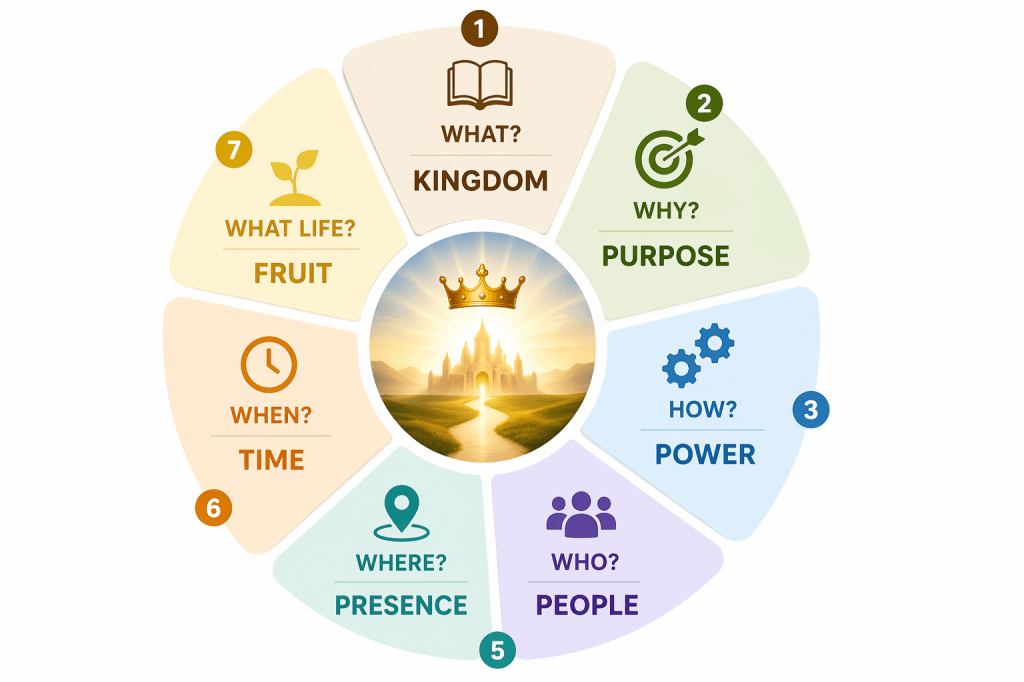
- What is this Kingdom?
- Why does it exist?
- How does it come and operate?
- Who belongs to it?
- Where is it found?
- When does it come?
- And what sort of people and life does it produce?
These are not small questions. They help us understand the whole message of Jesus.
This paper is purely canonical. Its only authority is the Bible. We will not depend on mathematics or outside writers here. We will simply listen carefully to the four Gospels and let Scripture speak.
The order of our study will be:
What → Why → How → Who → Where → When → What life
This order is helpful because it moves from the nature of the Kingdom, to its purpose, to its operation, to its people, to its place, to its timing, and finally to the kind of life it creates.
Before answering these seven questions, it is helpful to place together the main Kingdom-themed parables and figures of speech in the four Gospels.
Kingdom-Themed Parables in the Four Gospels
Kingdom Parables in the Gospel of Matthew
| # | Parable | Reference | Theme | Commonly accepted meaning |
|---|---|---|---|---|
| 1 | New Cloth on an Old Garment | Matthew 9:16 | Newness of Jesus’ work | Jesus’ ministry is not a mere patch on old forms; His coming brings something new that cannot simply be added superficially to the old order. |
| 2 | New Wine in Old Wineskins | Matthew 9:17 | New covenant and renewal | The life and power of the Kingdom require fitting forms; the gospel cannot be contained by rigid old structures unchanged by Christ. |
| 3 | The Sower | Matthew 13:3–9, 18–23 | Reception of the word | The same word of God produces different results depending on the condition of the heart; true fruitfulness marks genuine reception. |
| 4 | The Mustard Seed | Matthew 13:31–32 | Small beginnings, great growth | The Kingdom may begin in humble ways, yet it grows into something large and far-reaching under God’s power. |
| 5 | The Leaven | Matthew 13:33 | Hidden transforming power | The Kingdom works quietly from within, spreading and transforming more than first appears. |
| 6 | The Hidden Treasure | Matthew 13:44 | Supreme value of the Kingdom | The Kingdom of heaven is worth joyful total sacrifice; when one truly sees its worth, everything else becomes secondary. |
| 7 | The Pearl of Great Price | Matthew 13:45–46 | Ultimate worth | Like the hidden treasure, this teaches that the Kingdom is of incomparable value and worth giving up all to obtain. |
| 8 | The Marriage of the King’s Son / Wedding Banquet | Matthew 22:1–14 | Invitation, response, and readiness | God graciously invites many into His Kingdom, but invitation must be received rightly; outward inclusion alone is not enough. |
Kingdom Parables in the Gospel of Mark
| # | Parable | Reference | Theme | Commonly accepted meaning |
|---|---|---|---|---|
| 1 | New Cloth on an Old Garment | Mark 2:21 | Newness of Jesus’ work | Jesus’ mission is not a mere patch on the old order; His coming brings a new reality that cannot simply be added to unchanged forms. |
| 2 | New Wine in Old Wineskins | Mark 2:22 | New covenant and renewal | The life and power of God’s Kingdom require receptivity and renewal; the gospel cannot be contained in rigid old structures left untouched by Christ. |
| 3 | The Sower | Mark 4:3–9, 14–20 | Reception of the word | The word of God produces differing results depending on the condition of the heart; true reception is shown by fruitfulness. |
| 4 | The Lamp on a Stand | Mark 4:21–22 | Revelation and manifestation | The truth of the Kingdom is not meant to remain hidden forever; what God reveals in Christ is destined to be brought to light. |
| 5 | The Seed Growing Secretly | Mark 4:26–29 | Hidden growth of the Kingdom | God’s Kingdom grows quietly and mysteriously by divine power until the time of harvest. |
| 6 | The Mustard Seed | Mark 4:30–32 | Small beginnings, great growth | The Kingdom may begin in humble form, yet it grows into something great and far-reaching under God’s power. |
Kingdom Parables in the Gospel of Luke
| # | Parable | Reference | Theme | Commonly accepted meaning |
|---|---|---|---|---|
| 1 | New Cloth on an Old Garment | Luke 5:36 | Newness of Jesus’ work | Jesus is not merely patching the old order; He brings a new messianic reality. |
| 2 | New Wine in Old Wineskins | Luke 5:37–39 | New covenant and renewal | The Kingdom requires receptivity and cannot be contained in unchanged structures. |
| 3 | The Sower | Luke 8:5–15 | Reception of the word | The Kingdom word bears fruit only where it is truly received, held fast, and persevered in. |
| 4 | The Lamp on a Stand | Luke 8:16–18 | Revelation and manifestation | The mystery of the Kingdom is not meant to remain hidden forever; what God reveals will be brought to light. |
| 5 | The Mustard Seed | Luke 13:18–19 | Small beginnings, great growth | The Kingdom may begin very small, yet it grows into something large and sheltering. |
| 6 | The Leaven | Luke 13:20–21 | Hidden inward transformation | The Kingdom works quietly from within, permeating and transforming more than first appears. |
| 7 | The Great Banquet | Luke 14:16–24 | Invitation and inclusion | God’s Kingdom invitation is graciously extended, and when the expected guests refuse, others are brought in. |
| 8 | The Minas / Pounds | Luke 19:11–27 | Delayed Kingdom and accountability | The Kingdom does not appear in full immediately; in the meantime, servants must remain faithful until the king returns. |
Kingdom-Themed Figures of Speech in the Gospel of John
John’s Gospel contains fewer formal story parables than the other three Gospels, but it does contain several important figures of speech that reveal the life and reality of the Kingdom.
| # | Figure of speech | Reference | Theme | Commonly accepted meaning |
|---|---|---|---|---|
| 1 | The New Birth / Birth from Above / The Wind | John 3:3–8 | Entrance into God’s reign | No one can see or enter the Kingdom of God without being born from above, by water and Spirit. |
| 2 | The Harvest / Sower and Reaper | John 4:35–38 | Mission and ingathering | The fields are already ripe; God’s saving work is gathering people now. |
| 3 | The Good Shepherd / Door | John 10:1–18 | One flock under one Shepherd | Jesus is the true Shepherd and gate of salvation who gathers, protects, and gives life to His flock. |
| 4 | The Grain of Wheat | John 12:24 | Life through death | Fruitfulness comes through Jesus’ death; the Kingdom advances through sacrificial self-giving. |
| 5 | The True Vine and the Branches | John 15:1–8 | Abiding life and fruitfulness | Life in God’s reign is union with Christ, from whom all true fruitfulness comes. |
A brief observation
Even before we begin answering the seven questions, these passages already show a rich and united picture.
Matthew gives the broad structure of the Kingdom.
Mark emphasizes hiddenness, revelation, and growth.
Luke highlights welcome, fellowship, and stewardship.
John reveals the inward life of the Kingdom in new birth, one flock, life through death, and abiding fruitfulness.
We now turn to the seven questions.
1. What is the New Kingdom?
The New Kingdom is God’s new saving rule in Jesus Christ.
In Matthew, Jesus shows that something new has come. The old cannot simply continue unchanged. New cloth cannot be put on an old garment without trouble. New wine cannot remain in old wineskins. The Kingdom is a new order of God’s action.
In Mark, the Kingdom is hidden at first, but then revealed. It does not always come in ways that men expect. The seed grows, and people “know not how.” The lamp is not meant to remain hidden forever.
In Luke, the Kingdom appears as a welcoming and restoring fellowship. It is not only power; it is also invitation, banquet, joy, and mercy.
In John, the Kingdom is life from above. Jesus says:
“Verily, verily, I say unto thee, Except a man be born again, he cannot see the kingdom of God.”
John 3:3
So the Kingdom is not merely an outward arrangement. It is a new divine life centered in Christ.
Taken together, the four Gospels teach that the New Kingdom is God’s new saving order in Christ: hidden at first, then revealed, gathering people into fellowship, and giving them life from above.
2. Why does it exist?
The Kingdom exists to fulfill the Father’s saving will through the Son.
Jesus did not come only to speak beautiful words. He came to do the will of the Father. The Kingdom exists because God purposes to save, gather, feed, restore, and transform a people in Christ.
Matthew shows that the Kingdom fulfills the Father’s saving purpose.
Mark shows that it reveals God’s power, not human strength.
Luke shows that it restores the needy and includes the outsider.
John shows that it gives the life of the Son to His people.
Jesus says:
“For the Son of man is come to seek and to save that which was lost.”
Luke 19:10
And again:
“I am come that they might have life, and that they might have it more abundantly.”
John 10:10
So the Kingdom exists because the Father wills to reveal His rule in the Son, gather the lost, restore the broken, and give life.
3. How does it come and operate?
The Kingdom comes by Christ’s word, the Spirit’s work, and God’s hidden yet certain power.
It does not come by human force. It does not come by politics. It does not come by outward structure alone.
In Matthew, the Kingdom begins with Christ’s initiative, is received through the word, grows like seed, works like leaven, and is valued above all things.
In Mark, the Kingdom’s operation is especially clear. The seed grows secretly. The Kingdom works by divine power even when men do not fully understand it.
In Luke, the Kingdom operates through invitation, inclusion, table fellowship, and faithful stewardship.
In John, it comes through new birth, harvest, shepherding, life through death, and abiding in Christ.
Jesus says:
“The kingdom of God cometh not with observation.”
Luke 17:20
And in John:
“Without me ye can do nothing.”
John 15:5
So the Kingdom comes and operates by the call of Christ, the hearing of faith, the new birth of the Spirit, hidden divine growth, the gathering of the flock, and abiding union with Christ.
4. Who belongs to it?
Those who belong to the Kingdom are the chosen, the repentant, the obedient, the poor in spirit, the born-again, the gathered flock, and those who abide in Christ.
Matthew emphasizes readiness, humility, repentance, and true entry.
Mark emphasizes hearing and obedience.
Luke emphasizes the poor, the overlooked, the outsider, and the humble.
John emphasizes new birth and abiding.
Jesus says:
“Blessed are the poor in spirit: for theirs is the kingdom of heaven.”
Matthew 5:3
And again:
“My sheep hear my voice, and I know them, and they follow me.”
John 10:27
And again:
“I tell you, this man went down to his house justified rather than the other.”
Luke 18:14
So the Kingdom belongs not to the proud or self-satisfied, but to those whom God calls and changes: the chosen, obedient, penitent, Spirit-born, included, and abiding people of God.
5. Where is it found?
The Kingdom is found in Christ, in His gathered people, in the life of the Spirit, in fellowship with the risen Lord, and finally in the new creation.
Matthew points us to Christ, to the gathered people, and finally to the everlasting Kingdom.
Mark points us to the place where Christ is recognized and obeyed.
Luke points us to the table, the fellowship of the gathered, and the field of mission.
John points us to union with Christ, one flock under one Shepherd, and abiding communion.
Jesus says:
“For, behold, the kingdom of God is within you.”
Luke 17:21
And He also teaches us to pray:
“Our Father which art in heaven, Hallowed be thy name. Thy kingdom come.”
Matthew 6:9–10
So the Kingdom is found where Christ is present and obeyed, where His people are gathered and fed, where His flock is shepherded, where His life is shared, and finally in the new heaven and new earth.
6. When does it come?
The Kingdom has already come in Christ, is active now, and will be fully revealed at the end.
This is one of the greatest truths of the Gospels. The Kingdom is both already and not yet.
In Matthew, it is already present in Jesus, but still awaits final fulfillment.
In Mark, it may be present before people even recognize it.
In Luke, it is inaugurated now but unfolds through a time of mission and stewardship before the end.
In John, it begins now through new birth and abiding life, but still awaits fullness.
Jesus says:
“The time is fulfilled, and the kingdom of God is at hand: repent ye, and believe the gospel.”
Mark 1:15
Yet He also teaches us to keep praying:
“Thy kingdom come.”
Matthew 6:10
So the Kingdom comes hiddenly in Christ’s presence, decisively in His ministry, cross, and resurrection, presently in the life of the Church, and finally in open glory.
7. What sort of people and life does it produce?
The Kingdom produces a new kind of people: humble, receptive, obedient, fed by Christ, sent in service, cruciform in spirit, and fruitful in life.
Matthew shows people who value the Kingdom above all things.
Mark shows people who listen and obey.
Luke shows people who are humble, welcoming, fed, faithful, and sent.
John shows people who are reborn, shepherded, abiding, and fruit-bearing.
Jesus says:
“By this is my Father glorified, that ye bear much fruit; so shall ye be my disciples.”
John 15:8
The Kingdom does not only save people from judgment. It also forms them into a new people.
So Kingdom life is:
- repentant,
- teachable,
- obedient,
- dependent on grace,
- welcoming to others,
- faithful in stewardship,
- shaped by the cross,
- and fruitful in Christ.
Conclusion
The four Gospels speak with one voice, even though each has its own emphasis.
Matthew gives the broad framework.
Mark shows the hidden power and revelation of the Kingdom.
Luke shows its welcome, fellowship, and mission.
John shows its inner life in union with Christ.
Together they teach that the New Kingdom is God’s saving rule in His Son. It is already present, though not yet complete. It is entered by grace, received through faith, revealed by Christ, nourished in fellowship, and lived out in obedience, humility, and fruitfulness.
The Christian life, then, is not only about waiting for heaven. It is about entering, living in, and bearing witness to the Kingdom of God now, while waiting for its final glory.
Gospel synthesis table
| Question | Matthew | Mark | Luke | John | Final synthesized summary |
|---|---|---|---|---|---|
| 1. What is the New Kingdom? | The new messianic order of God’s saving rule; the New-Exodus Kingdom. | A hidden-yet-revealed divine reality, disclosed by the presence and word of the King. | A gathered, hospitable, restorative fellowship under God’s reign. | Life from above in Christ: new birth, one flock, life through death, abiding fruitfulness. | God’s new saving order in Christ: hidden then revealed, gathered into fellowship, and lived as life from above. |
| 2. Why does it exist? | To fulfill the Father’s saving will in the Son. | To show that true increase comes from Christ’s initiative, not human effort. | To restore, include, feed, and entrust a people with stewardship in the meantime. | To reproduce the life of the Son in His people and gather them into one flock. | To fulfill the Father’s will in the Son by revealing Christ’s rule, gathering the chosen, restoring them, and reproducing His life in them. |
| 3. How does it come and operate? | By Christ’s new initiative, right reception of the word, hidden divine growth, total valuation, and true entry. | Through revelation, obedient response, sovereign increase, and disproportionate growth from small beginnings. | Through invitation, inclusion, meal-fellowship, and faithful stewardship during the delay. | By new birth, harvest through Christ’s word, gathering into one flock, life through death, and abiding union. | By Christ’s revealing word, obedient response, divine ingathering, table fellowship, life through death, and abiding union. |
| 4. Who belongs to it? | Those chosen by the Father, given to the Son, penitent, cruciform, and ready for true entry. | Those who recognize and obey the risen Lord when He speaks. | The poor, overlooked, outsiders, and gathered guests who become a sent and stewarding people. | Those born from above, gathered by the Shepherd, abiding in Christ, and bearing fruit. | The chosen, obedient, penitent, Spirit-born, included, abiding, commissioned people of God. |
| 5. Where is it found? | In Christ, in the gathered people, in transformed life, and finally in the new Jerusalem. | Where Christ is present, recognized, and obeyed; where His word creates abundance. | At the table, in fellowship, in the widened community, and in the field of mission. | In union with Christ, in one flock under one Shepherd, in abiding communion. | Where Christ is recognized and obeyed, where His people are gathered and fed, where His flock is shepherded, where His life is shared, and finally in the new Jerusalem. |
| 6. When does it come? | Already inaugurated in Christ, not yet consummated in fullness. | It may already be present before it is recognized; it comes hiddenly, then is disclosed. | Inaugurated now, but unfolding through an interval of mission before final consummation. | Begun now in new birth and abiding life; deepened through time; completed finally in fullness. | Hiddenly in Christ’s presence, decisively in resurrection, presently in mission and abiding life, and finally in consummation. |
| 7. What sort of people and life does it produce? | A receptive, transformed, surrendered, penitent, cruciform people who prize the Kingdom above all. | An alert, responsive, obedient people whose fruitfulness depends wholly on the Lord’s word. | A fed, inclusive, humble, stewarding, sent people who live between resurrection and consummation. | A reborn, gathered, shepherded, cruciform, abiding, fruit-bearing people. | A receptive, reborn, cruciform, gathered, fed, shepherding, stewarding, fruit-bearing people. |
Matthew gives the framework, Mark the mode, Luke the communal shape, and John the inner life of the New Kingdom.

 The Lord's Prayer: A Mathematician's Creed