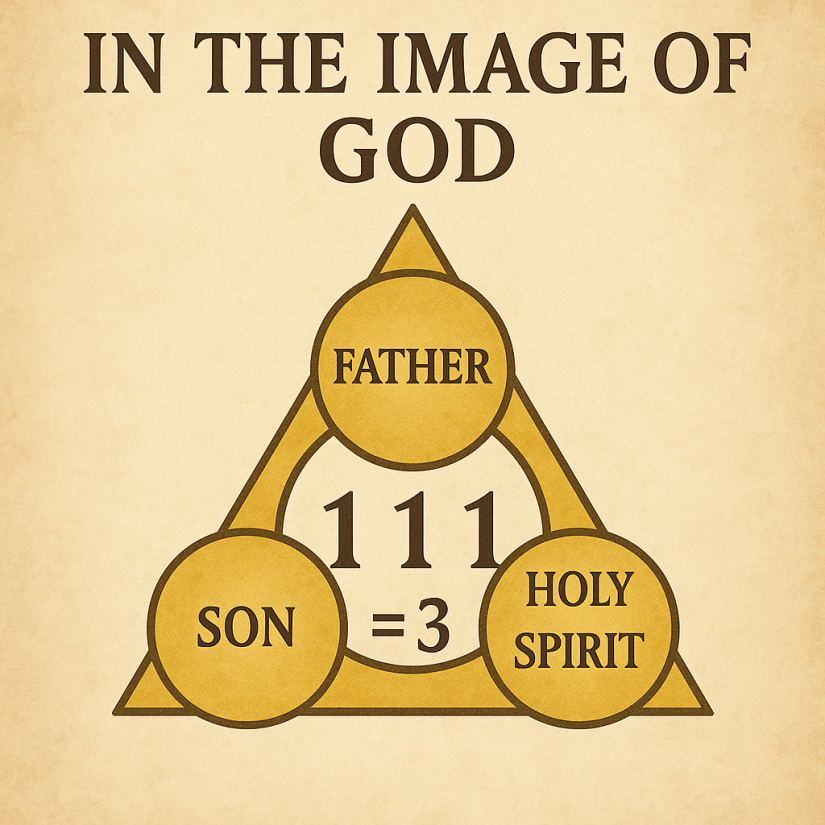
In the Image of God: A Trinitarian Revelation through the Number 111

Introduction

From the opening pages of Scripture, we encounter a profound mystery: God said, “Let us make man in our image, after our likeness” (Genesis 1:26). The deliberate use of the plural “us” and “our” has long invited theological reflection. For Christians, this plural unity anticipates the revelation of the Trinity: one God in three persons. This article explores the extraordinary convergence of biblical language, numerical structure, and Trinitarian theology, showing how the number 111 unveils a conclusive mathematical reflection of divine plurality within unity.

1. The Creation Statement: Genesis 1:26-27

“Then God said, ‘Let us make man in our image, after our likeness…’ So God created man in his own image, in the image of God he created him; male and female he created them.” (Genesis 1:26-27)

Here, the plural form of speech coexists with singular creative action. The Creator is referred to as “God” (Elohim), a grammatically plural noun that governs singular verbs. This textual pattern mirrors a divine unity that is not indivisible simplicity but harmonious multiplicity: one essence, three persons.

2. The Gematria of Identity: בני אל חי = 111

In Hosea 1:10, the prophetic promise of restoration declares:

“…it shall be said to them, ‘You are children of the living God.'”

The Hebrew expression b’nei El Chai (בני אל חי) has a gematria value of 111:

  • בני (b’nei) = 2 + 50 + 10 = 62
  • אל (El) = 1 + 30 = 31
  • חי (Chai) = 8 + 10 = 18
  • Total: 62 + 31 + 18 = 111

This number embodies the identity “Children of the Living God” and symbolically reflects the Trinitarian unity:

1 + 1 + 1 = 3

Yet, each “1” retains individuality, while the sum indicates perfect unity — the very concept behind the Trinity: three persons, one God.

3. From Creation to Adoption: Identifiers and Their Arc

Using the biblical verse identifier system (Book # + Chapter # + Verse #), the identifiers of Genesis 1:26 (28), Genesis 1:27 (29), Hosea 1:10 (39), and Romans 9:26 (80) create a narrative arc:

ThemeReferenceIdentifierCumulative
CreationGenesis 1:262828
CreationGenesis 1:272957
RestorationHosea 1:103996
AdoptionRomans 9:2680176

This arc (28 → 176) symbolizes humanity’s movement from origin, through rejection, to restored sonship. The final sum, 176, matches the number of verses in Psalm 119, the longest chapter in Scripture and a declaration of love for God’s Word — the very instrument of covenant identity.

4. Romans 9:26 and the Fulfillment of Hosea

“In the very place where it was said to them, ‘You are not my people,’ there they will be called ‘sons of the living God.'” (Romans 9:26)

Paul quotes Hosea to affirm that both Jews and Gentiles are now unified as one covenant family. The children of God are those brought into divine sonship through Christ, sealed by the Holy Spirit. The Trinitarian act of adoption is complete: the Father calls, the Son redeems, and the Spirit confirms.

5. Mathematical Proof of Trinitarian Unity

Mathematically, 111 = 1 + 1 + 1. Each “1” maintains distinction. Their unity in the number “3” echoes theological creeds:

  • One God in Three Persons
  • Three in One and One in Three

This numerical structure is not a man-made symbol but embedded in the very language and revelation of Scripture. The gematria 111 in Hosea 1:10 links identity (children of God) to divine structure (Elohim, plural yet one).

6. Radical 22: The Numerical Seal of Sonship

The final cumulative identifier in this arc, 176, holds an additional mathematical signature:

  • Its prime factorization is:
    176 = 2⁴ × 11
  • The radical (product of its distinct prime factors) is: rad(176) = 2 × 11 = 22

According to The Biblical Meaning of Numbers from One to Forty by Dr. Stephen E. Jones, the number 22 symbolizes:

  • Sonship
  • Sons of Light
  • The full revelation of God’s Word (since there are 22 letters in the Hebrew alphabet)

This hidden dimension confirms the prophetic journey from Genesis 1:26 to Romans 9:26:

Those made in the image of God, once declared “not my people,” are now mathematically and spiritually confirmed as sons of light, bearing the number of Sonship: 22.

Thus, the radical of 176 does not merely point to numerical structure — it seals the journey of identity. The number 22 affirms that those restored in Christ are no longer outsiders but bear the divine imprint as adopted sons of the Living God.

Conclusion: The Image Restored

Genesis 1:26-27 begins with the image of God in humanity, a reflection of divine plurality-in-unity. Hosea 1:10 and Romans 9:26 reveal how this image is restored and elevated: through adoption as children of the living God. The number 111 serves not merely as a gematria curiosity but as a mathematical testimony to the Trinitarian nature of God — and to our identity in Him.

In this, we behold the elegance of divine logic: theology harmonizing with arithmetic, Scripture unfolding as both word and number, and God revealing Himself as One, yet Three, in whose image we are lovingly made and eternally known.

From Prowling Sins to Morning Songs: A Theological Reflection on Psalm 59 and the Power of 185

Introduction Psalm 59 is a profound tapestry of lament, trust, and praise, penned by David in a time of peril. It is historically rooted in the event when Saul sent men to watch David’s house in order to kill him (1 Samuel 19). Yet beyond its immediate context, Psalm 59 becomes a rich metaphorical and theological canvas for exploring divine protection, spiritual warfare, and ultimate deliverance. This article draws together Psalm 59, the miraculous account of 185,000 slain Assyrians, and symbolic numerology to unveil deeper dimensions of God’s covenantal care and judgment.


1. Historical and Spiritual Context of Psalm 59 David writes Psalm 59 while being hunted by Saul’s assassins. His opening verses are a desperate cry: “Deliver me from my enemies, O my God” (v.1). His enemies are described as fierce, unjust, and bloodthirsty. But rather than retaliate in kind, David places his hope in God’s deliverance.

Metaphorically, David’s enemies may be understood as sins or temptations that relentlessly pursue the believer. Verses 14–15 give us this vivid imagery:

“They return at evening, snarling like dogs, and prowl about the city. They wander about for food and howl if not satisfied.”

This portrays sin as an ever-returning, insatiable threat—restless, hungry, and predatory.


2. Morning Praise and Fortress of Refuge The psalm then turns from night to day, from fear to faith:

“But I will sing of your strength, in the morning I will sing of your love; for you are my fortress, my refuge in times of trouble” (Psalm 59:16).

Here, morning becomes a symbol of divine deliverance. As darkness gives way to light, the believer transitions from survival to song. The city that once echoed with the howls of enemies now resonates with praise.


3. The Identifiers and the Mystery of 185 Applying biblical numerology, each verse may be given an identifier: Book Number + Chapter Number + Verse Number. For Psalm 59:

  • Psalm 59:14 = 19 + 59 + 14 = 92
  • Psalm 59:15 = 19 + 59 + 15 = 93
  • Sum = 185

This numerical sum draws us directly to 2 Kings 19:35 and Isaiah 37:36:

“That night the angel of the Lord went out and put to death 185,000 in the Assyrian camp. When the people got up the next morning—there were all the dead bodies!”

The parallel is striking:

  • In both narratives, night is the time of siege.
  • In both, deliverance comes invisibly.
  • And in both, morning reveals the total defeat of the enemy.

4. The Symbolism of the Number 185

✦ Divine Intervention
185 signifies God’s sovereign and sudden response. As the people of Jerusalem slept, God intervened without sword or human effort. Similarly, David’s foes—be they human or spiritual—are neutralized by divine initiative.

✦ Judgment and Justice
185 symbolizes the executed judgment against pride and oppression. The Assyrians mocked the God of Israel. Their fall reveals God’s unwillingness to let arrogance go unchallenged.

✦ Angelic Warfare
This number brings to light the unseen spiritual battle on behalf of the faithful. One angel, in obedience to God, renders a vast army powerless.

✦ Covenant Protection
185 also illustrates how God defends His covenant people when they turn to Him in humility and prayer—as Hezekiah did.


5. Theological Insert: 185 and the Lord’s Prayer

The number 185 also forms a symbolic bridge to the Lord’s Prayer, revealing itself as the divine execution of its petitions:

  • “Deliver us from evil” — exactly what happens in the slaying of the Assyrians.
  • “Thy kingdom come, Thy will be done on earth as in heaven” — fulfilled as God’s will is enforced through angelic power.
  • “Give us this day our daily bread” — answered through the lifting of siege and famine.

In fact, the Lord’s Prayer and the Assyrian episode share structural symmetry:

  • Hezekiah prays in humility;
  • God responds with covenant faithfulness;
  • An angel executes justice;
  • Morning reveals victory and peace.

185, then, is the numerical fulfillment of the Lord’s Prayer in action. It is what it looks like when heaven answers earth:

185 is the thunderclap of “deliver us from evil.”
It is the angel’s sword answering the disciple’s plea.


6. Theological Summary Psalm 59 is more than a psalm of survival—it is a blueprint for trust in the face of evil. Its spiritual arc mirrors the night-and-morning structure of the 185,000 Assyrian deaths:

  • Verses 14–15 mirror the threatening night, filled with prowling danger.
  • Verses 16–17 reflect the dawning praise, where the once-besieged soul now sings in freedom.

And embedded within it, the sum 185 serves as a numerical seal linking David’s personal enemies to Israel’s national threat and reminding us that God’s deliverance, whether personal or cosmic, is often unseen, but always certain.

“You are my strength, I sing praise to you; you, God, are my fortress, my God on whom I can rely” (Psalm 59:17).


Conclusion The theological convergence of Psalm 59 and the number 185 reveals a timeless truth: while sin may prowl at night, God sends His angels by decree, and morning always breaks with praise. The believer need not fear the howling of spiritual foes—for God’s covenant love ensures that the fortress will stand, the enemy will fall, and the song will rise.

The Lord’s Prayer as the Fulfillment of Torah

Introduction

The Torah—the foundational body of divine instruction in the Hebrew Scriptures—stands at the heart of Jewish identity and spirituality. Traditionally ascribed to Moses, the Torah encompasses not only law but the very covenantal framework of God’s relationship with His people. In the New Covenant, Jesus Christ offers the Lord’s Prayer (Matthew 6:9–13; Luke 11:2–4), not as a replacement for Torah, but as its consummate fulfillment. This essay explores how the Lord’s Prayer is the Torah re-spoken: a creedal, covenantal, and chronosanctifying invocation that transforms the law written on tablets into prayer inscribed on the heart.


The Gematria of תּוֹרָה (Torah)

The Hebrew word Torah (תּוֹרָה) comprises the letters:

  • ת (Tav) = 400
  • ו (Vav) = 6
  • ר (Resh) = 200
  • ה (Heh) = 5

Gematria of Torah=400+6+200+5=611

This number—611—is not arbitrary. It aligns perfectly with the rabbinic tradition which holds that Moses transmitted 611 commandments, while the first two commandments of the Decalogue were spoken directly by God, giving us the full 613 commandments of the Torah.


611 + 2 = 613: The Rabbinic Tradition of the Mitzvot

According to Babylonian Talmud, Makkot 23b, Rabbi Simlai teaches:

“613 commandments were given to Moses: 365 negative commandments corresponding to the solar days, and 248 positive commandments corresponding to the parts of the human body.”

Of these, 611 were delivered through Moses, while the first two (“I am the Lord your God…” and “You shall have no other gods…”) were heard directly from God at Sinai (Exodus 20:1–3; Deuteronomy 5:4–5). This profound structure is confirmed by Rashi in his commentary on Deuteronomy 33:4 and later codified by Maimonides in his Sefer HaMitzvot.


Numerical Alignment: 611 and 168

The Lord’s Prayer, in Luke 11:2–4, when analyzed using the identifier formula:

Identifier = Book # + Chapter # + Verse #

Gives:

  • Luke 11:2 → 42 + 11 + 2 = 55
  • Luke 11:3 → 42 + 11 + 3 = 56
  • Luke 11:4 → 42 + 11 + 4 = 57

Total=55+56+57=168

This result is astonishingly the arithmetic mean of the divisors of 611, which are {1, 13, 47, 611}: Mean=(1+13+47+611)/4=168

This reveals that the identifier of the Lord’s Prayer is encoded within the very gematria of the Torah—a mathematical witness to its role as Torah fulfilled in the Messiah.


Petitions as Torah Themes

Each line of the Lord’s Prayer corresponds to a key theme within the Torah:

PetitionTorah Parallel
Our Father in heavenGod as Covenant Father (Deut 32:6)
Hallowed be Thy NameSanctity of God’s Name (Exod 20:7)
Thy Kingdom comeGod as King over Israel (Num 23:21)
Thy will be done…Obedience to divine law (Deut 6:4–5)
Give us this day our daily breadManna and provision (Exod 16)
Forgive us… as we forgive…Atonement rituals (Lev 4–5; Exod 34:6)
Lead us not into temptationWilderness testing (Deut 8:2–5)
Deliver us from evilDivine rescue from enemies (Deut 20:4)

The Lord’s Prayer is therefore not a theological abstraction but a Torah in motion—the divine law prayed, lived, and embodied.


Chronosanctification: 168 and Sacred Time

The eight daily prayer times, derived from the permutations of the number 153, finds its numerical basis in the value 168—which also happens to equal the total hours in a week. The Lord’s Prayer thus functions not only as a theological summary but as a sacred rhythm of time, mirroring the structure of creation itself.


Gematria of the Five Books of the Torah

Let us now consider the Hebrew gematria of the names of the five books of the Torah:

  1. Genesis – בְּרֵאשִׁית (Bereshit) = 913
  2. Exodus – שְׁמוֹת (Shemot) = 746
  3. Leviticus – וַיִּקְרָא (Vayikra) = 317
  4. Numbers – בְּמִדְבַּר (Bamidbar) = 248
  5. Deuteronomy – דְּבָרִים (Devarim) = 256

Total=913+746+317+248+256=2480

This total is 10 × 248, a number that is itself theologically rich.


The Theological Significance of the Number 248

  1. Positive Commandments: The number 248 represents the positive mitzvot in the Torah—commandments of action and devotion.
  2. Embodied Obedience: Rabbinic tradition equates 248 with the number of limbs and organs in the human body, symbolizing that the whole person is to obey God.
  3. Torah Structuring: The gematria of the Torah’s book names totaling 2480 implies that the Torah is a blueprint for sanctifying the human body tenfold.
  4. Connection to the Lord’s Prayer: If 248 is the obedient body, then 168 (the Prayer’s identifier) is the spiritual breath—the rhythm of time and devotion that enlivens the body with prayer.
  5. Divine Perfection: The 248th even number is 496, a perfect number—hinting that the one who obeys (248) and prays (168) is made perfect in God’s covenant.

Conclusion

The Lord’s Prayer is not merely a petition; it is a prophecy fulfilled, a creed of the New Covenant, and a distillation of Sinai’s voice. It is Torah reborn—not as burden, but as blessing. It encapsulates divine instruction not in stone, but in supplication.

And the numbers declare it:

  • Torah = 611
  • Divisors’ Mean = 168
  • 168 = Lord’s Prayer Identifier
  • 248 = Human body commanded by Torah
  • 2480 = Gematria sum of the Torah’s five books

The Lord’s Prayer is the Torah breathed into time.
It is the sanctification of the whole person, across all hours, unto the fullness of God.

🔥 The Purification Has Begun: A Divine Intervention in the Churches

Using the Life and Ministry of Pope Francis as a Sign of the Times

Introduction: When God Intervenes from Within

God is not an indifferent spectator of history. He is not passively awaiting the return of His Son while His Church drifts into compromise, confusion, and complacency. The testimony of Scripture is clear: in the end days, God will purify His people, not by wrath but through a holy intervention from within.

This purification, long foretold by the prophets, the apostles, and by Christ Himself, has already begun. And one of the most visible signs of this divine movement may well be found in the unlikely figure of Pope Francis, the 266th pope of the Roman Catholic Church.


I. The Scriptural Basis for Purification in the End Days

1. Judgment Begins in the House of God

“For it is time for judgment to begin at the household of God…”
—1 Peter 4:17

Before God judges the world, He evaluates His people. This is not judgment unto destruction, but unto refinement, restoration, and readiness.

2. Christ Walks Among the Lampstands

“These are the words of Him who walks among the seven golden lampstands…”
—Revelation 2:1

The glorified Christ begins Revelation not with Rome, Babylon, or the nations, but with His own churches. He exposes hypocrisy, calls for repentance, and promises rewards for those who overcome. It is a pattern of internal intervention before external consummation.

3. The Bride Must Make Herself Ready

“His bride has made herself ready…”
—Revelation 19:7

The Church’s final act before the return of Christ is not evangelism or expansion, but purification. She must be presented without spot or wrinkle (Eph. 5:27)—something only possible through the sanctifying fire of the Holy Spirit.


II. Pope Francis: A Sign of Internal Intervention

Pope Francis, elected in 2013 as the 266th pope, may be more than a reformer. He may be a divine signpost.

1. A Lifestyle of Simplicity

Rejecting the papal palace, Francis chose a humble guesthouse. He wears plain white robes, washes the feet of prisoners and Muslims, and travels in a modest car. These are not mere personal quirks—they are a prophetic rebuke to centuries of ecclesiastical opulence. His very lifestyle says: Return to Christ. Return to simplicity.

2. Confronting Evil Within

Francis has not only called for transparency and accountability—he has exposed deep layers of abuse, secrecy, and spiritual corruption within the Vatican. From curial reform to financial transparency, his papacy has revealed rot beneath the surface of holiness. In doing so, he has embodied the prayer:

“Deliver us from evil.”

3. A Pattern of the Coming Purification

The significance of 266 is striking. Its Euler Totient is 108—the mirror image of 801 (Alpha & Omega), suggesting an end-time reversal of appearances. And the 266th odd number is 531—a permutation of 153, the number associated with the Remnant, the Sons of God, and the Lord’s Prayer times. Francis is a signal that the Lord of the Church has begun to walk among His lampstands.


III. A Movement Expanding Beyond Rome

What began with Rome will not stay in Rome. Jesus is Lord of all His Church, not just one denomination.

  • Anglicanism faces a moral and identity crisis.
  • Methodism is wrestling with fragmentation.
  • Evangelicalism battles consumerism and celebrity culture.
  • Pentecostalism, for all its passion, is plagued by unaccountable power.

Just as Christ purified the Temple at the beginning and end of His earthly ministry, He will purify His spiritual temple—the Church—before His return. This is not the death of the Church. This is her rebirth.


IV. The Role of the Invisible Church

In these end days, God is not raising a new denomination. He is awakening the Invisible Church—those who live by the Spirit, love truth, and walk in holiness. They are found across all traditions, races, and nations. They pray the Lord’s Prayer at appointed times, partake of the Lord’s Table in reverence, and yearn for the return of their King.

They understand that:

Unity is not an achievement. It is a resurrection miracle.
It is not man-made. It is God-given.
It begins when Christ walks among His people once again.


Conclusion: The Fire Has Started in the Sanctuary

“Who can endure the day of His coming? For He is like a refiner’s fire…”
—Malachi 3:2

The fire is not coming. It has already been lit.
It began with a humble man in white robes.
It will sweep through cathedrals and tents alike.
It will wound only to heal.
And it will leave behind a Bride clothed in splendor, without spot or wrinkle.

Let those who have ears to hear, hear what the Spirit is saying to the churches.
The purification has begun.

The Lord’s Prayer as the Law Written on the Heart: A Jewish-Covenantal Interpretation of the New Covenant

Abstract

This post argues that the Lord’s Prayer, often interpreted through a Greek-linguistic lens as a personal petition, is in fact rooted in Jewish covenantal theology. Drawing upon the prophetic promises in Jeremiah 31:31–34 and reinforced by numerical parallels in Hebrew gematria and number theory, we demonstrate that the Lord’s Prayer is not only a model of prayer but the actual fulfillment of the New Covenant—the Torah written on the heart. This reframes the prayer not merely as supplication but as a covenantal declaration—a daily vow to uphold God’s law and will as internalized by the Spirit. The conclusion is clear: the Lord’s Prayer is the sacred voice of covenant renewal for the remnant people of God.


1. Introduction

The Lord’s Prayer (Matthew 6:9–13) is often seen by Christians as a general model of devotion and supplication. However, when viewed through the lens of Jewish covenant theology, particularly the prophecy of Jeremiah 31:31–34, the prayer takes on a much deeper significance.

Jeremiah proclaims the coming of a New Covenant, unlike the one given at Sinai. This new covenant is defined by internal transformation:

“I will put my law within them, and I will write it on their hearts.” (Jer. 31:33)

This paper contends that the Lord’s Prayer is the very law God promised to inscribe on the hearts of His people. We will show this theologically and mathematically—proving that this ancient Jewish prayer is foremost a covenantal act.


2. The New Covenant in Jeremiah 31:31–34

Jeremiah 31:31–34 is the only place in the Old Testament where the phrase “new covenant” appears. It reads:

“I will put my law within them, and I will write it on their hearts. I will be their God, and they shall be my people.” (v.33)

This covenant is defined by:

  • Internal Torah (not tablets of stone)
  • Intimate relationship (“I will be their God…”)
  • Universal access to God (“They shall all know Me…”)
  • Total forgiveness (“I will forgive… I will remember sin no more.”)

It is a heart-centered Torah, infused by the Spirit (cf. Ezekiel 36:26–27), realized not through ritual, but through transformed inner life.


3. The Lord’s Prayer as Torah Written on the Heart

From a Jewish perspective, Torah refers to:

  1. The Five Books of Moses
  2. God’s instruction and moral guidance
  3. The covenantal framework shaping Israel’s spiritual identity

The Lord’s Prayer encompasses all these:

Line of the Lord’s PrayerTorah Principle Fulfilled
“Hallowed be Your name”Holiness code (Lev. 19:2)
“Your will be done…”Submission to divine law (Deut. 6:5)
“Give us daily bread”Trust in provision (Exodus 16)
“Forgive us… as we forgive”Justice and mercy (Lev. 19:18; Micah 6:8)
“Deliver us from evil”Moral purity and covenant protection

Thus, praying the Lord’s Prayer is an act of living the Torah from the inside out. It is God’s law written on the heart—not in tablets or scrolls, but in breath and commitment.


4. Mathematical Confirmation: A Hidden Covenant

The Hebrew gematria reveals a stunning correspondence:

PhraseHebrew Gematria
The Lord’s Prayer (Hebrew)10,838
Jeremiah 31:338,198

Using the Euler Totient function, we find (see the previous article Proof that the Lord’s Prayer is the Covenant of Jeremiah 31:33):

  • φ(10,838) = 1026
  • φ(8,198) = 4098
  • Mean of 4098’s divisors = 1026

The sanctified remnant number 1026 is embedded in both:

  • The covenant promise (Jeremiah 31:33)
  • Its fulfillment (The Lord’s Prayer)

Conclusion: The Lord’s Prayer is mathematically and spiritually the Torah written on the heart.


5. Covenant vs. Petition: A Theological Reframing

In Greek thought, the Lord’s Prayer is often treated as:

  • A petition (requests to a deity)
  • An individual act of devotion

But in Jewish thought, prayer is:

  • A covenantal declaration
  • A communal response to divine grace
  • A renewal of vows

Each line of the Lord’s Prayer contains a dual covenantal exchange:

God’s PromiseOur Response
“I will be your God”“Your kingdom come…”
“I will forgive…”“As we forgive…”
“I will write my law…”“Your will be done…”
“I will provide…”“Give us this day our daily bread…”

✨ The Lord’s Prayer is not just prayer—it is covenant renewal.

LineRitual MeaningCovenant Meaning
“Our Father in Heaven”A generic intro to prayerI acknowledge God as my Sovereign Father, and I commit to act as His child.
“Hallowed be Your Name”A statement of reverenceI pledge to honor God’s name in my actions, speech, and daily life.
“Your Kingdom come”Hope for the futureI surrender my own rule and pray: “Rule through me today.”
“Your will be done on earth…”Let God do what He wantsI align my life with His will—my desires, plans, and decisions become His.
“Give us today our daily bread”Ask for physical provisionI rely on God alone for provision, and I commit to contentment and trust.
“Forgive us… as we forgive…”Ask for mercyI commit to be an agent of mercy, living in forgiveness as a lifestyle.
“Lead us not into temptation”Keep me safeI declare war on sin, and invite God to discipline and direct me.
“Deliver us from evil”Protect me from harmI trust God for rescue and spiritual warfare, knowing the battle is real.
Doxology (Matt. 6:13)Formal endingI reaffirm God’s sovereignty, power, and glory over my life forever.

💥 When one prays this way, the Lord’s Prayer becomes a daily covenant renewal.


6. The Last Supper and the Inauguration of the Covenant

At the Last Supper, Jesus said:

“This cup is the new covenant in my blood…” (Luke 22:20)

He was directly referencing Jeremiah 31. His death would inaugurate this new internal covenant, not just for Israel but for the remnant of the nations.

Thus, the Lord’s Prayer, given by Jesus before His death, becomes the daily voice of this covenant.


7. Conclusion

The Lord’s Prayer is not a mere model of piety, nor a series of requests. It is:

✅ The Torah internalized
✅ The New Covenant activated
✅ A daily sanctification of the remnant
✅ A vow to live by God’s law
✅ The spiritual bridge between Jeremiah 31:33 and Matthew 6:9–13

To pray the Lord’s Prayer is to renew covenant—to say “yes” to the will of God etched on the heart, and to step into the divine destiny of the remnant.


References

  • The Holy Bible (Masoretic Text and Greek NT)
  • Jeremiah 31:31–34
  • Matthew 6:9–13
  • Luke 22:20; Hebrews 8–10
  • Vanualailai, J. (2025). Covenantal Prayer
  • Strong’s Concordance, Hebrew Lexicon
  • Bullinger, E.W. Number in Scripture