God’s Blessings Through the Lord’s Prayer and the Last Supper

Introduction

From the earliest pages of Scripture, God is revealed as a God of blessing. In creation, He blessed Adam and Eve (Genesis 1:28); in covenant, He blessed Abraham and his descendants (Genesis 12:2–3); in worship, He commanded Aaron to bless the people with His name (Numbers 6:24–26). Blessings are not peripheral but central to God’s purpose for His people.

When Christ came, He gave two lasting ordinances to His disciples: the Lord’s Prayer and the Lord’s Supper. According to Ernest Findlay Scott (“The Lord’s Prayer: Its Character, Purpose, and Interpretation,” 1951), these are the “two poles” of Christianity, containing the essence of what Jesus taught and accomplished.

The Prayer teaches us how to ask for blessings; the Supper assures us they are secured in His Cross.

In this article, we will explore how the blessings of God are (1) defined in Scripture, (2) prayed for in the Lord’s Prayer, and (3) fulfilled in the Lord’s Supper. Together, these two gifts of Christ shape the entire rhythm of Christian life.


1. The Scope of God’s Blessings

God’s blessings are not limited to material prosperity, though this is included. They are comprehensive and holistic, touching every dimension of life.

  1. 🕊️ Spiritual Blessings (Eph. 1:3; Rom. 5:1)
    • These include forgiveness of sins, peace with God, joy in the Holy Spirit, and adoption as children of God. The greatest spiritual blessing is reconciliation with the Father through Christ.
  2. 🍞 Material Provision (Deut. 28:1–14; Matt. 6:11)
    • God promises to supply daily needs — bread, water, health, fruitful labor, and prosperity. Material blessings remind us of God’s care for our physical lives.
  3. 🤝 Relational Blessings (Ps. 128:1–6; Prov. 3:3–4)
    • God blesses families with love, children with fruitfulness, and communities with favor and harmony. These blessings nurture covenant relationships among His people.
  4. ❤️ Inner Security (Jer. 17:7–8; Phil. 4:6–7)
    • This is the peace of heart and mind that comes from trusting God. Even in trials, the believer is anchored, like a tree planted by streams of water.
  5. 🌟 Guidance & Wisdom (Prov. 9:10; James 1:5)
    • God blesses those who seek His will with discernment and clarity. Wisdom is not merely knowledge but a Spirit-filled ability to walk in righteousness.
  6. 🙌 Beatitude Blessings (Matt. 5:3–12)
    • Jesus pronounced blessings on the poor in spirit, the meek, the merciful, the pure, the peacemakers, and those who suffer for righteousness. These blessings are paradoxical: they often come through weakness and suffering.
  7. 🛡️ Covenant Protection (Deut. 28:7; Matt. 6:13)
    • God blesses His people with deliverance from enemies, safety in times of danger, and victory over evil powers. This is part of His covenant loyalty.
  8. 👑 Eternal Blessings (John 3:16; Rev. 21:3–4)
    • The ultimate blessing is eternal life in the Kingdom of God — resurrection, immortality, and fellowship with God forever.

2. Conditions for Receiving Blessings

The Bible also makes clear that blessings are conditional upon faith, obedience, and covenant alignment:

  1. Obedience to God’s Word
    • “If you fully obey the Lord your God and carefully follow all his commands… all these blessings will come on you and accompany you” (Deut. 28:1–2).
    • Blessings are tied to walking in God’s ways.
  2. Fear of the Lord (reverence and awe)
    • “Blessed is the man who fears the Lord, who greatly delights in his commandments” (Psalm 112:1).
    • Reverence leads to wisdom and security.
  3. Trust and Faith in God
    • “Blessed is the man who trusts in the Lord, whose confidence is in him” (Jeremiah 17:7).
    • Faith brings stability and fruitfulness.
  4. Purity and Righteousness
    • Jesus’ Beatitudes (Matthew 5:3–12) show that humility, mercy, purity, peacemaking, and enduring persecution are conditions for blessing.
  5. Prayer and Dependence on God
    • The Lord’s Prayer teaches us to ask daily for bread, forgiveness, and deliverance. Brant Pitre (“The Lord’s Prayer and the New Exodus”, 2006) explains this as part of the “New Exodus”: God blesses when His people call upon Him in dependence and covenant loyalty.

Blessings are therefore not automatic; they flow from a heart aligned with God’s will, and from lives shaped by Christ.

Here is a clear Table of Blessings and Conditions from Scripture:


BlessingConstitutes (What It Is)Condition (Requirement)Scripture
Spiritual BlessingsForgiveness of sins, peace with God, joy, eternal salvationFaith in Christ, repentance, obedience to His WordEph. 1:3; Rom. 5:1; Acts 3:19
Material ProvisionDaily bread, health, fruitful harvest, prosperity, protectionObedience to God’s commands; seeking first His kingdomDeut. 28:1–14; Matt. 6:33
Relational BlessingsStrong families, fruitful children, harmony, favor with othersFear of the Lord, walking in righteousnessPsalm 128:1–6; Prov. 3:3–4
Inner SecurityPeace, stability, strength in trialsTrust and confidence in GodJer. 17:7–8; Phil. 4:6–7
Guidance & WisdomGod’s direction in life, discernment, clarityReverence (fear) of the Lord, prayer, dependenceProv. 9:10; James 1:5
Beatitude BlessingsComfort, inheritance, mercy, vision of God, sonshipHumility, meekness, mercy, purity, peacemaking, endurance under persecutionMatt. 5:3–12
Covenant ProtectionVictory over enemies, safety, deliverance from evilCovenant loyalty, prayer (Lord’s Prayer as dependence)Deut. 28:7; Matt. 6:13
Eternal BlessingsResurrection, eternal life, dwelling with God in the New JerusalemPerseverance in faith, overcoming trials, belonging to ChristJohn 3:16; Rev. 21:3–4

3. The Lord’s Prayer: Asking for the Blessings

The Lord’s Prayer (Matt. 6:9–13) is not merely a set of words but a comprehensive petition that sums up all of Jesus’ teaching. Each line corresponds to a category of blessing:

  • Our Father, who art in heaven 🛡️🤝
    • We are adopted children in covenant, under His protection and family care.
  • Hallowed be Thy Name 🕊️
    • We align ourselves with His holiness, seeking the spiritual blessing of sanctification and communion.
  • Thy Kingdom come 👑
    • We long for the fullness of eternal blessing, the reign of God on earth as in heaven.
  • Thy will be done on earth as it is in heaven 🌟
    • We ask for wisdom to walk in His will, for divine guidance in our daily steps.
  • Give us this day our daily bread 🍞
    • A direct request for provision: food, health, work, and sustenance.
  • Forgive us our trespasses… 🕊️🤝
    • We receive spiritual forgiveness and relational healing as we extend it to others.
  • Lead us not into temptation ❤️
    • A prayer for inner security and strength against weakness and sin.
  • Deliver us from evil 🛡️
    • A cry for covenant protection from the evil one and all spiritual enemies.
  • For thine is the kingdom, and the power, and the glory… 🙌
    • The Beatitude blessings are gathered in praise: joy, hope, and endurance in suffering.

In praying the Lord’s Prayer, we are in fact praying for the fullness of God’s covenant blessings.

Petition in the Lord’s PrayerBlessing it CoversExplanation
“Our Father, who art in heaven”Covenant Protection & Relational BlessingsWe enter God’s family, acknowledging His fatherhood — the basis of protection, provision, and healthy relationships.
“Hallowed be Thy Name”Spiritual BlessingsWe revere His holiness, aligning our hearts for forgiveness, sanctification, and joy in the Spirit.
“Thy Kingdom come”Eternal BlessingsWe long for God’s reign and the new creation, praying for eternal life in the restored Kingdom.
“Thy will be done on earth as it is in heaven”Guidance & WisdomSubmitting to God’s will brings clarity, discernment, and divine direction in all things.
“Give us this day our daily bread”Material ProvisionA direct request for daily needs — food, health, prosperity, and physical sustenance.
“Forgive us our trespasses, as we forgive those who trespass against us”Spiritual Blessings & Relational BlessingsForgiveness restores us to God and reconciles us with others, bringing peace and healing in relationships.
“Lead us not into temptation”Inner SecurityGod gives strength and stability in trials, protecting us from falling into sin.
“But deliver us from evil”Covenant ProtectionGod shields us from the evil one, granting victory over enemies and spiritual safety.
Doxology: “For thine is the kingdom, and the power, and the glory forever”Beatitude BlessingsPraise unites us with the Kingdom vision of Christ, lifting us to endurance, mercy, purity, and joy.

3. The Last Supper: Receiving the Blessings

The Last Supper (Luke 22:19–20; 1 Cor. 11:23–26) is the sacrament that seals the blessings prayed for in the Lord’s Prayer. What we ask in prayer, we receive in Christ’s body and blood:

  • 🕊️ Spiritual Blessings – His blood poured out for forgiveness secures our peace with God.
  • 🍞 Material Provision – In the bread of life, we taste God’s provision not only for the body but for the soul.
  • 🤝 Relational Blessings – At the Table, divisions are healed; we are one body in one cup.
  • ❤️ Inner Security – The command “Do this in remembrance of me” gives assurance of His abiding presence.
  • 🌟 Guidance & Wisdom – The Supper teaches us to live as Christ lived: in obedience, sacrifice, and love.
  • 🙌 Beatitude Blessings – To eat and drink is to share in His suffering and anticipate His Kingdom glory.
  • 🛡️ Covenant Protection – His blood is the new covenant, the ultimate Passover protection from death and judgment.
  • 👑 Eternal Blessings – The Supper anticipates the great wedding feast of the Lamb (Rev. 19:9).

Thus, the Last Supper is not simply a memorial but a covenantal act in which God’s blessings are received, sealed, and anticipated.

BlessingHow the Last Supper Fulfills It
Spiritual BlessingsForgiveness of sins through the blood of the New Covenant (Matthew 26:28).
Material ProvisionBread and wine symbolize God’s ongoing provision, “daily bread” now fulfilled in Christ Himself (John 6:35).
Relational BlessingsShared table fellowship creates unity — one body, one cup (1 Corinthians 10:16–17).
Inner SecurityChrist promises His abiding presence: “Do this in remembrance of me” — reassurance in times of trial.
Guidance & WisdomThe Supper calls us to live by His will, modeling self-sacrifice and love.
Beatitude BlessingsThose who share His sufferings will share His Kingdom blessings (Luke 22:29–30).
Covenant ProtectionParticipation in Christ’s sacrifice secures protection from judgment (like the Passover lamb in Exodus 12).
Eternal BlessingsThe Supper anticipates the wedding feast of the Lamb (Revelation 19:9).

4. Prayer and Supper: Two Poles of the Same Covenant

The Lord’s Prayer and the Lord’s Supper are inseparable:

  • The Prayer lifts our petitions to the Father.
  • The Supper reveals that those petitions are answered in Christ’s sacrifice.
  • The Prayer is our daily rhythm of dependence.
  • The Supper is our covenant anchor in His once-for-all work.

As Scott observed:

  • We cannot rightly say the Prayer without remembering the Cross.
  • We cannot celebrate the Supper without meaning to live the way of Jesus.

Scott is correct that the Lord’s Prayer and the Lord’s Supper are inseparable:

  • We cannot rightly say the Prayer without remembering the Cross.
    • When we ask for forgiveness, daily bread, deliverance from evil — all are possible only because of the sacrifice remembered in the Supper.
  • We cannot celebrate the Supper without following Jesus’ way of life.
    • To eat His body and drink His blood is to commit to living out the obedience, forgiveness, and kingdom-focus expressed in the Lord’s Prayer.

In other words:

  • The Prayer teaches us what to ask for.
  • The Supper assures us that God has already given it in Christ.

5. The Last Supper as the Covenant of Blessing

The biblical pattern is clear: God’s blessings always flow through covenant.

  • In the Old Testament, blessings were tied to obedience to the Law (Deut. 28).
  • In the New Testament, blessings are tied to the New Covenant in Christ’s blood (Luke 22:20).

At the Last Supper, Jesus enacted this covenant — guaranteeing all the blessings of God to those who partake in Him.

The Prayer points forward; the Supper points backward. Together, they hold the Church in the present — living daily in God’s blessings.


Conclusion

In His wisdom, Jesus gave His Church two enduring gifts: the Lord’s Prayer and the Lord’s Supper. One teaches us to ask for blessings, the other seals them in covenant. One shapes our petitions, the other embodies God’s provision. Together, they form the rhythm of Christian life — prayer and sacrament, request and fulfillment, promise and assurance.

To pray the Lord’s Prayer and to partake of the Lord’s Supper is to live fully in the covenant blessings of God: forgiveness, provision, peace, protection, and eternal life. In these two ordinances, Jesus has given us everything.
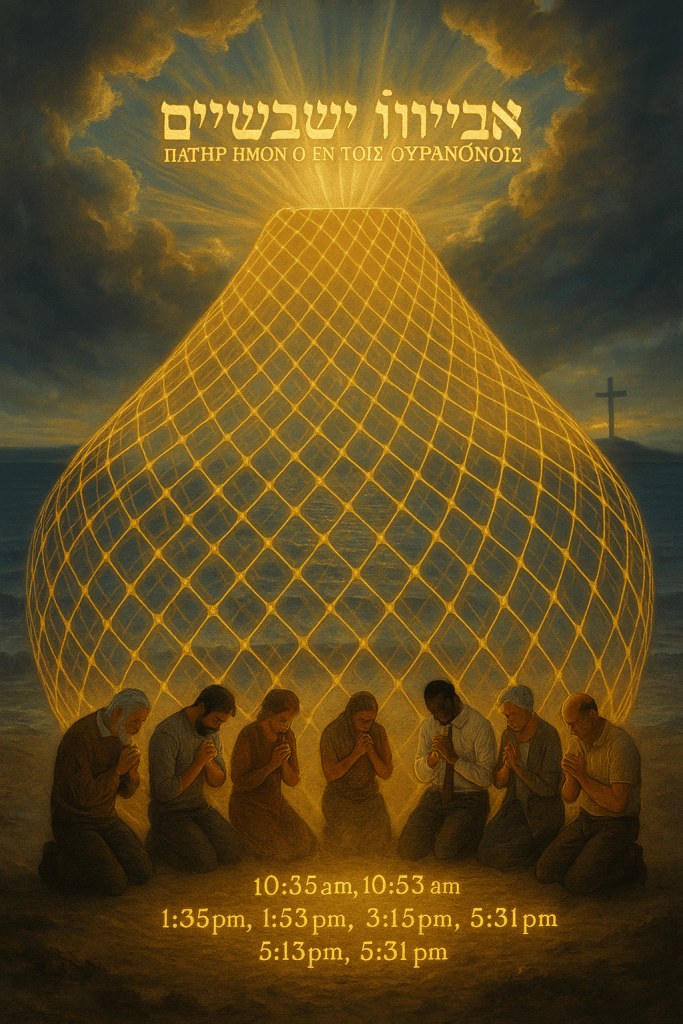
The Lord’s Prayer is the Net of God

Introduction

In the tapestry of divine revelation, Scripture interweaves image, number, and word with masterful precision. One such interlacing appears between Psalm 66:11, the Lord’s Prayer, and the miraculous catch of fish in John 21:11. This exposition uncovers a hidden structure of divine refinement and redemption, revealed through a remarkable numerical harmony anchored in Psalm 66:11, the identifier 168, and the total structure of Psalm 77.


1. Psalm 66:11 — The Net of Refinement

“Thou broughtest us into the net; thou laidst affliction upon our loins.”
Psalm 66:11

This verse encapsulates the experience of trial under God’s hand. The Hebrew gematria of its two key phrases provides a gateway into its spiritual significance:

PhraseHebrewGematria
“Thou broughtest us”הֲבֵאתָ֥נוּ464
“into the net”בַמְּצוּדָ֑ה147
Total611

The sum, 611, has four divisors: Divisors of 611=[1,13,47,611].

Arithmetic Mean=(1+13+47+611)/4=672/4=168


2. 168 — The Identifier of the Lord’s Prayer in Luke

According to the system of biblical identifiers (Book + Chapter + Verse):

VerseIdentifier
Luke 11:242 + 11 + 2 = 55
Luke 11:342 + 11 + 3 = 56
Luke 11:442 + 11 + 4 = 57
Total168

This identifies Luke 11:2–4, the concise form of the Lord’s Prayer, with the number 168.


3. Spiritual Insight: Into the Net of Prayer

The equivalence between:

  • The mean of the divisors of 611 (from Psalm 66:11), and
  • The identifier of the Lord’s Prayer in Luke,

is theologically profound:

To be brought “into the net” (Psalm 66:11) is to enter a divine pattern of discipline, refinement, and sanctification—and the very act of praying the Lord’s Prayer aligns the soul with this divine process.

This net is not one of condemnation, but of formation, drawing us into obedience and trust.


4. John 21:11 — The Net of Redemption

“Simon Peter climbed aboard and dragged the net ashore. It was full of large fish, 153, but even with so many the net was not torn.”
John 21:11

This verse reveals the net of grace, cast at the command of the risen Christ. It draws in 153 fish, symbolizing the fullness of the elect.

Together, Psalm 66:11 and John 21:11 create a unified narrative:

  • Psalm 66:11: Net of testing and discipline
  • John 21:11: Net of redemption and wholeness

5. The 8 Times of the Lord’s Prayer

From the permutations of 153 arise 6 spiritually significant numbers, which define 8 daily prayer times:

10:35 am, 10:53 am, 1:35 pm, 1:53 pm, 3:15 pm, 3:51 pm, 5:13 pm, 5:31 pm

These times serve as a spiritual entry into the net—a practice of daily discipline, surrender, and divine alignment.


6. The 2130 Revelation: Psalm 66:11 and Psalm 77

The Hebrew gematria of Psalm 66:11 totals 2130.

Psalm 66:11 — Word-by-Word Gematria Breakdown

#Hebrew WordTranslationGematria
1הֲבֵאתָ֥נוּ“You brought us”464
2בַמְּצוּדָ֑ה“into the net/prison”147
3שַׂ֖מְתָּ“You laid”740
4מוּעָקָ֣ה“burden”221
5בְמָתְנֵֽינוּ׃“on our loins”558
TOTAL2130

Surprisingly, the total of all verse identifiers in Psalm 77 also equals 2130.

ReferenceDescriptionValue
Psalm 66:11Gematria of the full verse2130
Psalm 77Sum of all verse identifiers (20 verses)2130

✨ Interpretation:

Psalm 66:11 describes the act of entering the net, while Psalm 77 is a spiritual map of what happens inside that net:

  • A descent into doubt (vv.1–9),
  • A decision to remember God’s faithfulness (vv.10–12),
  • A resurgence of praise grounded in redemptive history (vv.13–20).

This numerical unity teaches us that:

To enter the net (2130) is to enter the journey of Psalm 77—moving from affliction to assurance, and from despair to divine remembrance.

🔄 2. Psalm 77 — What Happens in the Net

This psalm maps the interior journey of the soul inside the net:

VersesPhaseDescription
1–3Crying OutDesperation and sleepless anguish
4–6QuestioningHas God forgotten? Why so silent?
7–9Crisis of FaithDoubting God’s mercy and covenant
10–12Turn to RemembranceActively choosing to recall God’s deeds
13–20Restoration of TrustAwe-filled meditation on the Exodus: “Your path led through the sea…”

It is the process of spiritual purification — the fire in the furnace, the pressure in the cocoon. The Psalm ends not with escape, but with reoriented faith.

🌅 3. Psalm 66:12 — What Happens After the Net

“You let people ride over our heads; we went through fire and water, but you brought us to a place of abundance.”

This is the glorious exit — a movement from:

  • Oppression to elevation
  • Trial to transformation
  • Narrowness to abundance

The Net was never the end — it was the threshold.
The end is abundance (רְוָיָה – revayah) — spiritually, emotionally, and covenantally.


Conclusion: Into the Net of the Kingdom

To pray the Lord’s Prayer is to enter God’s net—not of punishment, but of preparation and transformation.

  • Psalm 66:11 shows the entry into divine testing.
  • John 21:11 shows the redemptive purpose of that net.
  • Psalm 77 provides the spiritual anatomy of life inside the net.
  • Identifier 168 and total 2130 are the divine seals of this mystery.

The Lord’s Prayer is the net of God.
It refines, gathers, delivers—and fills the soul with remembrance of His mighty acts.

To pray at the 8 sacred times is to consciously step into God’s redemptive process and say, with full surrender:

Thy will be done.”

✅ Yes — praying the Lord’s Prayer at the 8 designated times draws us into the divine net, not to destroy us, but to:

  • Refine us like silver (Psalm 66:10),
  • Catch us for eternal life (John 21:11),
  • And prepare us to receive God’s abundance (Psalm 66:12).

“You brought us to a place of abundance.”

The Lord’s Prayer as the Law Written on the Heart: A Jewish-Covenantal Interpretation of the New Covenant

Abstract

This post argues that the Lord’s Prayer, often interpreted through a Greek-linguistic lens as a personal petition, is in fact rooted in Jewish covenantal theology. Drawing upon the prophetic promises in Jeremiah 31:31–34 and reinforced by numerical parallels in Hebrew gematria and number theory, we demonstrate that the Lord’s Prayer is not only a model of prayer but the actual fulfillment of the New Covenant—the Torah written on the heart. This reframes the prayer not merely as supplication but as a covenantal declaration—a daily vow to uphold God’s law and will as internalized by the Spirit. The conclusion is clear: the Lord’s Prayer is the sacred voice of covenant renewal for the remnant people of God.


1. Introduction

The Lord’s Prayer (Matthew 6:9–13) is often seen by Christians as a general model of devotion and supplication. However, when viewed through the lens of Jewish covenant theology, particularly the prophecy of Jeremiah 31:31–34, the prayer takes on a much deeper significance.

Jeremiah proclaims the coming of a New Covenant, unlike the one given at Sinai. This new covenant is defined by internal transformation:

“I will put my law within them, and I will write it on their hearts.” (Jer. 31:33)

This paper contends that the Lord’s Prayer is the very law God promised to inscribe on the hearts of His people. We will show this theologically and mathematically—proving that this ancient Jewish prayer is foremost a covenantal act.


2. The New Covenant in Jeremiah 31:31–34

Jeremiah 31:31–34 is the only place in the Old Testament where the phrase “new covenant” appears. It reads:

“I will put my law within them, and I will write it on their hearts. I will be their God, and they shall be my people.” (v.33)

This covenant is defined by:

  • Internal Torah (not tablets of stone)
  • Intimate relationship (“I will be their God…”)
  • Universal access to God (“They shall all know Me…”)
  • Total forgiveness (“I will forgive… I will remember sin no more.”)

It is a heart-centered Torah, infused by the Spirit (cf. Ezekiel 36:26–27), realized not through ritual, but through transformed inner life.


3. The Lord’s Prayer as Torah Written on the Heart

From a Jewish perspective, Torah refers to:

  1. The Five Books of Moses
  2. God’s instruction and moral guidance
  3. The covenantal framework shaping Israel’s spiritual identity

The Lord’s Prayer encompasses all these:

Line of the Lord’s PrayerTorah Principle Fulfilled
“Hallowed be Your name”Holiness code (Lev. 19:2)
“Your will be done…”Submission to divine law (Deut. 6:5)
“Give us daily bread”Trust in provision (Exodus 16)
“Forgive us… as we forgive”Justice and mercy (Lev. 19:18; Micah 6:8)
“Deliver us from evil”Moral purity and covenant protection

Thus, praying the Lord’s Prayer is an act of living the Torah from the inside out. It is God’s law written on the heart—not in tablets or scrolls, but in breath and commitment.


4. Mathematical Confirmation: A Hidden Covenant

The Hebrew gematria reveals a stunning correspondence:

PhraseHebrew Gematria
The Lord’s Prayer (Hebrew)10,838
Jeremiah 31:338,198

Using the Euler Totient function, we find (see the previous article Proof that the Lord’s Prayer is the Covenant of Jeremiah 31:33):

  • φ(10,838) = 1026
  • φ(8,198) = 4098
  • Mean of 4098’s divisors = 1026

The sanctified remnant number 1026 is embedded in both:

  • The covenant promise (Jeremiah 31:33)
  • Its fulfillment (The Lord’s Prayer)

Conclusion: The Lord’s Prayer is mathematically and spiritually the Torah written on the heart.


5. Covenant vs. Petition: A Theological Reframing

In Greek thought, the Lord’s Prayer is often treated as:

  • A petition (requests to a deity)
  • An individual act of devotion

But in Jewish thought, prayer is:

  • A covenantal declaration
  • A communal response to divine grace
  • A renewal of vows

Each line of the Lord’s Prayer contains a dual covenantal exchange:

God’s PromiseOur Response
“I will be your God”“Your kingdom come…”
“I will forgive…”“As we forgive…”
“I will write my law…”“Your will be done…”
“I will provide…”“Give us this day our daily bread…”

✨ The Lord’s Prayer is not just prayer—it is covenant renewal.

LineRitual MeaningCovenant Meaning
“Our Father in Heaven”A generic intro to prayerI acknowledge God as my Sovereign Father, and I commit to act as His child.
“Hallowed be Your Name”A statement of reverenceI pledge to honor God’s name in my actions, speech, and daily life.
“Your Kingdom come”Hope for the futureI surrender my own rule and pray: “Rule through me today.”
“Your will be done on earth…”Let God do what He wantsI align my life with His will—my desires, plans, and decisions become His.
“Give us today our daily bread”Ask for physical provisionI rely on God alone for provision, and I commit to contentment and trust.
“Forgive us… as we forgive…”Ask for mercyI commit to be an agent of mercy, living in forgiveness as a lifestyle.
“Lead us not into temptation”Keep me safeI declare war on sin, and invite God to discipline and direct me.
“Deliver us from evil”Protect me from harmI trust God for rescue and spiritual warfare, knowing the battle is real.
Doxology (Matt. 6:13)Formal endingI reaffirm God’s sovereignty, power, and glory over my life forever.

💥 When one prays this way, the Lord’s Prayer becomes a daily covenant renewal.


6. The Last Supper and the Inauguration of the Covenant

At the Last Supper, Jesus said:

“This cup is the new covenant in my blood…” (Luke 22:20)

He was directly referencing Jeremiah 31. His death would inaugurate this new internal covenant, not just for Israel but for the remnant of the nations.

Thus, the Lord’s Prayer, given by Jesus before His death, becomes the daily voice of this covenant.


7. Conclusion

The Lord’s Prayer is not a mere model of piety, nor a series of requests. It is:

✅ The Torah internalized
✅ The New Covenant activated
✅ A daily sanctification of the remnant
✅ A vow to live by God’s law
✅ The spiritual bridge between Jeremiah 31:33 and Matthew 6:9–13

To pray the Lord’s Prayer is to renew covenant—to say “yes” to the will of God etched on the heart, and to step into the divine destiny of the remnant.


References

  • The Holy Bible (Masoretic Text and Greek NT)
  • Jeremiah 31:31–34
  • Matthew 6:9–13
  • Luke 22:20; Hebrews 8–10
  • Vanualailai, J. (2025). Covenantal Prayer
  • Strong’s Concordance, Hebrew Lexicon
  • Bullinger, E.W. Number in Scripture

The Lord’s Prayer and the Last Supper are Inextricably Linked

The Last Supper is described in the Synoptic Gospels (Matthew, Mark, and Luke) and briefly referenced in John’s Gospel. The key passages are as follows:

1. Matthew 26:17-30

  • Preparation for the Passover meal.
  • Jesus institutes the Lord’s Supper: breaking the bread and offering the cup, symbolizing His body and blood.

2. Mark 14:12-26

  • Similar account as Matthew, including instructions to the disciples for preparing the Passover and the institution of the Eucharist.

3. Luke 22:7-23

  • Jesus expresses His desire to share this meal before His suffering.
  • The words of institution highlight the new covenant in His blood.

4. John 13:1-17

  • Instead of detailing the meal itself, John focuses on Jesus washing the disciples’ feet, a demonstration of humility and service.

5. 1 Corinthians 11:23-26

  • Paul provides a concise account of the Last Supper, emphasizing its theological significance as a proclamation of the Lord’s death until He comes.

These passages collectively describe the Last Supper’s events and theological meaning, making it central to Christian liturgy and theology.

It is Mark 14:12-36 that provides the mathematical link with the Lord’s Prayer in Luke 11:2-4. To see this, we note that the Gospel of Mark is the 41st of the Bible. Then the identifiers of the verses in Mark 14:12-36 are 67 to 81, respectively. Hence, the sum of the identifiers is 67+68+69+…+81 = 1110.

The number 1110 is the 923rd composite number. The divisors of 923 are in the set {1, 13, 71, 923}. The sum of the divisors is 1008 = 168 x 6. But 168 is precisely the identifier of Luke 11:2-4, the Lord’s Prayer.

Conclusion. The Lord’s Prayer and the Last Supper are inextricably linked mathematically through the number 168, itself the identifier for the Lord’s Prayer in the Gospel of Luke.

How are they inextricably linked?

The answer to this questions came from the biblical scholar and theologian Ernest Findlay Scott (1868 – 1964), who was “Professor Emeritus of Biblical Theology” of the Union Theological Seminary. In his 1951 book “The Lord’s Prayer: Its Character, Purpose and Interpretation”, he wrote:

Two things in our religion have come to us directly from Jesus himself – the Lord’s Supper and the Lord’s Prayer. He bequeathed to them these two ordinances which they were to preserve just as they had come from his hands – the Supper which tells us what he did for us, and the Prayer which sums up what he taught us. These two acts of worship have a place by themselves in our religion, and are like the two poles of which it turns. A Christian service would be complete if it consisted only of an observance of the Supper and a repetition of the Lord’s Prayer. Between them they represent everything that we believe, and they are necessary to each other.  We cannot rightly say the Prayer without remembering the Cross, and we cannot celebrate the Supper unless we mean to follow the way of Jesus in our daily lives. In all times, men have been conscious that in these two gifts Jesus gave us everything, and the chief aim of Christian thought has been to discover the full significance of the Lord’s Supper and the Lord’s Prayer.

The Lord’s Prayer is a Precise Summary of the Gospel of Jesus Christ: A Mathematical Proof

Biblical scholars and theologians have long known that the Lord’s Prayer was a precise summary of the Gospel of Jesus Christ. See some references in the Scholarly Comments section of this website.

The Gospel of Jesus Christ refers to the good news of God’s redemptive plan for humanity, accomplished through the life, death, resurrection, and ascension of Jesus Christ. It is the proclamation of salvation and eternal life available to all who believe in Him. It can be summarized under the following four categories of messianic prophecies in the Old Testament, as they comprehensively encapsulate the major themes and events central to His mission. Here’s how each category relates to the core message of the Gospel:

  1. Prophecies About Jesus’ Birth:
    • These prophecies highlight the miraculous and divine origins of Jesus, emphasizing His identity as the promised Messiah. His birth fulfills God’s promises to bring salvation to humanity, establishing the foundation of the Gospel.
  2. Prophecies About Jesus’ Life and Ministry:
    • Jesus’ teachings, miracles, and the way He lived demonstrate the nature of God, His love, and His kingdom. His life provides the model for righteous living and the manifestation of divine power and compassion.
  3. Prophecies About Jesus’ Death:
    • The death of Jesus is the climax of the Gospel, showing the ultimate sacrifice for humanity’s sins. This act of atonement is central to Christian belief, as it reconciles humans with God and provides a way for salvation.
  4. Prophecies About Jesus’ Resurrection:
    • The resurrection is the triumphant victory over sin and death, proving Jesus’ divinity and ensuring eternal life for believers. It is the cornerstone of Christian hope and the promise of a future resurrection for all who follow Him.

These categories collectively narrate the Gospel story—from the anticipation of the Messiah, His life on earth, the sacrificial death, and His victorious resurrection. They align with the essential message of the Gospel as expressed in 1 Corinthians 15:3-4:

“Christ died for our sins according to the Scriptures, that He was buried, that He was raised on the third day according to the Scriptures.”

Thus, the Gospel can be meaningfully summarized under these four categories.

Mathematically, it is sufficient to show that the total sum of the identifiers of any set of pertinent messianic prophecies in the Old Testament about Jesus Christ under the four categories points to the Lord’s Prayer, whose identifier is 168 in the Gospel of Luke and 285 in the Gospel of Matthew.

Accordingly, let us identify the pertinent verses and their identifiers:

1. Prophecies About Jesus’ Birth

  • Born of a Virgin: Isaiah 7:14 – “The virgin will conceive and give birth to a son, and will call him Immanuel.” Identifier=22.
  • Born in Bethlehem: Micah 5:2 – “But you, Bethlehem Ephrathah, though you are small among the clans of Judah, out of you will come for me one who will be ruler over Israel.” Identifier=40.
  • Descendant of Abraham: Genesis 22:18 – “Through your offspring all nations on earth will be blessed.” Identifier=41.
  • From the Line of David: Jeremiah 23:5 – “I will raise up for David a righteous Branch.” Identifier=52.
  • Herod’s Slaughter of Innocents Foretold: Jeremiah 31:15 – “A voice is heard in Ramah… Rachel weeping for her children.” Identifier=70.
  • Called Out of Egypt: Hosea 11:1 – “Out of Egypt I called my son.” Identifier=40.

Sum of all identifiers: 22+40+41+52+70+40=265.


2. Prophecies About Jesus’ Life and Ministry

  • Proceeded by a Messenger (John the Baptist): Isaiah 40:3 – “A voice of one calling in the wilderness: ‘Prepare the way for the LORD.’” Identifier=66.
  • A Light to the Gentiles: Isaiah 9:2 – “The people walking in darkness have seen a great light.” Identifier=34
  • He Will Teach in Parables: Psalm 78:2 – “I will open my mouth with a parable.” Identifier=99.
  • Perform Miracles: Isaiah 35:5 – “Then will the eyes of the blind be opened and the ears of the deaf unstopped.” Identifier=63.
  • Zeal for God’s House: Psalm 69:9 – “Zeal for your house consumes me.” Identifier=97.
  • The King Comes on a Donkey: Zechariah 9:9 – “See, your king comes to you, righteous and victorious, lowly and riding on a donkey.” Identifier=56.

Sum of all the identifiers: 66+34+99+63+97+56=415.


3. Prophecies About Jesus’ Death

  • Betrayed for Thirty Pieces of Silver: Zechariah 11:12 – “So they paid me thirty pieces of silver.” Identifier=61.
  • Silent Before His Accusers: Isaiah 53:7 – “He was oppressed and afflicted, yet he did not open his mouth.” Identifier=83.
  • Pierced Hands and Feet: Psalm 22:16 – “They pierce my hands and my feet.” Identifier=57.
  • Crucified with Criminals: Isaiah 53:12 – “He was numbered with the transgressors.” Identifier=88.
  • Mocked and Insulted: Psalm 22:7 – “All who see me mock me.” Identifier=48.
  • Given Vinegar to Drink: Psalm 69:21 – “They put gall in my food and gave me vinegar for my thirst.” Identifier=109.
  • His Side Pierced: Zechariah 12:10 – “They will look on me, the one they have pierced.” Identifier=60.
  • Cast Lots for His Clothing: Psalm 22:18 – “They divide my clothes among them and cast lots for my garment.” Identifier=59.

Sum of all identifiers: 61+83+57+88+48+109+60+59=565.


4. Prophecies About Jesus’ Resurrection

  • Raised on the Third Day: Hosea 6:2 – “After two days he will revive us; on the third day he will restore us.” Identifier=36.
  • Not Abandoned to the Grave: Psalm 16:10 – “You will not abandon me to the realm of the dead, nor will you let your faithful one see decay.” Identifier=45.
  • Ascends to Heaven: Psalm 68:18 – “When you ascended on high, you took many captives.” Identifier=105.
  • Seated at God’s Right Hand: Psalm 110:1 – “The LORD says to my lord: ‘Sit at my right hand until I make your enemies a footstool for your feet.’” Identifier=130.

Sum of all the identifiers: 36+45+105+130=316.

Hence, the total of all the sums is 265+415+565+316=1561.

Now, there are 215 sphenic numbers less than or equal to 1561. We can also get 215 if we consider the fact that 1561 is the 1314th composite number and that an approximation of the function Prime Pi evaluated at 1314 is 215.

But the astonishing result is that the Euler Totient function evaluated at 215 is precisely 168, the identifier of the Lord’s Prayer in the Gospel of Luke.

BookChapterVerseSum
4211255
4211356
4211457
  168

The identifier of the Lord’s Prayer in the Gospel of Luke is 168

Conclusion. The Lord’s Prayer is a precise summary of the Gospel of Jesus Christ.