A Theological Reflection on Psalm 79:10 and the Numbers 108 and 153

🙏 Introduction

The Lord’s Prayer stands as the most beloved and unifying prayer across all of Christianity. Reverently recited by Christians of every denomination, it encapsulates a sacred rhythm—anchoring believers in God’s will, provision, forgiveness, and protection. Yet, beneath its surface lies a remarkable numerical structure centered on the number 153—a number that also appears in the Gospel of John as the measure of the miraculous catch of fish, often symbolizing the fullness of redemption.

A fascinating interplay emerges when we consider Psalm 79:10, a verse of lament from ancient Israel. Its numerical identifier is 108, a number deeply revered in other spiritual traditions, particularly Hinduism and Buddhism. But rather than creating conflict, this juxtaposition offers an invitation: to explore how prayer—specifically, the Lord’s Prayer—becomes a faithful answer to the world’s deepest cries.


📖 Psalm 79:10 – A Cry for Justice

“Why should the nations say, ‘Where is their God?’ Let the avenging of the outpoured blood of your servants be known among the nations before our eyes.”
— Psalm 79:10

Psalm 79 is a communal lament composed during a time of great national distress. It reflects the grief of God’s people after the desecration of Jerusalem and the suffering of the innocent. In verse 10, the psalmist asks a poignant question: Why should the nations mock the silence of God?

Using the biblical method of calculating verse identifiers (Book + Chapter + Verse), Psalm 79:10 receives an identifier of:

19(BookofPsalms)+79(Chapter)+10(Verse)=108


🕉️ The Number 108 – Revered in Global Traditions

The number 108 holds deep spiritual significance in many Eastern traditions:

  • In Hinduism, it represents the 108 names of deities and is found in prayer beads (mala) used for chanting.
  • In Buddhism, it symbolizes the 108 afflictions of the human mind that practitioners seek to overcome through purification.
  • In Jainism, it denotes the 108 attributes of the enlightened beings.

For many, 108 is a symbol of spiritual wholeness and cosmic order. From a Christian perspective, however, the meaning of 108 invites a different reflection: not a condemnation of others’ beliefs, but a contemplation of what true fullness means, and where it is ultimately found.


🔢 The Response Hidden in the Numbers: 1035 and 153

While verse 10 stands out with its identifier 108, something extraordinary emerges when we calculate the cumulative identifiers of Psalm 79:1–10. That is, if we sum the identifiers of each verse from verse 1 to 10, we get:

99+100+101+…+108=103599 + 100 + 101 + … + 108 = 1035

The number 1035, when its digits are rearranged, contains 1–5–3: a clear allusion to 153, a number rich with theological meaning in Christian thought.


🎣 The Number 153 – The Net of Redemption

  • In John 21:11, after the Resurrection, the disciples catch 153 fish in a net that does not break. Early Christian interpreters saw this as a symbol of the totality of humanity gathered into God’s Kingdom.
  • Mathematically, 153 = 17 × 9, where 17 is the sum of the first 7 natural numbers (symbolizing divine order), and 9 represents spiritual completion.

In our own theological framework, 153 also encodes the 8 prayer times of the Lord’s Prayer (10:35, 10:53, 1:35, etc.), forming a sacred rhythm for daily communion with God.


🔁 From Mockery to Prayer: A Theological Arc
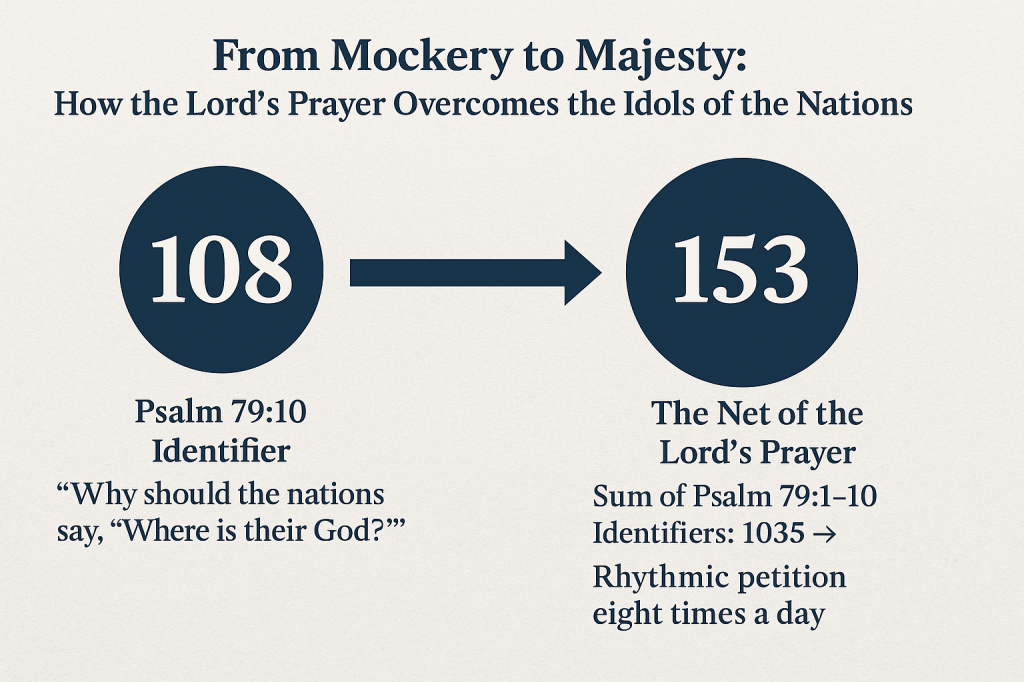
Psalm 79:10 begins with a question from the nations:

“Where is their God?”

This is not just a rhetorical question—it represents the longing of the world for a visible, just, and active God.

The answer comes not in thunder or force, but in the quiet power of prayer—the structured, faithful cry of God’s people. The cumulative sum of verses 1–10, totaling 1035, encodes 153, the number of the Lord’s Prayer. The implication is profound:

The mocking of the nations (108) is answered by the persistent prayer of God’s people (153).


🤝 Interfaith Sensitivity and Christian Testimony

In honoring this insight, we must approach it with humility and grace. While Christians believe that the fullness of spiritual truth is found in Jesus Christ, this belief does not diminish the sincerity, moral integrity, or spiritual longing of those from other faiths. Rather, we affirm that:

  • The number 108, as honored in other traditions, reflects a deep and beautiful search for divine connection.
  • In Christian theology, the number 153 becomes our symbol of divine response—a net cast by Christ to gather all who seek truth, hope, and redemption.

Thus, instead of condemnation, we offer an invitation—to consider that the rhythms of prayer, culminating in the Lord’s Prayer, answer the universal cry for justice, mercy, and spiritual completeness.


📊 Summary Table

ConceptValueInterpretation
Psalm 79:10 Identifier108Symbol of the nations’ question and longing
Cumulative Identifiers (v1–10)1035Encodes 153—the prayerful rhythm of divine presence
Christian Symbolism153The Net of Redemption; the Lord’s Prayer; divine fullness
Theological Insight108 → 153The cry of the nations is answered by the prayer of the faithful

🌍 Conclusion

In the tension between the nations’ mockery and God’s apparent silence, Psalm 79 gives voice to both anguish and hope. Hidden within its structure, however, is a revelation: the number 108, though honored in other traditions, becomes in this psalm the cry of the world. The response is found not in retaliation, but in the Lord’s Prayer, encoded in the number 153, the sum of accumulated cries and the rhythm of redemptive hope.

In this way, the Lord’s Prayer becomes not only the response of Israel—but the response of the Church—to the cry of the world. It is an act of love, rooted in faith, and extended in humility.
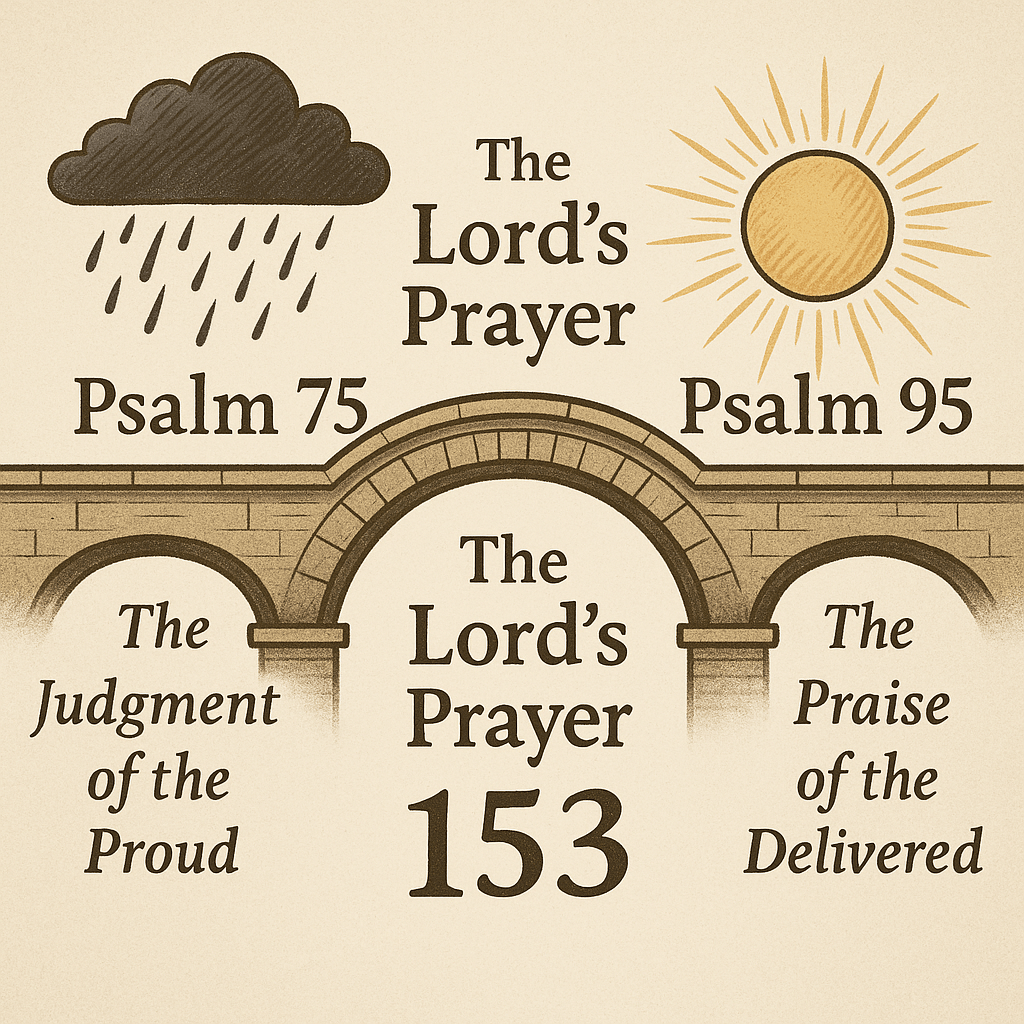
The Lord’s Prayer: A Spiritual Bridge from Judgment to Praise

1. Introduction

In the biblical narrative, God is not indifferent to injustice. Psalm 75 is a vivid declaration of divine judgment against prideful, oppressive, and paranoid rulers. Psalm 95, on the other hand, is a communal invitation to joyful worship and reverent obedience.

This paper contends that the Lord’s Prayer, embedded within the very fabric of Scripture, functions as the theological and numerical bridge between these two psalms. It facilitates the cry for justice and the praise of deliverance. The mathematical structure of these psalms affirms the Lord’s Prayer as a divine key.


2. Psalm 75: The Judgment of the Proud

Psalm 75 announces God as the ultimate judge who “puts down one, and sets up another” (v.7). The psalm speaks directly to arrogant and power-obsessed individuals: “Lift not up your horn on high: speak not with a stiff neck” (v.5). It offers assurance to the oppressed that justice will be served.

  • Total Identifier of Psalm 75: 995
    Computed as the sum of verse identifiers (Book 19 + Chapter 75 + Verse Number)
  • Divisors of 995: [1, 5, 199, 995]
    Geometric Mean ≈ 31.54 → digits: 3, 1, 5 → permutation of 153

This reveals that divine judgment in Psalm 75 is numerically tethered to the number 153, long recognized as a symbolic number of fullness, divine order, and the Lord’s Prayer itself.


3. Psalm 95: The Praise of the Delivered

Psalm 95 represents the spiritual condition of a community that has witnessed the fall of injustice. It begins with a call to thanksgiving and ends with a sober reminder not to repeat the errors of rebellion. It is the natural response after God has fulfilled the promise declared in Psalm 75.

  • Total Identifier of Psalm 95: 1320
  • Divisors of 1320: 32 in total
    Sum of Divisors: 4320 → Arithmetic Mean = 4320 / 32 = 135 → another permutation of 153

Again, we see the numerical resonance with 153, suggesting a hidden unity with Psalm 75 and a full-circle return to divine order through worship.


4. Theological Function of the Lord’s Prayer

The Lord’s Prayer operates on two planes simultaneously:

  1. As Petition for Judgment and Deliverance
    • “Thy kingdom come, Thy will be done on earth as it is in heaven” (Matthew 6:10) aligns with the themes of Psalm 75.
    • “Deliver us from evil” speaks directly to the plea against oppressive and paranoid leadership.
  2. As Praise for Redemption and Rest
    • “Give us this day our daily bread” and “Forgive us our trespasses” echo the spirit of Psalm 95—communal thanksgiving, humility, and worship.

These dual functions mirror the movement from Psalm 75 to Psalm 95, confirming the Lord’s Prayer as a spiritual bridge.


5. The Mystery of 153 and the Net of Prayer

The number 153 is most famously associated with John 21:11, the miraculous catch of fish. It symbolizes fullness, the gathering of the elect, and the net of divine calling.

In the framework discussed:

  • Psalm 75’s Geometric Mean (31.5) → 153
  • Psalm 95’s Arithmetic Mean (135) → 153

These findings show that the Lord’s Prayer, encoded in 153, is the sanctified net through which the justice of Psalm 75 is drawn into the praise of Psalm 95.


6. Conclusion: Sanctifying Time and Order through the Lord’s Prayer

The Lord’s Prayer is more than a petition; it is the divine engine that moves history from oppression to order, from sorrow to song. The numerical revelations encoded in Psalms 75 and 95 are not random coincidences but holy signatures of the spiritual transformation initiated by this prayer.

Thus, whether confronting the horns of the wicked or entering the rest of the righteous, we are called to pray:

“Thy kingdom come, Thy will be done… For Thine is the kingdom, and the power, and the glory forever. Amen.”

🙏 Theological Implication

The Lord’s Prayer can and should be:

  • Prayed during times of oppression as a petition for righteous judgment (Psalm 75).
  • Prayed after vindication as a song of thanks and renewed worship (Psalm 95).

It becomes the spiritual Net of 153:

  • Gathering the humble,
  • Separating the wicked,
  • Restoring the soul,
  • And sanctifying the time and the people.

From Prowling Sins to Morning Songs: A Theological Reflection on Psalm 59 and the Power of 185

Introduction Psalm 59 is a profound tapestry of lament, trust, and praise, penned by David in a time of peril. It is historically rooted in the event when Saul sent men to watch David’s house in order to kill him (1 Samuel 19). Yet beyond its immediate context, Psalm 59 becomes a rich metaphorical and theological canvas for exploring divine protection, spiritual warfare, and ultimate deliverance. This article draws together Psalm 59, the miraculous account of 185,000 slain Assyrians, and symbolic numerology to unveil deeper dimensions of God’s covenantal care and judgment.


1. Historical and Spiritual Context of Psalm 59 David writes Psalm 59 while being hunted by Saul’s assassins. His opening verses are a desperate cry: “Deliver me from my enemies, O my God” (v.1). His enemies are described as fierce, unjust, and bloodthirsty. But rather than retaliate in kind, David places his hope in God’s deliverance.

Metaphorically, David’s enemies may be understood as sins or temptations that relentlessly pursue the believer. Verses 14–15 give us this vivid imagery:

“They return at evening, snarling like dogs, and prowl about the city. They wander about for food and howl if not satisfied.”

This portrays sin as an ever-returning, insatiable threat—restless, hungry, and predatory.


2. Morning Praise and Fortress of Refuge The psalm then turns from night to day, from fear to faith:

“But I will sing of your strength, in the morning I will sing of your love; for you are my fortress, my refuge in times of trouble” (Psalm 59:16).

Here, morning becomes a symbol of divine deliverance. As darkness gives way to light, the believer transitions from survival to song. The city that once echoed with the howls of enemies now resonates with praise.


3. The Identifiers and the Mystery of 185 Applying biblical numerology, each verse may be given an identifier: Book Number + Chapter Number + Verse Number. For Psalm 59:

  • Psalm 59:14 = 19 + 59 + 14 = 92
  • Psalm 59:15 = 19 + 59 + 15 = 93
  • Sum = 185

This numerical sum draws us directly to 2 Kings 19:35 and Isaiah 37:36:

“That night the angel of the Lord went out and put to death 185,000 in the Assyrian camp. When the people got up the next morning—there were all the dead bodies!”

The parallel is striking:

  • In both narratives, night is the time of siege.
  • In both, deliverance comes invisibly.
  • And in both, morning reveals the total defeat of the enemy.

4. The Symbolism of the Number 185

✦ Divine Intervention
185 signifies God’s sovereign and sudden response. As the people of Jerusalem slept, God intervened without sword or human effort. Similarly, David’s foes—be they human or spiritual—are neutralized by divine initiative.

✦ Judgment and Justice
185 symbolizes the executed judgment against pride and oppression. The Assyrians mocked the God of Israel. Their fall reveals God’s unwillingness to let arrogance go unchallenged.

✦ Angelic Warfare
This number brings to light the unseen spiritual battle on behalf of the faithful. One angel, in obedience to God, renders a vast army powerless.

✦ Covenant Protection
185 also illustrates how God defends His covenant people when they turn to Him in humility and prayer—as Hezekiah did.


5. Theological Insert: 185 and the Lord’s Prayer

The number 185 also forms a symbolic bridge to the Lord’s Prayer, revealing itself as the divine execution of its petitions:

  • “Deliver us from evil” — exactly what happens in the slaying of the Assyrians.
  • “Thy kingdom come, Thy will be done on earth as in heaven” — fulfilled as God’s will is enforced through angelic power.
  • “Give us this day our daily bread” — answered through the lifting of siege and famine.

In fact, the Lord’s Prayer and the Assyrian episode share structural symmetry:

  • Hezekiah prays in humility;
  • God responds with covenant faithfulness;
  • An angel executes justice;
  • Morning reveals victory and peace.

185, then, is the numerical fulfillment of the Lord’s Prayer in action. It is what it looks like when heaven answers earth:

✢ 185 is the thunderclap of “deliver us from evil.”
✢ It is the angel’s sword answering the disciple’s plea.


6. Theological Summary Psalm 59 is more than a psalm of survival—it is a blueprint for trust in the face of evil. Its spiritual arc mirrors the night-and-morning structure of the 185,000 Assyrian deaths:

  • Verses 14–15 mirror the threatening night, filled with prowling danger.
  • Verses 16–17 reflect the dawning praise, where the once-besieged soul now sings in freedom.

And embedded within it, the sum 185 serves as a numerical seal linking David’s personal enemies to Israel’s national threat and reminding us that God’s deliverance, whether personal or cosmic, is often unseen, but always certain.

“You are my strength, I sing praise to you; you, God, are my fortress, my God on whom I can rely” (Psalm 59:17).


Conclusion The theological convergence of Psalm 59 and the number 185 reveals a timeless truth: while sin may prowl at night, God sends His angels by decree, and morning always breaks with praise. The believer need not fear the howling of spiritual foes—for God’s covenant love ensures that the fortress will stand, the enemy will fall, and the song will rise.

The Lord’s Right Hand Is Lifted High! (Psalm 118)

Psalm 118 is a joyful declaration of God’s steadfast love and the triumph of His righteousness. This psalm is a part of the Hallel, a series of psalms (Psalms 113–118) traditionally sung during Jewish festivals, particularly Passover. It is a communal and personal celebration of deliverance and thanksgiving to the Lord.

Verse 16 reads (NIV) : The Lord’s right hand is lifted high; the Lord’s right hand has done mighty things!

Since the Book of Psalms is the 19th book of the Bible, the identifier of the verse is (19+118+16=153).

Conclusion: When we pray the Lord’s Prayer, we declare that the Lord’s right hand is lifted high; the Lord’s right hand has done mighty things!

In the Lord’s Prayer, we say, “Thy Kingdom come, Thy will be done, on earth as it is in heaven” (Matthew 6:10). This petition acknowledges God’s supreme authority and power to accomplish His will. Similarly, Psalm 118:16 exalts the Lord’s “right hand,” a symbol of His sovereignty, which performs “mighty things” to fulfill His divine will.

Psalm 79 and the Lord’s Prayer

The entirety of Psalm 79 astonishingly points to the Lord’s Prayer. Here’s the table for Psalm 79, including the verse enumeration, verse citations, verse texts, identifiers for each verse, and their accumulated sums:

No.VerseTextIdentifierAccumulated Sum
1Psalm 79:1O God, the nations have come into your inheritance; they have defiled your holy temple; they have laid Jerusalem in ruins.9999
2Psalm 79:2They have given the bodies of your servants to the birds of the heavens for food, the flesh of your faithful to the beasts of the earth.100199
3Psalm 79:3They have poured out their blood like water all around Jerusalem, and there was no one to bury them.101300
4Psalm 79:4We have become a taunt to our neighbors, mocked and derided by those around us.102402
5Psalm 79:5How long, O LORD? Will you be angry forever? Will your jealousy burn like fire?103505
6Psalm 79:6Pour out your wrath on the nations that do not know you, and on the kingdoms that do not call upon your name!104609
7Psalm 79:7For they have devoured Jacob and laid waste his habitation.105714
8Psalm 79:8Do not remember against us our former iniquities; let your compassion come speedily to meet us, for we are brought very low.106820
9Psalm 79:9Help us, O God of our salvation, for the glory of your name; deliver us, and atone for our sins, for your name’s sake!107927
10Psalm 79:10Why should the nations say, ‘Where is their God?’ Let the avenging of the outpoured blood of your servants be known among the nations before our eyes!1081035
11Psalm 79:11Let the groans of the prisoners come before you; according to your great power, preserve those doomed to die!1091144
12Psalm 79:12Return sevenfold into the lap of our neighbors the taunts with which they have taunted you, O Lord!1101254
13Psalm 79:13But we your people, the sheep of your pasture, will give thanks to you forever; from generation to generation we will recount your praise.1111365

There are 16 divisors of 1365, namely, {1, 3, 5, 7, 13, 15, 21, 35, 39, 65, 91, 105, 195, 273, 455, 1365}. The sum of the divisors is 2688. Hence, the arithmetic mean of the divisors is 2688/16 = 168. Since 168 is the identifier of the Lord’s Prayer in the Gospel of Luke, the themes and moral lessons of Psalm 79 are encapsulated by the Lord’s Prayer.

Discussion

The themes and moral lessons of Psalm 79 center on the relationship between the community and God during times of extreme adversity. They teach the importance of turning to God in honest lament, seeking justice from a divine perspective, acknowledging communal and ancestral sins, and understanding the broader implications of God’s actions for His global reputation. Additionally, they reinforce the value of praising God for His deliverance and faithfulness, emphasizing a stance of gratitude and recognition of God’s mercy. They connect well with several elements of the Lord’s Prayer, offering a deeper understanding of how these scriptures complement each other in the broader context of faith and reliance on God.

Acknowledgment of God’s Sovereignty

  • Psalm 79. The Psalmist begins by acknowledging the devastation brought upon by foreign nations, yet it is clear that they turn to God as the ultimate authority and deliverer.
  • Lord’s Prayer. This is echoed in the opening of the Lord’s Prayer with “Our Father in heaven, hallowed be your name,” which recognizes God’s ultimate sovereignty over all things.

Seeking Deliverance and God’s Kingdom

  • Psalm 79. The Psalm appeals to God for deliverance from enemies and for the manifestation of His justice and mercy, showing reliance on God’s power to save.
  • Lord’s Prayer. Similarly, the prayer includes “Your kingdom come, your will be done, on earth as it is in heaven,” seeking God’s righteous rule and divine intervention in the world.

Request for Forgiveness

  • Psalm 79. The Psalmist pleads for forgiveness for past sins, recognizing that their current plight might be a consequence of these actions. They seek reconciliation and mercy.
  • Lord’s Prayer. This aspect aligns with “Forgive us our debts, as we also have forgiven our debtors,” emphasizing the need for divine forgiveness and the importance of forgiving others as a reflection of God’s forgiveness.

Protection from Evil

  • Psalm 79. The psalm ends with a plea for protection and deliverance from the evils that have befallen the people, hoping that God will not let their foes triumph over them permanently.
  • Lord’s Prayer. This is paralleled in “And lead us not into temptation, but deliver us from the evil one,” where there is a petition for guidance away from sin and protection from evil influences.

Call for Justice and Retribution

  • Psalm 79. The psalm specifically asks for God’s retribution against those who have wronged them, reflecting a desire for divine justice to prevail.
  • Lord’s Prayer. While the Lord’s Prayer does not explicitly call for retribution, the appeal for God’s kingdom and will implies a restoration of justice according to divine standards.

Conclusion with Praise and Hope

  • Psalm 79. Despite the lament and pleas for help, the Psalm concludes with a vow to give thanks and praise to God forever, showing trust in God’s faithfulness.
  • Lord’s Prayer. The prayer also concludes with a doxology in some traditions: “For yours is the kingdom, and the power, and the glory, forever. Amen.” This encapsulates the praise and acknowledgment of God’s eternal sovereignty and power.

Integration

Both Psalm 79 and the Lord’s Prayer encapsulate a profound reliance on God in times of distress, a plea for divine intervention, and an acknowledgment of God’s rule. They collectively teach about the relationship between human vulnerability, divine power, and the role of faith in navigating life’s challenges. Through these prayers, believers are reminded of the importance of turning to God, seeking His justice, and trusting in His eternal goodness and mercy.