Exploring the Lord’s Prayer as a profound summary of the Gospel of Jesus Christ—through Scripture, reflection, and carefully framed numerical patterns that serve as secondary witnesses to the truth and beauty of God’s Word.
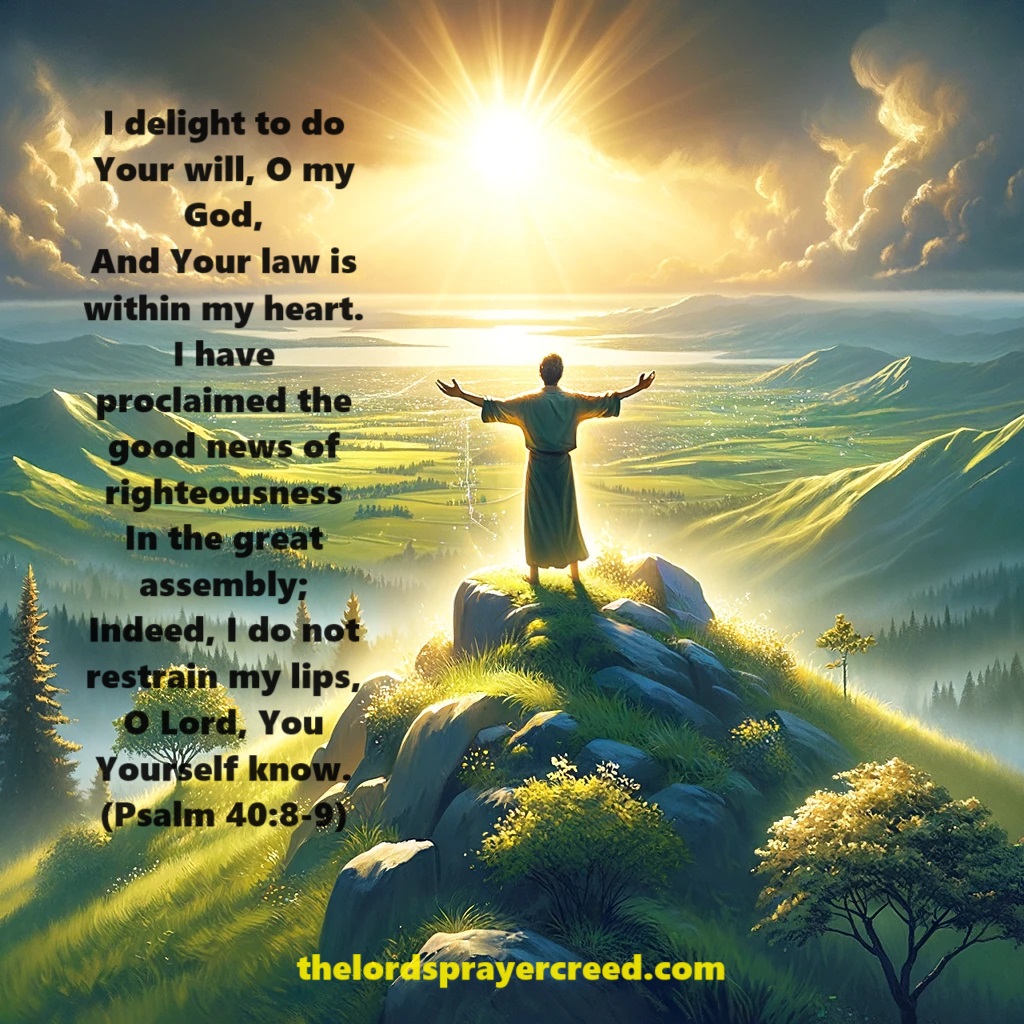
Psalm 40:8-9 captures the essence of wholehearted devotion and obedience to God: “I desire to do your will, my God; your law is within my heart.” (Psalm 40:8) “I proclaim your saving acts in the great assembly; I do not seal my lips, Lord, as you know.” (Psalm 40:9)
The essence of Psalm 40:8-9 is one of unwavering commitment to God, a fervent desire to follow His will, and a readiness to share His goodness with others. It reflects a heart fully surrendered to God, eager to live in obedience and bear witness to His faithfulness.
To calculate the sum of the identifiers for Psalm 40:8-9, we’ll find the identifier for each verse and then sum them up.
For Psalm 40:8:
Book of Psalms = 19 Chapter 40 Verse 8 Identifier = 19 + 40 + 8 = 67
For Psalm 40:9:
Book of Psalms = 19 Chapter 40 Verse 9 Identifier = 19 + 40 + 9 = 68
Now, let’s sum these identifiers:
For Psalm 40:8-9: 67 + 68 = 135
Therefore, the sum of the identifiers for Psalm 40:8-9 is 135.
In the Lord’s Prayer, Jesus teaches His disciples to pray, “Your will be done, on earth as it is in heaven” (Matthew 6:10), indicating a desire for God’s perfect will to be fulfilled. Similarly, Psalm 40:8 declares, “I desire to do your will, my God,” reflecting the psalmist’s earnest desire to align their life with God’s purposes.
Conclusion: When we pray the Lord’s Prayer, we declare to our Father in Heaven that we desire to do His Will.
Psalm 34:14 focuses on the individual’s responsibility to turn away from evil and actively do good, emphasizing that seeking and pursuing peace is a personal action. It suggests a moral and ethical lifestyle, guiding people towards righteousness and peace as central virtues in their lives. The journey of seeking and pursuing righteousness and peace, as outlined in Psalm 34:14, is met with God’s unwavering support and attentiveness, as affirmed in Psalm 34:15.
Psalm 34:14-15 (NKJV): 14 Depart from evil and do good; Seek peace and pursue it. 15 The eyes of the Lord are on the righteous, And His ears are open to their cry.
The identifiers for the verses are (19+34+14=67) and (19+34+15=68), so that the sum is 135.
Conclusion: When we pray the Lord’s Prayer, we petition our Father in Heaven to help us to be righteousand to seek peace and pursue it.
Discussions
In biblical context, righteousness often involves living in a way that is in alignment with God’s will—acting justly, loving mercy, and walking humbly with God (Micah 6:8).
He has shown you, O man, what is good; And what does the Lord require of you But to do justly, To love mercy, And to walk humbly with your God?
Micah 6:8
This ethical and moral conduct creates a foundation for peace. Peace (shalom in Hebrew) in the Bible is a comprehensive term that means more than the absence of conflict; it includes ideas of completeness, wholeness, health, welfare, safety, soundness, tranquility, prosperity, fullness, rest, and harmony. The pursuit of righteousness, therefore, is inherently linked to the creation and cultivation of peace because righteousness lays the groundwork for a life that fosters harmony within oneself, with others, and with God.
This relationship – where righteousness is a prerequisite for peace – reflects a broader biblical theme where peace is often seen as the fruit of righteousness. For example, Isaiah 32:17 says, “The fruit of that righteousness will be peace; its effect will be quietness and confidence forever.” This suggests that peace is both a consequence and a condition of righteousness; they feed into each other in a virtuous cycle.
Psalm 31:17-18 is a powerful plea to God for deliverance and justice. The verses express a deep trust in God’s protection and a request for vindication.
17 Do not let me be ashamed, O Lord, for I have called upon You;Let the wicked be ashamed;Let them be silent in the grave.18 Let the lying lips be put to silence,Which speak insolent things proudly and contemptuously against the righteous.
Psalm 31:17-18
Encapsulated within these verses is a heartfelt invocation for God’s guiding hand in delivering justice and protection.
The identifiers for these verses are (19+31+17=67) and (19+31+18=68), respectively. Hence, the sum is 135.
Conclusion. When we pray the Lord’s Prayer, we plea for divine intervention and justice, seek protection from shame, call for the accountability of the wicked, and pray for the end of their harmful actions and words against the righteous.
Discussions
The Lord’s Prayer and Psalm 31:17-18, while distinct in their focus and context, share underlying themes of reliance on God for deliverance, protection, and justice. Here’s how they can be related:
Seeking God’s Intervention and Will: The Lord’s Prayer includes the petition “Your kingdom come, Your will be done, on earth as it is in heaven.” This reflects a desire for God’s righteous rule and will to prevail in the world, aligning with the plea in Psalm 31:17-18 for God to act against the wicked and protect the righteous. Both passages express a trust in God’s sovereignty and justice.
Deliverance from Evil: In the Lord’s Prayer, “And lead us not into temptation, but deliver us from evil” echoes the sentiment of Psalm 31:17-18, where there’s a plea for protection from the harm and influence of the wicked. Both prayers seek God’s guiding hand to navigate and be safeguarded from the presence of evil.
Protection and Provision: The Lord’s Prayer asks for daily provision (“Give us this day our daily bread”) and implies a need for God’s ongoing protection and guidance. Similarly, Psalm 31:17-18’s appeal not to be put to shame and for the wicked to be silenced indicates a dependence on God for protection and justice, ensuring the well-being of the faithful.
Justice and Righteousness: The plea in Psalm 31:17-18 for the wicked to be ashamed and silenced reflects a yearning for divine justice, where the righteous are vindicated, and wrongdoers face consequences. The Lord’s Prayer, through its appeal for God’s kingdom and will, implicitly supports a world where God’s justice and righteousness are manifest, aligning with the themes of accountability and protection in the psalm.
In essence, both the Lord’s Prayer and Psalm 31:17-18 articulate a deep reliance on God for guidance, protection, and the establishment of His justice. They reflect a spiritual posture that acknowledges God’s sovereignty and seeks His intervention in the face of adversity and evil.
Psalm 25 is a prayer of David expressing trust in God, seeking guidance, forgiveness, and protection. It highlights themes of divine guidance, the plea for forgiveness of sins, and the desire for personal guidance and protection from enemies. David emphasizes his trust in God, asking for God’s mercy and guidance while acknowledging God’s goodness and steadfast love. He prays for protection from shame and the treachery of his enemies, expressing confidence that those who wait for the Lord will not be put to shame. The psalm reflects a deep yearning for a closer relationship with God, grounded in humility and a recognition of God’s mercy and truth. Verse 4, in particular, is reflective of the former: Show me Your ways, O LORD; teach me Your paths. In this article, we show how the Lord’s Prayer is actually a means to ask our Father in Heaven to teach us His ways.
The value of each Hebrew word in Psalm 25:4 is provided in the table below:
Psalm 25:4 Show me Your ways, O LORD; teach me Your paths.
The sum of the statement “Your ways, Yahweh, show me” is (254+26+155)=435. The divisors of 435 are in the set {1, 3, 5, 15, 29, 87, 145, 435}. The sum of the divisors is 720; hence the Aliquot Sum is 720 – 435 = 285, which is the identifier of the Lord’s Prayer in the Gospel of Matthew.
Book
Chapter
Verse
Sum
40
6
9
55
40
6
10
56
40
6
11
57
40
6
12
58
40
6
13
59
285
The identifier of the Lord’s Prayer in the Gospel of Matthew is 285
Conclusion. When we are praying the Lord’s Prayer, we are also petitioning our Father to show us His ways.
Discussions
The verse from Psalm 25:4, “Show me Your ways, O LORD; teach me Your paths,” resonates with themes found in the Lord’s Prayer, which is taught by Jesus in the New Testament (found in Matthew 6:9-13 and Luke 11:2-4). The connection between this verse and the Lord’s Prayer can be seen in the shared themes of seeking guidance, reliance on God’s will, and the desire for spiritual growth and understanding.
In the Lord’s Prayer, the petition “Your kingdom come, Your will be done, on earth as it is in heaven” directly parallels the plea in Psalm 25:4 for God to reveal His ways and paths. Both passages emphasize the importance of aligning oneself with God’s will and seeking divine direction in life. The request to be taught God’s paths suggests a desire to live in accordance with God’s commandments and to fulfill His purposes, mirroring the call in the Lord’s Prayer for God’s will to be paramount in the believer’s life.
Furthermore, the Lord’s Prayer includes requests for daily provision (“Give us this day our daily bread”), forgiveness (“And forgive us our debts, as we also have forgiven our debtors”), and guidance away from temptation and evil (“And lead us not into temptation, but deliver us from evil”). These elements can be seen as expanding on the desire expressed in Psalm 25:4 for guidance and teaching, indicating a holistic reliance on God for physical, spiritual, and moral support.
Both the verse from Psalm 25 and the Lord’s Prayer encapsulate a deep dependence on God, highlighting the believer’s need for divine direction, sustenance, and protection. They reflect a spiritual posture of humility and trust, acknowledging that true guidance and wisdom come from God alone.

 The Lord's Prayer: A Mathematician's Creed