Psalm 118: The Song of Final Victory and the Renewed Covenant

A Theological, Christological, and Numerical Exegesis

1. Introduction

Psalm 118 stands at the summit of biblical praise. It is the sixth and final psalm of the Egyptian Hallel (Pss. 113–118), the great liturgical sequence sung at Israel’s major festivals, particularly the Passover (Exod 12; Mishnah Pesachim 10). According to Matthew 26:30 and Mark 14:26, Psalm 118 was almost certainly the final hymn Jesus sang with His disciples at the Last Supper—mere hours before His crucifixion.

This psalm is therefore uniquely positioned: it is the closing anthem of the Old Covenant liturgy and the prophetic overture to the New Covenant established in Christ’s blood. It is the Song of Final Victory and the Song of Renewed Covenant—nationally, eschatologically, and personally.


2. Structure and Themes of Psalm 118

Psalm 118 moves through a dramatic theological arc:

  1. Call to Thanksgiving (vv. 1–4)
    Repeated liturgical refrain:
    “Give thanks to the LORD, for He is good; His mercy endures forever.”
    Hebrew: כִּי לְעוֹלָם חַסְדּוֹ (ki le‘olam ḥasdô)—“for His covenant-mercy endures forever.”
  2. Deliverance from Distress (vv. 5–9)
    A cry from the brink of collapse and enemies.
  3. Victory over the Nations (vv. 10–14)
    The LORD becomes salvation.
    Hebrew: יָשׁוּעָה (yeshu‘ah)—“salvation,” the root of Yeshua, Jesus’ name.
  4. The Right Hand of YHWH Triumphs (vv. 15–16)
    The theological centre of the psalm:
    “The right hand of YHWH is exalted; the right hand of YHWH does valiantly.”
    Hebrew: יְמִין יְהוָה (yemîn YHWH).
  5. Entrance through the Gates of Righteousness (vv. 19–21)
    A royal-priestly procession into the Temple.
  6. The Rejected Stone Exalted (v. 22–25)
    Messianic prophecy later cited by Jesus (Matt 21:42) and the apostles (Acts 4:11; 1 Pet 2:7).
  7. Final Doxology (vv. 26–29)
    “Blessed is He who comes in the name of the LORD!”—sung at Jesus’ triumphal entry (Matt 21:9).

Thus, Psalm 118 is a liturgical crescendo that celebrates salvation already received and salvation yet to come.


3. Psalm 118 as the Song of Final Victory

3.1 Historical Victory

Psalm 118 likely commemorated a great national deliverance—possibly a royal victory or temple dedication. Its tone reflects triumph after severe distress:
“I was pushed hard so that I was falling, but the LORD helped me.” (v. 13)

3.2 Theological Victory

The central proclamation,
“The right hand of YHWH does valiantly” (v. 16),
expresses divine, not human, triumph. In Scripture, God’s “Right Hand” symbolizes:

  • strength (Exod 15:6),
  • salvation (Ps 98:1),
  • exaltation (Ps 110:1),
  • and resurrection power (Acts 2:33; Eph 1:20).

Psalm 118 is therefore the anthem of decisive, covenantal victory—victory grounded not in human strength but in divine intervention.

3.3 Christological Victory

The New Testament repeatedly identifies Jesus as:

  • the Cornerstone of Psalm 118:22 (Matt 21:42),
  • the One who comes in the Name of the Lord (Matt 21:9),
  • and the Right Hand of God (Acts 2:33; Heb 1:3).

Thus, Psalm 118 foreshadows the victory of Christ’s death and resurrection. It is the victory hymn of the New Exodus.


4. Psalm 118 as the Song of the Renewed Covenant

4.1 The Covenant Refrain

The psalm begins and ends with:
“His mercy endures forever.”
Hebrew ḥesed—covenant loyalty—is the foundation of both the Mosaic and New Covenants.

4.2 The Temple Gates as Covenant Renewal

The psalmist asks:
“Open to me the gates of righteousness.” (v. 19)

Passing through these gates signifies renewed covenant fellowship.
In the New Covenant, these gates are opened by Christ, the Cornerstone (John 10:7; Heb 10:19–20).

4.3 The Psalm Sung at the Last Supper

Psalm 118 is the final psalm Jesus sang before inaugurating the New Covenant in His blood (Luke 22:20).
Thus, the covenant sung in Psalm 118 is fulfilled in the covenant sealed on the Cross.


5. Numerical Theology of Psalm 118

5.1 Identifier Table and Totient

Using the Identifier Method (Book + Chapter + Verse):

  • Book of Psalms = 19
  • Chapter = 118
  • Verse number = n

Identifier = 19 + 118 + n

Total of all 29 identifiers: 4408

Euler’s Totient:
φ(4408) = 2016

Factorization:
2016 = 168 × 12

The identifier for the Lord’s Prayer (Luke 11:2–4) is 168.

5.2 Meaning

Thus, the inner life of Psalm 118 (its totient) = twelve cycles of the Lord’s Prayer.

Theologically:
Psalm 118 is the architectural praise;
the Lord’s Prayer is its daily covenant rhythm.

5.3 The Central Identifier: 153

Psalm 118:16 (the Right Hand verse) has identifier:

19 + 118 + 16 = 153

The same number appears in John 21:11, the miraculous catch of 153 fish.

This creates a prophetic–numerical bridge:

  • Psalm 118:16 → the proclamation of the Right Hand
  • John 21:11 → the manifestation of the Right Hand (the risen Christ)

6. Psalm 118 and the Lord’s Prayer: A Structural Mapping

Psalm 118 ThemeVersesLord’s Prayer PetitionTheological Parallels
God’s enduring mercy1–4Our Father… hallowed be Your NameSanctification of the divine Name
Deliverance & trust5–9Your kingdom come; Your will be doneDivine rule replacing fear
Strength & salvation10–14Give us this day our daily breadGod sustains after deliverance
Gates of righteousness15–21Forgive us our sins…Forgiveness opens covenant access
The Cornerstone22–25Deliver us from evilChrist overcomes rejection and evil
Final doxology26–29Yours is the kingdom…Eternal praise and covenant completion

Psalm 118 contains the grand architecture;
the Lord’s Prayer delivers its distilled essence.


7. The Personal Dimension of Covenant Renewal

Psalm 118 is not only national and messianic—it is deeply personal.

7.1 The Psalmist’s Human Weakness

The psalmist confesses:

  • distress (v. 5)
  • fear (v. 6)
  • falling (v. 13)

This mirrors Paul’s confession:

“The spirit is willing, but the flesh is weak.” (Matt 26:41)

7.2 The Right Hand Lifts the Fallen

Psalm 118:16 proclaims God’s strength, not ours.

Just as Peter—weak, impulsive, and fallen—was restored by Christ in John 21,
the believer finds that:

  • we stumble daily,
  • but His mercy endures daily,
  • and His Right Hand lifts us daily.

7.3 Covenant Renewal for the Sinner

The refrain “His mercy endures forever” becomes the daily confession of the imperfect disciple.

Every time the believer prays the Lord’s Prayer,
every time he or she repents and returns,
Psalm 118 becomes personally true:

“Open to me the gates of righteousness;
I shall enter and give thanks.”
(v. 19)


8. Psalm 118, John 21, and the Right Hand of God

The command in John 21:6—
“Cast the net on the right side”
is deliberate theological symbolism.

  • The right side corresponds to the Right Hand of God, the position of strength and favor (Ps 16:11; Ps 110:1).
  • The full catch of 153 fish manifests the power proclaimed in Psalm 118:16.
  • The unbroken net symbolizes the wholeness and security of the redeemed Church.

Thus, Christ—exalted to the Right Hand—fulfills the psalm by gathering the fullness of His people.


9. Conclusion

Psalm 118 is the Song of Final Victory because it celebrates the ultimate triumph of God’s Right Hand—fulfilled in Christ’s resurrection.
It is the Song of the Renewed Covenant because it was sung at the Last Supper, the threshold of the New Covenant.

Numerically, its inner life (2016) consists of twelve cycles of the Lord’s Prayer, and its centre (153) points directly to the risen Christ.

Personally, it is the song of every believer who:

  • knows weakness,
  • stumbles often,
  • cries out in distress,
  • rises by mercy,
  • walks through the gates of righteousness,
  • and gives thanks from the depths of a humbled heart.

Thus, Psalm 118 teaches us:

The flesh is weak,
but the Right Hand of the LORD does valiantly.

And therefore:

Give thanks to the LORD, for He is good;
His mercy endures forever.


Appendix A: Key Hebrew Terms

Hebrew GematriaTransliterationMeaning
יְמִין יְהוָה 136yemîn YHWHRight Hand of YHWH
חֶסֶד72ḥesedSteadfast covenant-love, mercy
יָשׁוּעָה391yeshu‘ahSalvation; root of “Yeshua”
אֶבֶן מָאֲסוּ הַבּוֹנִים273ʾeven maʾasu habbonîmThe stone the builders rejected

Astonishingly, there are approximately 153 prime numbers less than or equal to 872, the sum of the alphanumeric values given in the table, that is, 136 + 72+391+273 = 872.


Appendix B: Identifier and Totient Calculations

Psalm 118: Identifier = 19 + 118 + verse number

Total: 4408

Euler’s Totient:
φ(4408) = 2016 = 168 × 12

Lord’s Prayer (Luke 11:2–4):
Sum of Identifiers = 168

Psalm 118:16 Identifier = 153

Two Fears with One Identifier (74)

Abstract

Both Job 28:28 and Proverbs 29:25 share the same biblical verse identifier: 74. This numerical convergence highlights a profound theological contrast between two kinds of fear: the fear of the Lord, which leads to wisdom and freedom, and the fear of man, which entraps and enslaves. By examining this contrast, and by tracing the numeric journey from 74 to 153, we see that prayer—especially the Lord’s Prayer—becomes the Spirit-led path from bondage to freedom, from snare to safety, from fear to fullness.


The Verse Identifier: Definition and Calculation

A verse identifier is a numeric value assigned to a verse using the formula:

Identifier=Book Number+Chapter Number+Verse Number

  • Job 28:28
    • Book of Job = 18th book of the Bible
    • Chapter = 28
    • Verse = 28
    • Identifier = 18 + 28 + 28 = 74
  • Proverbs 29:25
    • Book of Proverbs = 20th book of the Bible
    • Chapter = 29
    • Verse = 25
    • Identifier = 20 + 29 + 25 = 74

Thus, both verses—though separated by context and content—share the same identifier, pointing us to a deeper thematic connection.


The Two Fears in Contrast

1. Fear of the Lord (Job 28:28 – Identifier 74)

And to man He said, ‘Behold, the fear of the Lord, that is wisdom, And to depart from evil is understanding.’ ” (Job 28:28, NKJV)

In Job’s wisdom poem, human ingenuity in mining the earth’s treasures is contrasted with the inaccessibility of wisdom. True wisdom cannot be mined; it is given by God. Its essence is captured in the phrase, “The fear of the Lord—that is wisdom.” This fear is reverence, awe, and holy submission. It liberates because it orients life toward God’s sovereignty, resulting in discernment and moral clarity.

2. Fear of Man (Proverbs 29:25 – Identifier 74)

The fear of man brings a snare, But whoever trusts in the Lord shall be safe. (Proverbs 29:25, NKJV)

In Proverbs, the “fear of man” is described as a trap, a snare that entangles the soul. This fear is rooted in the quest for human approval, the dread of rejection, or the anxiety of opposition. Unlike the fear of the Lord, it enslaves, leading to compromise, silence, and insecurity. The proverb immediately offers its counterbalance: “But whoever trusts in the Lord shall be safe.” Trust displaces fear.


The Unity of the Identifier (74)

That both verses share the number 74 is more than coincidence. In biblical mathematics, numbers often serve as thematic bridges. Here, 74 unites two opposites:

  • Fear of the Lord (wisdom, freedom, safety).
  • Fear of man (folly, bondage, danger).

Thus, the shared identifier sets before us a stark spiritual choice: Which fear will rule our hearts? The same number that binds the verses calls us to discern between life-giving reverence and soul-ensnaring anxiety.


From 74 to 153: The Harmonic Path to the Lord’s Prayer

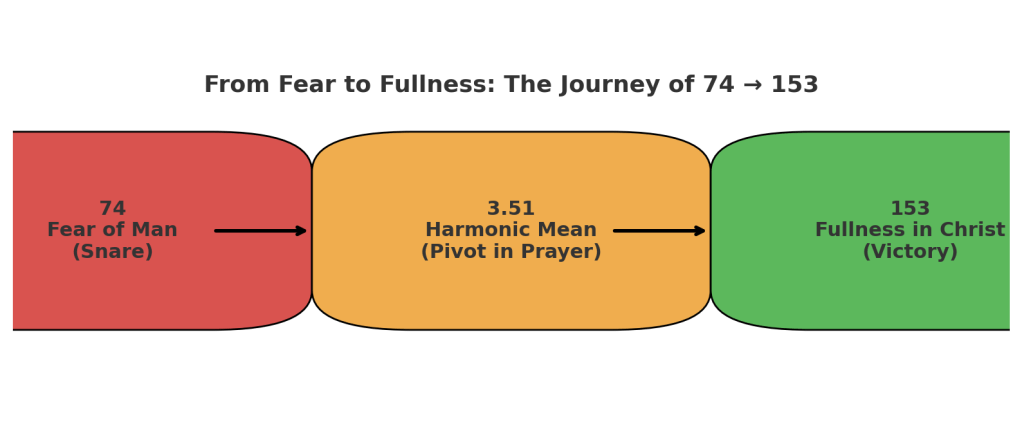
The number 74 does not stand alone; it carries within it a hidden journey. Its divisors are {1, 2, 37, 74}. The harmonic mean of these divisors is 3.51.

On the surface, this is a simple mathematical property. Yet its digits [3-5-1] conceal a hidden key: a permutation to [1-5-3], pointing directly to 153.

  • 74 – the snare of fearing man (Proverbs 29:25).
  • 3.51 – the pivot, the crossing point, the hidden code.
  • 153 – the fullness of victory in Christ, the number of fish in John 21:11 symbolizing the gathered Church.

In prayer practice, this pattern unfolds in sacred time. In the rhythm of the Lord’s Prayer, daily prayers are offered at 1:53 pm and 3:51 pm. The digits of the harmonic mean thus become embodied in prayer:

  • 1:53 pm → the fullness of the net (153): “Your kingdom come.”
  • 3:51 pm → the reversal of 153 (351): “Deliver us from evil.”

This shows that the fear of man (74) is not overcome by willpower, but by stepping into the victory of Christ (153), made present through the Lord’s Prayer. The journey of numbers thus becomes the journey of the soul: from fear → to fullness, from snare → to deliverance, from 74 → 153.


Overcoming the Fear of Man: Practical Pathways

  1. Re-anchor Identity in God
    Fear of man thrives when self-worth rests on others’ opinions. Meditating on God’s declaration—“You are accepted in the Beloved” (Ephesians 1:6)—shifts the foundation of identity from human applause to divine approval.
  2. Reorder Your Fears
    Jesus said: “Do not fear those who kill the body…but rather fear Him who can destroy both soul and body in hell” (Matthew 10:28). Perspective frees us: man’s power is limited; God’s power is ultimate.
  3. Practice Trust Daily
    Proverbs 29:25 emphasizes that trust in the Lord brings safety. Each decision to honor God over pleasing people strengthens spiritual courage. Trust becomes the antidote to entrapment.
  4. Seek God’s Vision
    Without prophetic vision, people drift into conformity (Proverbs 29:18). Fixing our eyes on God’s call clarifies which voices matter.
  5. Rely on Prayer and the Spirit
    The numeric arc from 74 → 153 reveals that prayer is the Spirit’s appointed path out of fear. The harmonic mean (3.51) points to times of prayer that lead from snare to safety, from bondage to deliverance. The Lord’s Prayer, prayed faithfully at sacred times, becomes the doorway into Christ’s fullness.

Conclusion

The number 74 binds together two verses that illuminate the two fears vying for mastery over human hearts. Job 28:28 calls us into the liberating fear of the Lord, the beginning of wisdom. Proverbs 29:25 warns against the fear of man, a snare that robs us of freedom.

Yet the journey does not end there. Through the harmonic path of 74 → 153, mathematics itself testifies to the gospel: fear of man is overcome not by suppression but by substitution—by trusting in God, praying in the Spirit, and stepping into the completeness of Christ. The Lord’s Prayer thus becomes the pivot point where fear turns into freedom, and where the soul moves from snare into safety.

A Theological Reflection on Psalm 79:10 and the Numbers 108 and 153

🙏 Introduction

The Lord’s Prayer stands as the most beloved and unifying prayer across all of Christianity. Reverently recited by Christians of every denomination, it encapsulates a sacred rhythm—anchoring believers in God’s will, provision, forgiveness, and protection. Yet, beneath its surface lies a remarkable numerical structure centered on the number 153—a number that also appears in the Gospel of John as the measure of the miraculous catch of fish, often symbolizing the fullness of redemption.

A fascinating interplay emerges when we consider Psalm 79:10, a verse of lament from ancient Israel. Its numerical identifier is 108, a number deeply revered in other spiritual traditions, particularly Hinduism and Buddhism. But rather than creating conflict, this juxtaposition offers an invitation: to explore how prayer—specifically, the Lord’s Prayer—becomes a faithful answer to the world’s deepest cries.


📖 Psalm 79:10 – A Cry for Justice

“Why should the nations say, ‘Where is their God?’ Let the avenging of the outpoured blood of your servants be known among the nations before our eyes.”
— Psalm 79:10

Psalm 79 is a communal lament composed during a time of great national distress. It reflects the grief of God’s people after the desecration of Jerusalem and the suffering of the innocent. In verse 10, the psalmist asks a poignant question: Why should the nations mock the silence of God?

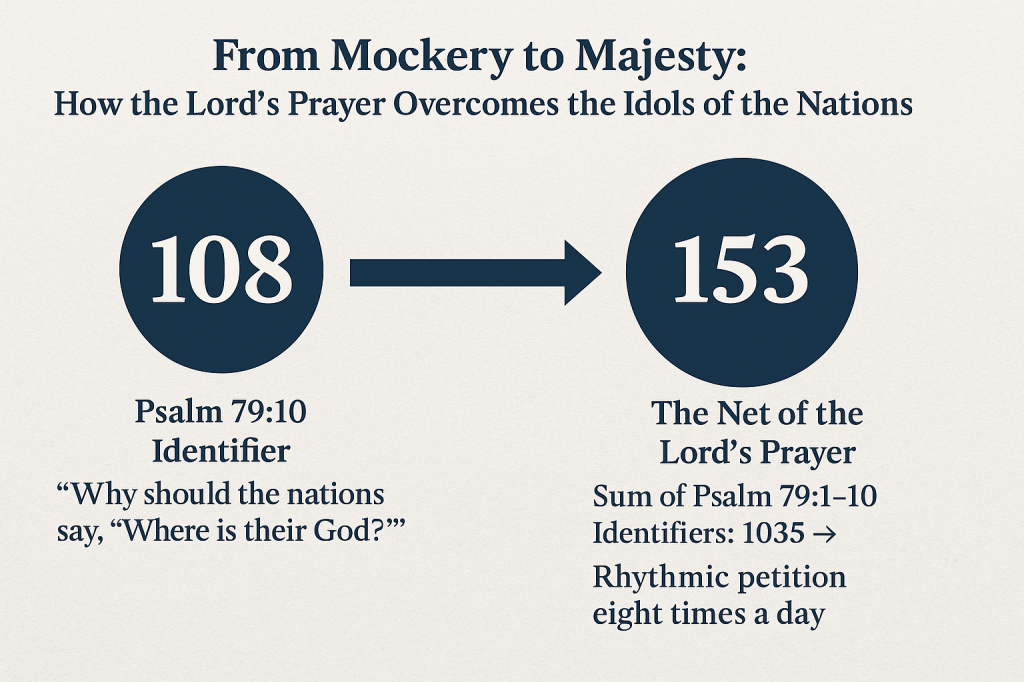
Using the biblical method of calculating verse identifiers (Book + Chapter + Verse), Psalm 79:10 receives an identifier of:

19(BookofPsalms)+79(Chapter)+10(Verse)=108


🕉️ The Number 108 – Revered in Global Traditions

The number 108 holds deep spiritual significance in many Eastern traditions:

  • In Hinduism, it represents the 108 names of deities and is found in prayer beads (mala) used for chanting.
  • In Buddhism, it symbolizes the 108 afflictions of the human mind that practitioners seek to overcome through purification.
  • In Jainism, it denotes the 108 attributes of the enlightened beings.

For many, 108 is a symbol of spiritual wholeness and cosmic order. From a Christian perspective, however, the meaning of 108 invites a different reflection: not a condemnation of others’ beliefs, but a contemplation of what true fullness means, and where it is ultimately found.


🔢 The Response Hidden in the Numbers: 1035 and 153

While verse 10 stands out with its identifier 108, something extraordinary emerges when we calculate the cumulative identifiers of Psalm 79:1–10. That is, if we sum the identifiers of each verse from verse 1 to 10, we get:

99+100+101+…+108=103599 + 100 + 101 + … + 108 = 1035

The number 1035, when its digits are rearranged, contains 1–5–3: a clear allusion to 153, a number rich with theological meaning in Christian thought.


🎣 The Number 153 – The Net of Redemption

  • In John 21:11, after the Resurrection, the disciples catch 153 fish in a net that does not break. Early Christian interpreters saw this as a symbol of the totality of humanity gathered into God’s Kingdom.
  • Mathematically, 153 = 17 × 9, where 17 is the sum of the first 7 natural numbers (symbolizing divine order), and 9 represents spiritual completion.

In our own theological framework, 153 also encodes the 8 prayer times of the Lord’s Prayer (10:35, 10:53, 1:35, etc.), forming a sacred rhythm for daily communion with God.


🔁 From Mockery to Prayer: A Theological Arc

Psalm 79:10 begins with a question from the nations:

“Where is their God?”

This is not just a rhetorical question—it represents the longing of the world for a visible, just, and active God.

The answer comes not in thunder or force, but in the quiet power of prayer—the structured, faithful cry of God’s people. The cumulative sum of verses 1–10, totaling 1035, encodes 153, the number of the Lord’s Prayer. The implication is profound:

The mocking of the nations (108) is answered by the persistent prayer of God’s people (153).


🤝 Interfaith Sensitivity and Christian Testimony

In honoring this insight, we must approach it with humility and grace. While Christians believe that the fullness of spiritual truth is found in Jesus Christ, this belief does not diminish the sincerity, moral integrity, or spiritual longing of those from other faiths. Rather, we affirm that:

  • The number 108, as honored in other traditions, reflects a deep and beautiful search for divine connection.
  • In Christian theology, the number 153 becomes our symbol of divine response—a net cast by Christ to gather all who seek truth, hope, and redemption.

Thus, instead of condemnation, we offer an invitation—to consider that the rhythms of prayer, culminating in the Lord’s Prayer, answer the universal cry for justice, mercy, and spiritual completeness.


📊 Summary Table

ConceptValueInterpretation
Psalm 79:10 Identifier108Symbol of the nations’ question and longing
Cumulative Identifiers (v1–10)1035Encodes 153—the prayerful rhythm of divine presence
Christian Symbolism153The Net of Redemption; the Lord’s Prayer; divine fullness
Theological Insight108 → 153The cry of the nations is answered by the prayer of the faithful

🌍 Conclusion

In the tension between the nations’ mockery and God’s apparent silence, Psalm 79 gives voice to both anguish and hope. Hidden within its structure, however, is a revelation: the number 108, though honored in other traditions, becomes in this psalm the cry of the world. The response is found not in retaliation, but in the Lord’s Prayer, encoded in the number 153, the sum of accumulated cries and the rhythm of redemptive hope.

In this way, the Lord’s Prayer becomes not only the response of Israel—but the response of the Church—to the cry of the world. It is an act of love, rooted in faith, and extended in humility.

The Lord’s Prayer: A Spiritual Bridge from Judgment to Praise

1. Introduction

In the biblical narrative, God is not indifferent to injustice. Psalm 75 is a vivid declaration of divine judgment against prideful, oppressive, and paranoid rulers. Psalm 95, on the other hand, is a communal invitation to joyful worship and reverent obedience.

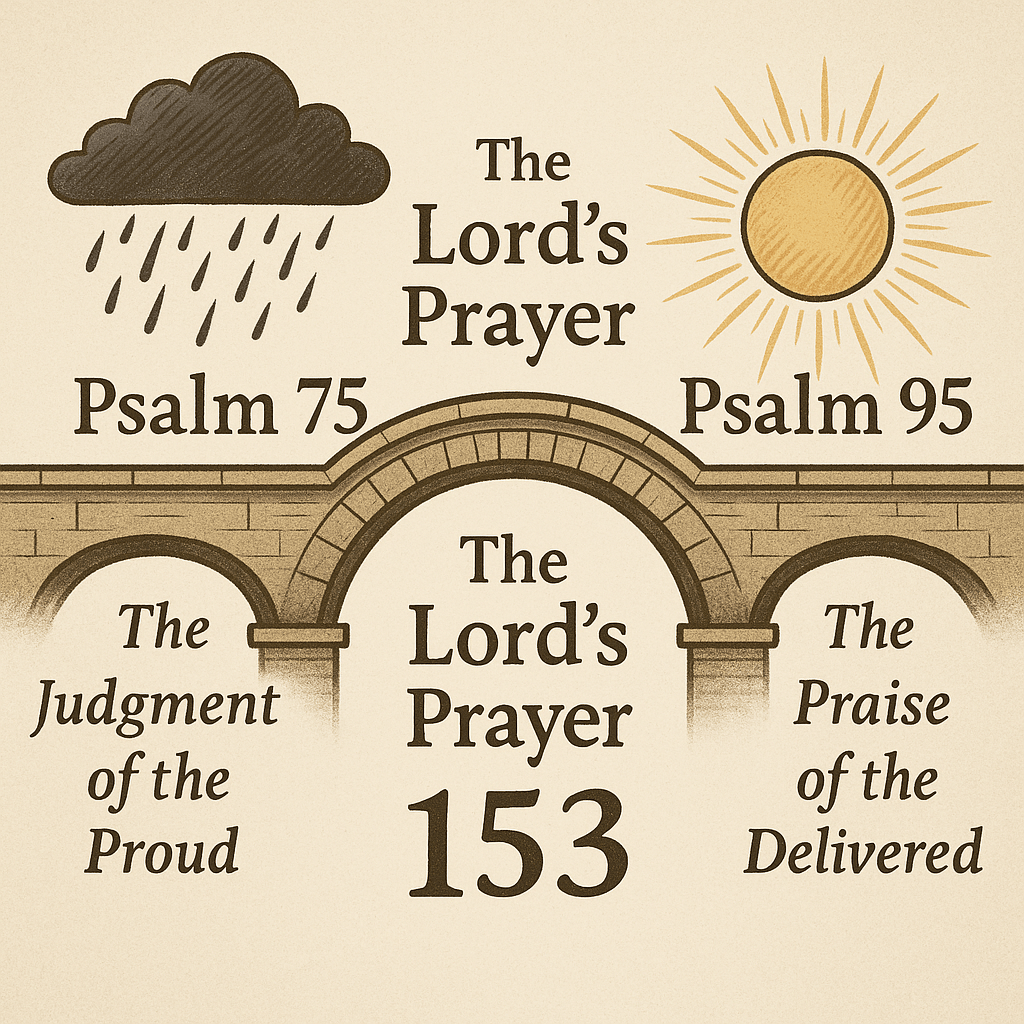
This paper contends that the Lord’s Prayer, embedded within the very fabric of Scripture, functions as the theological and numerical bridge between these two psalms. It facilitates the cry for justice and the praise of deliverance. The mathematical structure of these psalms affirms the Lord’s Prayer as a divine key.


2. Psalm 75: The Judgment of the Proud

Psalm 75 announces God as the ultimate judge who “puts down one, and sets up another” (v.7). The psalm speaks directly to arrogant and power-obsessed individuals: “Lift not up your horn on high: speak not with a stiff neck” (v.5). It offers assurance to the oppressed that justice will be served.

  • Total Identifier of Psalm 75: 995
    Computed as the sum of verse identifiers (Book 19 + Chapter 75 + Verse Number)
  • Divisors of 995: [1, 5, 199, 995]
    Geometric Mean ≈ 31.54 → digits: 3, 1, 5 → permutation of 153

This reveals that divine judgment in Psalm 75 is numerically tethered to the number 153, long recognized as a symbolic number of fullness, divine order, and the Lord’s Prayer itself.


3. Psalm 95: The Praise of the Delivered

Psalm 95 represents the spiritual condition of a community that has witnessed the fall of injustice. It begins with a call to thanksgiving and ends with a sober reminder not to repeat the errors of rebellion. It is the natural response after God has fulfilled the promise declared in Psalm 75.

  • Total Identifier of Psalm 95: 1320
  • Divisors of 1320: 32 in total
    Sum of Divisors: 4320 → Arithmetic Mean = 4320 / 32 = 135 → another permutation of 153

Again, we see the numerical resonance with 153, suggesting a hidden unity with Psalm 75 and a full-circle return to divine order through worship.


4. Theological Function of the Lord’s Prayer

The Lord’s Prayer operates on two planes simultaneously:

  1. As Petition for Judgment and Deliverance
    • “Thy kingdom come, Thy will be done on earth as it is in heaven” (Matthew 6:10) aligns with the themes of Psalm 75.
    • “Deliver us from evil” speaks directly to the plea against oppressive and paranoid leadership.
  2. As Praise for Redemption and Rest
    • “Give us this day our daily bread” and “Forgive us our trespasses” echo the spirit of Psalm 95—communal thanksgiving, humility, and worship.

These dual functions mirror the movement from Psalm 75 to Psalm 95, confirming the Lord’s Prayer as a spiritual bridge.


5. The Mystery of 153 and the Net of Prayer

The number 153 is most famously associated with John 21:11, the miraculous catch of fish. It symbolizes fullness, the gathering of the elect, and the net of divine calling.

In the framework discussed:

  • Psalm 75’s Geometric Mean (31.5) → 153
  • Psalm 95’s Arithmetic Mean (135) → 153

These findings show that the Lord’s Prayer, encoded in 153, is the sanctified net through which the justice of Psalm 75 is drawn into the praise of Psalm 95.


6. Conclusion: Sanctifying Time and Order through the Lord’s Prayer

The Lord’s Prayer is more than a petition; it is the divine engine that moves history from oppression to order, from sorrow to song. The numerical revelations encoded in Psalms 75 and 95 are not random coincidences but holy signatures of the spiritual transformation initiated by this prayer.

Thus, whether confronting the horns of the wicked or entering the rest of the righteous, we are called to pray:

“Thy kingdom come, Thy will be done… For Thine is the kingdom, and the power, and the glory forever. Amen.”

🙏 Theological Implication

The Lord’s Prayer can and should be:

  • Prayed during times of oppression as a petition for righteous judgment (Psalm 75).
  • Prayed after vindication as a song of thanks and renewed worship (Psalm 95).

It becomes the spiritual Net of 153:

  • Gathering the humble,
  • Separating the wicked,
  • Restoring the soul,
  • And sanctifying the time and the people.

From Prowling Sins to Morning Songs: A Theological Reflection on Psalm 59 and the Power of 185

Introduction Psalm 59 is a profound tapestry of lament, trust, and praise, penned by David in a time of peril. It is historically rooted in the event when Saul sent men to watch David’s house in order to kill him (1 Samuel 19). Yet beyond its immediate context, Psalm 59 becomes a rich metaphorical and theological canvas for exploring divine protection, spiritual warfare, and ultimate deliverance. This article draws together Psalm 59, the miraculous account of 185,000 slain Assyrians, and symbolic numerology to unveil deeper dimensions of God’s covenantal care and judgment.


1. Historical and Spiritual Context of Psalm 59 David writes Psalm 59 while being hunted by Saul’s assassins. His opening verses are a desperate cry: “Deliver me from my enemies, O my God” (v.1). His enemies are described as fierce, unjust, and bloodthirsty. But rather than retaliate in kind, David places his hope in God’s deliverance.

Metaphorically, David’s enemies may be understood as sins or temptations that relentlessly pursue the believer. Verses 14–15 give us this vivid imagery:

“They return at evening, snarling like dogs, and prowl about the city. They wander about for food and howl if not satisfied.”

This portrays sin as an ever-returning, insatiable threat—restless, hungry, and predatory.


2. Morning Praise and Fortress of Refuge The psalm then turns from night to day, from fear to faith:

“But I will sing of your strength, in the morning I will sing of your love; for you are my fortress, my refuge in times of trouble” (Psalm 59:16).

Here, morning becomes a symbol of divine deliverance. As darkness gives way to light, the believer transitions from survival to song. The city that once echoed with the howls of enemies now resonates with praise.


3. The Identifiers and the Mystery of 185 Applying biblical numerology, each verse may be given an identifier: Book Number + Chapter Number + Verse Number. For Psalm 59:

  • Psalm 59:14 = 19 + 59 + 14 = 92
  • Psalm 59:15 = 19 + 59 + 15 = 93
  • Sum = 185

This numerical sum draws us directly to 2 Kings 19:35 and Isaiah 37:36:

“That night the angel of the Lord went out and put to death 185,000 in the Assyrian camp. When the people got up the next morning—there were all the dead bodies!”

The parallel is striking:

  • In both narratives, night is the time of siege.
  • In both, deliverance comes invisibly.
  • And in both, morning reveals the total defeat of the enemy.

4. The Symbolism of the Number 185

✦ Divine Intervention
185 signifies God’s sovereign and sudden response. As the people of Jerusalem slept, God intervened without sword or human effort. Similarly, David’s foes—be they human or spiritual—are neutralized by divine initiative.

✦ Judgment and Justice
185 symbolizes the executed judgment against pride and oppression. The Assyrians mocked the God of Israel. Their fall reveals God’s unwillingness to let arrogance go unchallenged.

✦ Angelic Warfare
This number brings to light the unseen spiritual battle on behalf of the faithful. One angel, in obedience to God, renders a vast army powerless.

✦ Covenant Protection
185 also illustrates how God defends His covenant people when they turn to Him in humility and prayer—as Hezekiah did.


5. Theological Insert: 185 and the Lord’s Prayer

The number 185 also forms a symbolic bridge to the Lord’s Prayer, revealing itself as the divine execution of its petitions:

  • “Deliver us from evil” — exactly what happens in the slaying of the Assyrians.
  • “Thy kingdom come, Thy will be done on earth as in heaven” — fulfilled as God’s will is enforced through angelic power.
  • “Give us this day our daily bread” — answered through the lifting of siege and famine.

In fact, the Lord’s Prayer and the Assyrian episode share structural symmetry:

  • Hezekiah prays in humility;
  • God responds with covenant faithfulness;
  • An angel executes justice;
  • Morning reveals victory and peace.

185, then, is the numerical fulfillment of the Lord’s Prayer in action. It is what it looks like when heaven answers earth:

185 is the thunderclap of “deliver us from evil.”
It is the angel’s sword answering the disciple’s plea.


6. Theological Summary Psalm 59 is more than a psalm of survival—it is a blueprint for trust in the face of evil. Its spiritual arc mirrors the night-and-morning structure of the 185,000 Assyrian deaths:

  • Verses 14–15 mirror the threatening night, filled with prowling danger.
  • Verses 16–17 reflect the dawning praise, where the once-besieged soul now sings in freedom.

And embedded within it, the sum 185 serves as a numerical seal linking David’s personal enemies to Israel’s national threat and reminding us that God’s deliverance, whether personal or cosmic, is often unseen, but always certain.

“You are my strength, I sing praise to you; you, God, are my fortress, my God on whom I can rely” (Psalm 59:17).


Conclusion The theological convergence of Psalm 59 and the number 185 reveals a timeless truth: while sin may prowl at night, God sends His angels by decree, and morning always breaks with praise. The believer need not fear the howling of spiritual foes—for God’s covenant love ensures that the fortress will stand, the enemy will fall, and the song will rise.