
Abstract
This paper argues that the Kingdom parables in the Gospel of Matthew form a coherent sequence rather than a loose collection of sayings. Read together, they describe a new divine order, the need for true reception of God’s word, hidden but certain growth, the incomparable value of the Kingdom, and the necessity of genuine transformation for entry. The same Kingdom pattern can then be seen narratively in John 21:4–17, where the risen Jesus redirects fruitless discipleship, gathers the chosen into an unbroken net, feeds them on the shore, and then commissions Peter for a new movement. Within the framework of Biblical Mathematics, the cumulative identifier total of the Matthew Kingdom parables is 2507, which matches the Greek isopsephy of συνεσταύρωμαι in Galatians 2:20, “I am crucified with.” The cumulative identifier total of John 21:4–17 is 1043, which matches the Hebrew gematria of Psalm 38:17, a penitential lament of weakness, sorrow, and continued hope in God. Read together with the Lord’s Prayer as the proclamation of faith and as the prayer of the New Exodus, these texts help answer five major questions about the New Kingdom of God: what it is, why it exists, who belongs to it, when it comes, and where it is found.
1. Introduction
The parables of the Kingdom in Matthew are usually studied one by one. Yet when they are read in sequence, they appear to tell a larger story. They begin by showing that God is doing something new in Jesus Christ. They then explain that this new reality must be received inwardly, that it begins quietly but grows surely, that it is worth everything, and that invitation alone is not enough for entry. This structure becomes even more striking when it is compared with John 21:4–17, where the risen Christ stands on the shore, directs the disciples into a miraculous catch, gathers them to a meal, and then sends Peter into pastoral mission.
This paper proposes that the Kingdom parables in Matthew and the shore scene in John 21 are closely related witnesses to the same Kingdom reality. It also proposes that two numerical correspondences support this reading. First, the Matthew Kingdom total points to Galatians 2:20, suggesting that the true life of the Kingdom is the life of one crucified with Christ. Second, the John 21 total points to Psalm 38:17, suggesting that those who belong to this Kingdom are not the self-sufficient but the broken and penitent who still turn to God in hope.
2. Method
This paper uses our Biblical Mathematics framework. In that framework, a verse identifier is defined as the sum of the book number, chapter number, and verse number, and a set of verses may also be identified by their total gematria. The paper also draws on two prior theological anchors.
First, our book, The Lord’s Prayer: A Mathematician’s Creed argues, that the Lord’s Prayer is itself the proclamation of faith referred to in Ephesians 2:8, and that the number 153 in John 21:11 links the prayer with faith in the fulfillment of the Father’s will in His Son. It also argues that the 153 fish represent those chosen by the Father and given to the Son, whom He must not lose.
That is, in our Biblical Mathematics framework, the number 153 is not about a mere fish count. In John 21, Jesus speaks of “meat,” and in John 4:34 He says, “My meat is to do the will of him that sent me.” The Father’s will is defined precisely in John 6:39–40, 44 and John 17:1–2: that is, the Father gives those He has chosen to the Son, the Son loses none of them, and those who see and believe receive eternal life. The 153 fishes therefore represent those given by the Father to the Son, and the unbroken net signifies that none are lost. The resurrection breakfast scene becomes an allegory of Christ having completed the Father’s saving will. Hence, the number 153 represents the fulfillment of the will of the Father in His Son, Jesus Christ. And because the Lord’s Prayer is the foremost proclamation of faith in that fulfilled will, the number 153 and the Lord’s Prayer are inseparably linked.
Second, Brant Pitre’s essay on the Lord’s Prayer argues that the prayer is best read as a prayer for the new Exodus, in which God gathers His people, restores them, and brings them into a restored Kingdom and a new Jerusalem.
3. The Kingdom Sequence in Matthew
The Kingdom-category parables may be arranged in the following order: the New Cloth and the New Wineskins, the Sower, the Mustard Seed and the Leaven, the Hidden Treasure and the Pearl of Great Price, and the Wedding Banquet. Read together, they form a clear progression.
The first pair announces that the Kingdom comes as something new. Jesus is not merely patching an old arrangement. He is bringing a new divine order that cannot be contained within unchanged forms. The point is not simply reform but redemptive transition.
The Sower then explains how this new Kingdom is entered. It is not enough that the word is spoken. It must be genuinely received. Some hear and lose it. Some receive it briefly. Some are choked by other concerns. Only good soil bears fruit. This shows that the Kingdom begins with inward response.
The Mustard Seed and the Leaven then show how the Kingdom grows. It starts in small, quiet, hidden ways, yet it does not remain small. Outwardly it may appear insignificant at first; inwardly it may seem almost invisible. Yet it expands and transforms.
The Hidden Treasure and the Pearl then move from growth to value. Once the Kingdom is seen for what it is, all else becomes secondary. The Kingdom is not one important good among many. It is the supreme good.
The Wedding Banquet completes the sequence by adding a note of seriousness. The invitation is broad, but entry is not careless. Many are called, but not all are truly ready. The Kingdom requires more than outward inclusion.
Kingdom Parables in the Gospel of Matthew
| # | Parable | Reference | Theme | Commonly accepted meaning |
|---|---|---|---|---|
| 1 | New Cloth on an Old Garment | Matthew 9:16 | Newness of Jesus’ work | Jesus’ ministry is not a mere patch on old forms; His coming brings something new that cannot simply be added superficially to the old order. |
| 2 | New Wine in Old Wineskins | Matthew 9:17 | New covenant and renewal | The life and power of the kingdom require fitting forms; the gospel is not contained by rigid old structures unchanged by Christ. |
| 3 | The Sower | Matthew 13:3–9, 18–23 | Reception of the word | The same word of God produces different results depending on the condition of the heart. True fruitfulness marks genuine reception. |
| 4 | Mustard Seed | Matthew 13:31–32 | Small beginnings, great growth | The kingdom may begin in hidden or humble ways, yet it grows into something large and far-reaching under God’s power. |
| 5 | Leaven | Matthew 13:33 | Hidden transforming power | The kingdom works quietly from within, spreading and transforming more than first appears. |
| 6 | Hidden Treasure | Matthew 13:44 | Supreme value of the kingdom | The kingdom of heaven is worth joyful total sacrifice. When one truly sees its worth, everything else becomes secondary. |
| 7 | Pearl of Great Price | Matthew 13:45–46 | Ultimate worth | Like the hidden treasure, this teaches that the kingdom is of incomparable value and worth giving up all to obtain. |
| 8 | Marriage of the King’s Son / Wedding Banquet | Matthew 22:1–14 | Invitation, response, and readiness | God graciously invites many into His kingdom, but invitation must be received rightly. Acceptance without proper response and transformation is insufficient. |
The deeper structure. Summary the Whole Kingdom Group
| Movement | Parables | Main idea |
|---|---|---|
| Newness | #1–2 | The Kingdom comes as a new divine order in Christ |
| Reception | #3 | The Kingdom must be rightly received in the heart |
| Growth | #4–5 | The Kingdom begins hiddenly and grows powerfully |
| Value | #6–7 | The Kingdom is worth everything |
| Entrance | #8 | The Kingdom invites many, but only the rightly clothed enter |
Matthew’s Kingdom material here can be read as answering six major questions:
- What is the Kingdom?
A new order brought by Jesus. - How does it begin in a person?
By true reception of the word. - How does it appear at first?
Small and hidden. - What will it become?
Expansive and transformative. - How should one respond to it?
By valuing it above all else. - Who finally enters it?
Those who respond rightly, not merely those who are invited outwardly.
4. The Same Pattern in John 21:4–17
This same Kingdom pattern appears again in John 21, but now as narrative rather than discourse.
The scene opens with the disciples laboring through the night and catching nothing. More than that, they do not recognize Jesus standing on the shore. This is a picture of sincere but fruitless labor before the risen Lord reorients the mission. It is close in spirit to the opening Matthew pair: the old way of operating is no longer enough.
When Jesus commands them to cast the net on the right side, they obey, and the great catch comes. This corresponds to the Sower and to the growth parables. The decisive point is that abundance comes not from human strength but from obedience to the word of Christ. Reception comes first; growth follows.
Peter then throws himself into the sea to get to Jesus, while the others draw the net toward shore. This resembles the Treasure and the Pearl. The Kingdom is worth everything because Christ Himself is its center and goal. The movement is not simply toward fish, but toward Jesus.
The command, “Bring of the fish,” followed by “Come and dine,” is especially important. The Kingdom does not end in gathering alone. It ends in fellowship with the risen Lord. That makes John 21 feel like a narrative counterpart to the banquet language that closes the Matthew sequence.
Finally, after the meal, Peter is restored and commissioned: “Feed my lambs … feed my sheep.” Thus the gathered people become the sent people. The shore breakfast is not merely a peaceful ending. It is a hinge between ingathering and mission.
Side-by-side Table
| Matthew Kingdom sequence | John 21 enacted sequence | Shared movement |
|---|---|---|
| 1–2. New cloth / New wineskins | 21:4–5: the disciples labor in an old, fruitless mode and do not yet recognize Jesus | Old form proves inadequate; a new kingdom order must begin |
| 3. The Sower | 21:6: Jesus speaks, they obey, and the catch comes | The kingdom begins through right reception of the Lord’s word |
| 4. Mustard Seed | 21:6: one simple act of obedience yields an unexpectedly great catch | Small external beginning, large outward growth |
| 5. Leaven | 21:6–8: the change starts quietly, then the whole scene is transformed | Hidden inward shift becomes visible abundance |
| 6. Hidden Treasure | 21:7: Peter leaves all immediate calculation and rushes to Jesus | The kingdom is worth everything because Christ Himself is its treasure |
| 7. Pearl of Great Price | 21:8–9: the others strain toward Jesus with the net and catch | The kingdom is precious enough to reorder action and effort toward Him |
| 8. Wedding Banquet | 21:10–12: “Come and dine”; the gathered fish are brought to the Lord and shared in His presence | The kingdom culminates in gathered fellowship with the risen King |
| Kingdom entry requires true response | 21:15–17: Peter is restored and charged, “Feed my sheep” | Communion with Christ leads to transformed service |
| Kingdom invitation extends outward | 21:15–17, in light of Matt 28:18–20 | The gathered people become the sent people |
5. Numerical Witness I: The Matthew Kingdom Total and Galatians 2:20
Using the verse identifier method, the Kingdom sequence in Matthew yields the following totals. The New Cloth and New Wineskins total 131. The Sower totals 854. The Mustard Seed and Leaven total 255. The Hidden Treasure and Pearl total 294. The Wedding Banquet totals 973. Together they produce a grand total of 2507.
Incredibly, that number matches only one Greek isopsephy in the New Testament. It is the Greek isopsephy of συνεσταύρωμαι, “I am crucified with,” the opening word of Galatians 2:20. This is a powerful result. It suggests that the true inhabitant of the New Kingdom is not simply an invited person, or even merely a morally improved person, but one whose old life has ended in union with Christ.
Galatians 2:20 says, “I am crucified with Christ: nevertheless I live; yet not I, but Christ liveth in me.”
Scrivener’s Textus Receptus 1894
Χριστῷ συνεσταύρωμαι ζῶ δὲ οὐκέτι ἐγώ ζῇ δὲ ἐν ἐμοὶ Χριστός ὃ δὲ νῦν ζῶ ἐν σαρκί ἐν πίστει ζῶ τῇ τοῦ υἱοῦ τοῦ θεοῦ τοῦ ἀγαπήσαντός με καὶ παραδόντος ἑαυτὸν ὑπὲρ ἐμοῦ
συνεσταύρωμαι ( I am crucified with Christ) = 2507
That is exactly the kind of life the Matthew sequence has been describing. The New Kingdom cannot be contained in old forms. It requires true reception, inward change, surrender of all lesser claims, and a fitting response. The total of the parables points to the same truth in a single Pauline sentence: life in the Kingdom is cruciform life.
The force of this is even deeper when one notices that Galatians 2:20 speaks not merely in the simple modern sense of “my faith in Christ,” but with language that can also be heard as the faithfulness of the Son of God. The new life of the believer rests not first on the strength of human believing, but on the prior fidelity of Christ Himself.
6. Numerical Witness II: John 21:4–17 and Psalm 38:17
The cumulative identifier total of John 21:4–17 is 1043. Astonishingly, that number matches only one Hebrew gematria in the Old Testament. It is Psalm 38:17, “For I am ready to halt, and my sorrow is continually before me.”
38:17 תהילים Hebrew Bible
כי אני לצלע נכון ומכאובי נגדי תמיד׃ = 1043
This result is theologically significant. Psalm 38 is a penitential lament. It is the voice of one who feels crushed under sin, divine chastening, bodily weakness, social isolation, and hostile opposition, yet still turns to God. That is a deeply fitting portrait of those who belong to the New Kingdom.
John 21 begins not with strength but with failure. The disciples are tired, fruitless, and unperceptive. They do not recognize Jesus at first. Their breakthrough comes only when they obey Him. Psalm 38:17 therefore gives an inward portrait of the same kind of Kingdom person described outwardly in John 21: not the triumphant and self-sufficient, but the broken and penitent who still look to the Lord in hope.
7. The Lord’s Prayer as the Creed of the New Kingdom
At this point the Lord’s Prayer becomes central. It is the proclamation of faith referred to in Ephesians 2:8 and that, through the 153 of John 21:11, it is linked to faith in the fulfillment of the Father’s will in His Son. The the Lord’s Prayer is Jesus’ and therefore the believer’s creed.
Pitre’s essay supports this from another angle. He argues that the Lord’s Prayer is best understood as a prayer for the New Exodus, that is, for the gathering of God’s people into the restored messianic Kingdom.
These two lines of thought fit together very well. The Lord’s Prayer is not merely a model prayer in a narrow sense. It is the prayer-form of the New Kingdom people. It teaches them to confess the Father’s name, the Father’s Kingdom, the Father’s will, daily dependence, forgiveness, and deliverance. In that sense it is indispensable, not as a replacement for the Gospel, but as the irreplaceable prayer-form in which the Gospel is confessed, inhabited, and lived.
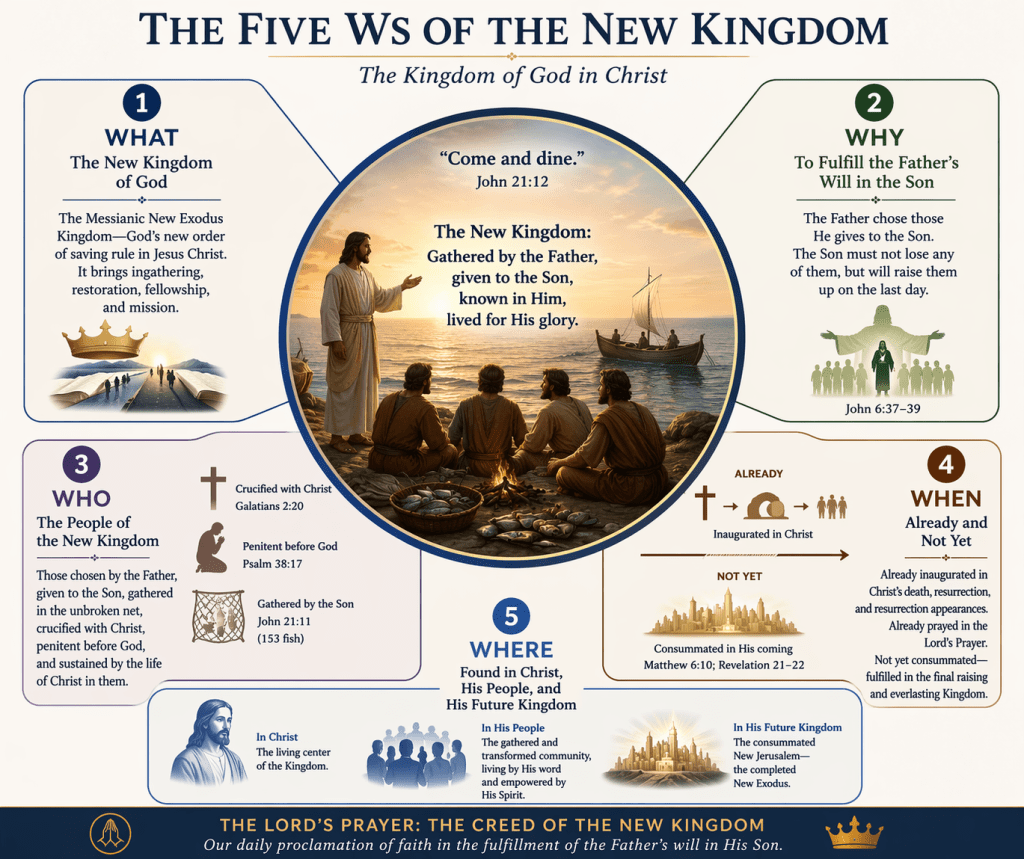
8. The Five W-Questions of the New Kingdom
The material now allows the five major questions to be answered with some clarity.
What is this New Kingdom?
It is the messianic New Exodus Kingdom of God. It is the new order of divine rule brought by Christ, marked by ingathering, fellowship, restoration, and mission.
Why this New Kingdom?
It exists because the Father wills to gather, preserve, justify, sanctify, and finally raise to life those He gives to the Son.
Who belongs to this New Kingdom?
The New Kingdom belongs to those chosen by the Father, given to the Son, crucified with Christ, penitent before God, and sustained by the life of Christ in them.
When is this New Kingdom?
It is both present and future. It is already inaugurated in Christ’s death, resurrection, and resurrection appearances, and it is already prayed in the Lord’s Prayer. Yet it is not fully consummated until the final raising of those given to the Son.
Where is this New Kingdom?
It is found first in Christ Himself, then in the gathered and transformed people of God, and finally in the consummated restored Kingdom, the new Jerusalem of the completed New Exodus.
9. Conclusion
The Kingdom parables in Matthew form a coherent theological sequence. They show that the Kingdom is new, must be received, grows quietly, is worth everything, and requires true readiness. John 21:4–17 then enacts the same Kingdom story in resurrection form. The risen Christ reorients fruitless labor, creates abundance through obedience, gathers the chosen to Himself, feeds them, and then sends them outward in mission.
The numerical results support this reading in a striking way. The Matthew Kingdom total of 2507 points to συνεσταύρωμαι, “I am crucified with,” in Galatians 2:20. The John 21 total of 1043 points to Psalm 38:17, the lament of the broken but hopeful believer. Together these suggest that the New Kingdom belongs to those whose old life is crucified with Christ and whose new life is lived in humble dependence on God.
The Lord’s Prayer stands at the center of the whole picture. It is the proclamation of faith, the prayer of the New Exodus, and the Creed of the New Kingdom people.
Selected Source Basis
- Vanualailai, J., Tomasi, E., Vanualailai, P., and Takala, J. The Lord’s Prayer: A Mathematician’s Creed.
- Pitre, Brant. “The Lord’s Prayer and the New Exodus.”
Appendix A. Numerical Tables
A1. Matthew Kingdom Parables: Identifier Totals
| Parable / Group | Reference | Summation |
| New Cloth on an Old Garment | Matthew 9:16 | 65 |
| New Wine in Old Wineskins | Matthew 9:17 | 66 |
| The Sower (including interpretation) | Matthew 13:3–9, 18–23 | 854 |
| Mustard Seed | Matthew 13:31–32 | 169 |
| Leaven | Matthew 13:33 | 86 |
| Hidden Treasure | Matthew 13:44 | 97 |
| Pearl of Great Price | Matthew 13:45–46 | 197 |
| Wedding Banquet | Matthew 22:1–14 | 973 |
| Grand Total | Kingdom set | 2507 |
A2. John 21:4–17: Identifier Totals
| Unit | Verses | Summation |
| Old, unfruitful, non-recognition scene | John 21:4–6 | 207 |
| Movement toward Jesus | John 21:7–9 | 216 |
| Bring the catch / come and dine | John 21:10–12 | 225 |
| Meal hinge | John 21:13–14 | 155 |
| Peter restored and commissioned | John 21:15–17 | 240 |
| Grand Total | John 21:4–17 | 1043 |
A3. Key Numerical Correspondences
| Number | Textual Match | Interpretive Significance |
| 2507 | συνεσταύρωμαι (Galatians 2:20) | Kingdom life is cruciform: “I am crucified with Christ.” |
| 1043 | Psalm 38:17 (Hebrew gematria) | Kingdom belonging is marked by penitence, weakness, and hope in God. |
| 153 | John 21:11 | Those chosen by the Father and given to the Son; the gathered people in the unbroken net. |
 The Lord's Prayer: A Mathematician's Creed