A Theological Reflection on Psalm 79:10 and the Numbers 108 and 153

🙏 Introduction

The Lord’s Prayer stands as the most beloved and unifying prayer across all of Christianity. Reverently recited by Christians of every denomination, it encapsulates a sacred rhythm—anchoring believers in God’s will, provision, forgiveness, and protection. Yet, beneath its surface lies a remarkable numerical structure centered on the number 153—a number that also appears in the Gospel of John as the measure of the miraculous catch of fish, often symbolizing the fullness of redemption.

A fascinating interplay emerges when we consider Psalm 79:10, a verse of lament from ancient Israel. Its numerical identifier is 108, a number deeply revered in other spiritual traditions, particularly Hinduism and Buddhism. But rather than creating conflict, this juxtaposition offers an invitation: to explore how prayer—specifically, the Lord’s Prayer—becomes a faithful answer to the world’s deepest cries.


📖 Psalm 79:10 – A Cry for Justice

“Why should the nations say, ‘Where is their God?’ Let the avenging of the outpoured blood of your servants be known among the nations before our eyes.”
— Psalm 79:10

Psalm 79 is a communal lament composed during a time of great national distress. It reflects the grief of God’s people after the desecration of Jerusalem and the suffering of the innocent. In verse 10, the psalmist asks a poignant question: Why should the nations mock the silence of God?

Using the biblical method of calculating verse identifiers (Book + Chapter + Verse), Psalm 79:10 receives an identifier of:

19(BookofPsalms)+79(Chapter)+10(Verse)=108


🕉️ The Number 108 – Revered in Global Traditions

The number 108 holds deep spiritual significance in many Eastern traditions:

  • In Hinduism, it represents the 108 names of deities and is found in prayer beads (mala) used for chanting.
  • In Buddhism, it symbolizes the 108 afflictions of the human mind that practitioners seek to overcome through purification.
  • In Jainism, it denotes the 108 attributes of the enlightened beings.

For many, 108 is a symbol of spiritual wholeness and cosmic order. From a Christian perspective, however, the meaning of 108 invites a different reflection: not a condemnation of others’ beliefs, but a contemplation of what true fullness means, and where it is ultimately found.


🔢 The Response Hidden in the Numbers: 1035 and 153

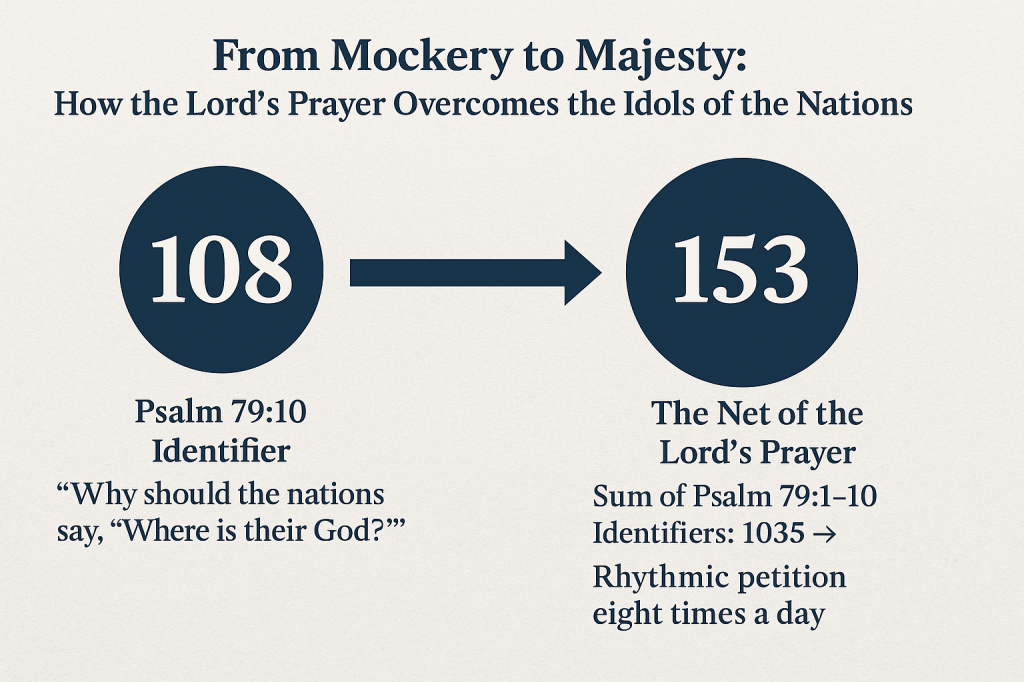
While verse 10 stands out with its identifier 108, something extraordinary emerges when we calculate the cumulative identifiers of Psalm 79:1–10. That is, if we sum the identifiers of each verse from verse 1 to 10, we get:

99+100+101+…+108=103599 + 100 + 101 + … + 108 = 1035

The number 1035, when its digits are rearranged, contains 1–5–3: a clear allusion to 153, a number rich with theological meaning in Christian thought.


🎣 The Number 153 – The Net of Redemption

  • In John 21:11, after the Resurrection, the disciples catch 153 fish in a net that does not break. Early Christian interpreters saw this as a symbol of the totality of humanity gathered into God’s Kingdom.
  • Mathematically, 153 = 17 × 9, where 17 is the sum of the first 7 natural numbers (symbolizing divine order), and 9 represents spiritual completion.

In our own theological framework, 153 also encodes the 8 prayer times of the Lord’s Prayer (10:35, 10:53, 1:35, etc.), forming a sacred rhythm for daily communion with God.


🔁 From Mockery to Prayer: A Theological Arc

Psalm 79:10 begins with a question from the nations:

“Where is their God?”

This is not just a rhetorical question—it represents the longing of the world for a visible, just, and active God.

The answer comes not in thunder or force, but in the quiet power of prayer—the structured, faithful cry of God’s people. The cumulative sum of verses 1–10, totaling 1035, encodes 153, the number of the Lord’s Prayer. The implication is profound:

The mocking of the nations (108) is answered by the persistent prayer of God’s people (153).


🤝 Interfaith Sensitivity and Christian Testimony

In honoring this insight, we must approach it with humility and grace. While Christians believe that the fullness of spiritual truth is found in Jesus Christ, this belief does not diminish the sincerity, moral integrity, or spiritual longing of those from other faiths. Rather, we affirm that:

  • The number 108, as honored in other traditions, reflects a deep and beautiful search for divine connection.
  • In Christian theology, the number 153 becomes our symbol of divine response—a net cast by Christ to gather all who seek truth, hope, and redemption.

Thus, instead of condemnation, we offer an invitation—to consider that the rhythms of prayer, culminating in the Lord’s Prayer, answer the universal cry for justice, mercy, and spiritual completeness.


📊 Summary Table

ConceptValueInterpretation
Psalm 79:10 Identifier108Symbol of the nations’ question and longing
Cumulative Identifiers (v1–10)1035Encodes 153—the prayerful rhythm of divine presence
Christian Symbolism153The Net of Redemption; the Lord’s Prayer; divine fullness
Theological Insight108 → 153The cry of the nations is answered by the prayer of the faithful

🌍 Conclusion

In the tension between the nations’ mockery and God’s apparent silence, Psalm 79 gives voice to both anguish and hope. Hidden within its structure, however, is a revelation: the number 108, though honored in other traditions, becomes in this psalm the cry of the world. The response is found not in retaliation, but in the Lord’s Prayer, encoded in the number 153, the sum of accumulated cries and the rhythm of redemptive hope.

In this way, the Lord’s Prayer becomes not only the response of Israel—but the response of the Church—to the cry of the world. It is an act of love, rooted in faith, and extended in humility.

The Lord’s Prayer: A Spiritual Bridge from Judgment to Praise

1. Introduction

In the biblical narrative, God is not indifferent to injustice. Psalm 75 is a vivid declaration of divine judgment against prideful, oppressive, and paranoid rulers. Psalm 95, on the other hand, is a communal invitation to joyful worship and reverent obedience.

This paper contends that the Lord’s Prayer, embedded within the very fabric of Scripture, functions as the theological and numerical bridge between these two psalms. It facilitates the cry for justice and the praise of deliverance. The mathematical structure of these psalms affirms the Lord’s Prayer as a divine key.


2. Psalm 75: The Judgment of the Proud

Psalm 75 announces God as the ultimate judge who “puts down one, and sets up another” (v.7). The psalm speaks directly to arrogant and power-obsessed individuals: “Lift not up your horn on high: speak not with a stiff neck” (v.5). It offers assurance to the oppressed that justice will be served.

  • Total Identifier of Psalm 75: 995
    Computed as the sum of verse identifiers (Book 19 + Chapter 75 + Verse Number)
  • Divisors of 995: [1, 5, 199, 995]
    Geometric Mean ≈ 31.54 → digits: 3, 1, 5 → permutation of 153

This reveals that divine judgment in Psalm 75 is numerically tethered to the number 153, long recognized as a symbolic number of fullness, divine order, and the Lord’s Prayer itself.


3. Psalm 95: The Praise of the Delivered

Psalm 95 represents the spiritual condition of a community that has witnessed the fall of injustice. It begins with a call to thanksgiving and ends with a sober reminder not to repeat the errors of rebellion. It is the natural response after God has fulfilled the promise declared in Psalm 75.

  • Total Identifier of Psalm 95: 1320
  • Divisors of 1320: 32 in total
    Sum of Divisors: 4320 → Arithmetic Mean = 4320 / 32 = 135 → another permutation of 153

Again, we see the numerical resonance with 153, suggesting a hidden unity with Psalm 75 and a full-circle return to divine order through worship.


4. Theological Function of the Lord’s Prayer

The Lord’s Prayer operates on two planes simultaneously:

  1. As Petition for Judgment and Deliverance
    • “Thy kingdom come, Thy will be done on earth as it is in heaven” (Matthew 6:10) aligns with the themes of Psalm 75.
    • “Deliver us from evil” speaks directly to the plea against oppressive and paranoid leadership.
  2. As Praise for Redemption and Rest
    • “Give us this day our daily bread” and “Forgive us our trespasses” echo the spirit of Psalm 95—communal thanksgiving, humility, and worship.

These dual functions mirror the movement from Psalm 75 to Psalm 95, confirming the Lord’s Prayer as a spiritual bridge.


5. The Mystery of 153 and the Net of Prayer

The number 153 is most famously associated with John 21:11, the miraculous catch of fish. It symbolizes fullness, the gathering of the elect, and the net of divine calling.

In the framework discussed:

  • Psalm 75’s Geometric Mean (31.5) → 153
  • Psalm 95’s Arithmetic Mean (135) → 153

These findings show that the Lord’s Prayer, encoded in 153, is the sanctified net through which the justice of Psalm 75 is drawn into the praise of Psalm 95.


6. Conclusion: Sanctifying Time and Order through the Lord’s Prayer

The Lord’s Prayer is more than a petition; it is the divine engine that moves history from oppression to order, from sorrow to song. The numerical revelations encoded in Psalms 75 and 95 are not random coincidences but holy signatures of the spiritual transformation initiated by this prayer.

Thus, whether confronting the horns of the wicked or entering the rest of the righteous, we are called to pray:

“Thy kingdom come, Thy will be done… For Thine is the kingdom, and the power, and the glory forever. Amen.”

🙏 Theological Implication

The Lord’s Prayer can and should be:

  • Prayed during times of oppression as a petition for righteous judgment (Psalm 75).
  • Prayed after vindication as a song of thanks and renewed worship (Psalm 95).

It becomes the spiritual Net of 153:

  • Gathering the humble,
  • Separating the wicked,
  • Restoring the soul,
  • And sanctifying the time and the people.

The Lord’s Prayer is the Net of God

Introduction

In the tapestry of divine revelation, Scripture interweaves image, number, and word with masterful precision. One such interlacing appears between Psalm 66:11, the Lord’s Prayer, and the miraculous catch of fish in John 21:11. This exposition uncovers a hidden structure of divine refinement and redemption, revealed through a remarkable numerical harmony anchored in Psalm 66:11, the identifier 168, and the total structure of Psalm 77.


1. Psalm 66:11 — The Net of Refinement

“Thou broughtest us into the net; thou laidst affliction upon our loins.”
Psalm 66:11

This verse encapsulates the experience of trial under God’s hand. The Hebrew gematria of its two key phrases provides a gateway into its spiritual significance:

PhraseHebrewGematria
“Thou broughtest us”הֲבֵאתָ֥נוּ464
“into the net”בַמְּצוּדָ֑ה147
Total611

The sum, 611, has four divisors: Divisors of 611=[1,13,47,611].

Arithmetic Mean=(1+13+47+611)/4=672/4=168


2. 168 — The Identifier of the Lord’s Prayer in Luke

According to the system of biblical identifiers (Book + Chapter + Verse):

VerseIdentifier
Luke 11:242 + 11 + 2 = 55
Luke 11:342 + 11 + 3 = 56
Luke 11:442 + 11 + 4 = 57
Total168

This identifies Luke 11:2–4, the concise form of the Lord’s Prayer, with the number 168.


3. Spiritual Insight: Into the Net of Prayer

The equivalence between:

  • The mean of the divisors of 611 (from Psalm 66:11), and
  • The identifier of the Lord’s Prayer in Luke,

is theologically profound:

To be brought “into the net” (Psalm 66:11) is to enter a divine pattern of discipline, refinement, and sanctification—and the very act of praying the Lord’s Prayer aligns the soul with this divine process.

This net is not one of condemnation, but of formation, drawing us into obedience and trust.


4. John 21:11 — The Net of Redemption

“Simon Peter climbed aboard and dragged the net ashore. It was full of large fish, 153, but even with so many the net was not torn.”
John 21:11

This verse reveals the net of grace, cast at the command of the risen Christ. It draws in 153 fish, symbolizing the fullness of the elect.

Together, Psalm 66:11 and John 21:11 create a unified narrative:

  • Psalm 66:11: Net of testing and discipline
  • John 21:11: Net of redemption and wholeness

5. The 8 Times of the Lord’s Prayer

From the permutations of 153 arise 6 spiritually significant numbers, which define 8 daily prayer times:

10:35 am, 10:53 am, 1:35 pm, 1:53 pm, 3:15 pm, 3:51 pm, 5:13 pm, 5:31 pm

These times serve as a spiritual entry into the net—a practice of daily discipline, surrender, and divine alignment.


6. The 2130 Revelation: Psalm 66:11 and Psalm 77

The Hebrew gematria of Psalm 66:11 totals 2130.

Psalm 66:11 — Word-by-Word Gematria Breakdown

#Hebrew WordTranslationGematria
1הֲבֵאתָ֥נוּ“You brought us”464
2בַמְּצוּדָ֑ה“into the net/prison”147
3שַׂ֖מְתָּ“You laid”740
4מוּעָקָ֣ה“burden”221
5בְמָתְנֵֽינוּ׃“on our loins”558
TOTAL2130

Surprisingly, the total of all verse identifiers in Psalm 77 also equals 2130.

ReferenceDescriptionValue
Psalm 66:11Gematria of the full verse2130
Psalm 77Sum of all verse identifiers (20 verses)2130

✨ Interpretation:

Psalm 66:11 describes the act of entering the net, while Psalm 77 is a spiritual map of what happens inside that net:

  • A descent into doubt (vv.1–9),
  • A decision to remember God’s faithfulness (vv.10–12),
  • A resurgence of praise grounded in redemptive history (vv.13–20).

This numerical unity teaches us that:

To enter the net (2130) is to enter the journey of Psalm 77—moving from affliction to assurance, and from despair to divine remembrance.

🔄 2. Psalm 77 — What Happens in the Net

This psalm maps the interior journey of the soul inside the net:

VersesPhaseDescription
1–3Crying OutDesperation and sleepless anguish
4–6QuestioningHas God forgotten? Why so silent?
7–9Crisis of FaithDoubting God’s mercy and covenant
10–12Turn to RemembranceActively choosing to recall God’s deeds
13–20Restoration of TrustAwe-filled meditation on the Exodus: “Your path led through the sea…”

It is the process of spiritual purification — the fire in the furnace, the pressure in the cocoon. The Psalm ends not with escape, but with reoriented faith.

🌅 3. Psalm 66:12 — What Happens After the Net

“You let people ride over our heads; we went through fire and water, but you brought us to a place of abundance.”

This is the glorious exit — a movement from:

  • Oppression to elevation
  • Trial to transformation
  • Narrowness to abundance

The Net was never the end — it was the threshold.
The end is abundance (רְוָיָה – revayah) — spiritually, emotionally, and covenantally.


Conclusion: Into the Net of the Kingdom

To pray the Lord’s Prayer is to enter God’s net—not of punishment, but of preparation and transformation.

  • Psalm 66:11 shows the entry into divine testing.
  • John 21:11 shows the redemptive purpose of that net.
  • Psalm 77 provides the spiritual anatomy of life inside the net.
  • Identifier 168 and total 2130 are the divine seals of this mystery.

The Lord’s Prayer is the net of God.
It refines, gathers, delivers—and fills the soul with remembrance of His mighty acts.

To pray at the 8 sacred times is to consciously step into God’s redemptive process and say, with full surrender:

Thy will be done.”

✅ Yes — praying the Lord’s Prayer at the 8 designated times draws us into the divine net, not to destroy us, but to:

  • Refine us like silver (Psalm 66:10),
  • Catch us for eternal life (John 21:11),
  • And prepare us to receive God’s abundance (Psalm 66:12).

“You brought us to a place of abundance.”

The Hidden Structure of Redemption in Isaiah 53: A Mathematical Revelation of the Lord’s Prayer

Preface and Scholarly Disclaimer

This paper explores Isaiah 53 through the lens of biblical mathematics, uncovering a numerical pattern that points symbolically to the redemptive structure of the Lord’s Prayer. It is important to state from the outset that this study is not intended as a polemic or an attempt to supersede traditional Jewish interpretations of Isaiah 53. In Judaism, this chapter has long been understood to refer to the collective suffering and vindication of the nation of Israel—a view held with deep reverence and supported by many rabbinic authorities.

The present analysis is offered from within a Christian theological framework, using mathematical symbolism to reflect on how the chapter might encode the fullness, frequency, and form of divine redemption. The use of numerical structures—such as identifiers and divisor sums—is grounded in the historical traditions of gematria and sacred number, which are common to both Jewish and Christian mystical thought. The results are not presented as proof texts or doctrinal claims, but as contemplative insights that may enrich our understanding of the spiritual unity underlying Scripture.

It is the hope of the author that readers of all faiths will receive this exploration in the spirit of intellectual curiosity and respectful engagement, recognizing that Scripture, like number, contains layers of depth that reward reverent reflection.


Abstract

Isaiah 53 stands as one of the most profound prophetic passages in the Hebrew Bible, presenting the mysterious figure of the “Suffering Servant.” While traditionally interpreted theologically, this paper explores its numerical structure through biblical mathematics. We reveal that the chapter’s identifiers and divisor structure mathematically encode the number 153—associated with divine fullness and the Lord’s Prayer—and show that Isaiah 53 contains embedded numerical patterns corresponding to the fullness, frequency, and form of divine redemption. The conclusion is that the Lord’s Prayer is the spiritual fulfillment of the Suffering Servant’s work, mathematically and theologically.


1. Introduction

Isaiah 53 is often referred to as the “Gospel in the Old Testament” due to its intense focus on the themes of suffering, substitution, and ultimate vindication. For Christians, it prefigures the passion and atonement of Jesus Christ; for Jews, it captures Israel’s suffering on behalf of the nations. But beyond these interpretations lies a deeper dimension—one unveiled through sacred number.

In this study, we investigate the numerical structure of Isaiah 53 and demonstrate how it encodes the number 153, the biblical number of divine fullness, grace, and redemptive harvest. We show that the sum of identifiers and the sum of divisors both converge to affirm that the redemptive pattern of Isaiah 53 is mathematically fulfilled in the Lord’s Prayer.


2. The Identifier Structure of Isaiah 53

Let us begin by assigning each verse in Isaiah 53 a numerical identifier. The method is simple:

Identifier = Book Number + Chapter Number + Verse Number

Isaiah is the 23rd book of the Bible. Isaiah 53 contains 12 verses, so the identifiers range from:

23 + 53 + 1 = 77
to
23 + 53 + 12 = 88

Thus, the identifiers are 77, 78, …, 88.

Total sum of identifiers
77+78+79+80+81+82+83+84+85+86+87+88=990

So the total identifier sum for Isaiah 53 is: 990.


3. The Sum of the Divisors of 990

Let us now examine the number 990. It has 24 divisors, namely,

[1, 2, 3, 5, 6, 9, 10, 11, 15, 18, 22, 30, 33, 45, 55, 66, 90, 99, 110, 165, 198, 330, 495, 990]

Then the sum of the divisors is 2808 = 351 x 8.

Why is this significant?

  • The digits of 351 are in the set {3,5,1}, a permutation of which is the 3-tuple (1,5,3), which can be written “1 5 3”, mathematically called the one-line notation. On its own, it is simply a list of digits arranged in order. However, because we can agree on a mathematical rule—namely, that each position represents a power of 10—we can convert the list “1 5 3” into the number 153.
  • The set {153, 315, 513, 135, 351, 531} defines the 8 sacred Lord’s Prayer times from The Lord’s Prayer: A Mathematician’s Creed: 10:35 am, 10:53 am, 1:35 pm, 1:53 pm, 3:15 pm, 3:51 pm, 5:13 pm, 5:31 pm

Thus:

2808 encodes 8 manifestations of 153, in the form 351 × 8


4. Theological Implication: The Lord’s Prayer Fulfilled in Isaiah 53

The synthesis of these observations leads to a powerful conclusion:

Isaiah 53 is the prophetic song of the Suffering Servant. Its identifier structure (990) and summative pattern (2808 = 351 × 8) encode:

  • The form of divine redemption: 153
  • The frequency of divine prayer: 8 times daily
  • The fullness of redemptive intercession: 2808

And what prayer fulfills this redemptive structure?

The Lord’s Prayer, given by the Suffering Servant, who embodies Isaiah 53 and reveals the rhythm of divine communion.


5. Conclusion

Isaiah 53 mathematically encodes the fullness, frequency, and form of divine redemption as revealed through the Lord’s Prayer—the spiritual fulfillment of the Suffering Servant’s work.

The identifier total (990) and the sum of its divisors (2808 = 351 × 8) both point decisively to the redemptive number 153 and its sacred structure in the Lord’s Prayer.

In this light, Isaiah 53 becomes not only a prophetic witness of Christ’s redemptive mission but also a numerical prelude to the Prayer that saves.

In the Image of God: A Trinitarian Revelation through the Number 111

Introduction

From the opening pages of Scripture, we encounter a profound mystery: God said, “Let us make man in our image, after our likeness” (Genesis 1:26). The deliberate use of the plural “us” and “our” has long invited theological reflection. For Christians, this plural unity anticipates the revelation of the Trinity: one God in three persons. This article explores the extraordinary convergence of biblical language, numerical structure, and Trinitarian theology, showing how the number 111 unveils a conclusive mathematical reflection of divine plurality within unity.

1. The Creation Statement: Genesis 1:26-27

“Then God said, ‘Let us make man in our image, after our likeness…’ So God created man in his own image, in the image of God he created him; male and female he created them.” (Genesis 1:26-27)

Here, the plural form of speech coexists with singular creative action. The Creator is referred to as “God” (Elohim), a grammatically plural noun that governs singular verbs. This textual pattern mirrors a divine unity that is not indivisible simplicity but harmonious multiplicity: one essence, three persons.

2. The Gematria of Identity: בני אל חי = 111

In Hosea 1:10, the prophetic promise of restoration declares:

“…it shall be said to them, ‘You are children of the living God.'”

The Hebrew expression b’nei El Chai (בני אל חי) has a gematria value of 111:

  • בני (b’nei) = 2 + 50 + 10 = 62
  • אל (El) = 1 + 30 = 31
  • חי (Chai) = 8 + 10 = 18
  • Total: 62 + 31 + 18 = 111

This number embodies the identity “Children of the Living God” and symbolically reflects the Trinitarian unity:

1 + 1 + 1 = 3

Yet, each “1” retains individuality, while the sum indicates perfect unity — the very concept behind the Trinity: three persons, one God.

3. From Creation to Adoption: Identifiers and Their Arc

Using the biblical verse identifier system (Book # + Chapter # + Verse #), the identifiers of Genesis 1:26 (28), Genesis 1:27 (29), Hosea 1:10 (39), and Romans 9:26 (80) create a narrative arc:

ThemeReferenceIdentifierCumulative
CreationGenesis 1:262828
CreationGenesis 1:272957
RestorationHosea 1:103996
AdoptionRomans 9:2680176

This arc (28 → 176) symbolizes humanity’s movement from origin, through rejection, to restored sonship. The final sum, 176, matches the number of verses in Psalm 119, the longest chapter in Scripture and a declaration of love for God’s Word — the very instrument of covenant identity.

4. Romans 9:26 and the Fulfillment of Hosea

“In the very place where it was said to them, ‘You are not my people,’ there they will be called ‘sons of the living God.'” (Romans 9:26)

Paul quotes Hosea to affirm that both Jews and Gentiles are now unified as one covenant family. The children of God are those brought into divine sonship through Christ, sealed by the Holy Spirit. The Trinitarian act of adoption is complete: the Father calls, the Son redeems, and the Spirit confirms.

5. Mathematical Proof of Trinitarian Unity

Mathematically, 111 = 1 + 1 + 1. Each “1” maintains distinction. Their unity in the number “3” echoes theological creeds:

  • One God in Three Persons
  • Three in One and One in Three

This numerical structure is not a man-made symbol but embedded in the very language and revelation of Scripture. The gematria 111 in Hosea 1:10 links identity (children of God) to divine structure (Elohim, plural yet one).

6. Radical 22: The Numerical Seal of Sonship

The final cumulative identifier in this arc, 176, holds an additional mathematical signature:

  • Its prime factorization is:
    176 = 2⁴ × 11
  • The radical (product of its distinct prime factors) is: rad(176) = 2 × 11 = 22

According to The Biblical Meaning of Numbers from One to Forty by Dr. Stephen E. Jones, the number 22 symbolizes:

  • Sonship
  • Sons of Light
  • The full revelation of God’s Word (since there are 22 letters in the Hebrew alphabet)

This hidden dimension confirms the prophetic journey from Genesis 1:26 to Romans 9:26:

Those made in the image of God, once declared “not my people,” are now mathematically and spiritually confirmed as sons of light, bearing the number of Sonship: 22.

Thus, the radical of 176 does not merely point to numerical structure — it seals the journey of identity. The number 22 affirms that those restored in Christ are no longer outsiders but bear the divine imprint as adopted sons of the Living God.

Conclusion: The Image Restored

Genesis 1:26-27 begins with the image of God in humanity, a reflection of divine plurality-in-unity. Hosea 1:10 and Romans 9:26 reveal how this image is restored and elevated: through adoption as children of the living God. The number 111 serves not merely as a gematria curiosity but as a mathematical testimony to the Trinitarian nature of God — and to our identity in Him.

In this, we behold the elegance of divine logic: theology harmonizing with arithmetic, Scripture unfolding as both word and number, and God revealing Himself as One, yet Three, in whose image we are lovingly made and eternally known.