Exploring the Lord’s Prayer as a profound summary of the Gospel of Jesus Christ—through Scripture, reflection, and carefully framed numerical patterns that serve as secondary witnesses to the truth and beauty of God’s Word.
This paper explores the theological unity of Psalms 31–39 as a coherent spiritual arc, tracing the journey of the righteous sufferer through distress, repentance, endurance, and hope. It then considers the numerical observation that the sum of Psalm numbers 31–39 equals 315, a permutation of 153, and examines how this may function as a secondary witness within a broader biblical framework. The study argues that the textual movement of these psalms aligns closely with the pattern of Christ’s suffering and vindication, culminating in the eschatological gathering of the “chosen ones” associated with the number 153.
1. Introduction: Letting the Text Speak First
The aim of this study is not to replace exegesis with arithmetic, but to show how numeric structure—handled modestly—can confirm themes already present in Scripture.
Psalms 31–39, when read together, present a sustained reflection on the life of the faithful in a fallen world. These psalms are traditionally read individually, yet their sequential arrangement suggests a deeper unity.
Only after establishing this textual unity do we consider the numerical observation:
31 + 32 + 33 + 34 + 35 + 36 + 37 + 38 + 39 = 315
This number, in turn, relates to 153, a number associated in John 21:11 with the gathered fish, often interpreted symbolically as the fullness of the redeemed community.
2. The Arc of Psalms 31–39
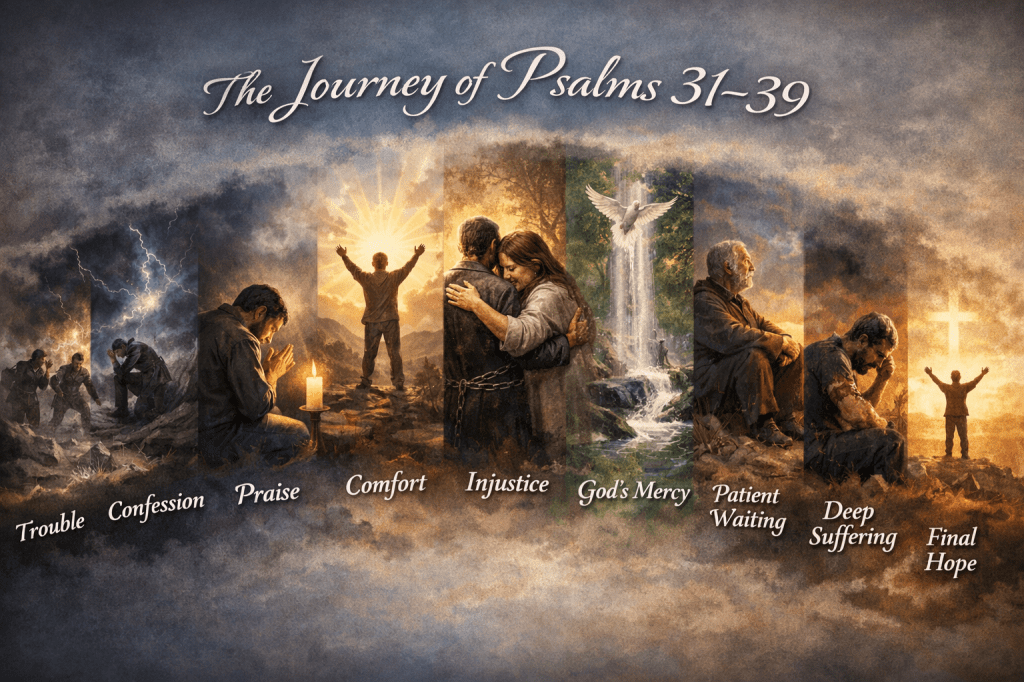
When read sequentially, Psalms 31–39 form a clear spiritual progression:
2.1 Psalm 31 — Trouble and Trust
The journey begins in distress. The psalmist is surrounded by enemies, fear, and social rejection, yet declares:
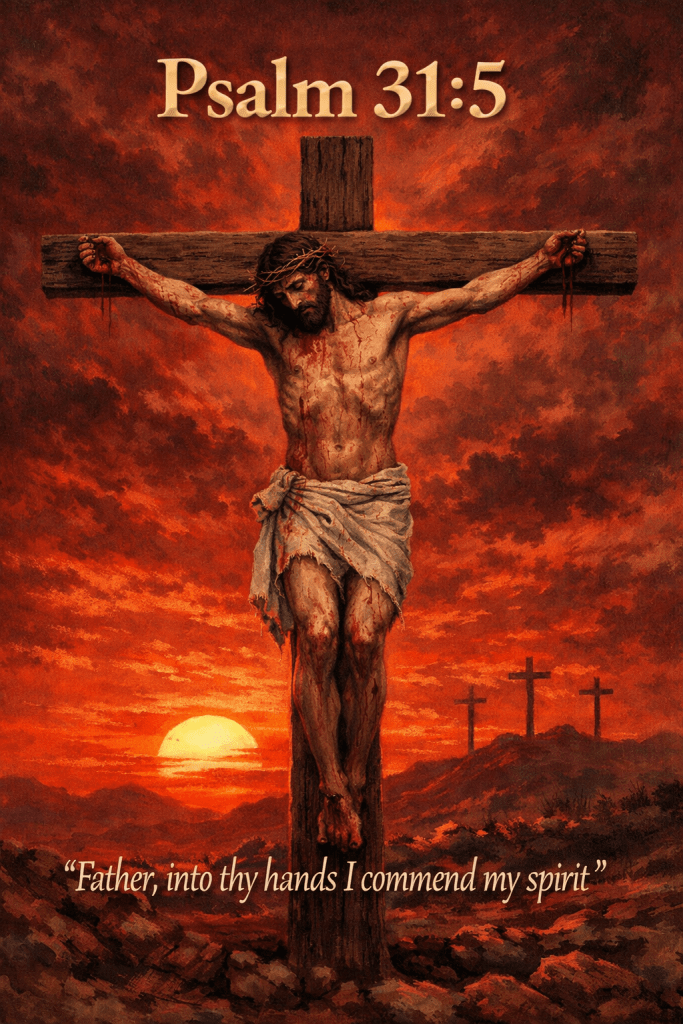
“Into thy hand I commit my spirit.”
This establishes the foundation: trust in God amid suffering.
2.2 Psalm 32 — Confession and Forgiveness
The focus shifts inward. The problem is not only external enemies, but internal sin.
“Blessed is he whose transgression is forgiven.”
Thus, repentance becomes central to the life of faith.
2.3 Psalm 33 — Praise and Sovereignty
The psalmist lifts his gaze from personal struggle to the universal rule of God.
God is Creator, King, and sovereign over history.
This introduces cosmic perspective.
2.4 Psalm 34 — Comfort and Divine Nearness
The emphasis becomes pastoral:
“The LORD is nigh unto them that are of a broken heart.”
God is not distant; He is present with the afflicted.
2.5 Psalm 35 — Injustice and Vindication
At the center of the arc lies unjust suffering.
The righteous one is:
falsely accused
hated without cause
surrounded by enemies
This psalm strongly anticipates the messianic pattern of unjust suffering.
2.6 Psalm 36 — Human Sin and Divine Mercy
A sharp contrast emerges:
human wickedness is deep
God’s mercy is higher
“Thy mercy, O LORD, is in the heavens.”
Thus, the answer to evil is not human effort, but divine steadfast love.
2.7 Psalm 37 — Patient Waiting and Inheritance
The faithful are instructed:
“Fret not… trust in the LORD… wait patiently for him.”
This psalm introduces the theme of inheritance, promised to those who endure.
2.8 Psalm 38 — Deep Suffering and Burden
The tone becomes heavy again:
physical pain
emotional anguish
spiritual burden
The believer experiences the weight of life under discipline and suffering.
2.9 Psalm 39 — Frailty and Final Hope
The sequence ends with reflection:
“My hope is in thee.”
Human life is short. Strength fades. But hope remains in God.
3. Summary of the Arc
The nine psalms together form the following progression:
Or more simply: this is path of the righteous in a fallen world.
This is not abstract theology. It is lived faith.
4. Christological Fulfillment
From a Christian perspective, this arc aligns closely with the life of Christ:
Psalm 31 → quoted by Jesus at the cross
Psalm 35 → hatred without cause
Psalm 37 → inheritance of the meek
Psalm 38–39 → suffering and human frailty
Together, these psalms form a portrait of the righteous sufferer, fulfilled ultimately in Jesus.
The pattern is clear:
suffering → trust → surrender → vindication
This is the pattern of the cross and resurrection.
5. The Numerical Witness: 315
The sum of Psalms 31–39 is 315:
Within our broader framework, 315 is a permutation of 153, and is associated with:
the hour of Christ’s death (3:15 pm tradition)
the moment of surrender (“Into thy hands…”)
Thus, 315 becomes a signature of sacrifice.
Importantly, this is not the basis of interpretation, but a confirmation:
The text already presents a pattern of suffering and surrender. The number 315 echoes that same pattern.
6. The Jasper Throne (Revelation 4:3)
The Greek word:
ἰάσπιδι (iaspidi) — “jasper”
has an isopsephy value of 315.
This word describes the One seated on the throne in heaven.
And he that sat was to look upon like a jasper and a sardine stone: and there was a rainbow round about the throne, in sight like unto an emerald. (Revelation 4:3)
This creates a profound connection:
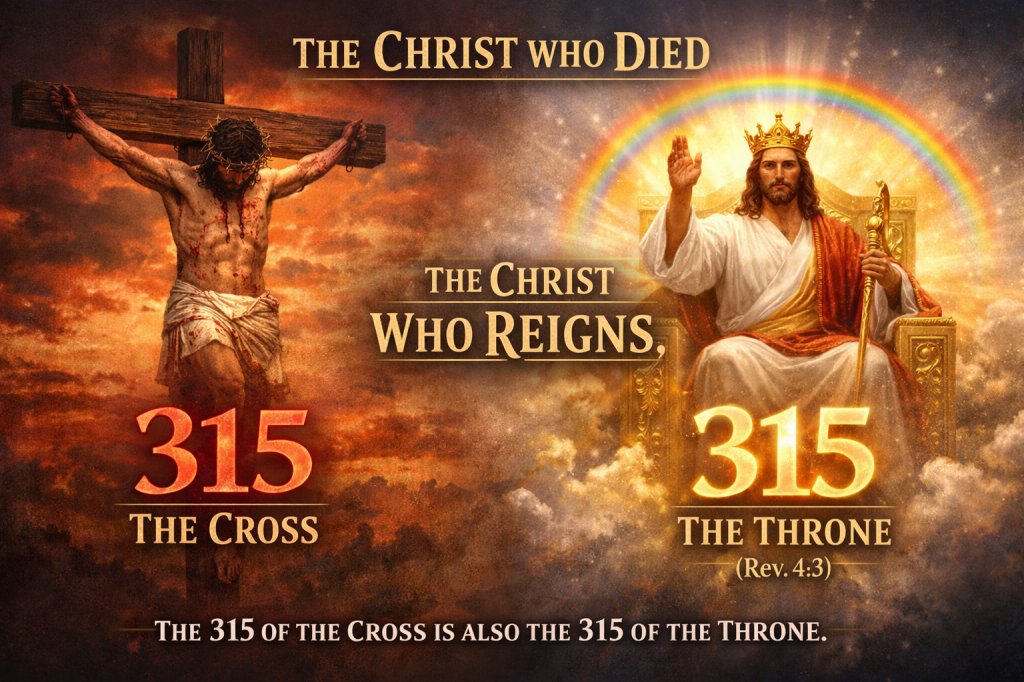
315 (Psalms 31–39) → suffering and surrender
315 (jasper) → divine enthronement
Thus, the number associated with the cross is also associated with the throne.
In biblical theology: The Lamb who was slain is the One who reigns.
7. From 315 to 153: Sacrifice and Harvest
In John 21:11, the disciples catch 153 fish.
Simon Peter went up, and drew the net to land full of great fishes, an hundred and fifty and three: and for all there were so many, yet was not the net broken. (John 21:11)
This number has long been associated with:
completeness
fullness
the gathering of the redeemed
Within this framework:
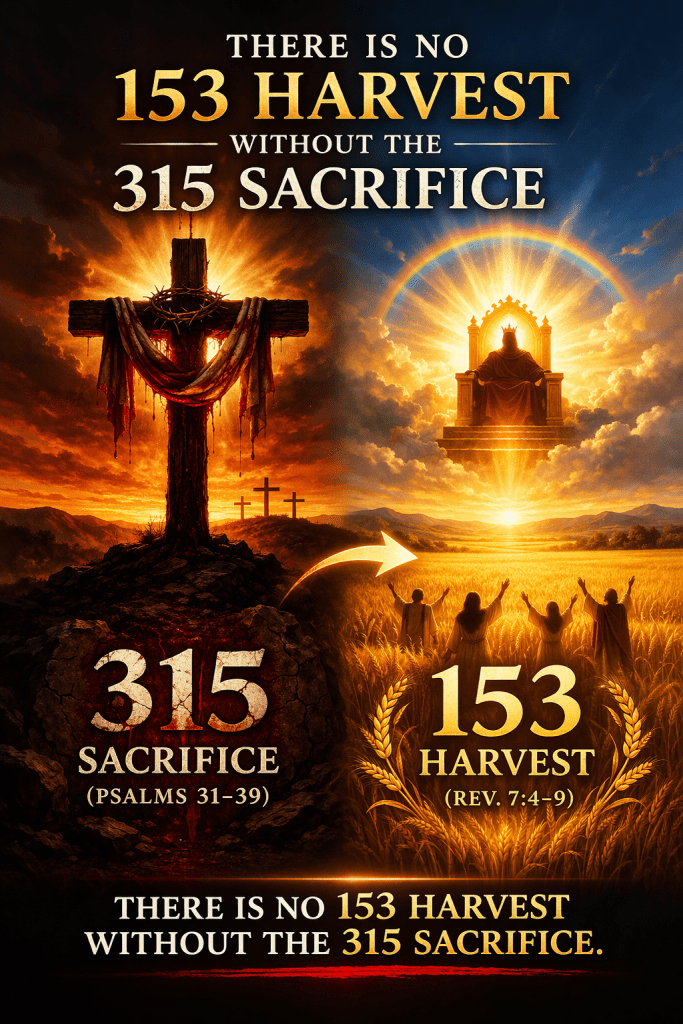
315 = sacrifice
153 = harvest
Thus:
There is no 153 harvest without the 315 sacrifice.
This aligns perfectly with the New Testament:
Christ dies → then gathers His people
the cross → then the church
sacrifice → then fulfillment
A further observation may be noted as a confirming numerical witness within Revelation 7 itself. The identifiers of verses 3 and 4—where the servants of God are first sealed and then numbered as one hundred and forty-four thousand—are 76 and 77 respectively, which together sum to 153.
3 Saying, Hurt not the earth, neither the sea, nor the trees, till we have sealed the servants of our God in their foreheads. 4 And I heard the number of them which were sealed: and there were sealed an hundred and forty and four thousand of all the tribes of the children of Israel. (Revelation 7: 3-4)
Sum of Verse Identifiers = (66+7+3)+(66+7+4) = 76 + 77 = 153.
While this does not establish doctrine, it functions within the present framework as a secondary confirmation of the theological unity already evident in the text: that the sealed servants of God belong to the same reality as the gathered people symbolized by the 153 fish in John 21. In this way, the act of sealing (Revelation 7:3) and the act of numbering (Revelation 7:4) converge numerically in the number of fulfillment, suggesting that those marked by God are also those gathered by the Son. Thus, the movement from sacrifice (315) to harvest (153) finds a final and elegant resonance within the sealing vision itself.
8. Theological Synthesis
We can now summarize the full pattern:
Textual Level
Psalms 31–39 describe the life of the righteous sufferer:
trust
repentance
endurance
hope
Christological Level
This pattern is fulfilled in Jesus:
unjust suffering
complete surrender
final vindication
Numerical Level (Secondary Witness)
315 → sacrifice (cross)
315 → throne (Revelation)
153 → harvest (John 21)
Unified Message
The path to glory passes through suffering. The cross precedes the harvest. The One who surrendered is now enthroned.
9. Conclusion
Psalms 31–39 form a powerful and coherent spiritual journey. They teach that:
life is difficult
sin is real
suffering is unavoidable
but God is faithful
When read in light of Christ, they reveal: the way of the Son is the way of trust through suffering into glory
The numerical observation that these psalms sum to 315 does not create this meaning—it confirms it.
And when placed alongside 153, the message becomes complete.
The sacrifice of Christ (315) leads to the gathering of His people (153).
A Canon-Guided Numerical Reading in Service of Theology
Abstract
Psalm 30 is a Davidic thanksgiving psalm that narrates divine deliverance, exposes the spiritual danger of prosperity, and culminates in enduring praise. Using the Verse Identifier method (Book Number + Chapter Number + Verse Number), this study reports three cumulative totals within Psalm 30 (KJV): 153 after verse 3, 315 after verse 6 (a digit permutation of 153), and 666 as the total sum of all verse-identifiers. Rather than treating these totals as drivers of interpretation, the paper employs them as confirmatory echoes within a text-first, canon-informed approach. The resulting reading highlights (i) deliverance “from the pit” as consecration for worship (vv.1–4), (ii) verse 6 as the psalm’s moral and spiritual hinge (“I shall never be moved”), and (iii) the whole-psalm total 666 as a cautionary enclosure of the “man-exaltation” impulse that the psalm ultimately overturns into perpetual thanksgiving. The “so what” is pastoral and practical: Psalm 30 functions as a template for the rescued community—deliverance must become worship, prosperity must be held with humility, and adversity can serve as divine reorientation toward prayer and transformed joy. Mathematical details are confined to appendices.
Psalm 30 is frequently read as a song of reversal: weeping in the night, joy in the morning. Yet the psalm is equally a sober warning about what prosperity can do to the human heart. This paper presents a numerical discovery that appears to align closely with that theological movement: three cumulative identifier totals (153, 315, 666) emerge at spiritually decisive points.
The aim is not to replace exegesis with arithmetic, but to show how numeric structure—when handled modestly—can function as a secondary witness that confirms themes already present in the text. In short: the text governs; the numbers corroborate.
2. Text, Genre, and Context
Psalm 30 is a thanksgiving psalm attributed to David, bearing the superscription: “A Psalm and Song at the dedication of the house of David.” The heading suggests a setting of dedication (royal house/palace, or later liturgical reuse at dedications). While the precise historical occasion remains debated, the psalm’s internal logic is clear:
David recalls rescue from near-death (vv.1–3),
calls the community to worship (v.4),
states a theological maxim about divine favor and temporal grief (v.5),
confesses the spiritual risk of prosperity (v.6),
recounts destabilization when God “hid” His face (v.7),
records renewed supplication (vv.8–10),
concludes with transformation and perpetual praise (vv.11–12).
Within Book I (Psalms 1–41), Psalm 30 functions as a testimony-psalm that strengthens trust for ongoing struggle.
3. Methodology
3.1 Verse Identifier Method
Each verse receives an identifier:
Identifier = Book Number + Chapter Number + Verse Number.
For Psalm 30 (Book of Psalms = 19; Chapter = 30), the identifier for verse v is:
19 + 30 + v = 49 + v.
Thus Psalm 30:1–12 yields identifiers 50–61, and cumulative sums can be tracked across the psalm (see Appendix A).
3.2 Canon-Guided Restraint
Digit permutations (e.g., 153 ↔ 315) are treated as auxiliary rather than primary meaning-makers: they may confirm a hinge already evident in the text but should not override exegetical sense.
4. Exegetical Flow and the Hinge of the Psalm
A concise hinge reading reveals the psalm’s structure:
vv.1–3 (deliverance): lifted up, healed, brought up from the grave/pit.
v.4 (public worship): the rescued calls the saints to praise.
vv.8–10 (supplication): renewed dependence; life preserved in order to praise.
vv.11–12 (transformation): mourning to dancing; perpetual thanksgiving.
The textual hinge is unmistakably v.6, because it names the inward error prosperity can produce. Everything after v.6 functions as God’s corrective path into prayer and transformed worship.
5. Numerical Findings
Three cumulative totals stand out (see Appendix A):
The number 153 occurs as the cumulative sum at verse 3 (end of the deliverance unit).
The number 315 occurs as the cumulative sum at verse 6 (the hinge confession), and is a base-10 digit permutation of 153.
The number 666 is the total cumulative sum at verse 12 (the psalm’s conclusion).
These totals align with the psalm’s theological movement: rescue (v.3), hinge (v.6), and whole-psalm resolution (v.12).
6. Theological Interpretation of the Three Signatures
6.1 Appearance of153 at v.3: Deliverance as Consecration for Witness
Verse 3 is the rescue threshold: “Thou hast brought up my soul from the grave… kept me alive.” The cumulative total reaching 153 at this moment coheres with the “153 net” framing (John 21:11): the rescued are not merely spared; they are kept alive for worship and obedience. The very next verse (v.4) turns rescue into communal praise, which is precisely how testimony is meant to function.
6.2 Appearance of 315 at v.6: The Prosperity Trap as the Psalm’s Moral Center
The cumulative total 315 occurs exactly at v.6: “In my prosperity I said, I shall never be moved.” Textually, v.6 is the pivot from celebration to correction. Numerically, 315 echoes 153 by permutation—functioning as confirmation that the same life that is rescued must still be purified from self-security. In biblical number vocabulary, 6 is associated with man, and it is fitting that verse 6 articulates the “man-impulse” of self-grounded permanence.
6.3 Appearance of 666 as Whole-Psalm Total: Enclosing the “Man” Impulse and Converting It into Worship
The total sum 666 is symbolically weighty in Christian canon because Revelation associates it with “the number of a man” and counterfeit worship. Read within Psalm 30 itself (rather than imported fearfully into it), 666 can be treated as an enclosure warning: the “man” tendency to enthrone self is genuinely present (v.6), yet the psalm ends not in self-rule but in perpetual thanksgiving (v.12). Psalm 30 exposes the impulse, breaks it, and converts the outcome into worship.
7. Christological Reading (Christian Perspective)
Psalm 30 is not a direct messianic prophecy in the manner of Psalm 22; however, it readily supports a typological reading:
“brought up… from the grave” (v.3) harmonizes with resurrection-shaped hope,
“joy… in the morning” (v.5) resonates with the pattern of suffering followed by divine vindication,
the movement from sackcloth to gladness (v.11) mirrors gospel reversal themes.
From a Christian perspective, Psalm 30 functions as a pattern that finds fuller realization in Christ: suffering does not have the last word; deliverance yields worship; restoration culminates in praise.
8. The “So What?” Pastoral and Practical Implications
This approach yields takeaways that do not require numerical reasoning to be persuasive, but are strengthened by the numeric confirmations:
Deliverance must become worship, not merely relief. Psalm 30 moves quickly from rescue (vv.1–3) to communal praise (v.4).
Prosperity is spiritually dangerous when it produces false permanence. The hinge confession (v.6) warns leaders and believers against “I am unmovable.”
God’s destabilization can be mercy. When God “hid His face” (v.7), the outcome was renewed prayer and transformation, not abandonment.
The goal is transformation, not survival. The psalm ends with mourning turned to dancing (v.11) and thanksgiving “for ever” (v.12).
A simple discipleship template emerges:
153 (vv.1–3): rescued from the pit → preserved for praise
666 (whole): the “man” impulse is enclosed, judged, and converted into worship
9. Limits and Methodological Cautions
The numerical results are not presented as independent proof of doctrine.
Digit permutation is treated as confirmatory, not determinative.
The approach is best used where the text already has strong internal hinges—as Psalm 30 does at v.6.
10. Conclusion
Psalm 30 narrates a complete spiritual arc: God delivers, disciplines, restores, and establishes lifelong praise. The three signature totals (153 → 315 → 666) align with the psalm’s internal movement—deliverance (v.3), hinge confession (v.6), and final resolution (v.12). Held under a text-first discipline, these signatures function as a secondary witness that highlights Psalm 30’s central message: God rescues in order to consecrate; He humbles in order to heal; He transforms sorrow into worship that endures.
Appendices
Appendix A. Table of Identifiers (Psalm 30, KJV)
Identifier = 19 + 30 + v = 49 + v.
Verse
Verse text (KJV)
Identifier
Cumulative sum
1
I will extol thee, O LORD; for thou hast lifted me up, and hast not made my foes to rejoice over me.
50
50
2
O LORD my God, I cried unto thee, and thou hast healed me.
51
101
3
O LORD, thou hast brought up my soul from the grave: thou hast kept me alive, that I should not go down to the pit.
52
153
4
Sing unto the LORD, O ye saints of his, and give thanks at the remembrance of his holiness.
53
206
5
For his anger endureth but a moment; in his favour is life: weeping may endure for a night, but joy cometh in the morning.
54
260
6
And in my prosperity I said, I shall never be moved.
55
315
7
LORD, by thy favour thou hast made my mountain to stand strong: thou didst hide thy face, and I was troubled.
56
371
8
I cried to thee, O LORD; and unto the LORD I made supplication.
57
428
9
What profit is there in my blood, when I go down to the pit? Shall the dust praise thee? shall it declare thy truth?
58
486
10
Hear, O LORD, and have mercy upon me: LORD, be thou my helper.
59
545
11
Thou hast turned for me my mourning into dancing: thou hast put off my sackcloth, and girded me with gladness;
60
605
12
To the end that my glory may sing praise to thee, and not be silent. O LORD my God, I will give thanks unto thee for ever.
61
666
Note: KJV is public domain. For a standard online rendering of Psalm 30 (KJV), see BibleGateway: Psalm 30 (KJV).
Appendix B. Canon of Numeric Invariants Snapshot (153, 315, 666)
Primary operators: divisor set D, divisor count τ, sum-of-divisors σ, aliquot sum s = σ − n, totient φ, Carmichael λ, radical rad. Digit permutation is used only as an auxiliary confirmation.
n
Prime factorization
D(n) (divisors)
τ(n)
σ(n)
s(n)=σ−n
φ(n)
rad(n)
λ(n)
153
3²·17
{1, 3, 9, 17, 51, 153}
6
234
81
96
51
48
315
3²·5·7
{1, 3, 5, 7, 9, 15, 21, 35, 45, 63, 105, 315}
12
624
309
144
105
12
666
2·3²·37
{1, 2, 3, 6, 9, 18, 37, 74, 111, 222, 333, 666}
12
1482
816
216
222
36
Auxiliary note: 315 is a base-10 digit permutation of 153, treated here as a confirmatory resonance at the textual hinge (v.6).
Appendix C. Number-Meaning Vocabulary Employed (from the user’s Numbers framework)
Psalms 18–20 as a Lord’s Prayer Formation Sequence (with Joshua 5–6 as the Template)
Abstract
This paper argues that Psalms 18–20 form a coherent spiritual-formation sequence that can be read as a “Lord’s Prayer template” for believers: deliverance remembered (faith with evidence), consecration embraced (surrender to the true Commander), and commission received (the plan is the Name of God, not worldly power). Psalm 18 supplies the experiential foundation of faith: God has delivered, therefore God can be trusted to deliver again. Psalm 19 functions as the bridge: revelation (creation and Torah) leads into inner holiness and submission. Psalm 20 then becomes the commissioning liturgy: the community moves forward with confidence that salvation comes from the LORD, rejecting counterfeit security (“chariots and horses”) and rallying under the divine Name. Numeric results (Verse Identifiers and selected canonical invariants) are presented only as corroborative witnesses in appendices; the paper’s main contribution is theological and pastoral: it offers a replicable framework for discipleship under pressure—alignment before action, trust before vindication, and discernment against counterfeit salvations—with the Lord’s Prayer as the governing pattern of life and mission.
Immediately before the fall of Jericho, Joshua is not given a plan first—he is given a handover. In Joshua 5:13–15, he meets the Captain/Commander of the LORD’s host, stands on holy ground, and submits. Only then does Joshua receive the instruction that governs the battle (Joshua 6:1–5), an instruction framed as worship-led obedience rather than conventional siege strategy. The narrative thus discloses a durable spiritual principle: authority is revealed before strategy is received; surrender precedes instruction.
This paper argues that the Psalter supplies a believer-facing version of that same pattern in Psalms 18–20, with Psalm 19 functioning as the crucial bridge. Psalm 18 provides the foundation of biblical faith: faith is not merely hopeful sentiment but confidence grounded in God’s demonstrated deliverance—memory transfigured into trust. Psalm 19 then turns revelation into consecration: creation and Torah declare God’s authority, and the worshipper responds with inward surrender, seeking cleansing, restraint from presumptuous sin, and acceptance before God. Psalm 20 follows as the commissioning psalm: the community receives the “plan” not as technique but as covenant reliance—“Some trust in chariots and some in horses, but we will remember the name of the LORD our God.” Taken together, Psalms 18–20 form a coherent discipleship sequence: Deliverance remembered (faith) → surrender enacted (consecration) → plan received (commission under the Name).
The “so what?” of this synthesis is practical and pastoral. In seasons when believers feel threatened, delayed, or tempted by rival securities, Scripture does not simply offer comfort—it forms character. The sequence trains the reader to (i) ground trust in God’s proven saving action, (ii) submit inwardly to the true Commander, and (iii) move outwardly with a strategy centered on God’s Name rather than on worldly power. This formation logic naturally resonates with the Lord’s Prayer as the Church’s daily rule of life.
A secondary aim of the study is to document, with transparency and restraint, a small set of numerical corroborations that accompany this theological coherence (reported in the appendices). These results do not establish doctrine independently; they are treated as structured witnesses to a unity already visible in the narrative and theological movement of the texts.
2. Background and Context: From Joshua’s Holy-Ground Handover to a Psalter Formation Pattern (Psalms 18–20)
The interpretive starting point for this study is an Old Testament narrative template in Joshua 5–6 that reveals how divine victory is prepared. Immediately before the fall of Jericho, Joshua encounters a sword-bearing figure identified as the Captain/Commander of the LORD’s host (Joshua 5:13–15). The effect of this encounter is not tactical but theological: Joshua is re-centered. The ground is declared holy; Joshua falls in submission; the decisive question becomes not whether God supports Joshua’s agenda, but whether Joshua will align himself with God’s command.
Only after this act of surrender does the battle plan arrive (Joshua 6:1–5). Jericho’s defeat is framed not as ordinary siegecraft but as worship-led obedience—the ark, priests, trumpets, and a divinely ordered sequence of marching. The narrative thus establishes a durable spiritual law: authority is revealed before instruction is given; surrender precedes strategy.
This Joshua “handover → instruction” template becomes especially fruitful when applied to believers more generally through Psalms 18–20, a sequence that is already thematically linked in the Psalter. Psalm 18 is a comprehensive testimony of divine rescue and supplies the existential foundation of biblical faith: confidence grounded in God’s proven deliverance. Psalm 19 moves from cosmic revelation (creation) to moral revelation (Torah) and culminates in personal consecration (Psalm 19:12–14), where revelation becomes surrender. Psalm 20 then functions as a liturgy for conflict and mission: the community receives the plan as covenant reliance—remembering the Name of the LORD rather than trusting in chariots and horses.
Taken together, Psalms 18–20 provide a believer’s formation sequence that mirrors Joshua’s ordering: Deliverance remembered (faith) → surrender enacted (consecration) → plan received (commission).
3. Method and Guardrails
3.1 Method Summary (text-first; numbers as secondary witnesses)
This paper proceeds in two stages. First, it identifies hinge units—short passages that concentrate the theological tension of a section and initiate its decisive turn—within Joshua 5–6 and Psalms 18–20. These hinge units are interpreted through close reading, with priority given to literary cues (turning points, contrasts, commands, confessions, and outcome statements). Second, a restrained set of canonical numeric invariants is applied to the hinge units as a corroborative layer. All numerical results are reported transparently in the appendices and are not used to establish doctrine independently.
3.2 Why “Hinge Passages” Are Not Cherry-Picking in This Study
A foreseeable criticism of hinge-based readings is that they can become a form of theological cherry-picking: selecting a few convenient verses to force a predetermined conclusion. This paper takes that concern seriously and adopts three guardrails that make hinge selection text-disciplined, replicable, and theologically accountable.
First, hinge selection is governed by literary cues, not preference. In each case, the hinge unit is identified by structural features: a turning point in the narrative (Joshua’s holy-ground encounter immediately preceding the Jericho instructions), a pivot from revelation to personal consecration (Psalm 19), and a shift from petition to assurance and strategic contrast (Psalm 20). These are not obscure fragments; they are points where the text concentrates its theological load and signals a decisive transition.
Second, hinges are chosen as minimum sufficient units, not maximal proof-texts. A hinge unit is the smallest coherent segment that carries the chapter’s pivot. This is a standard practice in exegesis and homiletics; our method formalizes it by requiring that each hinge be justified by textual features (turns, contrasts, commands, confessions, or verdict statements).
Third, numeric signature pointers function as confirmatory constraints, not as generators of meaning. In our corpus, 153 and 168 function as pointers to the Lord’s Prayer formation pattern (with 168 associated with Luke’s Lord’s Prayer unit), 285 points to the Lord’s Prayer in Matthew, while 108 and 666 are treated as discernment markers for counterfeit “redeemers”—systems, powers, or spiritual claims that promise security without confessing the lordship of God in Christ. Crucially, these numbers do not determine the hinge. The hinge is established first by textual coherence; only then are numeric results consulted as secondary witnesses.
4. Psalm 18: Faith with Evidence (Deliverance Remembered)
Psalm 18 is a testimonial psalm that gives faith its substance. David is not hoping that God might be strong—he is confessing that God has been strong. Biblical faith is therefore not wishful thinking but confidence anchored in the demonstrated character of God.
4.1 Psalm 18 in context: deliverance as a foundation for trust
Psalm 18 recounts rescue, vindication, and stabilization. The LORD’s deliverance reveals a pattern: God intervenes decisively, overturns threats, and establishes the one who takes refuge in Him. That memory becomes the believer’s evidence base for future obedience.
4.2 Hinge A (Psalm 18:1–3): allegiance as the starting posture
The opening hinge is a confession of allegiance: God is strength, rock, fortress, deliverer. This functions as a handover at the level of the heart. Faith begins not with control but with attachment—love and dependence that precede outcomes.
4.3 Hinge B (Psalm 18:46–50): deliverance that becomes witness and mission
The closing hinge expands deliverance outward. Praise is offered among the nations, and mercy to the anointed is placed on a covenant horizon. Deliverance becomes public witness and a forward-facing identity, preparing the logic of Psalm 20: if salvation is real, it must govern the community’s future engagements.
Psalm 18 gives the believer a non-fragile faith. Faith is not merely hope that God will help; it is a settled belief that God delivers, because God has delivered. Such faith is ready for Psalm 19’s consecration and Psalm 20’s commissioning.
5. Psalm 19: Surrender to the True Commander (Consecration)
Psalm 19 bridges deliverance to mission by turning revelation into holiness. Revelation is meant to produce surrender, preventing deliverance-faith from becoming triumphalism and commissioning from becoming activism.
5.1 Three movements: creation witness → Torah witness → consecration
Creation declares God’s glory; Torah declares God’s will; and the worshipper yields. The ultimate goal is not information but transformation.
5.2 Hinge (Psalm 19:12–14): “holy ground within”
Psalm 19:12–14 is a compact act of surrender: cleansing from hidden faults, restraint from presumptuous sin, and consecration of speech and meditation. Here the authority of God is welcomed into the hidden places of the self. This consecration moment is the spiritual handover that makes later strategy safe.
5.3 Formation outcome: alignment before action
Psalm 19 supplies the core discipline of the sequence: alignment precedes action. Faith provides confidence; consecration provides purity and surrender; only then is commission rightly received.
6. Psalm 20: Receiving the True Plan (Commission Under the Name)
Psalm 20 is the next step after consecration: the community can ask for help and move forward. It defines success under God as reliance on the LORD rather than on the world’s instruments.
6.1 Psalm 20 as commissioning liturgy
Psalm 20 reads like a communal sending prayer. It assumes trouble and conflict and asks for help from the sanctuary, training confidence shaped by covenant reliance.
6.2 Hinge (Psalm 20:6–9): assurance and the strategy principle
Psalm 20:6–9 pivots from petition to assurance and sets the decisive contrast: some trust in chariots and horses, but the faithful remember the Name of the LORD. That sentence is the plan. Even the closing cry—“Save, LORD”—keeps dependence central.
Definition (used in this paper): when Psalm 20 frames the community’s confidence as “remembering the Name of the LORD,” it treats the “plan” not as a technique for controlling outcomes but as covenant reliance on God’s revealed identity—His character, authority, and saving presence. In practice, this means the people step forward by prayerful obedience under God’s lordship, rejecting rival securities (“chariots and horses”) and acting in alignment with what God has made known of Himself.
6.3 Formation outcome: discernment against counterfeit security
Psalm 20 builds discernment into commissioning. Rival salvation stories will always be present—power, wealth-security, intimidation, manipulation. The psalm trains communities to act without idolatry by placing threat under the sovereignty of God’s Name.
7. Synthesis: The Formation Sequence and the Lord’s Prayer
Psalms 18–20 form a coherent discipleship arc that naturally resonates with the Lord’s Prayer as the Church’s daily rule of life.
7.1 The sequence: Deliverance → Consecration → Commission
Psalm 18 (Deliverance): faith with evidence. Psalm 19 (Consecration): submission and inner alignment. Psalm 20 (Commission): strategy under the Name. This ordering amplifies the Joshua template: surrender precedes instruction, and instruction is received as worship-led obedience.
7.2 Lord’s Prayer mapping (formation, not proof-texting)
“Hallowed be Your name” corresponds to Psalm 20’s plan: the divine Name is the banner and ground of confidence. “Your will be done” corresponds to Psalm 19’s consecration: the inner life aligns to God’s will. “Deliver us…” corresponds to Psalm 18’s testimony: deliverance is experienced and expected.
7.3 A confirmatory test: Psalm 37 and Psalm 62 as a parallel Submission → Plan pair
To test whether the formation logic observed in Psalms 18–20 generalizes beyond this local cluster, we briefly examine a second pair of psalms that exhibit the same movement. Psalm 37:1–11 trains the believer in submission of tempo and reaction—refusing fretting, envy, anger, and retaliatory urgency, and instead trusting, committing, resting, and waiting for the LORD. Psalm 62:1–8 then supplies the plan in concentrated form: “God alone” is rock, salvation, and refuge; therefore the community’s strategy is quiet trust, poured-out prayer, and refusal of counterfeit securities. This parallel pair strengthens the main claim of the paper by showing that “Submission → Plan” is not a one-off pattern but a repeatable formation grammar within the Psalter. Numeric corroboration for this supporting case study is reported in Appendix G.
7.4 Pastoral implications: living faithfully under pressure and delay
This framework answers “God feels late” with formation rather than slogans. Psalm 18 anchors trust in God’s proven character; Psalm 19 turns fear into cleansing and surrender; Psalm 20 commissions action under God’s Name, not the illusions of worldly strength.
Nations, institutions, and leaders are constantly offered “chariots and horses”—systems promising security at the cost of truth and holiness. Psalm 20’s strategy principle trains communities to critique counterfeit salvations and commit to the only deliverance that does not collapse under ultimate pressure.
8. Conclusion
Psalms 18–20 form a coherent formation sequence that answers a practical discipleship need: how to live faithfully under pressure, delay, and competing claims of security. Psalm 18 grounds faith in evidence—God has delivered, therefore trust is rational and resilient. Psalm 19 bridges deliverance to mission by turning revelation into consecration: surrender to the true Commander must take place inwardly, where hidden faults and presumptuous sin are confronted and the heart is aligned to God’s will. Psalm 20 then commissions the community with the true plan—confidence in the LORD’s saving action and a decisive refusal of counterfeit security in favor of the divine Name. Read through Joshua’s “handover → instruction” template, this sequence becomes a replicable spiritual grammar: alignment before action, trust before vindication, and dependence before strategy. The Lord’s Prayer functions as the Christian rule of life that gathers these movements into daily practice—hallowing the Father’s Name, submitting to His will, and seeking deliverance with confidence. The numerical results reported in the appendices are presented as secondary witnesses that corroborate this unity; the primary claim remains theological and pastoral.
APPENDICES (Corroborative Numeric Witnesses)
Appendix A. Texts and hinge units used (with brief rationale notes)
Supplemental case study: Psalm 37:1–11 = 682; Psalm 62:1–8 = 684; combined = 1366 (see Appendix G).
Appendix D. Canonical invariants used (only those referenced)
For Psalm 18 combined hinge total 542: 542 = 2 × 271 (271 prime). Divisors {1, 2, 271, 542}. Sum of divisors σ(542) = 816 (digit permutation of 168).
Appendix E. Signature pointers and interpretive constraints (framework summary)
Signature pointers are treated as confirmatory constraints, not generators of meaning. After hinge units are justified by literary and theological criteria, their numeric behavior may be consulted as secondary corroboration.
Lord’s Prayer pointers: 153 and 168 (Luke anchor), and 285 (Matthew anchor).
Discernment markers for counterfeit redeemers: 108 and 666.
Method rule: text first; numbers second; corroboration, not coercion.
Appendix F. Technical conventions and transparency notes
Translation: KJV-style quotations for readability.
Book numbering: Joshua #6; Psalms #19; John #43 (standard Protestant ordering).
Verse Identifier: ID(B,C,V) = B + C + V; hinge totals sum verse IDs across the hinge block.
Pointer matches may be direct equality or digit permutation; treated explicitly as pointers, not proofs.
If approximations (e.g., PrimePi) are used, the formula and rounding convention must be stated at the point of use and recorded in the appendix where the calculation appears.
Appendix G. Supplemental case study tables and corroboration: Psalms 37 and 62
This appendix records the identifier tables for Psalm 37:1–11 (Submission hinge) and Psalm 62:1–8 (Plan hinge), together with the corroborative invariant observation used in the main text.
Truly my soul waiteth upon God: from him cometh my salvation.
82
82
Psalm 62:2
He only is my rock and my salvation…
83
165
Psalm 62:3
How long will ye imagine mischief…
84
249
Psalm 62:4
They only consult to cast him down…
85
334
Psalm 62:5
My soul, wait thou only upon God…
86
420
Psalm 62:6
He only is my rock and my salvation…
87
507
Psalm 62:7
In God is my salvation and my glory…
88
595
Psalm 62:8
Trust in him at all times… God is a refuge for us.
89
684
Corroborative computation (reported for completeness): 682 + 684 = 1366. Since 1366 = 2 × 683 (with 683 prime), its divisors are {1, 2, 683, 1366}. The arithmetic mean of the divisors is (1 + 2 + 683 + 1366)/4 = 513, which is a digit permutation of 153.
Selected Bibliography
Brevard S. Childs. Introduction to the Old Testament as Scripture. Fortress Press, 1979.
John H. Walton. Ancient Near Eastern Thought and the Old Testament: Introducing the Conceptual World of the Hebrew Bible. Baker Academic, 2006.
Walter Brueggemann. The Message of the Psalms: A Theological Commentary. Augsburg Publishing House, 1984.
James L. Mays. Psalms. Interpretation: A Bible Commentary for Teaching and Preaching. Westminster John Knox Press, 1994.
D. A. Carson. The Gospel According to John. Pillar New Testament Commentary. Eerdmans, 1991.
N. T. Wright. John for Everyone, Parts 1 & 2. SPCK, 2004–2006.
This paper presents a theological and mathematical reading of Psalm 7 using the Verse Identifier method (Book + Chapter + Verse) and the Canon of Numeric Invariants (divisors, sum-of-divisors, divisor mean, and related measures). Two principal findings emerge. First, the “moral recoil” unit of Psalm 7:14–16—where evil is conceived, set as a trap, and returns upon the perpetrator—yields an identifier total of 123 whose sum-of-divisors is 168. Strikingly, 168 is also the identifier total of Luke 11:2–4, Luke’s core presentation of the Lord’s Prayer, culminating in deliverance from evil. Second, the full-psalm identifier total 595 possesses a divisor mean of 108, a number treated in our apologetic framework as a symbolic marker of counterfeit completeness when devotion is detached from Christ. These results invite a coherent theological interpretation: Psalm 7 functions as a courtroom appeal for divine judgment, and its numeric structure gestures toward the Lord’s Prayer as the daily liturgical key for deliverance from evil, while simultaneously warning against substitute “complete” systems that imitate wholeness but deny Christ.
Psalm 7 is a juridical lament: a prayer shaped like a court case. The psalmist (David, per superscription) pleads for refuge, protests integrity against accusation, summons divine judgment, and ends in praise. The theological center is not vengeance but justice: God judges truly, tests hearts, shields the upright, and causes evil to collapse on itself.
Within the Biblical Mathematics framework developed in this project, Psalm 7 becomes a test case: can numeric invariants illuminate theological contours already present in the text—without replacing exegesis, but serving as a structural “witness” to meaning? The findings below suggest that divisor-structure functions not as arbitrary play, but as an interpretive bridge that intensifies three themes already central to Psalm 7: (i) God as Judge, (ii) evil recoiling on the evildoer, and (iii) prayer as the faithful posture while awaiting God’s verdict.
2. Textual-Theological Context of Psalm 7
Psalm 7 is framed by crisis: persecution, false accusation, and the threat of being “torn” like prey. The psalmist’s protestation (“if I have done this…”) is not a denial of all sinfulness, but a claim of innocence regarding the specific charge at hand. This is covenantal courtroom language: David appeals to God’s righteous governance rather than to self-help, manipulation, or retaliation.
The psalm’s inner logic culminates in the moral boomerang of vv. 14–16: the wicked “conceive” trouble, “dig a pit,” and “fall into” their own snare; violence returns upon their own head. The closing vow of praise asserts that God’s righteousness is not merely feared but celebrated.
From a Christian perspective, Psalm 7 is not a direct predictive messianic oracle in the manner of Psalm 22, yet it readily participates in a typological arc: the righteous sufferer falsely accused, entrusting vindication to God, resonates with the passion of Christ and the New Testament’s insistence that God is the ultimate Judge.
3. Methodology
3.1 Verse Identifier System
We use the Verse Identifier:
For Psalms, Book# = 19 (standard Protestant ordering). For Luke, Book# = 42.
3.2 Canon of Numeric Invariants (Operational Form)
We apply four invariants to a passage total :
Divisor set
Number of divisors
Sum-of-divisors
Mean divisor value
In this project’s interpretive practice:
Divisors function as “structural witnesses” (what can enter the number evenly).
Sum-of-divisors often behaves as a bridge: a fullness measure that can land on a theologically aligned signature.
Divisor mean functions as a centering signal that may invite discernment (true vs counterfeit completeness).
4. Results
4.1 The “Moral Recoil” Unit (Psalm 7:14–16)
Identifiers (Psalms = Book 19; Chapter 7):
Psalm 7:14 →
Psalm 7:15 →
Psalm 7:16 →
Total:
Divisors:
4.2 Luke’s Lord’s Prayer Block (Luke 11:2–4)
Identifiers (Luke = Book 42; Chapter 11):
Luke 11:2 →
Luke 11:3 →
Luke 11:4 →
Total:
Thus:
4.3 Full Psalm 7 Total and the 108 Mean
From the earlier Psalm 7 identifier table, the cumulative total is:
Prime factorization:
Divisors:
Sum-of-divisors:
Number of divisors:
Mean:
5. Theological Interpretation
5.1 Psalm 7’s Courtroom Theology and the “Bridge” to Luke 11
Psalm 7’s defining move is to relocate conflict into God’s courtroom. The psalmist does not deny danger; he denies ultimate agency to his enemies. He petitions the Judge. This is precisely the posture Jesus teaches in Luke 11: prayer that begins with God’s holiness and kingdom and culminates in daily provision, forgiveness, and deliverance from evil.
The numeric bridge is therefore not a random coincidence in this framework; it maps onto an already coherent theological relation:
Psalm 7:14–16 describes the mechanism of evil (conception → trap → recoil).
Luke 11:2–4 provides the daily liturgical response by which disciples ask God to govern life under temptation, debt, and evil.
In short: the psalm’s moral architecture finds its devotional key in the Lord’s Prayer.
5.2 The Specificity of “Deliver us from evil”
Luke’s prayer-form includes the explicit petition “deliver us from evil” (Luke 11:4). The Psalm 7 recoil unit is, functionally, a portrait of deliverance: God does not merely remove the righteous from danger; He overturns the wicked scheme so that violence collapses upon itself. The bridge reads like a mathematical witness that the Lord’s Prayer is not only doctrine but an enacted theology of deliverance—prayed into the very dynamics Psalm 7 describes.
5.3 Completion and Spiritual Perfection: Psalm 7 as a Seventh Psalm
Within the biblical numerology appendix adopted in The Lord’s Prayer: A Mathematician’s Creed, the number 7 is associated with “Completion” and “Spiritual Perfection.” Psalm 7, as the seventh psalm, is structurally poised to present a complete moral-theological cycle: accusation → appeal → judgment → recoil → praise. The “completion” is not merely narrative; it is doxological: the faithful end in worship, not obsession.
5.4 595 and the Mean 108: Centering, Counterfeit Completeness, and Discernment
The divisor mean of the full psalm total, , introduces a second layer of interpretation: discernment.
It is well known that the numeral 108 functions as a “completion-of-devotion” number in several Eastern traditions (e.g., 108 names, 108 beads, 108 ritual repetitions). From an orthodox biblical/Christian viewpoint, devotional systems directed to other gods are understood as idolatrous substitutes—religiously impressive, spiritually comprehensive, but not the redemption God gives.
Thus, 108 can be treated as a symbol of “unified counterfeit” completeness when tied to devotion directed away from the God of Israel, and it is explicitly contrasted with the Lord’s Prayer as a Christ-centered counter-symbol. Also 108 can be framed as a “counterfeit fullness,” set in opposition to Christ’s true completeness, even using the mirror motif (801 ↔ 108) to portray imitation-versus-truth dynamics.
Read this way, Psalm 7’s 108-mean becomes spiritually apt: Psalm 7 is exactly the kind of psalm one prays when tempted to grasp for “complete solutions” in the wrong places—self-justification, revenge, manipulative spiritual techniques, or any totalizing system promising safety apart from covenant trust. The psalm teaches the opposite: the righteous flee to God as Judge and wait for His verdict.
This is where Psalm 7’s two discoveries interact powerfully:
The bridge to 168 says: the proper response is Christ’s prayer-life—“deliver us from evil.”
The centering 108 warns: in crisis, counterfeit completeness is attractive; resist devotion divorced from Christ.
So the mathematics does not invent a theology foreign to the text. It intensifies what the psalm already demands: fidelity to the true Judge rather than escape into substitute systems.
5.5 The Lord’s Prayer as Creed and Covenant Practice
The Lord’s Prayer is not merely a devotional form but a proclamation of faith—indeed “the foremost proclamation of faith,” encompassing Christ’s death, resurrection, ascension, and return to judge, and is linked to the number 153 within our biblical mathematics results.
This matters for Psalm 7 because Psalm 7 is a judgment psalm: God judges peoples, tries hearts, and vindicates the righteous. Our framing of the Lord’s Prayer as creed (and covenant practice) means that praying it is not escapism; it is aligning oneself with the coming judgment and choosing trust over retaliation. Psalm 7’s courtroom is not abandoned in Luke 11; it is carried forward into the disciples’ daily life.
6. A Synthesis: Psalm 7 as a Two-Threshold Psalm
Within the Canon of Numeric Invariants, Psalm 7 can be read as a “two-threshold” structure:
Threshold of Deliverance (123 → σ → 168): The moral recoil unit opens into the Lord’s Prayer total, suggesting that the psalm’s teaching about evil’s self-defeat is meant to be prayed—regularly—through Christ’s own words.
Threshold of Discernment (595 → mean → 108): The psalm’s full architecture centers on a number treated in our apologetic framework as counterfeit completeness, thereby warning that crises often push people toward comprehensive “answers” that are not God. The text itself already insists: only God is Judge and shield.
In theological terms: Psalm 7 teaches both deliverance and discernment—deliverance from evil and discernment against the counterfeit.
7. Implications for Devotion and Formation
Liturgical implication: The Lord’s Prayer is not merely compatible with Psalm 7; it is a practical “key” for living Psalm 7’s theology daily—especially the petition for deliverance from evil.
Moral implication: Psalm 7’s recoil logic underwrites a Christian ethic of non-retaliation-with-faith: the righteous entrust judgment to God.
Discernment implication: The 108-centering invites vigilance: when under accusation or threat, the human heart seeks total solutions; Psalm 7 directs the heart back to covenant trust, and the Lord’s Prayer provides the Christ-given form of that trust.
8. Limitations and Next Steps
This paper works within a defined interpretive framework (Verse Identifiers + Numeric Invariants). The results are internally consistent and theologically coherent with the texts in question, but prudence requires continued testing across other psalms and prayer passages. Next steps could include:
extending the same invariant analysis to adjacent psalms (3–8) to test whether similar “prayer-bridges” recur;
mapping recoil/justice units elsewhere in Psalms to New Testament prayer teachings;
integrating further invariants (aliquot sums, totients) as secondary witnesses, not primary drivers.
9. Conclusion
Psalm 7 is a courtroom lament that culminates in a profound moral truth: evil is self-defeating under God’s righteous rule. Using the Canon of Numeric Invariants, we found (i) a bridge from Psalm 7’s recoil unit (123) to Luke’s Lord’s Prayer block via σ(123)=168, and (ii) a centering signal in the full psalm total whose divisor mean is 108, interpreted in this project as counterfeit completeness when devotion is detached from Christ. Together, these findings cohere into a single theological claim: Psalm 7’s justice and deliverance are meant to be inhabited through Christ’s prayer, while resisting counterfeit systems that mimic completeness. In the life of faith, the psalm trains believers to submit their case to the Judge and to pray their way into deliverance—daily.
References
The Lord’s Prayer: A Mathematician’s Creed (project text), especially the framing of the Lord’s Prayer as proclamation of faith and its linkage to 153.
The Biblical Meaning of Numbers from One to Forty (project reference; Appendix reproduced in the Mathematician’s Creed), including the meaning of seven as completion/spiritual perfection.
A Theological, Christological, and Numerical Exegesis
1. Introduction
Psalm 118 stands at the summit of biblical praise. It is the sixth and final psalm of the Egyptian Hallel (Pss. 113–118), the great liturgical sequence sung at Israel’s major festivals, particularly the Passover (Exod 12; Mishnah Pesachim 10). According to Matthew 26:30 and Mark 14:26, Psalm 118 was almost certainly the final hymn Jesus sang with His disciples at the Last Supper—mere hours before His crucifixion.
This psalm is therefore uniquely positioned: it is the closing anthem of the Old Covenant liturgy and the prophetic overture to the New Covenant established in Christ’s blood. It is the Song of Final Victory and the Song of Renewed Covenant—nationally, eschatologically, and personally.
2. Structure and Themes of Psalm 118
Psalm 118 moves through a dramatic theological arc:
Call to Thanksgiving (vv. 1–4) Repeated liturgical refrain: “Give thanks to the LORD, for He is good; His mercy endures forever.” Hebrew: כִּי לְעוֹלָם חַסְדּוֹ (ki le‘olam ḥasdô)—“for His covenant-mercy endures forever.”
Deliverance from Distress (vv. 5–9) A cry from the brink of collapse and enemies.
Victory over the Nations (vv. 10–14) The LORD becomes salvation. Hebrew: יָשׁוּעָה (yeshu‘ah)—“salvation,” the root of Yeshua, Jesus’ name.
The Right Hand of YHWH Triumphs (vv. 15–16) The theological centre of the psalm: “The right hand of YHWH is exalted; the right hand of YHWH does valiantly.” Hebrew: יְמִין יְהוָה (yemîn YHWH).
Entrance through the Gates of Righteousness (vv. 19–21) A royal-priestly procession into the Temple.
The Rejected Stone Exalted (v. 22–25) Messianic prophecy later cited by Jesus (Matt 21:42) and the apostles (Acts 4:11; 1 Pet 2:7).
Final Doxology (vv. 26–29) “Blessed is He who comes in the name of the LORD!”—sung at Jesus’ triumphal entry (Matt 21:9).
Thus, Psalm 118 is a liturgical crescendo that celebrates salvation already received and salvation yet to come.
3. Psalm 118 as the Song of Final Victory
3.1 Historical Victory
Psalm 118 likely commemorated a great national deliverance—possibly a royal victory or temple dedication. Its tone reflects triumph after severe distress: “I was pushed hard so that I was falling, but the LORD helped me.” (v. 13)
3.2 Theological Victory
The central proclamation, “The right hand of YHWH does valiantly” (v. 16), expresses divine, not human, triumph. In Scripture, God’s “Right Hand” symbolizes:
strength (Exod 15:6),
salvation (Ps 98:1),
exaltation (Ps 110:1),
and resurrection power (Acts 2:33; Eph 1:20).
Psalm 118 is therefore the anthem of decisive, covenantal victory—victory grounded not in human strength but in divine intervention.
3.3 Christological Victory
The New Testament repeatedly identifies Jesus as:
the Cornerstone of Psalm 118:22 (Matt 21:42),
the One who comes in the Name of the Lord (Matt 21:9),
and the Right Hand of God (Acts 2:33; Heb 1:3).
Thus, Psalm 118 foreshadows the victory of Christ’s death and resurrection. It is the victory hymn of the New Exodus.
4. Psalm 118 as the Song of the Renewed Covenant
4.1 The Covenant Refrain
The psalm begins and ends with: “His mercy endures forever.” Hebrew ḥesed—covenant loyalty—is the foundation of both the Mosaic and New Covenants.
4.2 The Temple Gates as Covenant Renewal
The psalmist asks: “Open to me the gates of righteousness.” (v. 19)
Passing through these gates signifies renewed covenant fellowship. In the New Covenant, these gates are opened by Christ, the Cornerstone (John 10:7; Heb 10:19–20).
4.3 The Psalm Sung at the Last Supper
Psalm 118 is the final psalm Jesus sang before inaugurating the New Covenant in His blood (Luke 22:20). Thus, the covenant sung in Psalm 118 is fulfilled in the covenant sealed on the Cross.
5. Numerical Theology of Psalm 118
5.1 Identifier Table and Totient
Using the Identifier Method (Book + Chapter + Verse):
Book of Psalms = 19
Chapter = 118
Verse number = n
Identifier = 19 + 118 + n
Total of all 29 identifiers: 4408
Euler’s Totient: φ(4408) = 2016
Factorization: 2016 = 168 × 12
The identifier for the Lord’s Prayer (Luke 11:2–4) is 168.
5.2 Meaning
Thus, the inner life of Psalm 118 (its totient) = twelve cycles of the Lord’s Prayer.
Theologically: Psalm 118 is the architectural praise; the Lord’s Prayer is its daily covenant rhythm.
5.3 The Central Identifier: 153
Psalm 118:16 (the Right Hand verse) has identifier:
19 + 118 + 16 = 153
The same number appears in John 21:11, the miraculous catch of 153 fish.
This creates a prophetic–numerical bridge:
Psalm 118:16 → the proclamation of the Right Hand
John 21:11 → the manifestation of the Right Hand (the risen Christ)
6. Psalm 118 and the Lord’s Prayer: A Structural Mapping
Psalm 118 Theme
Verses
Lord’s Prayer Petition
Theological Parallels
God’s enduring mercy
1–4
Our Father… hallowed be Your Name
Sanctification of the divine Name
Deliverance & trust
5–9
Your kingdom come; Your will be done
Divine rule replacing fear
Strength & salvation
10–14
Give us this day our daily bread
God sustains after deliverance
Gates of righteousness
15–21
Forgive us our sins…
Forgiveness opens covenant access
The Cornerstone
22–25
Deliver us from evil
Christ overcomes rejection and evil
Final doxology
26–29
Yours is the kingdom…
Eternal praise and covenant completion
Psalm 118 contains the grand architecture; the Lord’s Prayer delivers its distilled essence.
7. The Personal Dimension of Covenant Renewal
Psalm 118 is not only national and messianic—it is deeply personal.
7.1 The Psalmist’s Human Weakness
The psalmist confesses:
distress (v. 5)
fear (v. 6)
falling (v. 13)
This mirrors Paul’s confession:
“The spirit is willing, but the flesh is weak.” (Matt 26:41)
7.2 The Right Hand Lifts the Fallen
Psalm 118:16 proclaims God’s strength, not ours.
Just as Peter—weak, impulsive, and fallen—was restored by Christ in John 21, the believer finds that:
we stumble daily,
but His mercy endures daily,
and His Right Hand lifts us daily.
7.3 Covenant Renewal for the Sinner
The refrain “His mercy endures forever” becomes the daily confession of the imperfect disciple.
Every time the believer prays the Lord’s Prayer, every time he or she repents and returns, Psalm 118 becomes personally true:
“Open to me the gates of righteousness; I shall enter and give thanks.” (v. 19)
8. Psalm 118, John 21, and the Right Hand of God
The command in John 21:6— “Cast the net on the right side”— is deliberate theological symbolism.
The right side corresponds to the Right Hand of God, the position of strength and favor (Ps 16:11; Ps 110:1).
The full catch of 153 fish manifests the power proclaimed in Psalm 118:16.
The unbroken net symbolizes the wholeness and security of the redeemed Church.
Thus, Christ—exalted to the Right Hand—fulfills the psalm by gathering the fullness of His people.
9. Conclusion
Psalm 118 is the Song of Final Victory because it celebrates the ultimate triumph of God’s Right Hand—fulfilled in Christ’s resurrection. It is the Song of the Renewed Covenant because it was sung at the Last Supper, the threshold of the New Covenant.
Numerically, its inner life (2016) consists of twelve cycles of the Lord’s Prayer, and its centre (153) points directly to the risen Christ.
Personally, it is the song of every believer who:
knows weakness,
stumbles often,
cries out in distress,
rises by mercy,
walks through the gates of righteousness,
and gives thanks from the depths of a humbled heart.
Thus, Psalm 118 teaches us:
The flesh is weak, but the Right Hand of the LORD does valiantly.
And therefore:
Give thanks to the LORD, for He is good; His mercy endures forever.
Appendix A: Key Hebrew Terms
Hebrew
Gematria
Transliteration
Meaning
יְמִין יְהוָה
136
yemîn YHWH
Right Hand of YHWH
חֶסֶד
72
ḥesed
Steadfast covenant-love, mercy
יָשׁוּעָה
391
yeshu‘ah
Salvation; root of “Yeshua”
אֶבֶן מָאֲסוּ הַבּוֹנִים
273
ʾeven maʾasu habbonîm
The stone the builders rejected
Astonishingly, there are approximately 153 prime numbers less than or equal to 872, the sum of the alphanumeric values given in the table, that is, 136 + 72+391+273 = 872.
Appendix B: Identifier and Totient Calculations
Psalm 118: Identifier = 19 + 118 + verse number
Total: 4408
Euler’s Totient: φ(4408) = 2016 = 168 × 12
Lord’s Prayer (Luke 11:2–4): Sum of Identifiers = 168

 The Lord's Prayer: A Mathematician's Creed