The Lord’s Prayer is a Precise Summary of the Gospel of Jesus Christ: A Mathematical Proof

Biblical scholars and theologians have long known that the Lord’s Prayer was a precise summary of the Gospel of Jesus Christ. See some references in the Scholarly Comments section of this website.

The Gospel of Jesus Christ refers to the good news of God’s redemptive plan for humanity, accomplished through the life, death, resurrection, and ascension of Jesus Christ. It is the proclamation of salvation and eternal life available to all who believe in Him. It can be summarized under the following four categories of messianic prophecies in the Old Testament, as they comprehensively encapsulate the major themes and events central to His mission. Here’s how each category relates to the core message of the Gospel:

  1. Prophecies About Jesus’ Birth:
    • These prophecies highlight the miraculous and divine origins of Jesus, emphasizing His identity as the promised Messiah. His birth fulfills God’s promises to bring salvation to humanity, establishing the foundation of the Gospel.
  2. Prophecies About Jesus’ Life and Ministry:
    • Jesus’ teachings, miracles, and the way He lived demonstrate the nature of God, His love, and His kingdom. His life provides the model for righteous living and the manifestation of divine power and compassion.
  3. Prophecies About Jesus’ Death:
    • The death of Jesus is the climax of the Gospel, showing the ultimate sacrifice for humanity’s sins. This act of atonement is central to Christian belief, as it reconciles humans with God and provides a way for salvation.
  4. Prophecies About Jesus’ Resurrection:
    • The resurrection is the triumphant victory over sin and death, proving Jesus’ divinity and ensuring eternal life for believers. It is the cornerstone of Christian hope and the promise of a future resurrection for all who follow Him.

These categories collectively narrate the Gospel story—from the anticipation of the Messiah, His life on earth, the sacrificial death, and His victorious resurrection. They align with the essential message of the Gospel as expressed in 1 Corinthians 15:3-4:

“Christ died for our sins according to the Scriptures, that He was buried, that He was raised on the third day according to the Scriptures.”

Thus, the Gospel can be meaningfully summarized under these four categories.

Mathematically, it is sufficient to show that the total sum of the identifiers of any set of pertinent messianic prophecies in the Old Testament about Jesus Christ under the four categories points to the Lord’s Prayer, whose identifier is 168 in the Gospel of Luke and 285 in the Gospel of Matthew.

Accordingly, let us identify the pertinent verses and their identifiers:

1. Prophecies About Jesus’ Birth

  • Born of a Virgin: Isaiah 7:14 – “The virgin will conceive and give birth to a son, and will call him Immanuel.” Identifier=22.
  • Born in Bethlehem: Micah 5:2 – “But you, Bethlehem Ephrathah, though you are small among the clans of Judah, out of you will come for me one who will be ruler over Israel.” Identifier=40.
  • Descendant of Abraham: Genesis 22:18 – “Through your offspring all nations on earth will be blessed.” Identifier=41.
  • From the Line of David: Jeremiah 23:5 – “I will raise up for David a righteous Branch.” Identifier=52.
  • Herod’s Slaughter of Innocents Foretold: Jeremiah 31:15 – “A voice is heard in Ramah… Rachel weeping for her children.” Identifier=70.
  • Called Out of Egypt: Hosea 11:1 – “Out of Egypt I called my son.” Identifier=40.

Sum of all identifiers: 22+40+41+52+70+40=265.


2. Prophecies About Jesus’ Life and Ministry

  • Proceeded by a Messenger (John the Baptist): Isaiah 40:3 – “A voice of one calling in the wilderness: ‘Prepare the way for the LORD.’” Identifier=66.
  • A Light to the Gentiles: Isaiah 9:2 – “The people walking in darkness have seen a great light.” Identifier=34
  • He Will Teach in Parables: Psalm 78:2 – “I will open my mouth with a parable.” Identifier=99.
  • Perform Miracles: Isaiah 35:5 – “Then will the eyes of the blind be opened and the ears of the deaf unstopped.” Identifier=63.
  • Zeal for God’s House: Psalm 69:9 – “Zeal for your house consumes me.” Identifier=97.
  • The King Comes on a Donkey: Zechariah 9:9 – “See, your king comes to you, righteous and victorious, lowly and riding on a donkey.” Identifier=56.

Sum of all the identifiers: 66+34+99+63+97+56=415.


3. Prophecies About Jesus’ Death

  • Betrayed for Thirty Pieces of Silver: Zechariah 11:12 – “So they paid me thirty pieces of silver.” Identifier=61.
  • Silent Before His Accusers: Isaiah 53:7 – “He was oppressed and afflicted, yet he did not open his mouth.” Identifier=83.
  • Pierced Hands and Feet: Psalm 22:16 – “They pierce my hands and my feet.” Identifier=57.
  • Crucified with Criminals: Isaiah 53:12 – “He was numbered with the transgressors.” Identifier=88.
  • Mocked and Insulted: Psalm 22:7 – “All who see me mock me.” Identifier=48.
  • Given Vinegar to Drink: Psalm 69:21 – “They put gall in my food and gave me vinegar for my thirst.” Identifier=109.
  • His Side Pierced: Zechariah 12:10 – “They will look on me, the one they have pierced.” Identifier=60.
  • Cast Lots for His Clothing: Psalm 22:18 – “They divide my clothes among them and cast lots for my garment.” Identifier=59.

Sum of all identifiers: 61+83+57+88+48+109+60+59=565.


4. Prophecies About Jesus’ Resurrection

  • Raised on the Third Day: Hosea 6:2 – “After two days he will revive us; on the third day he will restore us.” Identifier=36.
  • Not Abandoned to the Grave: Psalm 16:10 – “You will not abandon me to the realm of the dead, nor will you let your faithful one see decay.” Identifier=45.
  • Ascends to Heaven: Psalm 68:18 – “When you ascended on high, you took many captives.” Identifier=105.
  • Seated at God’s Right Hand: Psalm 110:1 – “The LORD says to my lord: ‘Sit at my right hand until I make your enemies a footstool for your feet.’” Identifier=130.

Sum of all the identifiers: 36+45+105+130=316.

Hence, the total of all the sums is 265+415+565+316=1561.

Now, there are 215 sphenic numbers less than or equal to 1561. We can also get 215 if we consider the fact that 1561 is the 1314th composite number and that an approximation of the function Prime Pi evaluated at 1314 is 215.

But the astonishing result is that the Euler Totient function evaluated at 215 is precisely 168, the identifier of the Lord’s Prayer in the Gospel of Luke.

BookChapterVerseSum
4211255
4211356
4211457
  168

The identifier of the Lord’s Prayer in the Gospel of Luke is 168

Conclusion. The Lord’s Prayer is a precise summary of the Gospel of Jesus Christ.

The Lord’s Right Hand Is Lifted High! (Psalm 118)

Psalm 118 is a joyful declaration of God’s steadfast love and the triumph of His righteousness. This psalm is a part of the Hallel, a series of psalms (Psalms 113–118) traditionally sung during Jewish festivals, particularly Passover. It is a communal and personal celebration of deliverance and thanksgiving to the Lord.

Verse 16 reads (NIV) : The Lord’s right hand is lifted high; the Lord’s right hand has done mighty things!

Since the Book of Psalms is the 19th book of the Bible, the identifier of the verse is (19+118+16=153).

Conclusion: When we pray the Lord’s Prayer, we declare that the Lord’s right hand is lifted high; the Lord’s right hand has done mighty things!

In the Lord’s Prayer, we say, “Thy Kingdom come, Thy will be done, on earth as it is in heaven” (Matthew 6:10). This petition acknowledges God’s supreme authority and power to accomplish His will. Similarly, Psalm 118:16 exalts the Lord’s “right hand,” a symbol of His sovereignty, which performs “mighty things” to fulfill His divine will.

Psalm 79 and the Lord’s Prayer

The entirety of Psalm 79 astonishingly points to the Lord’s Prayer. Here’s the table for Psalm 79, including the verse enumeration, verse citations, verse texts, identifiers for each verse, and their accumulated sums:

No.VerseTextIdentifierAccumulated Sum
1Psalm 79:1O God, the nations have come into your inheritance; they have defiled your holy temple; they have laid Jerusalem in ruins.9999
2Psalm 79:2They have given the bodies of your servants to the birds of the heavens for food, the flesh of your faithful to the beasts of the earth.100199
3Psalm 79:3They have poured out their blood like water all around Jerusalem, and there was no one to bury them.101300
4Psalm 79:4We have become a taunt to our neighbors, mocked and derided by those around us.102402
5Psalm 79:5How long, O LORD? Will you be angry forever? Will your jealousy burn like fire?103505
6Psalm 79:6Pour out your wrath on the nations that do not know you, and on the kingdoms that do not call upon your name!104609
7Psalm 79:7For they have devoured Jacob and laid waste his habitation.105714
8Psalm 79:8Do not remember against us our former iniquities; let your compassion come speedily to meet us, for we are brought very low.106820
9Psalm 79:9Help us, O God of our salvation, for the glory of your name; deliver us, and atone for our sins, for your name’s sake!107927
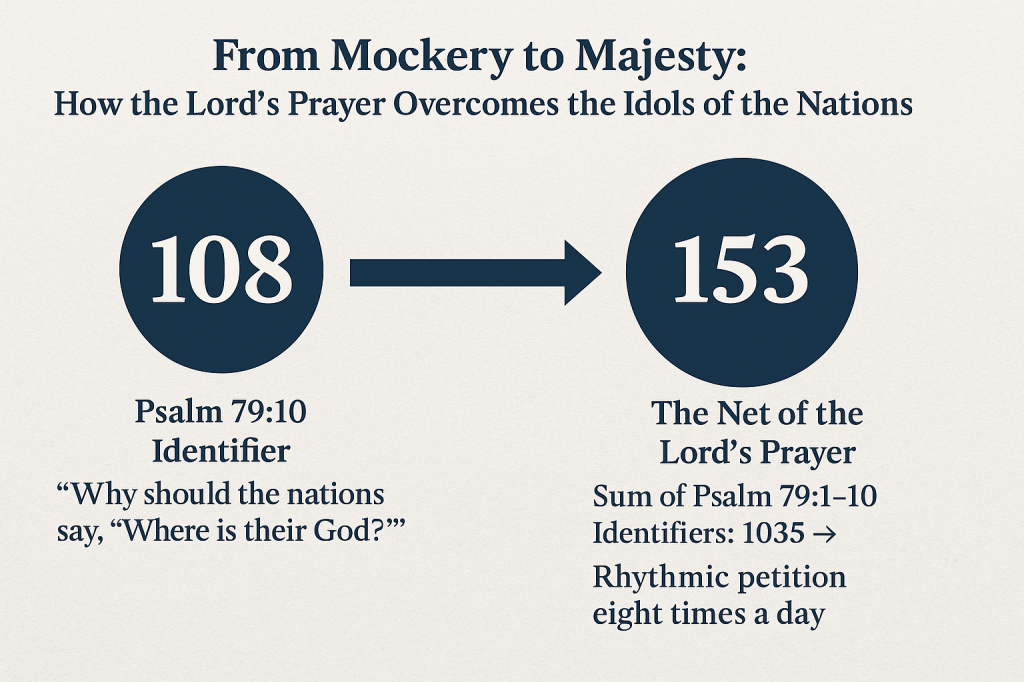
10Psalm 79:10Why should the nations say, ‘Where is their God?’ Let the avenging of the outpoured blood of your servants be known among the nations before our eyes!1081035
11Psalm 79:11Let the groans of the prisoners come before you; according to your great power, preserve those doomed to die!1091144
12Psalm 79:12Return sevenfold into the lap of our neighbors the taunts with which they have taunted you, O Lord!1101254
13Psalm 79:13But we your people, the sheep of your pasture, will give thanks to you forever; from generation to generation we will recount your praise.1111365

There are 16 divisors of 1365, namely, {1, 3, 5, 7, 13, 15, 21, 35, 39, 65, 91, 105, 195, 273, 455, 1365}. The sum of the divisors is 2688. Hence, the arithmetic mean of the divisors is 2688/16 = 168. Since 168 is the identifier of the Lord’s Prayer in the Gospel of Luke, the themes and moral lessons of Psalm 79 are encapsulated by the Lord’s Prayer.

Discussion

The themes and moral lessons of Psalm 79 center on the relationship between the community and God during times of extreme adversity. They teach the importance of turning to God in honest lament, seeking justice from a divine perspective, acknowledging communal and ancestral sins, and understanding the broader implications of God’s actions for His global reputation. Additionally, they reinforce the value of praising God for His deliverance and faithfulness, emphasizing a stance of gratitude and recognition of God’s mercy. They connect well with several elements of the Lord’s Prayer, offering a deeper understanding of how these scriptures complement each other in the broader context of faith and reliance on God.

Acknowledgment of God’s Sovereignty

  • Psalm 79. The Psalmist begins by acknowledging the devastation brought upon by foreign nations, yet it is clear that they turn to God as the ultimate authority and deliverer.
  • Lord’s Prayer. This is echoed in the opening of the Lord’s Prayer with “Our Father in heaven, hallowed be your name,” which recognizes God’s ultimate sovereignty over all things.

Seeking Deliverance and God’s Kingdom

  • Psalm 79. The Psalm appeals to God for deliverance from enemies and for the manifestation of His justice and mercy, showing reliance on God’s power to save.
  • Lord’s Prayer. Similarly, the prayer includes “Your kingdom come, your will be done, on earth as it is in heaven,” seeking God’s righteous rule and divine intervention in the world.

Request for Forgiveness

  • Psalm 79. The Psalmist pleads for forgiveness for past sins, recognizing that their current plight might be a consequence of these actions. They seek reconciliation and mercy.
  • Lord’s Prayer. This aspect aligns with “Forgive us our debts, as we also have forgiven our debtors,” emphasizing the need for divine forgiveness and the importance of forgiving others as a reflection of God’s forgiveness.

Protection from Evil

  • Psalm 79. The psalm ends with a plea for protection and deliverance from the evils that have befallen the people, hoping that God will not let their foes triumph over them permanently.
  • Lord’s Prayer. This is paralleled in “And lead us not into temptation, but deliver us from the evil one,” where there is a petition for guidance away from sin and protection from evil influences.

Call for Justice and Retribution

  • Psalm 79. The psalm specifically asks for God’s retribution against those who have wronged them, reflecting a desire for divine justice to prevail.
  • Lord’s Prayer. While the Lord’s Prayer does not explicitly call for retribution, the appeal for God’s kingdom and will implies a restoration of justice according to divine standards.

Conclusion with Praise and Hope

  • Psalm 79. Despite the lament and pleas for help, the Psalm concludes with a vow to give thanks and praise to God forever, showing trust in God’s faithfulness.
  • Lord’s Prayer. The prayer also concludes with a doxology in some traditions: “For yours is the kingdom, and the power, and the glory, forever. Amen.” This encapsulates the praise and acknowledgment of God’s eternal sovereignty and power.

Integration

Both Psalm 79 and the Lord’s Prayer encapsulate a profound reliance on God in times of distress, a plea for divine intervention, and an acknowledgment of God’s rule. They collectively teach about the relationship between human vulnerability, divine power, and the role of faith in navigating life’s challenges. Through these prayers, believers are reminded of the importance of turning to God, seeking His justice, and trusting in His eternal goodness and mercy.

“I AM WHO I AM” is Jesus Christ: A Mathematical Argument

In Exodus 3:14, we read:

14 And God said to Moses, “I AM WHO I AM.” And He said, “Thus you shall say to the children of Israel, ‘I AM has sent me to you.’ ”

Theorem: “I AM WHO I AM” in Exodus 3:14 is Jesus Christ.

Proof: In Hebrew, the phrase “I AM WHO I AM” is אֶֽהְיֶ֖ה אֲשֶׁ֣ר אֶֽהְיֶ֑ה from the שמות 3:14 Hebrew OT: Westminster Leningrad Codex:

וַיֹּ֤אמֶר אֱלֹהִים֙ אֶל־מֹשֶׁ֔ה אֶֽהְיֶ֖ה אֲשֶׁ֣ר אֶֽהְיֶ֑ה וַיֹּ֗אמֶר כֹּ֤ה תֹאמַר֙ לִבְנֵ֣י יִשְׂרָאֵ֔ל אֶֽהְיֶ֖ה שְׁלָחַ֥נִי אֲלֵיכֶֽם׃

Using the standard values of the Hebrew letters, we easily get the following values:

{
{“אהיה” I AM, 21},
{“אשר” WHO, 501},
{“אהיה” I AM, 21}
}

The sum is 543, which is the 442nd composite number. The 442nd even number is 884. But there are exactly 153 prime numbers less than or equal to 884. That is, the Prime Pi function evaluated at 884 is 153.

Since 153 refers to the Lord’s Prayer, which Jesus Christ taught us, we arrived at the conclusion of the theorem.

DISCUSSIONS

Outside of mathematics, we Christians can, of course, argue that the “I AM WHO I AM” statement in Exodus 3:14 refers to Jesus Christ based on several key theological and scriptural connections between the Old and New Testaments. Here are the main points supporting this argument.

The “I AM” Statement in Exodus 3:14

  1. Divine Self-Identification
    • In Exodus 3:14, God reveals Himself to Moses with the name “I AM WHO I AM” (Hebrew: “Ehyeh-Asher-Ehyeh”), which is understood to mean that God is self-existent, eternal, and unchanging. This name is central to God’s identity and His covenant relationship with Israel.

Jesus’ Use of “I AM” in the New Testament

  1. Jesus’ Explicit Claims
    • In the Gospel of John, Jesus uses the phrase “I AM” (Greek: “Ego Eimi”) multiple times in a way that echoes God’s self-revelation in Exodus. Notable instances include:
      • John 8:58: Jesus says, “Before Abraham was born, I am.” This statement caused a strong reaction from the Jewish leaders, who understood it as a claim to divinity, leading them to attempt to stone Him for blasphemy.
      • John 8:24: Jesus states, “For if you do not believe that I am He, you will die in your sins.”
      • John 18:5-6: When the soldiers come to arrest Jesus, He responds with “I am He,” and they fall to the ground, indicating a display of divine authority.
  2. “I AM” Statements and Divine Attributes
    • Throughout John’s Gospel, Jesus uses “I AM” in conjunction with metaphors that describe His divine role and mission:
      • John 6:35: “I am the bread of life.”
      • John 8:12: “I am the light of the world.”
      • John 10:11: “I am the good shepherd.”
      • John 11:25: “I am the resurrection and the life.”
      • John 14:6: “I am the way, the truth, and the life.”
      • John 15:1: “I am the true vine.”

Theological Implications

  1. Identification with Yahweh
    • By using the “I AM” formula, Jesus identifies Himself with Yahweh, the God of Israel. This is seen as a direct claim to be the same God who spoke to Moses at the burning bush.
  2. Divine Nature of Jesus
    • The early Christian church interpreted these statements as affirmations of Jesus’ divinity. They saw Jesus not just as a prophet or teacher, but as God incarnate, the second person of the Trinity.
  3. Fulfillment of Prophecy
    • Christians believe that Jesus fulfills the Old Testament prophecies about the coming of God in the flesh to save His people. The “I AM” statements reinforce this belief by directly linking Jesus to the God of Israel.

Scriptural Support

  1. Colossians 1:15-17
    • Paul describes Jesus as “the image of the invisible God,” affirming His divine nature and role in creation.
  2. Philippians 2:6-11
    • Paul speaks of Jesus, who “being in very nature God, did not consider equality with God something to be used to his own advantage,” further emphasizing Jesus’ divinity and pre-existence.
  3. Hebrews 1:3
    • The writer of Hebrews describes Jesus as “the radiance of God’s glory and the exact representation of His being.”

By connecting Jesus’ “I AM” statements in the New Testament with God’s revelation to Moses in the Old Testament, we Christians understand and argue that Jesus is indeed the “I AM,” the eternal, self-existent God who has come in the flesh to reveal Himself fully and provide salvation.

Importance of Our Words and Their Impact on Others

In Ephesians 4:29, we read:

Do not let any unwholesome talk come out of your mouths, but only what is helpful for building others up according to their needs, that it may benefit those who listen.

Since the Book of Ephesians is the 49th book of the Bible, the identifier for the verse is 49+4+29=82. The four divisors of 82 are in the set of divisors {1, 2, 41, 82}. Hence the arithmetic mean of the divisors is 126/4 = 31.5. This means that we can link Ephesians 4:29 with the Lord’s Prayer, particularly the petition “forgive us our debts, as we also have forgiven our debtors” (Matthew 6:12). Both passages emphasize the importance of our words and their impact on others.

In Ephesians 4:29, Paul instructs believers to speak in a way that is beneficial and edifying to others, avoiding unwholesome talk. This aligns with the spirit of forgiveness and reconciliation found in the Lord’s Prayer. By asking for forgiveness and expressing our willingness to forgive others, we acknowledge the power of our words to hurt or heal and strive to use them in a way that builds up rather than tears down.

Additionally, the Lord’s Prayer teaches us to pray for God’s kingdom to come and His will to be done on earth as it is in heaven (Matthew 6:10). This includes praying for the transformation of our own hearts and the hearts of others, so that our words and actions reflect God’s love and grace.

Conclusion. Both Ephesians 4:29 and the Lord’s Prayer emphasize the importance of our words and the need to use them in a way that reflects God’s character of love, forgiveness, and grace.