Two Fears with One Identifier (74)

Abstract

Both Job 28:28 and Proverbs 29:25 share the same biblical verse identifier: 74. This numerical convergence highlights a profound theological contrast between two kinds of fear: the fear of the Lord, which leads to wisdom and freedom, and the fear of man, which entraps and enslaves. By examining this contrast, and by tracing the numeric journey from 74 to 153, we see that prayer—especially the Lord’s Prayer—becomes the Spirit-led path from bondage to freedom, from snare to safety, from fear to fullness.


The Verse Identifier: Definition and Calculation

A verse identifier is a numeric value assigned to a verse using the formula:

Identifier=Book Number+Chapter Number+Verse Number

  • Job 28:28
    • Book of Job = 18th book of the Bible
    • Chapter = 28
    • Verse = 28
    • Identifier = 18 + 28 + 28 = 74
  • Proverbs 29:25
    • Book of Proverbs = 20th book of the Bible
    • Chapter = 29
    • Verse = 25
    • Identifier = 20 + 29 + 25 = 74

Thus, both verses—though separated by context and content—share the same identifier, pointing us to a deeper thematic connection.


The Two Fears in Contrast

1. Fear of the Lord (Job 28:28 – Identifier 74)

And to man He said, ‘Behold, the fear of the Lord, that is wisdom, And to depart from evil is understanding.’ ” (Job 28:28, NKJV)

In Job’s wisdom poem, human ingenuity in mining the earth’s treasures is contrasted with the inaccessibility of wisdom. True wisdom cannot be mined; it is given by God. Its essence is captured in the phrase, “The fear of the Lord—that is wisdom.” This fear is reverence, awe, and holy submission. It liberates because it orients life toward God’s sovereignty, resulting in discernment and moral clarity.

2. Fear of Man (Proverbs 29:25 – Identifier 74)

The fear of man brings a snare, But whoever trusts in the Lord shall be safe. (Proverbs 29:25, NKJV)

In Proverbs, the “fear of man” is described as a trap, a snare that entangles the soul. This fear is rooted in the quest for human approval, the dread of rejection, or the anxiety of opposition. Unlike the fear of the Lord, it enslaves, leading to compromise, silence, and insecurity. The proverb immediately offers its counterbalance: “But whoever trusts in the Lord shall be safe.” Trust displaces fear.


The Unity of the Identifier (74)

That both verses share the number 74 is more than coincidence. In biblical mathematics, numbers often serve as thematic bridges. Here, 74 unites two opposites:

  • Fear of the Lord (wisdom, freedom, safety).
  • Fear of man (folly, bondage, danger).

Thus, the shared identifier sets before us a stark spiritual choice: Which fear will rule our hearts? The same number that binds the verses calls us to discern between life-giving reverence and soul-ensnaring anxiety.


From 74 to 153: The Harmonic Path to the Lord’s Prayer

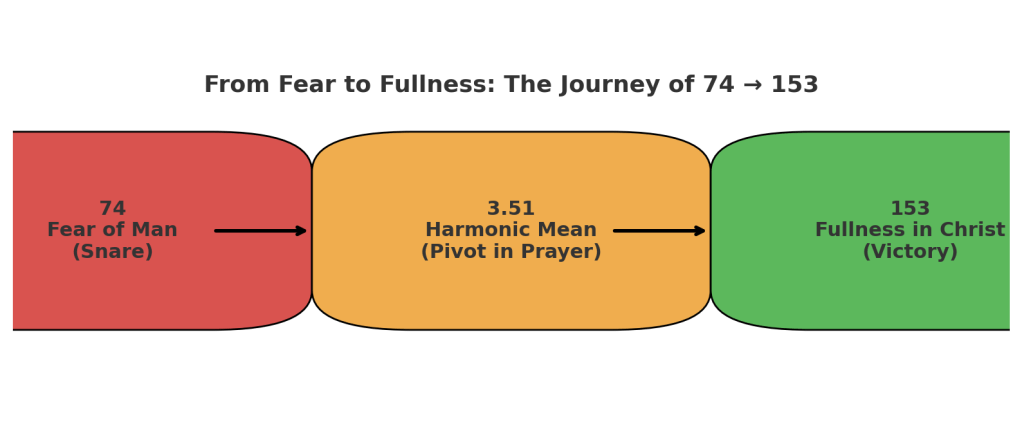
The number 74 does not stand alone; it carries within it a hidden journey. Its divisors are {1, 2, 37, 74}. The harmonic mean of these divisors is 3.51.

On the surface, this is a simple mathematical property. Yet its digits [3-5-1] conceal a hidden key: a permutation to [1-5-3], pointing directly to 153.

  • 74 – the snare of fearing man (Proverbs 29:25).
  • 3.51 – the pivot, the crossing point, the hidden code.
  • 153 – the fullness of victory in Christ, the number of fish in John 21:11 symbolizing the gathered Church.

In prayer practice, this pattern unfolds in sacred time. In the rhythm of the Lord’s Prayer, daily prayers are offered at 1:53 pm and 3:51 pm. The digits of the harmonic mean thus become embodied in prayer:

  • 1:53 pm → the fullness of the net (153): “Your kingdom come.”
  • 3:51 pm → the reversal of 153 (351): “Deliver us from evil.”

This shows that the fear of man (74) is not overcome by willpower, but by stepping into the victory of Christ (153), made present through the Lord’s Prayer. The journey of numbers thus becomes the journey of the soul: from fear → to fullness, from snare → to deliverance, from 74 → 153.

Overcoming the Fear of Man: Practical Pathways

  1. Re-anchor Identity in God
    Fear of man thrives when self-worth rests on others’ opinions. Meditating on God’s declaration—“You are accepted in the Beloved” (Ephesians 1:6)—shifts the foundation of identity from human applause to divine approval.
  2. Reorder Your Fears
    Jesus said: “Do not fear those who kill the body…but rather fear Him who can destroy both soul and body in hell” (Matthew 10:28). Perspective frees us: man’s power is limited; God’s power is ultimate.
  3. Practice Trust Daily
    Proverbs 29:25 emphasizes that trust in the Lord brings safety. Each decision to honor God over pleasing people strengthens spiritual courage. Trust becomes the antidote to entrapment.
  4. Seek God’s Vision
    Without prophetic vision, people drift into conformity (Proverbs 29:18). Fixing our eyes on God’s call clarifies which voices matter.
  5. Rely on Prayer and the Spirit
    The numeric arc from 74 → 153 reveals that prayer is the Spirit’s appointed path out of fear. The harmonic mean (3.51) points to times of prayer that lead from snare to safety, from bondage to deliverance. The Lord’s Prayer, prayed faithfully at sacred times, becomes the doorway into Christ’s fullness.

Conclusion

The number 74 binds together two verses that illuminate the two fears vying for mastery over human hearts. Job 28:28 calls us into the liberating fear of the Lord, the beginning of wisdom. Proverbs 29:25 warns against the fear of man, a snare that robs us of freedom.

Yet the journey does not end there. Through the harmonic path of 74 → 153, mathematics itself testifies to the gospel: fear of man is overcome not by suppression but by substitution—by trusting in God, praying in the Spirit, and stepping into the completeness of Christ. The Lord’s Prayer thus becomes the pivot point where fear turns into freedom, and where the soul moves from snare into safety.

🔥 The Purification Has Begun: A Divine Intervention in the Churches

Using the Life and Ministry of Pope Francis as a Sign of the Times

Introduction: When God Intervenes from Within

God is not an indifferent spectator of history. He is not passively awaiting the return of His Son while His Church drifts into compromise, confusion, and complacency. The testimony of Scripture is clear: in the end days, God will purify His people, not by wrath but through a holy intervention from within.

This purification, long foretold by the prophets, the apostles, and by Christ Himself, has already begun. And one of the most visible signs of this divine movement may well be found in the unlikely figure of Pope Francis, the 266th pope of the Roman Catholic Church.


I. The Scriptural Basis for Purification in the End Days

1. Judgment Begins in the House of God

“For it is time for judgment to begin at the household of God…”
—1 Peter 4:17

Before God judges the world, He evaluates His people. This is not judgment unto destruction, but unto refinement, restoration, and readiness.

2. Christ Walks Among the Lampstands

“These are the words of Him who walks among the seven golden lampstands…”
—Revelation 2:1

The glorified Christ begins Revelation not with Rome, Babylon, or the nations, but with His own churches. He exposes hypocrisy, calls for repentance, and promises rewards for those who overcome. It is a pattern of internal intervention before external consummation.

3. The Bride Must Make Herself Ready

“His bride has made herself ready…”
—Revelation 19:7

The Church’s final act before the return of Christ is not evangelism or expansion, but purification. She must be presented without spot or wrinkle (Eph. 5:27)—something only possible through the sanctifying fire of the Holy Spirit.


II. Pope Francis: A Sign of Internal Intervention

Pope Francis, elected in 2013 as the 266th pope, may be more than a reformer. He may be a divine signpost.

1. A Lifestyle of Simplicity

Rejecting the papal palace, Francis chose a humble guesthouse. He wears plain white robes, washes the feet of prisoners and Muslims, and travels in a modest car. These are not mere personal quirks—they are a prophetic rebuke to centuries of ecclesiastical opulence. His very lifestyle says: Return to Christ. Return to simplicity.

2. Confronting Evil Within

Francis has not only called for transparency and accountability—he has exposed deep layers of abuse, secrecy, and spiritual corruption within the Vatican. From curial reform to financial transparency, his papacy has revealed rot beneath the surface of holiness. In doing so, he has embodied the prayer:

“Deliver us from evil.”

3. A Pattern of the Coming Purification

The significance of 266 is striking. Its Euler Totient is 108—the mirror image of 801 (Alpha & Omega), suggesting an end-time reversal of appearances. And the 266th odd number is 531—a permutation of 153, the number associated with the Remnant, the Sons of God, and the Lord’s Prayer times. Francis is a signal that the Lord of the Church has begun to walk among His lampstands.


III. A Movement Expanding Beyond Rome

What began with Rome will not stay in Rome. Jesus is Lord of all His Church, not just one denomination.

  • Anglicanism faces a moral and identity crisis.
  • Methodism is wrestling with fragmentation.
  • Evangelicalism battles consumerism and celebrity culture.
  • Pentecostalism, for all its passion, is plagued by unaccountable power.

Just as Christ purified the Temple at the beginning and end of His earthly ministry, He will purify His spiritual temple—the Church—before His return. This is not the death of the Church. This is her rebirth.


IV. The Role of the Invisible Church

In these end days, God is not raising a new denomination. He is awakening the Invisible Church—those who live by the Spirit, love truth, and walk in holiness. They are found across all traditions, races, and nations. They pray the Lord’s Prayer at appointed times, partake of the Lord’s Table in reverence, and yearn for the return of their King.

They understand that:

Unity is not an achievement. It is a resurrection miracle.
It is not man-made. It is God-given.
It begins when Christ walks among His people once again.


Conclusion: The Fire Has Started in the Sanctuary

“Who can endure the day of His coming? For He is like a refiner’s fire…”
—Malachi 3:2

The fire is not coming. It has already been lit.
It began with a humble man in white robes.
It will sweep through cathedrals and tents alike.
It will wound only to heal.
And it will leave behind a Bride clothed in splendor, without spot or wrinkle.

Let those who have ears to hear, hear what the Spirit is saying to the churches.
The purification has begun.

“I AM WHO I AM” is Jesus Christ: A Mathematical Argument

In Exodus 3:14, we read:

14 And God said to Moses, “I AM WHO I AM.” And He said, “Thus you shall say to the children of Israel, ‘I AM has sent me to you.’ ”

Theorem: “I AM WHO I AM” in Exodus 3:14 is Jesus Christ.

Proof: In Hebrew, the phrase “I AM WHO I AM” is אֶֽהְיֶ֖ה אֲשֶׁ֣ר אֶֽהְיֶ֑ה from the שמות 3:14 Hebrew OT: Westminster Leningrad Codex:

וַיֹּ֤אמֶר אֱלֹהִים֙ אֶל־מֹשֶׁ֔ה אֶֽהְיֶ֖ה אֲשֶׁ֣ר אֶֽהְיֶ֑ה וַיֹּ֗אמֶר כֹּ֤ה תֹאמַר֙ לִבְנֵ֣י יִשְׂרָאֵ֔ל אֶֽהְיֶ֖ה שְׁלָחַ֥נִי אֲלֵיכֶֽם׃

Using the standard values of the Hebrew letters, we easily get the following values:

{
{“אהיה” I AM, 21},
{“אשר” WHO, 501},
{“אהיה” I AM, 21}
}

The sum is 543, which is the 442nd composite number. The 442nd even number is 884. But there are exactly 153 prime numbers less than or equal to 884. That is, the Prime Pi function evaluated at 884 is 153.

Since 153 refers to the Lord’s Prayer, which Jesus Christ taught us, we arrived at the conclusion of the theorem.

DISCUSSIONS

Outside of mathematics, we Christians can, of course, argue that the “I AM WHO I AM” statement in Exodus 3:14 refers to Jesus Christ based on several key theological and scriptural connections between the Old and New Testaments. Here are the main points supporting this argument.

The “I AM” Statement in Exodus 3:14

  1. Divine Self-Identification
    • In Exodus 3:14, God reveals Himself to Moses with the name “I AM WHO I AM” (Hebrew: “Ehyeh-Asher-Ehyeh”), which is understood to mean that God is self-existent, eternal, and unchanging. This name is central to God’s identity and His covenant relationship with Israel.

Jesus’ Use of “I AM” in the New Testament

  1. Jesus’ Explicit Claims
    • In the Gospel of John, Jesus uses the phrase “I AM” (Greek: “Ego Eimi”) multiple times in a way that echoes God’s self-revelation in Exodus. Notable instances include:
      • John 8:58: Jesus says, “Before Abraham was born, I am.” This statement caused a strong reaction from the Jewish leaders, who understood it as a claim to divinity, leading them to attempt to stone Him for blasphemy.
      • John 8:24: Jesus states, “For if you do not believe that I am He, you will die in your sins.”
      • John 18:5-6: When the soldiers come to arrest Jesus, He responds with “I am He,” and they fall to the ground, indicating a display of divine authority.
  2. “I AM” Statements and Divine Attributes
    • Throughout John’s Gospel, Jesus uses “I AM” in conjunction with metaphors that describe His divine role and mission:
      • John 6:35: “I am the bread of life.”
      • John 8:12: “I am the light of the world.”
      • John 10:11: “I am the good shepherd.”
      • John 11:25: “I am the resurrection and the life.”
      • John 14:6: “I am the way, the truth, and the life.”
      • John 15:1: “I am the true vine.”

Theological Implications

  1. Identification with Yahweh
    • By using the “I AM” formula, Jesus identifies Himself with Yahweh, the God of Israel. This is seen as a direct claim to be the same God who spoke to Moses at the burning bush.
  2. Divine Nature of Jesus
    • The early Christian church interpreted these statements as affirmations of Jesus’ divinity. They saw Jesus not just as a prophet or teacher, but as God incarnate, the second person of the Trinity.
  3. Fulfillment of Prophecy
    • Christians believe that Jesus fulfills the Old Testament prophecies about the coming of God in the flesh to save His people. The “I AM” statements reinforce this belief by directly linking Jesus to the God of Israel.

Scriptural Support

  1. Colossians 1:15-17
    • Paul describes Jesus as “the image of the invisible God,” affirming His divine nature and role in creation.
  2. Philippians 2:6-11
    • Paul speaks of Jesus, who “being in very nature God, did not consider equality with God something to be used to his own advantage,” further emphasizing Jesus’ divinity and pre-existence.
  3. Hebrews 1:3
    • The writer of Hebrews describes Jesus as “the radiance of God’s glory and the exact representation of His being.”

By connecting Jesus’ “I AM” statements in the New Testament with God’s revelation to Moses in the Old Testament, we Christians understand and argue that Jesus is indeed the “I AM,” the eternal, self-existent God who has come in the flesh to reveal Himself fully and provide salvation.