In the Image of God: A Trinitarian Revelation through the Number 111

Introduction

From the opening pages of Scripture, we encounter a profound mystery: God said, “Let us make man in our image, after our likeness” (Genesis 1:26). The deliberate use of the plural “us” and “our” has long invited theological reflection. For Christians, this plural unity anticipates the revelation of the Trinity: one God in three persons. This article explores the extraordinary convergence of biblical language, numerical structure, and Trinitarian theology, showing how the number 111 unveils a conclusive mathematical reflection of divine plurality within unity.

1. The Creation Statement: Genesis 1:26-27

“Then God said, ‘Let us make man in our image, after our likeness…’ So God created man in his own image, in the image of God he created him; male and female he created them.” (Genesis 1:26-27)

Here, the plural form of speech coexists with singular creative action. The Creator is referred to as “God” (Elohim), a grammatically plural noun that governs singular verbs. This textual pattern mirrors a divine unity that is not indivisible simplicity but harmonious multiplicity: one essence, three persons.

2. The Gematria of Identity: בני אל חי = 111

In Hosea 1:10, the prophetic promise of restoration declares:

“…it shall be said to them, ‘You are children of the living God.'”

The Hebrew expression b’nei El Chai (בני אל חי) has a gematria value of 111:

  • בני (b’nei) = 2 + 50 + 10 = 62
  • אל (El) = 1 + 30 = 31
  • חי (Chai) = 8 + 10 = 18
  • Total: 62 + 31 + 18 = 111

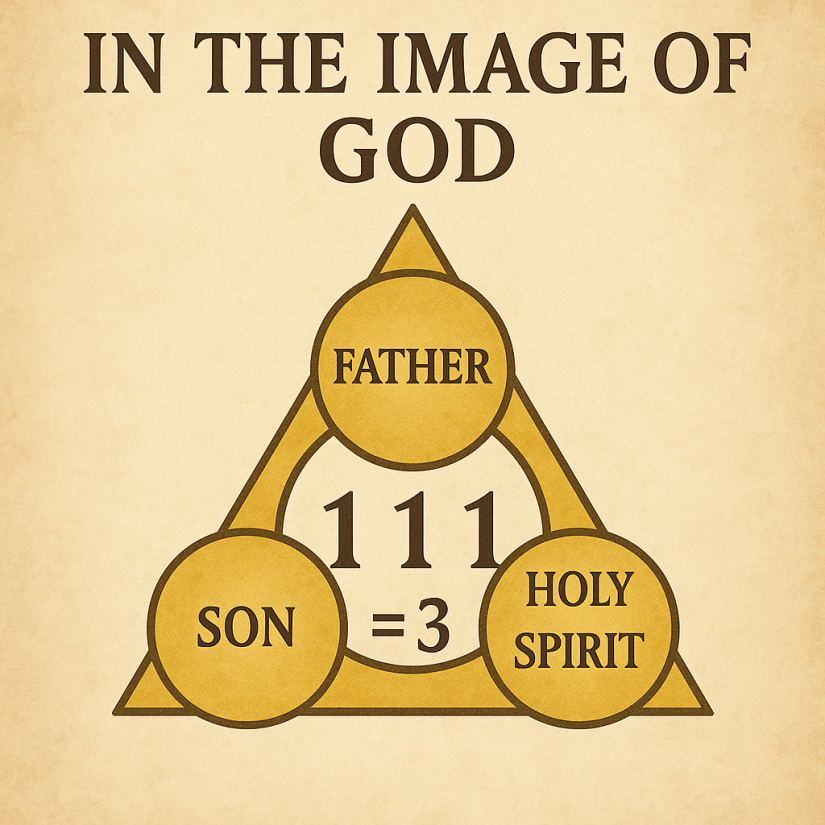
This number embodies the identity “Children of the Living God” and symbolically reflects the Trinitarian unity:

1 + 1 + 1 = 3

Yet, each “1” retains individuality, while the sum indicates perfect unity — the very concept behind the Trinity: three persons, one God.

3. From Creation to Adoption: Identifiers and Their Arc

Using the biblical verse identifier system (Book # + Chapter # + Verse #), the identifiers of Genesis 1:26 (28), Genesis 1:27 (29), Hosea 1:10 (39), and Romans 9:26 (80) create a narrative arc:

ThemeReferenceIdentifierCumulative
CreationGenesis 1:262828
CreationGenesis 1:272957
RestorationHosea 1:103996
AdoptionRomans 9:2680176

This arc (28 → 176) symbolizes humanity’s movement from origin, through rejection, to restored sonship. The final sum, 176, matches the number of verses in Psalm 119, the longest chapter in Scripture and a declaration of love for God’s Word — the very instrument of covenant identity.

4. Romans 9:26 and the Fulfillment of Hosea

“In the very place where it was said to them, ‘You are not my people,’ there they will be called ‘sons of the living God.'” (Romans 9:26)

Paul quotes Hosea to affirm that both Jews and Gentiles are now unified as one covenant family. The children of God are those brought into divine sonship through Christ, sealed by the Holy Spirit. The Trinitarian act of adoption is complete: the Father calls, the Son redeems, and the Spirit confirms.

5. Mathematical Proof of Trinitarian Unity

Mathematically, 111 = 1 + 1 + 1. Each “1” maintains distinction. Their unity in the number “3” echoes theological creeds:

  • One God in Three Persons
  • Three in One and One in Three

This numerical structure is not a man-made symbol but embedded in the very language and revelation of Scripture. The gematria 111 in Hosea 1:10 links identity (children of God) to divine structure (Elohim, plural yet one).

6. Radical 22: The Numerical Seal of Sonship

The final cumulative identifier in this arc, 176, holds an additional mathematical signature:

  • Its prime factorization is:
    176 = 2⁴ × 11
  • The radical (product of its distinct prime factors) is: rad(176) = 2 × 11 = 22

According to The Biblical Meaning of Numbers from One to Forty by Dr. Stephen E. Jones, the number 22 symbolizes:

  • Sonship
  • Sons of Light
  • The full revelation of God’s Word (since there are 22 letters in the Hebrew alphabet)

This hidden dimension confirms the prophetic journey from Genesis 1:26 to Romans 9:26:

Those made in the image of God, once declared “not my people,” are now mathematically and spiritually confirmed as sons of light, bearing the number of Sonship: 22.

Thus, the radical of 176 does not merely point to numerical structure — it seals the journey of identity. The number 22 affirms that those restored in Christ are no longer outsiders but bear the divine imprint as adopted sons of the Living God.

Conclusion: The Image Restored

Genesis 1:26-27 begins with the image of God in humanity, a reflection of divine plurality-in-unity. Hosea 1:10 and Romans 9:26 reveal how this image is restored and elevated: through adoption as children of the living God. The number 111 serves not merely as a gematria curiosity but as a mathematical testimony to the Trinitarian nature of God — and to our identity in Him.

In this, we behold the elegance of divine logic: theology harmonizing with arithmetic, Scripture unfolding as both word and number, and God revealing Himself as One, yet Three, in whose image we are lovingly made and eternally known.

Apologetics and the Limits of Worldview Cross-Talk

Abstract This paper explores the philosophical and theological limits of apologetics when engaging with naturalistic and secular worldviews, as well as with other religious systems that, while also believing in the supernatural, operate from fundamentally different assumptions. It argues that while Christian apologetics can clarify, defend, and illuminate faith for the believer and seeker, it is ultimately ineffective at persuading those whose frameworks categorically exclude or redefine the nature of divine revelation and salvation. The paper concludes that Christian, non-Christian religious, and secular worldviews are so incommensurable in their foundational assumptions that cross-persuasive dialogue is largely futile. Rather than attempting to “win” debates within foreign epistemological systems, Christian apologetics is better positioned as an internal clarifying tool, a witness to faith, and a bridge for those already wrestling with existential questions beyond the empirical realm.

1. Introduction Apologetics, from the Greek apologia, refers to the reasoned defense of the Christian faith. Rooted in biblical exhortations such as 1 Peter 3:15, which instructs believers to “always be ready to give a defense to everyone who asks you a reason for the hope that is in you, with gentleness and respect,” Christian apologetics is originally envisioned not as an aggressive or unsolicited enterprise, but as a responsive and humble articulation of faith. This scriptural foundation suggests that apologetics is most appropriate when answering genuine inquiry, rather than confronting those who have not asked but may only have offered an opposing view. However, in an increasingly pluralistic context that includes both secular naturalism and diverse religious traditions, the effectiveness and appropriateness of apologetics as a tool for persuasion are under renewed scrutiny.

2. The Naturalistic Worldview: Assumptions and Boundaries The naturalistic worldview is grounded in materialism, empiricism, and methodological skepticism. It holds that only that which is observable, testable, and repeatable can be known. Supernatural claims, by definition, lie outside this frame and are treated as non-evidentiary or mythological. From this perspective, religious events such as Jesus’ crucifixion and resurrection carry no epistemic weight.

3. The Christian Worldview: Revelation and Transcendence In contrast, Christianity is founded upon divine revelation, personal encounter, and the historical claim of God entering human history in the person of Jesus Christ. It presupposes the existence of a metaphysical realm and the possibility of miracles, fulfilled prophecy, and divine intervention. It also holds that salvation is unique to the person and work of Christ.

4. Incommensurability of Worldviews The paper argues that naturalism, Christianity, and other religious worldviews (e.g., Islam, Hinduism, Buddhism) are not merely differing opinions but operate from fundamentally incompatible epistemological and metaphysical systems. Naturalism excludes the supernatural; Christianity hinges on a personal, incarnate God; other religions often accept the supernatural but define God, truth, and salvation differently. Therefore, debating within one paradigm using the terms and expectations of another is like comparing apples, oranges, and bananas.

5. Historical Responses to Competing Worldviews Early Christians acknowledged the apparent foolishness of the cross (1 Cor. 1:18) and responded by redefining power, wisdom, and sacrifice through the lens of divine revelation. To both the Jewish and Greco-Roman mind, the crucifixion was either a stumbling block or folly: Jews expected a triumphant messianic deliverer, not a humiliated and executed criminal; Greeks prized rational philosophy and heroic virtue, not apparent weakness and shame. However, early Christians turned this perception on its head by proclaiming that true power was revealed in Jesus’ voluntary self-sacrifice, true wisdom in God’s mysterious plan to redeem through suffering, and true glory in the resurrection that followed apparent defeat. The cross, once a symbol of shame, was reframed as the ultimate sign of divine love and victory, encapsulating a new vision of what it means to triumph—not through domination, but through redemptive suffering. Apologists such as Justin Martyr and Origen engaged not only with naturalistic critiques but also with pagan and Jewish objections. However, their most compelling arguments were aimed not at converting skeptics, but at articulating the reasonableness of faith to those already open to it.

6. The True Role of Apologetics Rather than striving to ‘prove’ the Christian faith to those unwilling to consider the supernatural or to those committed to alternative supernatural frameworks, apologetics serves best in three roles:

  • Clarifying doctrine and addressing doubt within the Church.
  • Strengthening believers intellectually.
  • Serving as a bridge to seekers already questioning the limits of naturalism or the sufficiency of other religious systems.

7. Conclusion While engaging secular and religious viewpoints with humility and intellectual rigor is important, Christian apologetics should resist the temptation to validate the faith using tools of a worldview that denies or redefines its central claims. Faith in the Christian story begins not with empirical proof or religious synthesis, but with the acknowledgment that the natural is not all there is, and that divine revelation has occurred uniquely in Christ. Apologetics is therefore less a weapon of conquest and more a light for those already seeking the transcendent.

From the Edge of the Earth: Cosmic Renewal Through the Lord’s Prayer

Uniting the Mathematical Precision of 153 with the Theological Depth of 70

Abstract

This article explores a global spiritual architecture founded upon the sacred numbers 153 and 70, brought to life through the rhythmic praying of the Lord’s Prayer. Rooted in the premise that Fiji, the first country to greet the rising sun, can become the epicenter of an unceasing wave of global intercession, we present a theological and eschatological vision in which the world is progressively transformed, time zone by time zone, through the divine cadence of prayer. Drawing on biblical typologies and numerology, this paper weaves a call to cosmic renewal anchored in the daily glorification of the Father and the Son.


1. Introduction: Numbers as Sacred Architecture

Throughout Scripture, numbers are never arbitrary. They carry theological, prophetic, and symbolic weight. The number 153 appears in John 21:11, where the disciples pull in a miraculous catch of 153 fish, often interpreted as representing the totality of saved souls or the universal scope of redemption. The number 70, meanwhile, emerges repeatedly as a symbol of completion in leadership, mission, and judgment—from the 70 nations listed in Genesis 10, to the 70 elders appointed by Moses, to the 70 years of exile in Babylon, and the 70 disciples sent out by Jesus.


2. The Daily Cadence: Eight Times of Prayer Rooted in 153

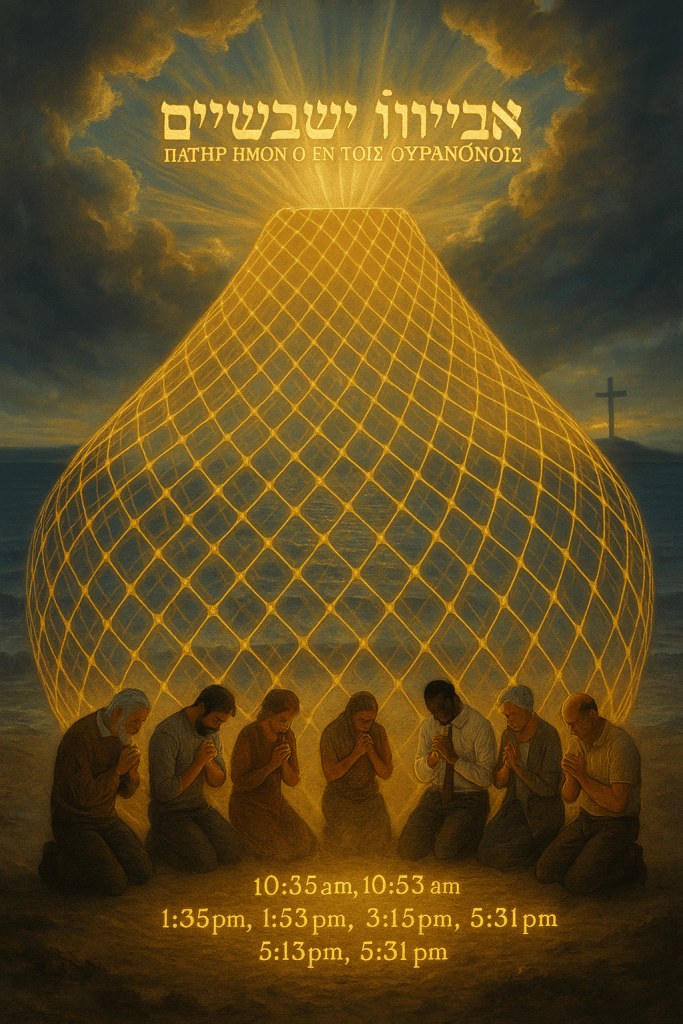
Inspired by the permutations of the digits 1, 5, and 3, the following eight times of day have been proposed for praying the Lord’s Prayer:

SequenceTimePrayer Focus
110:35 AMPraise & Alignment
210:53 AMSurrender
31:35 PMProvision
41:53 PMForgiveness
53:15 PMProtection
63:51 PMDeliverance
75:13 PMGlory
85:31 PMCelebration

Each time functions not only as a prayer moment but as a numerical echo of redemption, reasserting the salvific purpose of the Church in the world.


3. Fiji: The First Cry in the Prayer Tsunami

Due to its location on the 180th meridian (UTC+12), Fiji is the first nation to experience each new day. By initiating the Lord’s Prayer at the above times, believers in Fiji become the first voice in a chain reaction—a tsunami of prayer that travels with the sun, passing through each time zone, mobilizing believers around the globe in synchronized glorification of God.

This fulfills the prophetic words of Isaiah 24:16:

“From the ends of the earth we hear singing: ‘Glory to the Righteous One.’”


4. The Theology of 70: Four Pillars of Divine Transformation

The number 70 stands as the theological backbone of this vision. Its four major symbolic meanings reflect the deep structure and outcome of the global prayer movement.

a. 🌐 Universality

  • In Genesis 10, 70 descendants of Noah symbolize the fullness of nations.
  • This prayer tsunami embraces all languages, all peoples—fulfilling Jesus’ vision in Matthew 28:19, to disciple “all nations.”

b. 🕊️ Leadership

  • The 70 elders appointed in Numbers 11 formed a governing body filled with God’s Spirit.
  • The Lord’s Prayer, when practiced globally, calls forth spiritual leaders in every region, each carrying the responsibility of upholding divine truth.

c. ⚖️ Judgment and Redemption

  • 70 years of Babylonian exile (Jeremiah 25:11) reflect divine judgment and the hope of restoration.
  • 70 weeks in Daniel 9 herald the coming of the Messiah and the end of sin.
  • Daily recitation of “Forgive us our sins…” embeds believers in the drama of ongoing judgment and mercy, preparing hearts for final redemption.

d. 🌏 Mission

  • Jesus sends out 70 disciples in Luke 10, symbolizing global evangelism.
  • This prayer movement is not static devotion but a mobile mission, a prophetic call for the world to turn its face to God.

5. Eschatological Implications: Preparing the World for His Return

The global movement of prayer rooted in 153 and framed by the theology of 70 points directly to the eschatological parable of Luke 12:35–36:

“Be dressed ready for service and keep your lamps burning,
like servants waiting for their master to return from a wedding banquet…”

The Lord’s Prayer is not merely a petition; it is a watchman’s call, keeping the Church vigilant, pure, and engaged. It becomes the oil that keeps the lamps of the wise virgins burning (Matthew 25:1–13).


6. Conclusion: The Sound of Many Waters

As the Lord’s Prayer is lifted up hour by hour, nation by nation, tongue by tongue, the earth becomes drenched in glorification:

“Like the sound of many waters and like the sound of loud thunder…” — Revelation 14:2

This sacred pattern, born of 153 and sustained by the mission of 70, offers the blueprint for cosmic renewal. What began with a simple prayer in a hidden corner of the Pacific becomes a divine wave covering the globe.

The Bride is made ready.

The Spirit and the Bride say, “Come.”

📎 Appendix: Revelation 14:2 — Heaven’s Harmony in the Digits of 153


🔢 Numerical Identifier Analysis
The verse in question:

Revelation 14:2 (NIV)

“And I heard a sound from heaven like the roar of rushing waters and like a loud peal of thunder. The sound I heard was like that of harpists playing their harps.”

This verse is among the most vivid depictions of divine worship and celestial resonance in the Book of Revelation.

Identifier of Revelation 14:2 = Book (66) + Chapter (14) + Verse (2) = 82

Divisors of 82 = {1, 2, 41, 82}

Arithmetic Mean of Divisors = (1 + 2 + 41 + 82) ÷ 4 = 31.5

Now observe this subtle numerical resonance:

The digits of 31.5 form a permutation of 1, 3, and 5—the sacred digits of 153, the number on which the daily prayer pattern is based.

🎼 Interpretation: Earth’s Prayer, Heaven’s Sound
The echo of 153 within the arithmetic mean of 82 suggests that:

The daily rhythm of prayer established by 153 is not isolated to earth, but is met by a heavenly sound.

Revelation 14:2 describes a roar of rushing waters, a thunderclap, and harpists playing—a symphony of divine approval and angelic response.

Thus, 82 becomes the numeric symbol of divine resonance:

Heaven hears the voice of earth when the Lord’s Prayer is lifted faithfully.

This insight aligns beautifully with the theology of the article:

From the ends of the earth (Fiji), a prayer tsunami rises; from the heights of heaven, a thundering chorus replies.

🔄 Concluding Thought
The daily prayer rhythm governed by 153, and the cosmic sound described in Revelation 14:2, converge numerically and spiritually in the identifier 82. This confirms that:

Mathematics is not just a tool of measure, but a language of worship.

The number 153 structures prayer, and the number 82 reflects its heavenly reception.

As it is prayed on earth, so it resounds in heaven.

From Prowling Sins to Morning Songs: A Theological Reflection on Psalm 59 and the Power of 185

Introduction Psalm 59 is a profound tapestry of lament, trust, and praise, penned by David in a time of peril. It is historically rooted in the event when Saul sent men to watch David’s house in order to kill him (1 Samuel 19). Yet beyond its immediate context, Psalm 59 becomes a rich metaphorical and theological canvas for exploring divine protection, spiritual warfare, and ultimate deliverance. This article draws together Psalm 59, the miraculous account of 185,000 slain Assyrians, and symbolic numerology to unveil deeper dimensions of God’s covenantal care and judgment.


1. Historical and Spiritual Context of Psalm 59 David writes Psalm 59 while being hunted by Saul’s assassins. His opening verses are a desperate cry: “Deliver me from my enemies, O my God” (v.1). His enemies are described as fierce, unjust, and bloodthirsty. But rather than retaliate in kind, David places his hope in God’s deliverance.

Metaphorically, David’s enemies may be understood as sins or temptations that relentlessly pursue the believer. Verses 14–15 give us this vivid imagery:

“They return at evening, snarling like dogs, and prowl about the city. They wander about for food and howl if not satisfied.”

This portrays sin as an ever-returning, insatiable threat—restless, hungry, and predatory.


2. Morning Praise and Fortress of Refuge The psalm then turns from night to day, from fear to faith:

“But I will sing of your strength, in the morning I will sing of your love; for you are my fortress, my refuge in times of trouble” (Psalm 59:16).

Here, morning becomes a symbol of divine deliverance. As darkness gives way to light, the believer transitions from survival to song. The city that once echoed with the howls of enemies now resonates with praise.


3. The Identifiers and the Mystery of 185 Applying biblical numerology, each verse may be given an identifier: Book Number + Chapter Number + Verse Number. For Psalm 59:

  • Psalm 59:14 = 19 + 59 + 14 = 92
  • Psalm 59:15 = 19 + 59 + 15 = 93
  • Sum = 185

This numerical sum draws us directly to 2 Kings 19:35 and Isaiah 37:36:

“That night the angel of the Lord went out and put to death 185,000 in the Assyrian camp. When the people got up the next morning—there were all the dead bodies!”

The parallel is striking:

  • In both narratives, night is the time of siege.
  • In both, deliverance comes invisibly.
  • And in both, morning reveals the total defeat of the enemy.

4. The Symbolism of the Number 185

✦ Divine Intervention
185 signifies God’s sovereign and sudden response. As the people of Jerusalem slept, God intervened without sword or human effort. Similarly, David’s foes—be they human or spiritual—are neutralized by divine initiative.

✦ Judgment and Justice
185 symbolizes the executed judgment against pride and oppression. The Assyrians mocked the God of Israel. Their fall reveals God’s unwillingness to let arrogance go unchallenged.

✦ Angelic Warfare
This number brings to light the unseen spiritual battle on behalf of the faithful. One angel, in obedience to God, renders a vast army powerless.

✦ Covenant Protection
185 also illustrates how God defends His covenant people when they turn to Him in humility and prayer—as Hezekiah did.


5. Theological Insert: 185 and the Lord’s Prayer

The number 185 also forms a symbolic bridge to the Lord’s Prayer, revealing itself as the divine execution of its petitions:

  • “Deliver us from evil” — exactly what happens in the slaying of the Assyrians.
  • “Thy kingdom come, Thy will be done on earth as in heaven” — fulfilled as God’s will is enforced through angelic power.
  • “Give us this day our daily bread” — answered through the lifting of siege and famine.

In fact, the Lord’s Prayer and the Assyrian episode share structural symmetry:

  • Hezekiah prays in humility;
  • God responds with covenant faithfulness;
  • An angel executes justice;
  • Morning reveals victory and peace.

185, then, is the numerical fulfillment of the Lord’s Prayer in action. It is what it looks like when heaven answers earth:

185 is the thunderclap of “deliver us from evil.”
It is the angel’s sword answering the disciple’s plea.


6. Theological Summary Psalm 59 is more than a psalm of survival—it is a blueprint for trust in the face of evil. Its spiritual arc mirrors the night-and-morning structure of the 185,000 Assyrian deaths:

  • Verses 14–15 mirror the threatening night, filled with prowling danger.
  • Verses 16–17 reflect the dawning praise, where the once-besieged soul now sings in freedom.

And embedded within it, the sum 185 serves as a numerical seal linking David’s personal enemies to Israel’s national threat and reminding us that God’s deliverance, whether personal or cosmic, is often unseen, but always certain.

“You are my strength, I sing praise to you; you, God, are my fortress, my God on whom I can rely” (Psalm 59:17).


Conclusion The theological convergence of Psalm 59 and the number 185 reveals a timeless truth: while sin may prowl at night, God sends His angels by decree, and morning always breaks with praise. The believer need not fear the howling of spiritual foes—for God’s covenant love ensures that the fortress will stand, the enemy will fall, and the song will rise.

The Lord’s Prayer as the Fulfillment of Torah

Introduction

The Torah—the foundational body of divine instruction in the Hebrew Scriptures—stands at the heart of Jewish identity and spirituality. Traditionally ascribed to Moses, the Torah encompasses not only law but the very covenantal framework of God’s relationship with His people. In the New Covenant, Jesus Christ offers the Lord’s Prayer (Matthew 6:9–13; Luke 11:2–4), not as a replacement for Torah, but as its consummate fulfillment. This essay explores how the Lord’s Prayer is the Torah re-spoken: a creedal, covenantal, and chronosanctifying invocation that transforms the law written on tablets into prayer inscribed on the heart.


The Gematria of תּוֹרָה (Torah)

The Hebrew word Torah (תּוֹרָה) comprises the letters:

  • ת (Tav) = 400
  • ו (Vav) = 6
  • ר (Resh) = 200
  • ה (Heh) = 5

Gematria of Torah=400+6+200+5=611

This number—611—is not arbitrary. It aligns perfectly with the rabbinic tradition which holds that Moses transmitted 611 commandments, while the first two commandments of the Decalogue were spoken directly by God, giving us the full 613 commandments of the Torah.


611 + 2 = 613: The Rabbinic Tradition of the Mitzvot

According to Babylonian Talmud, Makkot 23b, Rabbi Simlai teaches:

“613 commandments were given to Moses: 365 negative commandments corresponding to the solar days, and 248 positive commandments corresponding to the parts of the human body.”

Of these, 611 were delivered through Moses, while the first two (“I am the Lord your God…” and “You shall have no other gods…”) were heard directly from God at Sinai (Exodus 20:1–3; Deuteronomy 5:4–5). This profound structure is confirmed by Rashi in his commentary on Deuteronomy 33:4 and later codified by Maimonides in his Sefer HaMitzvot.


Numerical Alignment: 611 and 168

The Lord’s Prayer, in Luke 11:2–4, when analyzed using the identifier formula:

Identifier = Book # + Chapter # + Verse #

Gives:

  • Luke 11:2 → 42 + 11 + 2 = 55
  • Luke 11:3 → 42 + 11 + 3 = 56
  • Luke 11:4 → 42 + 11 + 4 = 57

Total=55+56+57=168

This result is astonishingly the arithmetic mean of the divisors of 611, which are {1, 13, 47, 611}: Mean=(1+13+47+611)/4=168

This reveals that the identifier of the Lord’s Prayer is encoded within the very gematria of the Torah—a mathematical witness to its role as Torah fulfilled in the Messiah.


Petitions as Torah Themes

Each line of the Lord’s Prayer corresponds to a key theme within the Torah:

PetitionTorah Parallel
Our Father in heavenGod as Covenant Father (Deut 32:6)
Hallowed be Thy NameSanctity of God’s Name (Exod 20:7)
Thy Kingdom comeGod as King over Israel (Num 23:21)
Thy will be done…Obedience to divine law (Deut 6:4–5)
Give us this day our daily breadManna and provision (Exod 16)
Forgive us… as we forgive…Atonement rituals (Lev 4–5; Exod 34:6)
Lead us not into temptationWilderness testing (Deut 8:2–5)
Deliver us from evilDivine rescue from enemies (Deut 20:4)

The Lord’s Prayer is therefore not a theological abstraction but a Torah in motion—the divine law prayed, lived, and embodied.


Chronosanctification: 168 and Sacred Time

The eight daily prayer times, derived from the permutations of the number 153, finds its numerical basis in the value 168—which also happens to equal the total hours in a week. The Lord’s Prayer thus functions not only as a theological summary but as a sacred rhythm of time, mirroring the structure of creation itself.


Gematria of the Five Books of the Torah

Let us now consider the Hebrew gematria of the names of the five books of the Torah:

  1. Genesis – בְּרֵאשִׁית (Bereshit) = 913
  2. Exodus – שְׁמוֹת (Shemot) = 746
  3. Leviticus – וַיִּקְרָא (Vayikra) = 317
  4. Numbers – בְּמִדְבַּר (Bamidbar) = 248
  5. Deuteronomy – דְּבָרִים (Devarim) = 256

Total=913+746+317+248+256=2480

This total is 10 × 248, a number that is itself theologically rich.


The Theological Significance of the Number 248

  1. Positive Commandments: The number 248 represents the positive mitzvot in the Torah—commandments of action and devotion.
  2. Embodied Obedience: Rabbinic tradition equates 248 with the number of limbs and organs in the human body, symbolizing that the whole person is to obey God.
  3. Torah Structuring: The gematria of the Torah’s book names totaling 2480 implies that the Torah is a blueprint for sanctifying the human body tenfold.
  4. Connection to the Lord’s Prayer: If 248 is the obedient body, then 168 (the Prayer’s identifier) is the spiritual breath—the rhythm of time and devotion that enlivens the body with prayer.
  5. Divine Perfection: The 248th even number is 496, a perfect number—hinting that the one who obeys (248) and prays (168) is made perfect in God’s covenant.

Conclusion

The Lord’s Prayer is not merely a petition; it is a prophecy fulfilled, a creed of the New Covenant, and a distillation of Sinai’s voice. It is Torah reborn—not as burden, but as blessing. It encapsulates divine instruction not in stone, but in supplication.

And the numbers declare it:

  • Torah = 611
  • Divisors’ Mean = 168
  • 168 = Lord’s Prayer Identifier
  • 248 = Human body commanded by Torah
  • 2480 = Gematria sum of the Torah’s five books

The Lord’s Prayer is the Torah breathed into time.
It is the sanctification of the whole person, across all hours, unto the fullness of God.