
Introduction
From the opening pages of Scripture, we encounter a profound mystery: God said, “Let us make man in our image, after our likeness” (Genesis 1:26). The deliberate use of the plural “us” and “our” has long invited theological reflection. For Christians, this plural unity anticipates the revelation of the Trinity: one God in three persons. This article explores the extraordinary convergence of biblical language, numerical structure, and Trinitarian theology, showing how the number 111 unveils a conclusive mathematical reflection of divine plurality within unity.
1. The Creation Statement: Genesis 1:26-27
“Then God said, ‘Let us make man in our image, after our likeness…’ So God created man in his own image, in the image of God he created him; male and female he created them.” (Genesis 1:26-27)
Here, the plural form of speech coexists with singular creative action. The Creator is referred to as “God” (Elohim), a grammatically plural noun that governs singular verbs. This textual pattern mirrors a divine unity that is not indivisible simplicity but harmonious multiplicity: one essence, three persons.
2. The Gematria of Identity: בני אל חי = 111
In Hosea 1:10, the prophetic promise of restoration declares:
“…it shall be said to them, ‘You are children of the living God.'”
The Hebrew expression b’nei El Chai (בני אל חי) has a gematria value of 111:
- בני (b’nei) = 2 + 50 + 10 = 62
- אל (El) = 1 + 30 = 31
- חי (Chai) = 8 + 10 = 18
- Total: 62 + 31 + 18 = 111
This number embodies the identity “Children of the Living God” and symbolically reflects the Trinitarian unity:
1 + 1 + 1 = 3
Yet, each “1” retains individuality, while the sum indicates perfect unity — the very concept behind the Trinity: three persons, one God.
3. From Creation to Adoption: Identifiers and Their Arc
Using the biblical verse identifier system (Book # + Chapter # + Verse #), the identifiers of Genesis 1:26 (28), Genesis 1:27 (29), Hosea 1:10 (39), and Romans 9:26 (80) create a narrative arc:
| Theme | Reference | Identifier | Cumulative |
|---|---|---|---|
| Creation | Genesis 1:26 | 28 | 28 |
| Creation | Genesis 1:27 | 29 | 57 |
| Restoration | Hosea 1:10 | 39 | 96 |
| Adoption | Romans 9:26 | 80 | 176 |
This arc (28 → 176) symbolizes humanity’s movement from origin, through rejection, to restored sonship. The final sum, 176, matches the number of verses in Psalm 119, the longest chapter in Scripture and a declaration of love for God’s Word — the very instrument of covenant identity.
4. Romans 9:26 and the Fulfillment of Hosea
“In the very place where it was said to them, ‘You are not my people,’ there they will be called ‘sons of the living God.'” (Romans 9:26)
Paul quotes Hosea to affirm that both Jews and Gentiles are now unified as one covenant family. The children of God are those brought into divine sonship through Christ, sealed by the Holy Spirit. The Trinitarian act of adoption is complete: the Father calls, the Son redeems, and the Spirit confirms.
5. Mathematical Proof of Trinitarian Unity
Mathematically, 111 = 1 + 1 + 1. Each “1” maintains distinction. Their unity in the number “3” echoes theological creeds:
- One God in Three Persons
- Three in One and One in Three
This numerical structure is not a man-made symbol but embedded in the very language and revelation of Scripture. The gematria 111 in Hosea 1:10 links identity (children of God) to divine structure (Elohim, plural yet one).
6. Radical 22: The Numerical Seal of Sonship
The final cumulative identifier in this arc, 176, holds an additional mathematical signature:
- Its prime factorization is:
176 = 2⁴ × 11 - The radical (product of its distinct prime factors) is: rad(176) = 2 × 11 = 22
According to The Biblical Meaning of Numbers from One to Forty by Dr. Stephen E. Jones, the number 22 symbolizes:
- Sonship
- Sons of Light
- The full revelation of God’s Word (since there are 22 letters in the Hebrew alphabet)
This hidden dimension confirms the prophetic journey from Genesis 1:26 to Romans 9:26:
Those made in the image of God, once declared “not my people,” are now mathematically and spiritually confirmed as sons of light, bearing the number of Sonship: 22.
Thus, the radical of 176 does not merely point to numerical structure — it seals the journey of identity. The number 22 affirms that those restored in Christ are no longer outsiders but bear the divine imprint as adopted sons of the Living God.
Conclusion: The Image Restored
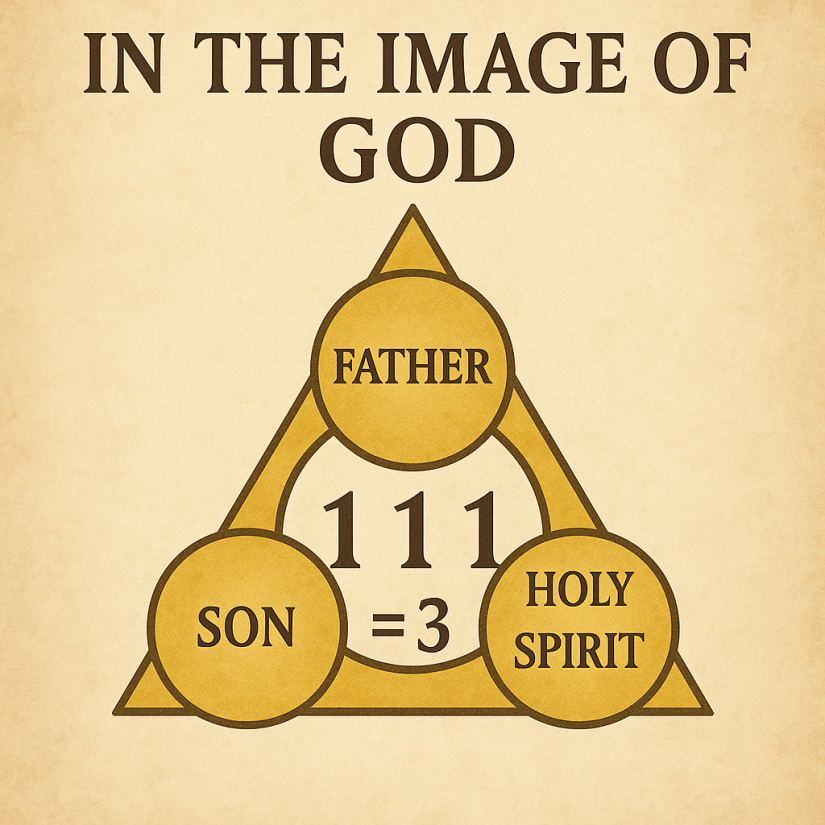
Genesis 1:26-27 begins with the image of God in humanity, a reflection of divine plurality-in-unity. Hosea 1:10 and Romans 9:26 reveal how this image is restored and elevated: through adoption as children of the living God. The number 111 serves not merely as a gematria curiosity but as a mathematical testimony to the Trinitarian nature of God — and to our identity in Him.
In this, we behold the elegance of divine logic: theology harmonizing with arithmetic, Scripture unfolding as both word and number, and God revealing Himself as One, yet Three, in whose image we are lovingly made and eternally known.
 The Lord's Prayer: A Mathematician's Creed