
🙏 Introduction
The Lord’s Prayer stands as the most beloved and unifying prayer across all of Christianity. Reverently recited by Christians of every denomination, it encapsulates a sacred rhythm—anchoring believers in God’s will, provision, forgiveness, and protection. Yet, beneath its surface lies a remarkable numerical structure centered on the number 153—a number that also appears in the Gospel of John as the measure of the miraculous catch of fish, often symbolizing the fullness of redemption.
A fascinating interplay emerges when we consider Psalm 79:10, a verse of lament from ancient Israel. Its numerical identifier is 108, a number deeply revered in other spiritual traditions, particularly Hinduism and Buddhism. But rather than creating conflict, this juxtaposition offers an invitation: to explore how prayer—specifically, the Lord’s Prayer—becomes a faithful answer to the world’s deepest cries.
📖 Psalm 79:10 – A Cry for Justice
“Why should the nations say, ‘Where is their God?’ Let the avenging of the outpoured blood of your servants be known among the nations before our eyes.”
— Psalm 79:10
Psalm 79 is a communal lament composed during a time of great national distress. It reflects the grief of God’s people after the desecration of Jerusalem and the suffering of the innocent. In verse 10, the psalmist asks a poignant question: Why should the nations mock the silence of God?
Using the biblical method of calculating verse identifiers (Book + Chapter + Verse), Psalm 79:10 receives an identifier of:
19(BookofPsalms)+79(Chapter)+10(Verse)=108
🕉️ The Number 108 – Revered in Global Traditions
The number 108 holds deep spiritual significance in many Eastern traditions:
- In Hinduism, it represents the 108 names of deities and is found in prayer beads (mala) used for chanting.
- In Buddhism, it symbolizes the 108 afflictions of the human mind that practitioners seek to overcome through purification.
- In Jainism, it denotes the 108 attributes of the enlightened beings.
For many, 108 is a symbol of spiritual wholeness and cosmic order. From a Christian perspective, however, the meaning of 108 invites a different reflection: not a condemnation of others’ beliefs, but a contemplation of what true fullness means, and where it is ultimately found.
🔢 The Response Hidden in the Numbers: 1035 and 153
While verse 10 stands out with its identifier 108, something extraordinary emerges when we calculate the cumulative identifiers of Psalm 79:1–10. That is, if we sum the identifiers of each verse from verse 1 to 10, we get:
99+100+101+…+108=103599 + 100 + 101 + … + 108 = 1035
The number 1035, when its digits are rearranged, contains 1–5–3: a clear allusion to 153, a number rich with theological meaning in Christian thought.
🎣 The Number 153 – The Net of Redemption
- In John 21:11, after the Resurrection, the disciples catch 153 fish in a net that does not break. Early Christian interpreters saw this as a symbol of the totality of humanity gathered into God’s Kingdom.
- Mathematically, 153 = 17 × 9, where 17 is the sum of the first 7 natural numbers (symbolizing divine order), and 9 represents spiritual completion.
In our own theological framework, 153 also encodes the 8 prayer times of the Lord’s Prayer (10:35, 10:53, 1:35, etc.), forming a sacred rhythm for daily communion with God.
🔁 From Mockery to Prayer: A Theological Arc
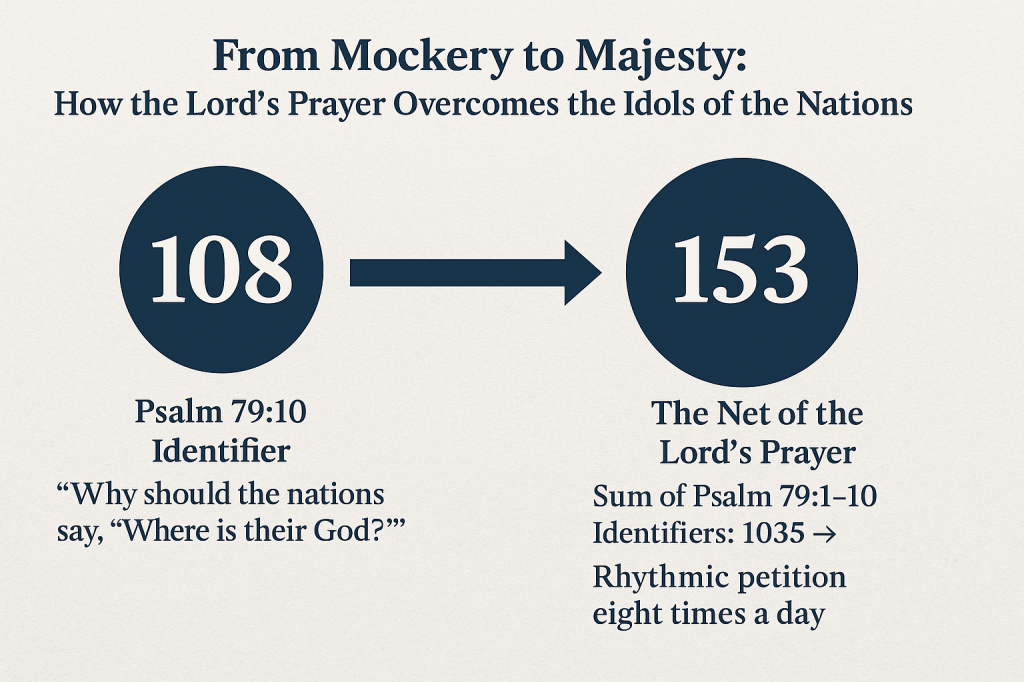
Psalm 79:10 begins with a question from the nations:
“Where is their God?”
This is not just a rhetorical question—it represents the longing of the world for a visible, just, and active God.
The answer comes not in thunder or force, but in the quiet power of prayer—the structured, faithful cry of God’s people. The cumulative sum of verses 1–10, totaling 1035, encodes 153, the number of the Lord’s Prayer. The implication is profound:
The mocking of the nations (108) is answered by the persistent prayer of God’s people (153).
🤝 Interfaith Sensitivity and Christian Testimony
In honoring this insight, we must approach it with humility and grace. While Christians believe that the fullness of spiritual truth is found in Jesus Christ, this belief does not diminish the sincerity, moral integrity, or spiritual longing of those from other faiths. Rather, we affirm that:
- The number 108, as honored in other traditions, reflects a deep and beautiful search for divine connection.
- In Christian theology, the number 153 becomes our symbol of divine response—a net cast by Christ to gather all who seek truth, hope, and redemption.
Thus, instead of condemnation, we offer an invitation—to consider that the rhythms of prayer, culminating in the Lord’s Prayer, answer the universal cry for justice, mercy, and spiritual completeness.
📊 Summary Table
| Concept | Value | Interpretation |
|---|---|---|
| Psalm 79:10 Identifier | 108 | Symbol of the nations’ question and longing |
| Cumulative Identifiers (v1–10) | 1035 | Encodes 153—the prayerful rhythm of divine presence |
| Christian Symbolism | 153 | The Net of Redemption; the Lord’s Prayer; divine fullness |
| Theological Insight | 108 → 153 | The cry of the nations is answered by the prayer of the faithful |
🌍 Conclusion
In the tension between the nations’ mockery and God’s apparent silence, Psalm 79 gives voice to both anguish and hope. Hidden within its structure, however, is a revelation: the number 108, though honored in other traditions, becomes in this psalm the cry of the world. The response is found not in retaliation, but in the Lord’s Prayer, encoded in the number 153, the sum of accumulated cries and the rhythm of redemptive hope.
In this way, the Lord’s Prayer becomes not only the response of Israel—but the response of the Church—to the cry of the world. It is an act of love, rooted in faith, and extended in humility.
 The Lord's Prayer: A Mathematician's Creed