The Prophetic Bridge: Daniel 9:26 and Matthew 5:17 in Light of the Identifier 62

Introduction

Among the vast number of verses in the Bible, the appearance of the number 62 in both Daniel 9:26 and Matthew 5:17 is nothing short of remarkable. One verse looks forward with prophetic clarity; the other looks back with Messianic fulfillment. That both share the same identifier number (sum of Book#, Chapter#, and Verse#) forms a mathematical and theological bridge that links prophecy with fulfillment, expectation with realization, and Daniel’s visions with Jesus’ declarations.


1. The Seventy Weeks Prophecy in Context (Daniel 9:24–27)

Daniel 9 records a moment of deep intercession, where the prophet Daniel pleads for the restoration of Jerusalem. In response, the angel Gabriel delivers the profound prophecy of the “Seventy Weeks.”

  • Daniel 9:24 sets the purpose: to finish transgression, to make an end of sin, to atone for iniquity, and to bring in everlasting righteousness.
  • Daniel 9:25 gives a starting point: from the decree to rebuild Jerusalem until the coming of an “Anointed One,” there will be 7 weeks and 62 weeks (49 + 434 years).
  • Daniel 9:26 then declares that after the 62 weeks, the Anointed One (Messiah) will be “cut off, but not for Himself”—a stunning anticipation of sacrificial death. It also foretells the destruction of Jerusalem and the Temple.
  • Daniel 9:27 describes the final week and a covenant confirmed with many, the cessation of sacrifice, and the arrival of desolation.

This structured prophecy outlines not only the timeline of redemption but also the suffering and judgment that accompany the coming of the Messiah.


2. The Identifier 62: A Numerical Signature

The method of assigning verse identifiers by summing the Book number, Chapter number, and Verse number reveals something astonishing:

  • Daniel 9:26: Book# 27 + Chapter# 9 + Verse# 26 = 62
  • Matthew 5:17: Book# 40 + Chapter# 5 + Verse# 17 = 62

Both verses bear the exact same identifier—62, forming a rare and powerful link across Testaments.

In Daniel 9:26, the Messiah is “cut off, but not for Himself”—a phrase resonating deeply with Christian theology that sees Jesus’ death as substitutionary.

In Matthew 5:17, Jesus declares: “Do not think that I have come to abolish the Law or the Prophets; I have not come to abolish them but to fulfill them.” Here, Jesus positions Himself not outside the Torah, but as its very fulfillment.

This symmetry—prophecy in Daniel and declaration in Matthew, both with identifier 62—functions as a divine signature stamped across Scripture.


3. Theological and Symbolic Significance of 62

The number 62 is not random. It is deeply woven into the prophetic timeline:

  • Daniel 9:25–26: 62 weeks (434 years) after the rebuilding decree leads to the arrival and cutting off of the Messiah.
  • Matthew 5:17 (ID: 62) is Jesus’ own announcement of fulfilling the Law and the Prophets—an unmistakable echo of Daniel’s Messianic reference.

Mathematically:

  • 62 = 2 × 31, and 31 = “El” (אל) in Hebrew, meaning God.
  • So 62 could symbolize a double witness of God, fitting for two Scriptures that jointly testify to the identity and mission of the Messiah.

4. The Fulfillment of the Torah: Jesus and the 613 Commandments

Jewish tradition holds there are 613 commandments (mitzvot) in the Torah: 248 positive and 365 negative. Jesus does not reject these but summarizes their entire moral and relational content into two:

“Love the Lord your God with all your heart, soul, and mind.” (Deut. 6:5)

“Love your neighbor as yourself.” (Lev. 19:18)

These two commandments, according to Matthew 22:40, are the pillars upon which “all the Law and the Prophets hang.” In Matthew 5:17, Jesus confirms that He came not to abolish, but to fulfill this entire body of divine instruction. The 613 mitzvot, in their deepest sense, are fulfilled in the Messiah’s love, life, and teachings.


5. Tabulated Identifiers: Daniel 9:24–27

VerseIdentifierCumulative Sum
Daniel 9:246060
Daniel 9:2561121
Daniel 9:2662183
Daniel 9:2763246

This sequence shows a crescendo of meaning, climaxing at verse 26—the Messiah being cut off—and culminating in the final judgment in verse 27.

Notably, the sum of the identifiers from Daniel 9:24–27 is 246, which corresponds to the 246th prime number: 1559. Both the Euler Totient function φ(1559) and the Carmichael Lambda function λ(1559) yield 1558, one less than the prime itself. The divisors of 1558 are {1, 2, 19, 38, 41, 82, 779, 1558}, whose arithmetic mean is 315. The digits of 315—{3, 1, 5}—form the permutation {1, 5, 3}, which reorders to 153, the number of fishes caught in John 21:11. In the context of biblical numerology, 153 symbolizes fullness, divine election, and the complete gathering of the faithful.

In the author’s framework, 153 also gives rise to the 8 Lord’s Prayer times, connecting time, prayer, and redemption in a daily sanctification cycle. This profound numerical resonance links the culmination of Daniel’s vision (identifier sum 246) to the Gospel’s post-resurrection scene of abundant divine provision (153), reinforcing the prophetic message and its Messianic fulfillment.

Furthermore, a profound parallel exists between Exodus 19:20 and Acts 2:4, representing the 50th-day gifts given to the faithful. The identifier for Exodus 19:20 is 41 (2 + 19 + 20), and for Acts 2:4 it is 50 (44 + 2 + 4), with their sum being 91.

✡️ The Number 91 and the Divine Names

The number 91 is the gematria of “Amen” (אמן), a word meaning “so be it,” “truly,” or “let it be confirmed.” Here’s how the gematria works:

Hebrew LetterNameValue
אAleph1
מMem40
נNun50
Total91

Additionally, 91 is the sum of two foundational Divine Names:

  • YHWH (יהוה) = 10 (Yod) + 5 (Heh) + 6 (Vav) + 5 (Heh) = 26
  • Adonai (אדני) = 1 (Aleph) + 4 (Dalet) + 50 (Nun) + 10 (Yod) = 65

26 + 65 = 91

Thus, when believers say “Amen,” they are affirming the unity between God’s eternal essence (YHWH) and His revealed lordship (Adonai)—a beautiful expression of trust and covenant faith.

This number, 91, therefore symbolizes the unity of the Old and New Covenants—the giving of the Torah at Sinai and the giving of the Holy Spirit at Pentecost—both divine revelations occurring on the 50th day, confirming God’s continuous redemptive plan across time. representing the 50th-day gifts given to the faithful. The identifier for Exodus 19:20 is 41 (2 + 19 + 20), and for Acts 2:4 it is 50 (44 + 2 + 4), with their sum being 91. This number, 91, is the gematria of “Amen” (אמן) and the sum of the divine names YHWH (26) and Adonai (65). It symbolizes the unity of the Old and New Covenants—the giving of the Torah at Sinai and the giving of the Holy Spirit at Pentecost—both divine revelations occurring on the 50th day, confirming God’s continuous redemptive plan across time.


6. Conclusion: The Divine Harmony Between Prophecy and Fulfillment

The fact that both Daniel 9:26 and Matthew 5:17—two of the most significant Messianic verses—share the identifier 62 cannot be dismissed as chance. It reflects a mathematical harmony and prophetic structure authored beyond human design.

  • Daniel announces the coming, sacrificial death of the Messiah.
  • Jesus affirms that His mission is the fulfillment of all that the Torah and Prophets anticipated.
  • Both verses share an encoded numerical fingerprint: 62.

This revelation invites the reader into a deeper confidence: that the Scriptures are not only divinely inspired but also mathematically and prophetically unified—and that Jesus of Nazareth is indeed the Messiah prophesied by Daniel.


“Truly, I say to you, until heaven and earth pass away, not an iota, not a dot, will pass from the Law until all is accomplished.”
Matthew 5:18

From Prowling Sins to Morning Songs: A Theological Reflection on Psalm 59 and the Power of 185

Introduction Psalm 59 is a profound tapestry of lament, trust, and praise, penned by David in a time of peril. It is historically rooted in the event when Saul sent men to watch David’s house in order to kill him (1 Samuel 19). Yet beyond its immediate context, Psalm 59 becomes a rich metaphorical and theological canvas for exploring divine protection, spiritual warfare, and ultimate deliverance. This article draws together Psalm 59, the miraculous account of 185,000 slain Assyrians, and symbolic numerology to unveil deeper dimensions of God’s covenantal care and judgment.


1. Historical and Spiritual Context of Psalm 59 David writes Psalm 59 while being hunted by Saul’s assassins. His opening verses are a desperate cry: “Deliver me from my enemies, O my God” (v.1). His enemies are described as fierce, unjust, and bloodthirsty. But rather than retaliate in kind, David places his hope in God’s deliverance.

Metaphorically, David’s enemies may be understood as sins or temptations that relentlessly pursue the believer. Verses 14–15 give us this vivid imagery:

“They return at evening, snarling like dogs, and prowl about the city. They wander about for food and howl if not satisfied.”

This portrays sin as an ever-returning, insatiable threat—restless, hungry, and predatory.


2. Morning Praise and Fortress of Refuge The psalm then turns from night to day, from fear to faith:

“But I will sing of your strength, in the morning I will sing of your love; for you are my fortress, my refuge in times of trouble” (Psalm 59:16).

Here, morning becomes a symbol of divine deliverance. As darkness gives way to light, the believer transitions from survival to song. The city that once echoed with the howls of enemies now resonates with praise.


3. The Identifiers and the Mystery of 185 Applying biblical numerology, each verse may be given an identifier: Book Number + Chapter Number + Verse Number. For Psalm 59:

  • Psalm 59:14 = 19 + 59 + 14 = 92
  • Psalm 59:15 = 19 + 59 + 15 = 93
  • Sum = 185

This numerical sum draws us directly to 2 Kings 19:35 and Isaiah 37:36:

“That night the angel of the Lord went out and put to death 185,000 in the Assyrian camp. When the people got up the next morning—there were all the dead bodies!”

The parallel is striking:

  • In both narratives, night is the time of siege.
  • In both, deliverance comes invisibly.
  • And in both, morning reveals the total defeat of the enemy.

4. The Symbolism of the Number 185

✦ Divine Intervention
185 signifies God’s sovereign and sudden response. As the people of Jerusalem slept, God intervened without sword or human effort. Similarly, David’s foes—be they human or spiritual—are neutralized by divine initiative.

✦ Judgment and Justice
185 symbolizes the executed judgment against pride and oppression. The Assyrians mocked the God of Israel. Their fall reveals God’s unwillingness to let arrogance go unchallenged.

✦ Angelic Warfare
This number brings to light the unseen spiritual battle on behalf of the faithful. One angel, in obedience to God, renders a vast army powerless.

✦ Covenant Protection
185 also illustrates how God defends His covenant people when they turn to Him in humility and prayer—as Hezekiah did.


5. Theological Insert: 185 and the Lord’s Prayer

The number 185 also forms a symbolic bridge to the Lord’s Prayer, revealing itself as the divine execution of its petitions:

  • “Deliver us from evil” — exactly what happens in the slaying of the Assyrians.
  • “Thy kingdom come, Thy will be done on earth as in heaven” — fulfilled as God’s will is enforced through angelic power.
  • “Give us this day our daily bread” — answered through the lifting of siege and famine.

In fact, the Lord’s Prayer and the Assyrian episode share structural symmetry:

  • Hezekiah prays in humility;
  • God responds with covenant faithfulness;
  • An angel executes justice;
  • Morning reveals victory and peace.

185, then, is the numerical fulfillment of the Lord’s Prayer in action. It is what it looks like when heaven answers earth:

185 is the thunderclap of “deliver us from evil.”
It is the angel’s sword answering the disciple’s plea.


6. Theological Summary Psalm 59 is more than a psalm of survival—it is a blueprint for trust in the face of evil. Its spiritual arc mirrors the night-and-morning structure of the 185,000 Assyrian deaths:

  • Verses 14–15 mirror the threatening night, filled with prowling danger.
  • Verses 16–17 reflect the dawning praise, where the once-besieged soul now sings in freedom.

And embedded within it, the sum 185 serves as a numerical seal linking David’s personal enemies to Israel’s national threat and reminding us that God’s deliverance, whether personal or cosmic, is often unseen, but always certain.

“You are my strength, I sing praise to you; you, God, are my fortress, my God on whom I can rely” (Psalm 59:17).


Conclusion The theological convergence of Psalm 59 and the number 185 reveals a timeless truth: while sin may prowl at night, God sends His angels by decree, and morning always breaks with praise. The believer need not fear the howling of spiritual foes—for God’s covenant love ensures that the fortress will stand, the enemy will fall, and the song will rise.

The Lord’s Prayer as the Fulfillment of Torah

Introduction

The Torah—the foundational body of divine instruction in the Hebrew Scriptures—stands at the heart of Jewish identity and spirituality. Traditionally ascribed to Moses, the Torah encompasses not only law but the very covenantal framework of God’s relationship with His people. In the New Covenant, Jesus Christ offers the Lord’s Prayer (Matthew 6:9–13; Luke 11:2–4), not as a replacement for Torah, but as its consummate fulfillment. This essay explores how the Lord’s Prayer is the Torah re-spoken: a creedal, covenantal, and chronosanctifying invocation that transforms the law written on tablets into prayer inscribed on the heart.


The Gematria of תּוֹרָה (Torah)

The Hebrew word Torah (תּוֹרָה) comprises the letters:

  • ת (Tav) = 400
  • ו (Vav) = 6
  • ר (Resh) = 200
  • ה (Heh) = 5

Gematria of Torah=400+6+200+5=611

This number—611—is not arbitrary. It aligns perfectly with the rabbinic tradition which holds that Moses transmitted 611 commandments, while the first two commandments of the Decalogue were spoken directly by God, giving us the full 613 commandments of the Torah.


611 + 2 = 613: The Rabbinic Tradition of the Mitzvot

According to Babylonian Talmud, Makkot 23b, Rabbi Simlai teaches:

“613 commandments were given to Moses: 365 negative commandments corresponding to the solar days, and 248 positive commandments corresponding to the parts of the human body.”

Of these, 611 were delivered through Moses, while the first two (“I am the Lord your God…” and “You shall have no other gods…”) were heard directly from God at Sinai (Exodus 20:1–3; Deuteronomy 5:4–5). This profound structure is confirmed by Rashi in his commentary on Deuteronomy 33:4 and later codified by Maimonides in his Sefer HaMitzvot.


Numerical Alignment: 611 and 168

The Lord’s Prayer, in Luke 11:2–4, when analyzed using the identifier formula:

Identifier = Book # + Chapter # + Verse #

Gives:

  • Luke 11:2 → 42 + 11 + 2 = 55
  • Luke 11:3 → 42 + 11 + 3 = 56
  • Luke 11:4 → 42 + 11 + 4 = 57

Total=55+56+57=168

This result is astonishingly the arithmetic mean of the divisors of 611, which are {1, 13, 47, 611}: Mean=(1+13+47+611)/4=168

This reveals that the identifier of the Lord’s Prayer is encoded within the very gematria of the Torah—a mathematical witness to its role as Torah fulfilled in the Messiah.


Petitions as Torah Themes

Each line of the Lord’s Prayer corresponds to a key theme within the Torah:

PetitionTorah Parallel
Our Father in heavenGod as Covenant Father (Deut 32:6)
Hallowed be Thy NameSanctity of God’s Name (Exod 20:7)
Thy Kingdom comeGod as King over Israel (Num 23:21)
Thy will be done…Obedience to divine law (Deut 6:4–5)
Give us this day our daily breadManna and provision (Exod 16)
Forgive us… as we forgive…Atonement rituals (Lev 4–5; Exod 34:6)
Lead us not into temptationWilderness testing (Deut 8:2–5)
Deliver us from evilDivine rescue from enemies (Deut 20:4)

The Lord’s Prayer is therefore not a theological abstraction but a Torah in motion—the divine law prayed, lived, and embodied.


Chronosanctification: 168 and Sacred Time

The eight daily prayer times, derived from the permutations of the number 153, finds its numerical basis in the value 168—which also happens to equal the total hours in a week. The Lord’s Prayer thus functions not only as a theological summary but as a sacred rhythm of time, mirroring the structure of creation itself.


Gematria of the Five Books of the Torah

Let us now consider the Hebrew gematria of the names of the five books of the Torah:

  1. Genesis – בְּרֵאשִׁית (Bereshit) = 913
  2. Exodus – שְׁמוֹת (Shemot) = 746
  3. Leviticus – וַיִּקְרָא (Vayikra) = 317
  4. Numbers – בְּמִדְבַּר (Bamidbar) = 248
  5. Deuteronomy – דְּבָרִים (Devarim) = 256

Total=913+746+317+248+256=2480

This total is 10 × 248, a number that is itself theologically rich.


The Theological Significance of the Number 248

  1. Positive Commandments: The number 248 represents the positive mitzvot in the Torah—commandments of action and devotion.
  2. Embodied Obedience: Rabbinic tradition equates 248 with the number of limbs and organs in the human body, symbolizing that the whole person is to obey God.
  3. Torah Structuring: The gematria of the Torah’s book names totaling 2480 implies that the Torah is a blueprint for sanctifying the human body tenfold.
  4. Connection to the Lord’s Prayer: If 248 is the obedient body, then 168 (the Prayer’s identifier) is the spiritual breath—the rhythm of time and devotion that enlivens the body with prayer.
  5. Divine Perfection: The 248th even number is 496, a perfect number—hinting that the one who obeys (248) and prays (168) is made perfect in God’s covenant.

Conclusion

The Lord’s Prayer is not merely a petition; it is a prophecy fulfilled, a creed of the New Covenant, and a distillation of Sinai’s voice. It is Torah reborn—not as burden, but as blessing. It encapsulates divine instruction not in stone, but in supplication.

And the numbers declare it:

  • Torah = 611
  • Divisors’ Mean = 168
  • 168 = Lord’s Prayer Identifier
  • 248 = Human body commanded by Torah
  • 2480 = Gematria sum of the Torah’s five books

The Lord’s Prayer is the Torah breathed into time.
It is the sanctification of the whole person, across all hours, unto the fullness of God.

🔥 The Purification Has Begun: A Divine Intervention in the Churches

Using the Life and Ministry of Pope Francis as a Sign of the Times

Introduction: When God Intervenes from Within

God is not an indifferent spectator of history. He is not passively awaiting the return of His Son while His Church drifts into compromise, confusion, and complacency. The testimony of Scripture is clear: in the end days, God will purify His people, not by wrath but through a holy intervention from within.

This purification, long foretold by the prophets, the apostles, and by Christ Himself, has already begun. And one of the most visible signs of this divine movement may well be found in the unlikely figure of Pope Francis, the 266th pope of the Roman Catholic Church.


I. The Scriptural Basis for Purification in the End Days

1. Judgment Begins in the House of God

“For it is time for judgment to begin at the household of God…”
—1 Peter 4:17

Before God judges the world, He evaluates His people. This is not judgment unto destruction, but unto refinement, restoration, and readiness.

2. Christ Walks Among the Lampstands

“These are the words of Him who walks among the seven golden lampstands…”
—Revelation 2:1

The glorified Christ begins Revelation not with Rome, Babylon, or the nations, but with His own churches. He exposes hypocrisy, calls for repentance, and promises rewards for those who overcome. It is a pattern of internal intervention before external consummation.

3. The Bride Must Make Herself Ready

“His bride has made herself ready…”
—Revelation 19:7

The Church’s final act before the return of Christ is not evangelism or expansion, but purification. She must be presented without spot or wrinkle (Eph. 5:27)—something only possible through the sanctifying fire of the Holy Spirit.


II. Pope Francis: A Sign of Internal Intervention

Pope Francis, elected in 2013 as the 266th pope, may be more than a reformer. He may be a divine signpost.

1. A Lifestyle of Simplicity

Rejecting the papal palace, Francis chose a humble guesthouse. He wears plain white robes, washes the feet of prisoners and Muslims, and travels in a modest car. These are not mere personal quirks—they are a prophetic rebuke to centuries of ecclesiastical opulence. His very lifestyle says: Return to Christ. Return to simplicity.

2. Confronting Evil Within

Francis has not only called for transparency and accountability—he has exposed deep layers of abuse, secrecy, and spiritual corruption within the Vatican. From curial reform to financial transparency, his papacy has revealed rot beneath the surface of holiness. In doing so, he has embodied the prayer:

“Deliver us from evil.”

3. A Pattern of the Coming Purification

The significance of 266 is striking. Its Euler Totient is 108—the mirror image of 801 (Alpha & Omega), suggesting an end-time reversal of appearances. And the 266th odd number is 531—a permutation of 153, the number associated with the Remnant, the Sons of God, and the Lord’s Prayer times. Francis is a signal that the Lord of the Church has begun to walk among His lampstands.


III. A Movement Expanding Beyond Rome

What began with Rome will not stay in Rome. Jesus is Lord of all His Church, not just one denomination.

  • Anglicanism faces a moral and identity crisis.
  • Methodism is wrestling with fragmentation.
  • Evangelicalism battles consumerism and celebrity culture.
  • Pentecostalism, for all its passion, is plagued by unaccountable power.

Just as Christ purified the Temple at the beginning and end of His earthly ministry, He will purify His spiritual temple—the Church—before His return. This is not the death of the Church. This is her rebirth.


IV. The Role of the Invisible Church

In these end days, God is not raising a new denomination. He is awakening the Invisible Church—those who live by the Spirit, love truth, and walk in holiness. They are found across all traditions, races, and nations. They pray the Lord’s Prayer at appointed times, partake of the Lord’s Table in reverence, and yearn for the return of their King.

They understand that:

Unity is not an achievement. It is a resurrection miracle.
It is not man-made. It is God-given.
It begins when Christ walks among His people once again.


Conclusion: The Fire Has Started in the Sanctuary

“Who can endure the day of His coming? For He is like a refiner’s fire…”
—Malachi 3:2

The fire is not coming. It has already been lit.
It began with a humble man in white robes.
It will sweep through cathedrals and tents alike.
It will wound only to heal.
And it will leave behind a Bride clothed in splendor, without spot or wrinkle.

Let those who have ears to hear, hear what the Spirit is saying to the churches.
The purification has begun.

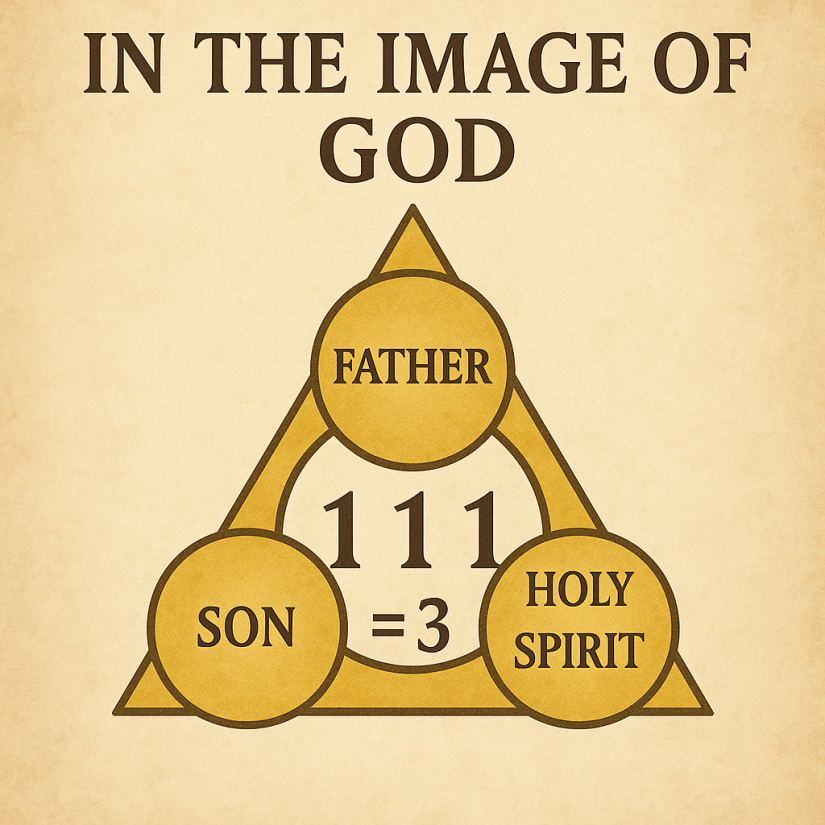
“In His Image”: The 168 Bridge between Genesis 1 : 27 and the Luke Lord’s Prayer

Abstract

Alphanumeric analysis and verse‑identifier arithmetic converge on the number 168 in two distant biblical loci: (1) the Hebrew word בְּצַלְמוֹ—“in His image” (Genesis 1 : 27) and (2) the cumulative identifier of the Lord’s Prayer in Luke 11 : 2‑4. The number 168 (= 7 × 24) signals the sanctification of every hour of a complete week. We argue that Luke’s form of the prayer is not only Petitional, Covenantal, and Creedal but also Chronosanctifying—the liturgical engine of new‑creation life that hallows time itself. Drawing on Brant Pitre’s “new Exodus” reading [2], classical number symbolism [1], and the mathematical patterns in The Lord’s Prayer: A Mathematician’s Creed [3], we integrate creation theology, messianic expectation, and practical spirituality.

1 Introduction

Genesis crowns the creation narrative with the declaration that humanity was made “in His image”. Centuries later Jesus teaches a concise prayer that becomes Christianity’s heartbeat. An unexpected numerical thread—168—links these two moments and invites a fresh canonical reading that unfolds in four dimensions: Petitional, Covenantal, Creedal, and Chronosanctifying.

2 Methodology

  1. Gematria of בְּצַלְמוֹ (“in His image”) is Bet 2 + Tsadi 90 + Lamed 30 + Mem 40 + Vav 6 = 168.
  2. Verse‑identifier computation for Luke 11 : 2‑4 → 55 + 56 + 57 = 168.
  3. Numerological analysis of 168, 153, 285, and 606.
  4. Canonical‑theological correlation (creation, Exodus, kingdom).
  5. Liturgical‑mathematical patterning of eight daily prayer times derived from 153.

3 The Numerical Data

3.1 Gematria of בְּצַלְמוֹ

Genesis 1 : 27’s phrase “in His image” [4] is a single word whose absolute value totals 168.

3.2 Identifier of the Luke Lord’s Prayer

Luke is the 42nd book: 42 + 11 + 2 = 55, 42 + 11 + 3 = 56, 42 + 11 + 4 = 57 → Σ = 168.

3.3 Interplay of 153 – 168 – 285 – 606

  • 153 – number of fish in John 21 : 11; symbol of the “sons of God”.
  • 168 – image/restoration number.
  • 285 – identifier of the Matthean Lord’s Prayer (55 + 56 + 57 + 58 + 59).
  • 606 – 153 + 168 + 285; its divisors (1, 2, 3, 6, 101, 202, 303, 606) sum to 1224 = 153 × 8, which equals the Greek isopsephy of τὸ δίκτυον (“the net”) in John 21 : 11 [3].
    This tapestry ties the prayer to the unbroken net that gathers believers into the kingdom.

3.4 The Number 168 as Symbolic Number

  • 7 × 24 → a complete week, signalling the consecration of time.
  • 14 × 12 → Davidic lineage (14) governing the twelve‑tribe kingdom (12).

4 Theological Synthesis

4.1 Creation and Image

Genesis presents humanity as God’s tselem—a royal‑priestly statue in the cosmic temple.

4.2 The Lord’s Prayer as New‑Exodus Petition

Pitre shows every clause echoes prophetic hopes for an eschatological Exodus [2]. The address “Our Father” invokes the father‑son Exodus motif (Ex 4 : 22) and Isaiah 63‑64, re‑activating the Genesis vocation.

4.3 Chronosanctifying (Time‑Sanctifying) Dimension

Time is first declared holy when God “blessed the seventh day and made it holy” (Gen 2 : 3): the Sabbath is a temporal sanctuary. Luke’s Lord’s Prayer extends that principle from one day to all 168 hours.

4.3.1 How the Prayer Hallows Time

  • Hourly recollection – every recitation converts ordinary chronos into kairos, aligning the heart with God’s reign (“Thy kingdom come”).
  • Temporal stewardship – Paul’s call to “redeem the time” (Eph 5 : 16) is operationalised; the prayer “buys back” each hour from vanity.
  • Continuous priesthood – believers become the temple’s unceasing incense (Rev 8 : 3‑4), fulfilling Peter’s “royal priesthood” (1 Pet 2 : 9).

🕊️ The Lord’s Prayer as Chronosanctification: A Line-by-Line Theology of Time

LineTemporal FunctionHow It Hallows Time
1. “Our Father, who art in heaven”Recalibrates Identity HourlyEach time we say “Our Father,” we reaffirm our covenantal identity as children of God. This orients the believer’s day—no hour is wasted when lived as a son or daughter under divine fatherhood. It recalls Israel’s new Exodus identity (Isaiah 63:16) and daily reminds us who we are.
2. “Hallowed be Thy Name”Consecrates the HourBy praying for God’s name to be hallowed, we “set apart” the moment in holiness. Each hour becomes a “temple moment” where God’s reputation is lifted high in our conduct and speech. Echoes Ezekiel 36:23—the sanctification of God’s name among the nations.
3. “Thy Kingdom come”Aligns the Present with the Coming ReignThis is an invocation for kairos—God’s appointed reign—to interrupt and take over our earthly schedules. We invite heaven to reorder our chronos. It places each moment under messianic expectation.
4. “Thy will be done on earth as it is in heaven”Activates Divine Purpose in TimeNo hour is aimless: we request that God’s perfect heavenly order break into earthly events. Every decision, duty, or delay can be infused with divine intent. This turns mundane time into mission time.
5. “Give us this day our daily bread”Blesses the Daily CycleIt invokes provision for today only—anchoring our lives in daily trust. It hallows each day as a gift, like the manna of Exodus, reminding us that each sunrise is a fresh outpouring of grace. This teaches dependence, resisting the anxiety of hoarding time or resources.
6. “Forgive us our trespasses, as we forgive…”Sanctifies Past TimeThis petition cleanses the memory of time. Past failures no longer dominate the present because time is now sanctified by mercy. It restores time by healing relationships, allowing the next hour to be lived in peace, not bitterness.
7. “Lead us not into temptation”Secures the Future HourA plea for guidance through upcoming moments—sanctifying the unknown. It is forward-looking, preparing the soul for future tests by seeking divine leading. Every future hour is put under God’s protective hand.
8. “Deliver us from evil”Covers Time in Spiritual WarfareThis is spiritual shielding over every tick of the clock. The unholy is repelled. Prayer here is proactive—not just reactive—warding off unseen evils that seek to steal time from God’s purpose.
9. “For Thine is the kingdom, and the power, and the glory…” (Doxology)Closes the Day with Eternal PerspectiveThis closing doxology lifts time into eternity. All our hours are bracketed by God’s sovereignty. It reminds us that our lives are part of a larger redemptive clock moving toward final restoration.

4.3.2 Eightfold Daily Rhythm

The eight moments derived from 153—10 : 35 am, 10 : 53 am, 1 : 35 pm, 1 : 53 pm, 3 : 15 pm, 3 : 51 pm, 5 : 13 pm, 5 : 31 pm—puncture secular time and net it for God. These hours map onto the passion timeline and distribute Sabbath‑like margins through every day [3].

4.3.3 Biblical Parallels

PrecedentTextFulfilment in the Prayer
Sabbath (one day made holy)Gen 2 : 3; Ex 20 : 8‑11168 hours sanctified
Thrice‑daily prayerPs 55 : 17; Dan 6 : 10Eight‑fold rhythm
Hours of incenseLuke 1 : 10“Our Father” rises day & night
Jubilee calendarLev 25“Thy kingdom come” = final Jubilee

4.3.4 Mathematical Icon of the Net

The summation 153 + 168 + 285 yields 606; the divisor‑sum of 606 is 1224 = 153 × 8, matching the Greek isopsephy of τὸ δίκτυον (“the net”) in John 21 : 11. Thus the eight prayer‑hours (8) cast the unbroken net (1224) that gathers the sons of God (153) until the boat reaches shore.

4.3.5 Implications

  • No hour is spiritually neutral; life becomes a rolling liturgy.
  • Regular forgiveness disarms resentment before it ossifies.
  • Work hours are offered to God (Col 3 : 23), embedding mission in routine.
  • Rhythmic pauses combat hurry and restore Sabbath shalom.

4.4 Davidic‑Kingdom Resonance Davidic‑Kingdom Resonance

Matthew’s 285 points to comprehensive governance; Luke’s 168 highlights the Davidic hope (14) within the twelve‑tribe kingdom (12). Together they show that the prayer stands at the juncture of creation theology and messianic expectation.

5 Pastoral Implications

  1. Weekly Rule of Prayer – adopt the eight‑fold rhythm (10 : 35 → 5 : 31) so that all 168 hours are held under the Father’s reign.
  2. Imago Dei Renewal – use the prayer as daily self‑judgment (palal) to align life with God’s holiness.
  3. Eucharistic Convergence – “Give us this day our daily bread” unites creation gift and eschatological banquet.
  4. Mathematical Meditation – reflecting on 606 and its divisor‑sum 1224 (τὸ δίκτυον) reinforces the call to remain in the unbroken net of grace.

6 Conclusion

The shared value 168 is more than numerical coincidence; it is a canonical hyperlink from Eden’s image to the new‑creation community. Luke’s Lord’s Prayer is Petitional, Covenantal, Creedal, and Chronosanctifying—the liturgical engine that sanctifies every hour of every week until the kingdom is fully revealed.

References

  • [1] S. E. Jones, The Biblical Meaning of Numbers from One to Forty 
  • [2] Brant Pitre, “The Lord’s Prayer and the New Exodus,” Letter & Spirit 2 (2006) 69‑96 
  • [3] J. Vanualailai et al., The Lord’s Prayer: A Mathematician’s Creed 
  • [4] Hebrew (MT) and Greek (LXX) biblical texts.