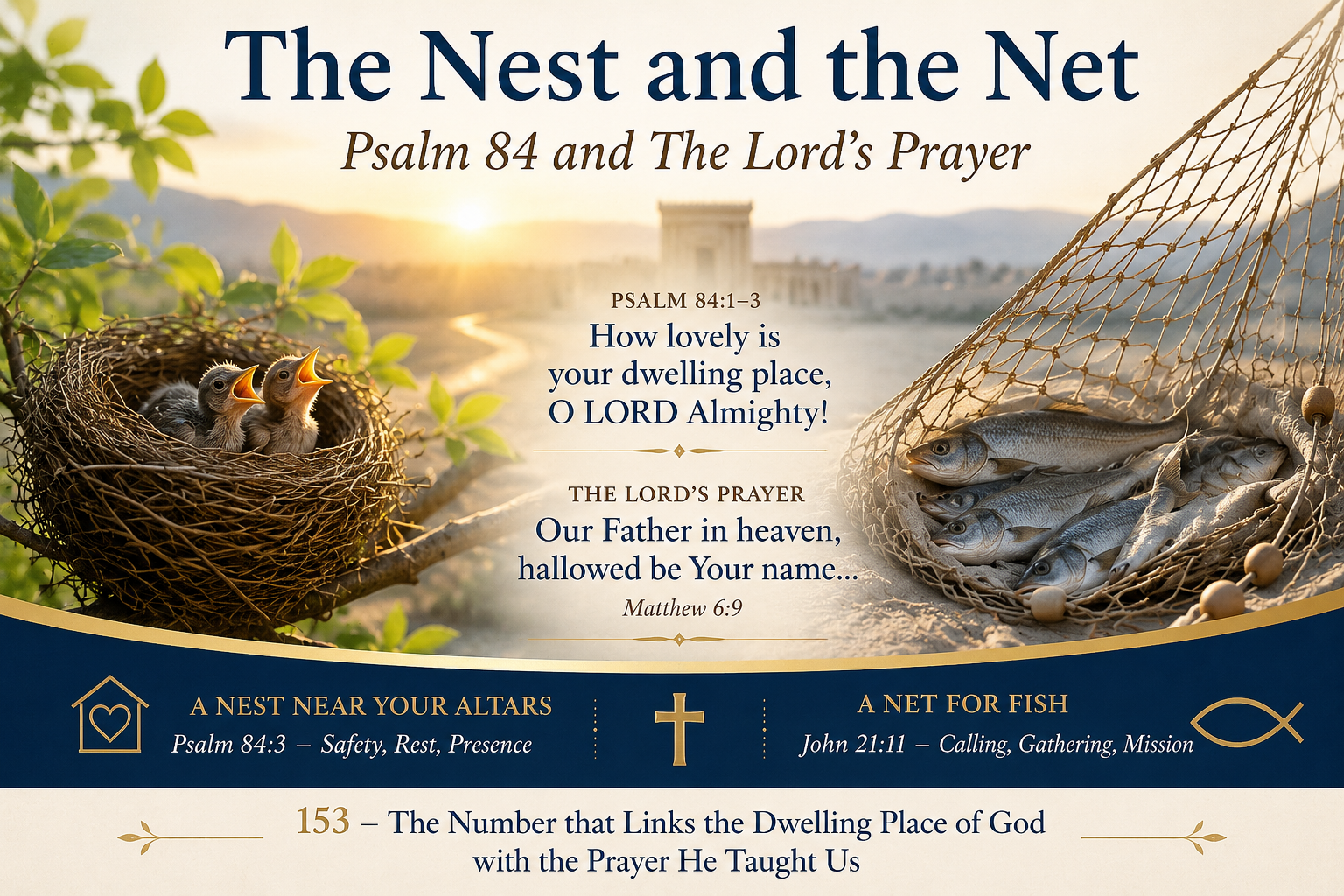
From Obedience to Redemption: Psalms 40–49 and the Message of Easter

Abstract

This paper argues that Psalms 40–49 may be read, from a Christian theological perspective, as a coherent Easter-shaped sequence. The movement begins with Psalm 40’s obedience to the will of God, passes through betrayal, anguish, vindication, and communal sorrow in Psalms 41–44, and then turns decisively in Psalms 45–49 toward resurrection glory, security, ascension, kingdom, and redemption from death. The argument is not that each psalm is an isolated predictive prophecy in the narrowest sense, but that taken together they form a canonical arc that aligns strikingly with the Passion, Resurrection, and Reign of Christ.

Within the framework of Biblical Mathematics, this sequence is further illuminated by the claim that the number 153 signifies the fulfillment of the will of the Father in His Son, and that the Lord’s Prayer is the foremost proclamation of faith in that fulfillment.

1. Introduction

The primary case for linking Psalms 40–49 to Easter is theological and textual. The numerical framework serves only as a confirming witness, never as the main engine of interpretation. In that spirit, this paper proceeds first by canonical and theological reading, and only then by modest numerical corroboration.

The central claim is that Psalms 40–49 form a sustained movement from willing obedience unto sacrifice to divine redemption over death. The sequence is not random. Psalm 40 is explicitly applied to Christ in Hebrews 10:5–10. Psalm 41 is applied by Jesus to the betrayal scene in John 13:18. Psalms 42–43 form a tightly linked pair of lament and hoped-for vindication. Psalm 44 broadens the suffering from the righteous individual to the covenant community. Psalm 45 is explicitly applied to the Son in Hebrews 1:8–9. Psalms 46–49 then unfold what may be called the consequences of Easter: security, reign, Zion, and redemption from Sheol.

Within the wider framework of Biblical Mathematics, this movement connects directly to two further claims. First, the number 153 is understood to signify the fulfillment of the will of the Father in His Son, Jesus Christ. Second, the Lord’s Prayer is understood to be the foremost proclamation of faith in that fulfillment. That is, in our Biblical Mathematics framework, the number 153 is not about a mere fish count. In John 21, Jesus speaks of “meat,” and in John 4:34 He says, “My meat is to do the will of him that sent me.” The Father’s will is defined precisely in John 6:39–40, 44 and John 17:1–2: that is, the Father gives those He has chosen to the Son, the Son loses none of them, and those who see and believe receive eternal life. The 153 fishes therefore represent those given by the Father to the Son, and the unbroken net signifies that none are lost. The resurrection breakfast scene becomes an allegory of Christ having completed the Father’s saving will. Hence, the number 153 represents the fulfillment of the will of the Father in His Son, Jesus Christ. And because the Lord’s Prayer is the foremost proclamation of faith in that fulfilled will, the number 153 and the Lord’s Prayer are inseparably linked.

2. Hermeneutical Method

This reading is best described as a canonical Christian reading rather than a claim that every verse in Psalms 40–49 is a direct prediction of Easter in isolation. Some psalms in this cluster are more explicitly messianic than others. Psalm 40 and Psalm 45 stand out in that regard. Others, such as Psalms 42–44, are more accurately understood as Davidic or communal laments that, in Christian reading, participate in the wider pattern of the suffering righteous one and the suffering covenant people.

That distinction matters. It preserves the historical integrity of the psalms while also allowing the Church to hear them in the light of Christ. In other words, the original setting is not denied; it is taken up into a fuller canonical horizon.

The numerical method used here is also modest. Numeric structures and identifiers may serve as secondary witnesses of remnant, fullness, structure, and evaluative support. They may confirm a reading already grounded in the text; they should not drive the reading independently.

3. Psalm 40: Obedience Unto Sacrifice

Psalm 40 is the true beginning of the Easter arc. Its center is not merely deliverance from trouble, but the willing heart of the servant: “Lo, I come… I delight to do thy will, O my God.” Hebrews 10:5–10 interprets this psalm christologically and sacrificially. The Son comes in a body prepared for obedience; that obedience culminates in self-offering.

Thus Psalm 40 supplies the theological foundation for the whole sequence. Easter begins here, not at the empty tomb, but at the willing acceptance of the Father’s will. The Son’s journey to resurrection begins in obedience.

This also links directly with the 153 framework. Psalm 40 gives the will, while 153 gives the fulfilled form of that will in death and resurrection.

4. Psalm 41: Betrayal by the Familiar Friend

Psalm 41 sharpens the sequence from obedience to betrayal. The climactic line, “mine own familiar friend… hath lifted up his heel against me,” is taken by Jesus in John 13:18 as fulfilled in Judas. This is why Psalm 41 belongs so naturally near Maundy Thursday and the Last Supper.

Theologically, Psalm 41 shows that the path of the obedient Son is not abstract. Obedience enters history through the wound of treachery. The Passion is not only Roman violence or priestly hostility; it is also the pain of betrayal at the table.

Hence the movement from Psalm 40 to Psalm 41 is exact and severe: willing obedience leads into intimate rejection.

5. Psalms 42–43: Anguish, Vindication, Light, and Return

Psalms 42 and 43 are best read together. Psalm 43 has no superscription and repeats the refrain of Psalm 42, suggesting that the two were originally, or functionally, one composition.

Psalm 42 gives the inward world of suffering: thirst, tears, taunts, and the downcast soul. It is the language of pressure, bewilderment, and spiritual depth. In Christian reading, it resonates powerfully with Gethsemane, the Passion, and the sorrow of the suffering Messiah.

Psalm 43 continues the same lament but adds a decisive turn. Now the prayer is: “Judge me, O God”; “Send out thy light and thy truth”; “Let them lead me”; “Then will I go unto the altar of God.” This is not yet a full resurrection narrative, but it is clearly the turning point beyond sorrow. Darkness is no longer the last word.

Psalm 42: anguish and the downcast soul.
Psalm 43: vindication, light, truth, and restored approach to God.

The textual logic is deeply important. Easter is not merely reversal; it is vindication. The suffering righteous one is not abandoned forever. He is led again by divine light and truth into the presence of God.

6. Psalm 44: The Sorrow of the Covenant People

Psalm 44 broadens the lens. The suffering is no longer framed only as the cry of the righteous individual but as the lament of the covenant community. The people remember God’s former acts and yet now feel cast off, scattered, and humiliated.

This psalm fits Easter theology in an important way. It is the communal echo of the Passion. If Psalms 40–43 center on the obedient sufferer and the first movement of vindication, Psalm 44 shows what the suffering means for those who belong to him. They too feel the reproach. They too cry out in bewilderment.

This is strengthened by the New Testament use of Psalm 44:22 in Romans 8:36: “For thy sake we are killed all the day long.” Paul reads the psalm as the experience of the suffering people of God. Thus Psalm 44 is not peripheral to Easter; it is the Church-with-the-Crucified.

7. Psalm 45: The Risen and Enthroned King

Psalm 45 is the great Easter unveiling.

Historically, it is a royal wedding psalm. Canonically and christologically, it becomes far more than that. Hebrews 1:8–9 applies its royal center directly to the Son: “Thy throne, O God, is for ever and ever.” Thus the New Testament itself authorizes a messianic reading here.

In the Easter arc, Psalm 45 is where suffering gives way to royal manifestation. The one who obeyed, was betrayed, suffered, and was vindicated is now seen in majesty. The atmosphere is no longer lament but beauty, righteousness, enthronement, and joy.

This is why Psalm 45 fits Easter Sunday so well. Easter is not only that Christ lives again. It is that the crucified one is revealed as King.

A modest numerical corroboration may be noted. Psalm 45 has 17 verses, and 17 is associated in the biblical number tradition with victory. This harmonizes well with a psalm whose theme is the victorious and enthroned King.

8. Psalm 46: The People of the Risen King Made Secure

If Psalm 45 reveals the King, Psalm 46 reveals the consequence of His reign for His people. “God is our refuge and strength”; “God is in the midst of her”; “she shall not be moved.”

This is resurrection confidence. Chaos may rage, mountains may shake, nations may roar, but the city of God stands because God Himself is present. Psalm 46 is therefore not simply about danger; it is about security after divine reversal.

In Easter terms: because the King is risen and enthroned, His people are no longer defined by fear. They are held by presence.

9. Psalm 47: The Ascended King Over All Nations

Psalm 47 extends the Easter arc upward. “God is gone up with a shout, the LORD with the sound of a trumpet.” Christian interpretation has long heard ascension in this language, and rightly so.

Theologically, the sequence is exact. Resurrection in Psalm 45, security in Psalm 46, ascension and universal kingship in Psalm 47. The King’s vindication is now public and cosmic. He reigns not only over Israel, but “over all the earth.”

Psalm 47 is also an enthronement psalm, and so it marks the widening of Easter into kingdom proclamation.

10. Psalm 48: The City and Kingdom of the Great King Established

Psalm 48 celebrates Zion: “Beautiful for situation, the joy of the whole earth, is mount Zion… the city of the great King.” In the present sequence, this is the established dwelling of the risen and ascended Lord.

Where Psalm 46 speaks of God in the midst of her, Psalm 48 contemplates the beauty and permanence of that reality. The city is no longer merely hoped for; it is confessed and admired.

This points naturally toward ecclesial and eschatological fulfillment: the Church as the people gathered under the great King, and the New Jerusalem as the final perfected city of divine presence.

11. Psalm 49: Death Answered by Divine Redemption

Psalm 49 closes the sequence by addressing the final enemy directly. Wealth cannot redeem a brother. Human power cannot prevent death. Yet the psalm declares: “But God will redeem my soul from the power of the grave.”

This is a fitting conclusion to the Easter arc. The sequence began with obedience unto sacrifice; it ends with divine redemption from death. Psalm 49 does not narrate Easter morning, but it articulates its deepest theological result: death does not finally own the people whom God redeems.

The psalm’s twenty verses are also suggestive in the biblical number tradition, where twenty is commonly associated with redemption. Here again, the numerical witness confirms what the text already proclaims.

12. The Lord’s Prayer, 153, and Easter as Confession

At this point the connection to the Lord’s Prayer becomes decisive.

Within the Biblical Mathematics framework, 153 is the signature of the fulfillment of the Father’s will in the Son. The Lord’s Prayer is the foremost proclamation of faith in that fulfillment. It is therefore not merely a devotional form, but a creed—a daily confession of the accomplished work of Christ.

This means that the Easter message of Psalms 40–49 is not merely contemplated; it is confessed. Psalm 40 gives the will of the Father in the obedient Son. Psalm 45 reveals the risen King. Psalm 49 answers death by redemption. The Lord’s Prayer gathers this whole theology into the worshipping mouth of the believer.

13. Conclusion

A coherent Christian reading of Psalms 40–49 reveals a powerful Easter arc.

Psalm 40 gives obedience unto sacrifice.
Psalm 41 gives betrayal.
Psalms 42–43 give anguish, then vindication and return.
Psalm 44 gives the sorrow of the covenant people.
Psalm 45 gives the risen and enthroned King.
Psalm 46 gives the security of His people.
Psalm 47 gives His ascended universal reign.
Psalm 48 gives the established city of the great King.
Psalm 49 gives redemption over death.

The sequence is not mechanically imposed. It arises from strong textual and canonical links, and it is reinforced—though never controlled—by the Biblical Mathematics framework, especially the claims that 153 signifies the fulfillment of the Father’s will in the Son and that the Lord’s Prayer is the foremost proclamation of faith in that fulfillment.

Psalms 40–49 do not merely surround Easter; they narrate its shape.

They move from the will of God, through the suffering of Christ and His people, into resurrection, reign, Zion, and redemption. In that sense, they do not stop at the empty tomb. They carry Easter forward into the life, security, worship, and hope of the covenant people.

Appendix: Psalm-Level Identifier Summary

PsalmVersesIdentifier RangeTotal Identifier SumBrief Reflection
401760–761156Obedience unto sacrifice begins the arc
411361–73871Betrayal enters the Passion sequence
421162–72737Anguish and the downcast soul
43563–67325Grace-shaped turning toward vindication
442664–891989Communal sorrow widens the suffering
451765–811241Victory-shaped unveiling of the King
461166–76781Secure people under divine presence
47967–75639Universal kingship and ascent
481468–811043Deliverance-shaped established city
492069–881570Redemption over death

Psalm 40 gives the will.
153 gives the fulfillment.
The Lord’s Prayer gives the confession.
Psalms 40–49 give the unfolding of Easter.

From Suffering to Sovereignty: The Arc of Psalms 31–39 and the Witness of 315 toward the 153 Harvest

Abstract

This paper explores the theological unity of Psalms 31–39 as a coherent spiritual arc, tracing the journey of the righteous sufferer through distress, repentance, endurance, and hope. It then considers the numerical observation that the sum of Psalm numbers 31–39 equals 315, a permutation of 153, and examines how this may function as a secondary witness within a broader biblical framework. The study argues that the textual movement of these psalms aligns closely with the pattern of Christ’s suffering and vindication, culminating in the eschatological gathering of the “chosen ones” associated with the number 153.


1. Introduction: Letting the Text Speak First

The aim of this study is not to replace exegesis with arithmetic, but to show how numeric structure—handled modestly—can confirm themes already present in Scripture.

Psalms 31–39, when read together, present a sustained reflection on the life of the faithful in a fallen world. These psalms are traditionally read individually, yet their sequential arrangement suggests a deeper unity.

Only after establishing this textual unity do we consider the numerical observation:

31 + 32 + 33 + 34 + 35 + 36 + 37 + 38 + 39 = 315

This number, in turn, relates to 153, a number associated in John 21:11 with the gathered fish, often interpreted symbolically as the fullness of the redeemed community.


2. The Arc of Psalms 31–39

When read sequentially, Psalms 31–39 form a clear spiritual progression:

2.1 Psalm 31 — Trouble and Trust

The journey begins in distress. The psalmist is surrounded by enemies, fear, and social rejection, yet declares:

“Into thy hand I commit my spirit.”

This establishes the foundation: trust in God amid suffering.


2.2 Psalm 32 — Confession and Forgiveness

The focus shifts inward. The problem is not only external enemies, but internal sin.

“Blessed is he whose transgression is forgiven.”

Thus, repentance becomes central to the life of faith.


2.3 Psalm 33 — Praise and Sovereignty

The psalmist lifts his gaze from personal struggle to the universal rule of God.

God is Creator, King, and sovereign over history.

This introduces cosmic perspective.


2.4 Psalm 34 — Comfort and Divine Nearness

The emphasis becomes pastoral:

“The LORD is nigh unto them that are of a broken heart.”

God is not distant; He is present with the afflicted.


2.5 Psalm 35 — Injustice and Vindication

At the center of the arc lies unjust suffering.

The righteous one is:

  • falsely accused
  • hated without cause
  • surrounded by enemies

This psalm strongly anticipates the messianic pattern of unjust suffering.


2.6 Psalm 36 — Human Sin and Divine Mercy

A sharp contrast emerges:

  • human wickedness is deep
  • God’s mercy is higher

“Thy mercy, O LORD, is in the heavens.”

Thus, the answer to evil is not human effort, but divine steadfast love.


2.7 Psalm 37 — Patient Waiting and Inheritance

The faithful are instructed:

“Fret not… trust in the LORD… wait patiently for him.”

This psalm introduces the theme of inheritance, promised to those who endure.


2.8 Psalm 38 — Deep Suffering and Burden

The tone becomes heavy again:

  • physical pain
  • emotional anguish
  • spiritual burden

The believer experiences the weight of life under discipline and suffering.


2.9 Psalm 39 — Frailty and Final Hope

The sequence ends with reflection:

“My hope is in thee.”

Human life is short. Strength fades. But hope remains in God.


3. Summary of the Arc

The nine psalms together form the following progression:

trouble → confession → praise → comfort → injustice → mercy → waiting → suffering → hope

Or more simply: this is path of the righteous in a fallen world.

This is not abstract theology. It is lived faith.

4. Christological Fulfillment

From a Christian perspective, this arc aligns closely with the life of Christ:

  • Psalm 31 → quoted by Jesus at the cross
  • Psalm 35 → hatred without cause
  • Psalm 37 → inheritance of the meek
  • Psalm 38–39 → suffering and human frailty

Together, these psalms form a portrait of the righteous sufferer, fulfilled ultimately in Jesus.

The pattern is clear:

suffering → trust → surrender → vindication

This is the pattern of the cross and resurrection.


5. The Numerical Witness: 315

The sum of Psalms 31–39 is 315:

Within our broader framework, 315 is a permutation of 153, and is associated with:

  • the hour of Christ’s death (3:15 pm tradition)
  • the moment of surrender (“Into thy hands…”)

Thus, 315 becomes a signature of sacrifice.

Importantly, this is not the basis of interpretation, but a confirmation:

The text already presents a pattern of suffering and surrender. The number 315 echoes that same pattern.


6. The Jasper Throne (Revelation 4:3)

The Greek word:

ἰάσπιδι (iaspidi) — “jasper”

has an isopsephy value of 315.

This word describes the One seated on the throne in heaven.

And he that sat was to look upon like a jasper and a sardine stone: and there was a rainbow round about the throne, in sight like unto an emerald. (Revelation 4:3)

This creates a profound connection:

  • 315 (Psalms 31–39) → suffering and surrender
  • 315 (jasper) → divine enthronement

Thus, the number associated with the cross is also associated with the throne.

In biblical theology: The Lamb who was slain is the One who reigns.


7. From 315 to 153: Sacrifice and Harvest

In John 21:11, the disciples catch 153 fish.

Simon Peter went up, and drew the net to land full of great fishes, an hundred and fifty and three: and for all there were so many, yet was not the net broken. (John 21:11)

This number has long been associated with:

  • completeness
  • fullness
  • the gathering of the redeemed

Within this framework:

  • 315 = sacrifice
  • 153 = harvest

Thus:

There is no 153 harvest without the 315 sacrifice.

This aligns perfectly with the New Testament:

  • Christ dies → then gathers His people
  • the cross → then the church
  • sacrifice → then fulfillment

A further observation may be noted as a confirming numerical witness within Revelation 7 itself. The identifiers of verses 3 and 4—where the servants of God are first sealed and then numbered as one hundred and forty-four thousand—are 76 and 77 respectively, which together sum to 153.

Saying, Hurt not the earth, neither the sea, nor the trees, till we have sealed the servants of our God in their foreheads. And I heard the number of them which were sealed: and there were sealed an hundred and forty and four thousand of all the tribes of the children of Israel. (Revelation 7: 3-4)

Sum of Verse Identifiers = (66+7+3)+(66+7+4) = 76 + 77 = 153.


While this does not establish doctrine, it functions within the present framework as a secondary confirmation of the theological unity already evident in the text: that the sealed servants of God belong to the same reality as the gathered people symbolized by the 153 fish in John 21. In this way, the act of sealing (Revelation 7:3) and the act of numbering (Revelation 7:4) converge numerically in the number of fulfillment, suggesting that those marked by God are also those gathered by the Son. Thus, the movement from sacrifice (315) to harvest (153) finds a final and elegant resonance within the sealing vision itself.


8. Theological Synthesis

We can now summarize the full pattern:

Textual Level

Psalms 31–39 describe the life of the righteous sufferer:

  • trust
  • repentance
  • endurance
  • hope

Christological Level

This pattern is fulfilled in Jesus:

  • unjust suffering
  • complete surrender
  • final vindication

Numerical Level (Secondary Witness)

  • 315 → sacrifice (cross)
  • 315 → throne (Revelation)
  • 153 → harvest (John 21)

Unified Message

The path to glory passes through suffering.
The cross precedes the harvest.
The One who surrendered is now enthroned.


9. Conclusion

Psalms 31–39 form a powerful and coherent spiritual journey.
They teach that:

  • life is difficult
  • sin is real
  • suffering is unavoidable
  • but God is faithful

When read in light of Christ, they reveal: the way of the Son is the way of trust through suffering into glory

The numerical observation that these psalms sum to 315 does not create this meaning—it confirms it.

And when placed alongside 153, the message becomes complete.

The sacrifice of Christ (315) leads to the gathering of His people (153).

  • The cross is not the end.
  • The cross leads to the throne.
  • And from the throne comes the harvest.

Psalm 30 and the Three Signature Totals (153 → 315 → 666)

A Canon-Guided Numerical Reading in Service of Theology


Abstract

Psalm 30 is a Davidic thanksgiving psalm that narrates divine deliverance, exposes the spiritual danger of prosperity, and culminates in enduring praise. Using the Verse Identifier method (Book Number + Chapter Number + Verse Number), this study reports three cumulative totals within Psalm 30 (KJV): 153 after verse 3, 315 after verse 6 (a digit permutation of 153), and 666 as the total sum of all verse-identifiers. Rather than treating these totals as drivers of interpretation, the paper employs them as confirmatory echoes within a text-first, canon-informed approach. The resulting reading highlights (i) deliverance “from the pit” as consecration for worship (vv.1–4), (ii) verse 6 as the psalm’s moral and spiritual hinge (“I shall never be moved”), and (iii) the whole-psalm total 666 as a cautionary enclosure of the “man-exaltation” impulse that the psalm ultimately overturns into perpetual thanksgiving. The “so what” is pastoral and practical: Psalm 30 functions as a template for the rescued community—deliverance must become worship, prosperity must be held with humility, and adversity can serve as divine reorientation toward prayer and transformed joy. Mathematical details are confined to appendices.

Keywords: Psalm 30, thanksgiving psalm, humility, prosperity, verse identifiers, 153, 666, typology, canonical numeric invariants


1. Introduction

Psalm 30 is frequently read as a song of reversal: weeping in the night, joy in the morning. Yet the psalm is equally a sober warning about what prosperity can do to the human heart. This paper presents a numerical discovery that appears to align closely with that theological movement: three cumulative identifier totals (153, 315, 666) emerge at spiritually decisive points.

The aim is not to replace exegesis with arithmetic, but to show how numeric structure—when handled modestly—can function as a secondary witness that confirms themes already present in the text. In short: the text governs; the numbers corroborate.

2. Text, Genre, and Context

Psalm 30 is a thanksgiving psalm attributed to David, bearing the superscription: “A Psalm and Song at the dedication of the house of David.” The heading suggests a setting of dedication (royal house/palace, or later liturgical reuse at dedications). While the precise historical occasion remains debated, the psalm’s internal logic is clear:

  • David recalls rescue from near-death (vv.1–3),
  • calls the community to worship (v.4),
  • states a theological maxim about divine favor and temporal grief (v.5),
  • confesses the spiritual risk of prosperity (v.6),
  • recounts destabilization when God “hid” His face (v.7),
  • records renewed supplication (vv.8–10),
  • concludes with transformation and perpetual praise (vv.11–12).

Within Book I (Psalms 1–41), Psalm 30 functions as a testimony-psalm that strengthens trust for ongoing struggle.

3. Methodology

3.1 Verse Identifier Method

Each verse receives an identifier:

Identifier = Book Number + Chapter Number + Verse Number.

For Psalm 30 (Book of Psalms = 19; Chapter = 30), the identifier for verse v is:

19 + 30 + v = 49 + v.

Thus Psalm 30:1–12 yields identifiers 50–61, and cumulative sums can be tracked across the psalm (see Appendix A).

3.2 Canon-Guided Restraint

Digit permutations (e.g., 153 ↔ 315) are treated as auxiliary rather than primary meaning-makers: they may confirm a hinge already evident in the text but should not override exegetical sense.

4. Exegetical Flow and the Hinge of the Psalm

A concise hinge reading reveals the psalm’s structure:

  1. vv.1–3 (deliverance): lifted up, healed, brought up from the grave/pit.
  2. v.4 (public worship): the rescued calls the saints to praise.
  3. v.5 (theological maxim): momentary anger; enduring favor; night-to-morning reversal.
  4. v.6 (false security confessed): prosperity births the claim, “I shall never be moved.”
  5. v.7 (divine destabilization): God’s “hidden face” exposes fragile self-grounded stability.
  6. vv.8–10 (supplication): renewed dependence; life preserved in order to praise.
  7. vv.11–12 (transformation): mourning to dancing; perpetual thanksgiving.

The textual hinge is unmistakably v.6, because it names the inward error prosperity can produce. Everything after v.6 functions as God’s corrective path into prayer and transformed worship.

5. Numerical Findings

Three cumulative totals stand out (see Appendix A):

  • The number 153 occurs as the cumulative sum at verse 3 (end of the deliverance unit).
  • The number 315 occurs as the cumulative sum at verse 6 (the hinge confession), and is a base-10 digit permutation of 153.
  • The number 666 is the total cumulative sum at verse 12 (the psalm’s conclusion).

These totals align with the psalm’s theological movement: rescue (v.3), hinge (v.6), and whole-psalm resolution (v.12).

6. Theological Interpretation of the Three Signatures

6.1 Appearance of153 at v.3: Deliverance as Consecration for Witness

Verse 3 is the rescue threshold: “Thou hast brought up my soul from the grave… kept me alive.” The cumulative total reaching 153 at this moment coheres with the “153 net” framing (John 21:11): the rescued are not merely spared; they are kept alive for worship and obedience. The very next verse (v.4) turns rescue into communal praise, which is precisely how testimony is meant to function.

6.2 Appearance of 315 at v.6: The Prosperity Trap as the Psalm’s Moral Center

The cumulative total 315 occurs exactly at v.6: “In my prosperity I said, I shall never be moved.” Textually, v.6 is the pivot from celebration to correction. Numerically, 315 echoes 153 by permutation—functioning as confirmation that the same life that is rescued must still be purified from self-security. In biblical number vocabulary, 6 is associated with man, and it is fitting that verse 6 articulates the “man-impulse” of self-grounded permanence.

6.3 Appearance of 666 as Whole-Psalm Total: Enclosing the “Man” Impulse and Converting It into Worship

The total sum 666 is symbolically weighty in Christian canon because Revelation associates it with “the number of a man” and counterfeit worship. Read within Psalm 30 itself (rather than imported fearfully into it), 666 can be treated as an enclosure warning: the “man” tendency to enthrone self is genuinely present (v.6), yet the psalm ends not in self-rule but in perpetual thanksgiving (v.12). Psalm 30 exposes the impulse, breaks it, and converts the outcome into worship.

7. Christological Reading (Christian Perspective)

Psalm 30 is not a direct messianic prophecy in the manner of Psalm 22; however, it readily supports a typological reading:

  • “brought up… from the grave” (v.3) harmonizes with resurrection-shaped hope,
  • “joy… in the morning” (v.5) resonates with the pattern of suffering followed by divine vindication,
  • the movement from sackcloth to gladness (v.11) mirrors gospel reversal themes.

From a Christian perspective, Psalm 30 functions as a pattern that finds fuller realization in Christ: suffering does not have the last word; deliverance yields worship; restoration culminates in praise.

8. The “So What?” Pastoral and Practical Implications

This approach yields takeaways that do not require numerical reasoning to be persuasive, but are strengthened by the numeric confirmations:

  1. Deliverance must become worship, not merely relief. Psalm 30 moves quickly from rescue (vv.1–3) to communal praise (v.4).
  2. Prosperity is spiritually dangerous when it produces false permanence. The hinge confession (v.6) warns leaders and believers against “I am unmovable.”
  3. God’s destabilization can be mercy. When God “hid His face” (v.7), the outcome was renewed prayer and transformation, not abandonment.
  4. The goal is transformation, not survival. The psalm ends with mourning turned to dancing (v.11) and thanksgiving “for ever” (v.12).
  5. A simple discipleship template emerges:
    • 153 (vv.1–3): rescued from the pit → preserved for praise
    • 315 (to v.6): prosperity exposes man’s self-reliance → humility required
    • 666 (whole): the “man” impulse is enclosed, judged, and converted into worship

9. Limits and Methodological Cautions

  • The numerical results are not presented as independent proof of doctrine.
  • Digit permutation is treated as confirmatory, not determinative.
  • The approach is best used where the text already has strong internal hinges—as Psalm 30 does at v.6.

10. Conclusion

Psalm 30 narrates a complete spiritual arc: God delivers, disciplines, restores, and establishes lifelong praise. The three signature totals (153 → 315 → 666) align with the psalm’s internal movement—deliverance (v.3), hinge confession (v.6), and final resolution (v.12). Held under a text-first discipline, these signatures function as a secondary witness that highlights Psalm 30’s central message: God rescues in order to consecrate; He humbles in order to heal; He transforms sorrow into worship that endures.


Appendices

Appendix A. Table of Identifiers (Psalm 30, KJV)

Identifier = 19 + 30 + v = 49 + v.

VerseVerse text (KJV)IdentifierCumulative sum
1I will extol thee, O LORD; for thou hast lifted me up, and hast not made my foes to rejoice over me.5050
2O LORD my God, I cried unto thee, and thou hast healed me.51101
3O LORD, thou hast brought up my soul from the grave: thou hast kept me alive, that I should not go down to the pit.52153
4Sing unto the LORD, O ye saints of his, and give thanks at the remembrance of his holiness.53206
5For his anger endureth but a moment; in his favour is life: weeping may endure for a night, but joy cometh in the morning.54260
6And in my prosperity I said, I shall never be moved.55315
7LORD, by thy favour thou hast made my mountain to stand strong: thou didst hide thy face, and I was troubled.56371
8I cried to thee, O LORD; and unto the LORD I made supplication.57428
9What profit is there in my blood, when I go down to the pit? Shall the dust praise thee? shall it declare thy truth?58486
10Hear, O LORD, and have mercy upon me: LORD, be thou my helper.59545
11Thou hast turned for me my mourning into dancing: thou hast put off my sackcloth, and girded me with gladness;60605
12To the end that my glory may sing praise to thee, and not be silent. O LORD my God, I will give thanks unto thee for ever.61666

Note: KJV is public domain. For a standard online rendering of Psalm 30 (KJV), see BibleGateway: Psalm 30 (KJV).

Appendix B. Canon of Numeric Invariants Snapshot (153, 315, 666)

Primary operators: divisor set D, divisor count τ, sum-of-divisors σ, aliquot sum s = σ − n, totient φ, Carmichael λ, radical rad. Digit permutation is used only as an auxiliary confirmation.

nPrime factorizationD(n) (divisors)τ(n)σ(n)s(n)=σ−nφ(n)rad(n)λ(n)
1533²·17{1, 3, 9, 17, 51, 153}623481965148
3153²·5·7{1, 3, 5, 7, 9, 15, 21, 35, 45, 63, 105, 315}1262430914410512
6662·3²·37{1, 2, 3, 6, 9, 18, 37, 74, 111, 222, 333, 666}12148281621622236

Auxiliary note: 315 is a base-10 digit permutation of 153, treated here as a confirmatory resonance at the textual hinge (v.6).

Appendix C. Number-Meaning Vocabulary Employed (from the user’s Numbers framework)

  • 6: Man
  • 8: New Beginning
  • 9: Visitation
  • 12: Governmental perfection / authority
  • 17: Victory
  • 26: Power of salvation
  • 30: Dedication for rulership

God’s Name as the Plan

Psalms 18–20 as a Lord’s Prayer Formation Sequence
(with Joshua 5–6 as the Template)

Abstract

This paper argues that Psalms 18–20 form a coherent spiritual-formation sequence that can be read as a “Lord’s Prayer template” for believers: deliverance remembered (faith with evidence), consecration embraced (surrender to the true Commander), and commission received (the plan is the Name of God, not worldly power). Psalm 18 supplies the experiential foundation of faith: God has delivered, therefore God can be trusted to deliver again. Psalm 19 functions as the bridge: revelation (creation and Torah) leads into inner holiness and submission. Psalm 20 then becomes the commissioning liturgy: the community moves forward with confidence that salvation comes from the LORD, rejecting counterfeit security (“chariots and horses”) and rallying under the divine Name. Numeric results (Verse Identifiers and selected canonical invariants) are presented only as corroborative witnesses in appendices; the paper’s main contribution is theological and pastoral: it offers a replicable framework for discipleship under pressure—alignment before action, trust before vindication, and discernment against counterfeit salvations—with the Lord’s Prayer as the governing pattern of life and mission.

Keywords: Psalms 18–20, Lord’s Prayer, spiritual formation, divine Name, deliverance, consecration, discernment, canonical synthesis.

1. Introduction: Why This Sequence Matters

Immediately before the fall of Jericho, Joshua is not given a plan first—he is given a handover. In Joshua 5:13–15, he meets the Captain/Commander of the LORD’s host, stands on holy ground, and submits. Only then does Joshua receive the instruction that governs the battle (Joshua 6:1–5), an instruction framed as worship-led obedience rather than conventional siege strategy. The narrative thus discloses a durable spiritual principle: authority is revealed before strategy is received; surrender precedes instruction.

This paper argues that the Psalter supplies a believer-facing version of that same pattern in Psalms 18–20, with Psalm 19 functioning as the crucial bridge. Psalm 18 provides the foundation of biblical faith: faith is not merely hopeful sentiment but confidence grounded in God’s demonstrated deliverance—memory transfigured into trust. Psalm 19 then turns revelation into consecration: creation and Torah declare God’s authority, and the worshipper responds with inward surrender, seeking cleansing, restraint from presumptuous sin, and acceptance before God. Psalm 20 follows as the commissioning psalm: the community receives the “plan” not as technique but as covenant reliance—“Some trust in chariots and some in horses, but we will remember the name of the LORD our God.” Taken together, Psalms 18–20 form a coherent discipleship sequence: Deliverance remembered (faith) → surrender enacted (consecration) → plan received (commission under the Name).

The “so what?” of this synthesis is practical and pastoral. In seasons when believers feel threatened, delayed, or tempted by rival securities, Scripture does not simply offer comfort—it forms character. The sequence trains the reader to (i) ground trust in God’s proven saving action, (ii) submit inwardly to the true Commander, and (iii) move outwardly with a strategy centered on God’s Name rather than on worldly power. This formation logic naturally resonates with the Lord’s Prayer as the Church’s daily rule of life.

A secondary aim of the study is to document, with transparency and restraint, a small set of numerical corroborations that accompany this theological coherence (reported in the appendices). These results do not establish doctrine independently; they are treated as structured witnesses to a unity already visible in the narrative and theological movement of the texts.

2. Background and Context: From Joshua’s Holy-Ground Handover to a Psalter Formation Pattern (Psalms 18–20)

The interpretive starting point for this study is an Old Testament narrative template in Joshua 5–6 that reveals how divine victory is prepared. Immediately before the fall of Jericho, Joshua encounters a sword-bearing figure identified as the Captain/Commander of the LORD’s host (Joshua 5:13–15). The effect of this encounter is not tactical but theological: Joshua is re-centered. The ground is declared holy; Joshua falls in submission; the decisive question becomes not whether God supports Joshua’s agenda, but whether Joshua will align himself with God’s command.

Only after this act of surrender does the battle plan arrive (Joshua 6:1–5). Jericho’s defeat is framed not as ordinary siegecraft but as worship-led obedience—the ark, priests, trumpets, and a divinely ordered sequence of marching. The narrative thus establishes a durable spiritual law: authority is revealed before instruction is given; surrender precedes strategy.

This Joshua “handover → instruction” template becomes especially fruitful when applied to believers more generally through Psalms 18–20, a sequence that is already thematically linked in the Psalter. Psalm 18 is a comprehensive testimony of divine rescue and supplies the existential foundation of biblical faith: confidence grounded in God’s proven deliverance. Psalm 19 moves from cosmic revelation (creation) to moral revelation (Torah) and culminates in personal consecration (Psalm 19:12–14), where revelation becomes surrender. Psalm 20 then functions as a liturgy for conflict and mission: the community receives the plan as covenant reliance—remembering the Name of the LORD rather than trusting in chariots and horses.

Taken together, Psalms 18–20 provide a believer’s formation sequence that mirrors Joshua’s ordering: Deliverance remembered (faith) → surrender enacted (consecration) → plan received (commission).

3. Method and Guardrails

3.1 Method Summary (text-first; numbers as secondary witnesses)

This paper proceeds in two stages. First, it identifies hinge units—short passages that concentrate the theological tension of a section and initiate its decisive turn—within Joshua 5–6 and Psalms 18–20. These hinge units are interpreted through close reading, with priority given to literary cues (turning points, contrasts, commands, confessions, and outcome statements). Second, a restrained set of canonical numeric invariants is applied to the hinge units as a corroborative layer. All numerical results are reported transparently in the appendices and are not used to establish doctrine independently.

3.2 Why “Hinge Passages” Are Not Cherry-Picking in This Study

A foreseeable criticism of hinge-based readings is that they can become a form of theological cherry-picking: selecting a few convenient verses to force a predetermined conclusion. This paper takes that concern seriously and adopts three guardrails that make hinge selection text-disciplined, replicable, and theologically accountable.

First, hinge selection is governed by literary cues, not preference. In each case, the hinge unit is identified by structural features: a turning point in the narrative (Joshua’s holy-ground encounter immediately preceding the Jericho instructions), a pivot from revelation to personal consecration (Psalm 19), and a shift from petition to assurance and strategic contrast (Psalm 20). These are not obscure fragments; they are points where the text concentrates its theological load and signals a decisive transition.

Second, hinges are chosen as minimum sufficient units, not maximal proof-texts. A hinge unit is the smallest coherent segment that carries the chapter’s pivot. This is a standard practice in exegesis and homiletics; our method formalizes it by requiring that each hinge be justified by textual features (turns, contrasts, commands, confessions, or verdict statements).

Third, numeric signature pointers function as confirmatory constraints, not as generators of meaning. In our corpus, 153 and 168 function as pointers to the Lord’s Prayer formation pattern (with 168 associated with Luke’s Lord’s Prayer unit), 285 points to the Lord’s Prayer in Matthew, while 108 and 666 are treated as discernment markers for counterfeit “redeemers”—systems, powers, or spiritual claims that promise security without confessing the lordship of God in Christ. Crucially, these numbers do not determine the hinge. The hinge is established first by textual coherence; only then are numeric results consulted as secondary witnesses.

4. Psalm 18: Faith with Evidence (Deliverance Remembered)

Psalm 18 is a testimonial psalm that gives faith its substance. David is not hoping that God might be strong—he is confessing that God has been strong. Biblical faith is therefore not wishful thinking but confidence anchored in the demonstrated character of God.

4.1 Psalm 18 in context: deliverance as a foundation for trust

Psalm 18 recounts rescue, vindication, and stabilization. The LORD’s deliverance reveals a pattern: God intervenes decisively, overturns threats, and establishes the one who takes refuge in Him. That memory becomes the believer’s evidence base for future obedience.

4.2 Hinge A (Psalm 18:1–3): allegiance as the starting posture

The opening hinge is a confession of allegiance: God is strength, rock, fortress, deliverer. This functions as a handover at the level of the heart. Faith begins not with control but with attachment—love and dependence that precede outcomes.

4.3 Hinge B (Psalm 18:46–50): deliverance that becomes witness and mission

The closing hinge expands deliverance outward. Praise is offered among the nations, and mercy to the anointed is placed on a covenant horizon. Deliverance becomes public witness and a forward-facing identity, preparing the logic of Psalm 20: if salvation is real, it must govern the community’s future engagements.

4.4 Formation outcome: faith becomes resilient trust

Psalm 18 gives the believer a non-fragile faith. Faith is not merely hope that God will help; it is a settled belief that God delivers, because God has delivered. Such faith is ready for Psalm 19’s consecration and Psalm 20’s commissioning.

5. Psalm 19: Surrender to the True Commander (Consecration)

Psalm 19 bridges deliverance to mission by turning revelation into holiness. Revelation is meant to produce surrender, preventing deliverance-faith from becoming triumphalism and commissioning from becoming activism.

5.1 Three movements: creation witness → Torah witness → consecration

Creation declares God’s glory; Torah declares God’s will; and the worshipper yields. The ultimate goal is not information but transformation.

5.2 Hinge (Psalm 19:12–14): “holy ground within”

Psalm 19:12–14 is a compact act of surrender: cleansing from hidden faults, restraint from presumptuous sin, and consecration of speech and meditation. Here the authority of God is welcomed into the hidden places of the self. This consecration moment is the spiritual handover that makes later strategy safe.

5.3 Formation outcome: alignment before action

Psalm 19 supplies the core discipline of the sequence: alignment precedes action. Faith provides confidence; consecration provides purity and surrender; only then is commission rightly received.

6. Psalm 20: Receiving the True Plan (Commission Under the Name)

Psalm 20 is the next step after consecration: the community can ask for help and move forward. It defines success under God as reliance on the LORD rather than on the world’s instruments.

6.1 Psalm 20 as commissioning liturgy

Psalm 20 reads like a communal sending prayer. It assumes trouble and conflict and asks for help from the sanctuary, training confidence shaped by covenant reliance.

6.2 Hinge (Psalm 20:6–9): assurance and the strategy principle

Psalm 20:6–9 pivots from petition to assurance and sets the decisive contrast: some trust in chariots and horses, but the faithful remember the Name of the LORD. That sentence is the plan. Even the closing cry—“Save, LORD”—keeps dependence central.

Definition (used in this paper): when Psalm 20 frames the community’s confidence as “remembering the Name of the LORD,” it treats the “plan” not as a technique for controlling outcomes but as covenant reliance on God’s revealed identity—His character, authority, and saving presence. In practice, this means the people step forward by prayerful obedience under God’s lordship, rejecting rival securities (“chariots and horses”) and acting in alignment with what God has made known of Himself.

6.3 Formation outcome: discernment against counterfeit security

Psalm 20 builds discernment into commissioning. Rival salvation stories will always be present—power, wealth-security, intimidation, manipulation. The psalm trains communities to act without idolatry by placing threat under the sovereignty of God’s Name.

7. Synthesis: The Formation Sequence and the Lord’s Prayer

Psalms 18–20 form a coherent discipleship arc that naturally resonates with the Lord’s Prayer as the Church’s daily rule of life.

7.1 The sequence: Deliverance → Consecration → Commission

Psalm 18 (Deliverance): faith with evidence. Psalm 19 (Consecration): submission and inner alignment. Psalm 20 (Commission): strategy under the Name. This ordering amplifies the Joshua template: surrender precedes instruction, and instruction is received as worship-led obedience.

7.2 Lord’s Prayer mapping (formation, not proof-texting)

“Hallowed be Your name” corresponds to Psalm 20’s plan: the divine Name is the banner and ground of confidence. “Your will be done” corresponds to Psalm 19’s consecration: the inner life aligns to God’s will. “Deliver us…” corresponds to Psalm 18’s testimony: deliverance is experienced and expected.

7.3 A confirmatory test: Psalm 37 and Psalm 62 as a parallel Submission → Plan pair

To test whether the formation logic observed in Psalms 18–20 generalizes beyond this local cluster, we briefly examine a second pair of psalms that exhibit the same movement. Psalm 37:1–11 trains the believer in submission of tempo and reaction—refusing fretting, envy, anger, and retaliatory urgency, and instead trusting, committing, resting, and waiting for the LORD. Psalm 62:1–8 then supplies the plan in concentrated form: “God alone” is rock, salvation, and refuge; therefore the community’s strategy is quiet trust, poured-out prayer, and refusal of counterfeit securities. This parallel pair strengthens the main claim of the paper by showing that “Submission → Plan” is not a one-off pattern but a repeatable formation grammar within the Psalter. Numeric corroboration for this supporting case study is reported in Appendix G.

7.4 Pastoral implications: living faithfully under pressure and delay

This framework answers “God feels late” with formation rather than slogans. Psalm 18 anchors trust in God’s proven character; Psalm 19 turns fear into cleansing and surrender; Psalm 20 commissions action under God’s Name, not the illusions of worldly strength.

7.5 Public-life implications: discerning rival “salvations”

Nations, institutions, and leaders are constantly offered “chariots and horses”—systems promising security at the cost of truth and holiness. Psalm 20’s strategy principle trains communities to critique counterfeit salvations and commit to the only deliverance that does not collapse under ultimate pressure.

8. Conclusion

Psalms 18–20 form a coherent formation sequence that answers a practical discipleship need: how to live faithfully under pressure, delay, and competing claims of security. Psalm 18 grounds faith in evidence—God has delivered, therefore trust is rational and resilient. Psalm 19 bridges deliverance to mission by turning revelation into consecration: surrender to the true Commander must take place inwardly, where hidden faults and presumptuous sin are confronted and the heart is aligned to God’s will. Psalm 20 then commissions the community with the true plan—confidence in the LORD’s saving action and a decisive refusal of counterfeit security in favor of the divine Name. Read through Joshua’s “handover → instruction” template, this sequence becomes a replicable spiritual grammar: alignment before action, trust before vindication, and dependence before strategy. The Lord’s Prayer functions as the Christian rule of life that gathers these movements into daily practice—hallowing the Father’s Name, submitting to His will, and seeking deliverance with confidence. The numerical results reported in the appendices are presented as secondary witnesses that corroborate this unity; the primary claim remains theological and pastoral.

APPENDICES (Corroborative Numeric Witnesses)

Appendix A. Texts and hinge units used (with brief rationale notes)

Joshua template (contextual anchor): Joshua 5:13–15; Joshua 6:1–5.

Psalms formation sequence (main study): Psalm 18:1–3; Psalm 18:46–50; Psalm 19:12–14; Psalm 20:6–9.

Supplemental confirmatory case study: Psalm 37:1–11; Psalm 62:1–8.

Appendix B. Tables of Identifiers

Table of Identifiers — Joshua 5:13–15 (Subtotal = 75)

VerseVerse textIdentifierCumulative sum
Joshua 5:13…Joshua… lifted up his eyes and looked… a man… with his sword drawn… “Art thou for us, or for our adversaries?”2424
Joshua 5:14“Nay; but as captain of the host of the LORD am I now come.” …Joshua… did worship… “What saith my lord unto his servant?”2549
Joshua 5:15“Loose thy shoe… for the place whereon thou standest is holy.” And Joshua did so.2675

Table of Identifiers — Joshua 6:1–5 (Subtotal = 75)

VerseVerse textIdentifierCumulative sum
Joshua 6:1Now Jericho was straitly shut up… none went out, and none came in.1313
Joshua 6:2“See, I have given into thine hand Jericho…”1427
Joshua 6:3“Ye shall compass the city… once… six days.”1542
Joshua 6:4“Seven priests… seven trumpets… seventh day… seven times…”1658
Joshua 6:5“…the wall… shall fall down flat…”1775

Table of Identifiers — Psalm 18:1–3 (Subtotal = 117)

VerseVerse textIdentifierCumulative sum
Psalm 18:1I will love thee, O LORD, my strength.3838
Psalm 18:2The LORD is my rock… fortress… deliverer… in whom I will trust…3977
Psalm 18:3I will call upon the LORD… so shall I be saved from mine enemies.40117

Table of Identifiers — Psalm 18:46–50 (Subtotal = 425)

VerseVerse textIdentifierCumulative sum
Psalm 18:46The LORD liveth… let the God of my salvation be exalted.8383
Psalm 18:47It is God that avengeth me…84167
Psalm 18:48He delivereth me from mine enemies… from the violent man.85252
Psalm 18:49Therefore will I give thanks… among the heathen…86338
Psalm 18:50Great deliverance… mercy to his anointed… for evermore.87425

Table of Identifiers — Psalm 19:12–14 (Subtotal = 153)

VerseVerse textIdentifierCumulative sum
Psalm 19:12Who can understand his errors? cleanse thou me from secret faults.5050
Psalm 19:13Keep back thy servant also from presumptuous sins…51101
Psalm 19:14Let the words of my mouth… be acceptable… O LORD, my strength, and my redeemer.52153

Table of Identifiers — Psalm 20:6–9 (Subtotal = 186)

VerseVerse textIdentifierCumulative sum
Psalm 20:6Now know I that the LORD saveth his anointed…4545
Psalm 20:7Some trust in chariots… but we will remember the name of the LORD…4691
Psalm 20:8They are brought down and fallen: but we are risen, and stand upright.47138
Psalm 20:9Save, LORD…48186

Appendix C. Hinge totals summary (minimal arithmetic)

Joshua 5:13–15 = 75; Joshua 6:1–5 = 75 (handover → instruction seal).

Psalm 18:1–3 = 117; Psalm 18:46–50 = 425; combined Psalm 18 hinges = 542.

Psalm 19:12–14 = 153.

Psalm 20:6–9 = 186 (digit permutation of 168).

Supplemental case study: Psalm 37:1–11 = 682; Psalm 62:1–8 = 684; combined = 1366 (see Appendix G).

Appendix D. Canonical invariants used (only those referenced)

For Psalm 18 combined hinge total 542: 542 = 2 × 271 (271 prime). Divisors {1, 2, 271, 542}. Sum of divisors σ(542) = 816 (digit permutation of 168).

Appendix E. Signature pointers and interpretive constraints (framework summary)

Signature pointers are treated as confirmatory constraints, not generators of meaning. After hinge units are justified by literary and theological criteria, their numeric behavior may be consulted as secondary corroboration.

Lord’s Prayer pointers: 153 and 168 (Luke anchor), and 285 (Matthew anchor).

Discernment markers for counterfeit redeemers: 108 and 666.

Method rule: text first; numbers second; corroboration, not coercion.

Appendix F. Technical conventions and transparency notes

Translation: KJV-style quotations for readability.

Book numbering: Joshua #6; Psalms #19; John #43 (standard Protestant ordering).

Verse Identifier: ID(B,C,V) = B + C + V; hinge totals sum verse IDs across the hinge block.

Pointer matches may be direct equality or digit permutation; treated explicitly as pointers, not proofs.

If approximations (e.g., PrimePi) are used, the formula and rounding convention must be stated at the point of use and recorded in the appendix where the calculation appears.

Appendix G. Supplemental case study tables and corroboration: Psalms 37 and 62

This appendix records the identifier tables for Psalm 37:1–11 (Submission hinge) and Psalm 62:1–8 (Plan hinge), together with the corroborative invariant observation used in the main text.

Table of Identifiers — Psalm 37:1–11 (Submission hinge) (Subtotal = 682)

VerseVerse textIdentifierCumulative sum
Psalm 37:1Fret not thyself because of evildoers…5757
Psalm 37:2For they shall soon be cut down like the grass…58115
Psalm 37:3Trust in the LORD, and do good…59174
Psalm 37:4Delight thyself also in the LORD…60234
Psalm 37:5Commit thy way unto the LORD…61295
Psalm 37:6And he shall bring forth thy righteousness…62357
Psalm 37:7Rest in the LORD, and wait patiently…63420
Psalm 37:8Cease from anger, and forsake wrath…64484
Psalm 37:9For evildoers shall be cut off…65549
Psalm 37:10For yet a little while, and the wicked shall not be…66615
Psalm 37:11But the meek shall inherit the earth…67682

Table of Identifiers — Psalm 62:1–8 (Plan hinge) (Subtotal = 684)

VerseVerse textIdentifierCumulative sum
Psalm 62:1Truly my soul waiteth upon God: from him cometh my salvation.8282
Psalm 62:2He only is my rock and my salvation…83165
Psalm 62:3How long will ye imagine mischief…84249
Psalm 62:4They only consult to cast him down…85334
Psalm 62:5My soul, wait thou only upon God…86420
Psalm 62:6He only is my rock and my salvation…87507
Psalm 62:7In God is my salvation and my glory…88595
Psalm 62:8Trust in him at all times… God is a refuge for us.89684

Corroborative computation (reported for completeness): 682 + 684 = 1366. Since 1366 = 2 × 683 (with 683 prime), its divisors are {1, 2, 683, 1366}. The arithmetic mean of the divisors is (1 + 2 + 683 + 1366)/4 = 513, which is a digit permutation of 153.

Selected Bibliography

  • Brevard S. Childs. Introduction to the Old Testament as Scripture. Fortress Press, 1979.
  • John H. Walton. Ancient Near Eastern Thought and the Old Testament: Introducing the Conceptual World of the Hebrew Bible. Baker Academic, 2006.
  • Walter Brueggemann. The Message of the Psalms: A Theological Commentary. Augsburg Publishing House, 1984.
  • James L. Mays. Psalms. Interpretation: A Bible Commentary for Teaching and Preaching. Westminster John Knox Press, 1994.
  • D. A. Carson. The Gospel According to John. Pillar New Testament Commentary. Eerdmans, 1991.
  • N. T. Wright. John for Everyone, Parts 1 & 2. SPCK, 2004–2006.

God Is Never Late

Hinge Texts, Canonical Discernment, and the 153 Signature Across John 11, Joshua 5–6, and Psalms 37 & 52

Abstract

This paper argues that John 11, Joshua 5–6, and Psalms 37 & 52 converge on a single pastoral-theological claim: God’s saving action is never “late,” and it is most clearly recognized where human timetables collapse—at holy ground, under prolonged waiting, and at the boundary of death itself. Using a synthesis of (i) close reading of hinge passages (textual pivots that carry the theological burden of a unit) and (ii) a restrained set of canonical numeric invariants (reported in appendices), we show that these texts share the same spiritual grammar: alignment before action, trust before vindication, and true deliverance that exposes counterfeit deliverances. The number 153 is treated not as an ornament but as a theological telos-signature—the fulfillment of the Father’s will in the Son—while 108 functions as a discernment marker flagging counterfeit “salvations” (systems, powers, and claims offering security without the lordship of Christ). The paper’s main contribution is not mathematical novelty but a Christ-centered, canonically consistent outcome: a framework for formation under delay, guidance for spiritual discernment, and a hope robust enough to face death and disillusionment.

Keywords: John 11, Joshua 5–6, Psalm 37, Psalm 52, divine timing, discernment, resurrection, 153, canonical invariants, counterfeit salvation.


1. Introduction: The “So What?” Question

Readers often approach biblical texts in isolation: Joshua as conquest history, Psalms as devotional poetry, John as theological narrative. Yet the lived experience of faith is integrated: we face delays, threats, injustice, grief, and the temptation to trust “fortified” securities. This paper begins with a question that is both pastoral and theological:

When God appears late, what is God actually doing?

John 11 names the crisis bluntly: “Lord, if you had been here…” (human time-scale faith). Joshua 5–6 presents the same crisis in leadership form: standing before Jericho, Joshua must learn that victory flows from holiness and obedience, not anxiety and tactics. Psalms 37 and 52 voice the same crisis in communal ethics: the wicked appear to flourish; the righteous are tempted to fret, envy, or compromise.

The thesis is simple but weighty:

Across these hinge texts, God forms a people who can live faithfully under delay, discern counterfeit salvations, and trust resurrection-shaped deliverance.

Mathematical results are treated as supporting witnesses to this unity; the paper’s center of gravity remains theological and practical.


2. Hinge Passages and Why They Matter

A hinge passage is a compact unit where (i) the tension is distilled and (ii) the decisive turn is initiated. In this study:

  • Joshua 5:13–15 is the hinge of alignment (holy ground; command re-centered).
  • Joshua 6:1–5 is the hinge of obedient strategy (God’s plan, not human siege logic).
  • Psalm 37:1–11 is the hinge of formation under delay (don’t fret; trust; wait).
  • Psalm 52:6–9 is the hinge of discernment and verdict (boaster exposed; righteous planted).
  • John 11:32–44 is the hinge of deadline faith confronted by resurrection authority.

These hinges are not arbitrary slices. They are the points where the text itself concentrates the “spiritual law” it wants the reader to learn.


3. The Core Synthesis: One Spiritual Grammar Across Three Genres

Across narrative, wisdom, denunciation, and Gospel sign-story, the hinges share a single sequence:

3.1. Alignment before action (Joshua 5 → Joshua 6)

Joshua encounters a sword-bearing commander and learns that the crucial question is not “Are you on our side?” but whether Joshua is aligned with God’s side. Only then does the battle plan arrive. This is not merely a military preface; it is theological pedagogy:

  • Holiness precedes instruction.
  • Worship precedes strategy.
  • Obedience precedes breakthrough.

Outcome: The reader learns that when the stakes rise, God often begins not by accelerating outcomes but by re-centering allegiance.

3.2. Trust before vindication (Psalm 37 → Psalm 52)

Psalm 37 trains the heart for the long stretch of “meanwhile,” where evil still looks successful:

  • don’t fret, don’t envy, do good, wait.

Psalm 52 then supplies the moral clarity of outcome:

  • the boaster’s “salvation” (wealth, violence, manipulation, speech as weapon) is uprooted,
  • the righteous remain planted—praising and waiting.

Outcome: the Psalms provide not only comfort but a moral discipline: waiting is not passivity; it is fidelity under pressure.

3.3. God is never late (John 11)

John 11 raises the issue to its highest intensity: death. Mary’s sentence is the purest form of deadline theology: “If you had been here…” Jesus does not merely empathize—though he does (“Jesus wept”)—he redefines the possible:

  • delay does not mean absence,
  • finality does not bind God,
  • the Father’s will is not constrained by human clocks.

Outcome: “God is never late” becomes a doctrine of divine lordship: God’s salvation is not only prevention; it is resurrection authority.


4. Discernment: Why True Deliverance Exposes Counterfeit Deliverance

One of the most important “so what?” outcomes of this synthesis is discernment.

Each hinge confronts a rival “salvation story”:

  • Jericho: fortified security, closed gates, human defense.
  • Psalm 52’s boaster: wealth-security, speech-power, manipulative influence.
  • John 11’s moment: death’s supposed finality (and the crowd’s cynicism about what Jesus “could have” done).

In each case, the text insists:

When God saves, false saviors are unmasked.

This matters because counterfeit salvations do not usually announce themselves as evil; they present as “practical wisdom,” “realism,” “the way the world works,” or “the only viable security.” The hinge texts teach the reader to measure salvation claims by a single criterion: do they submit to the lordship and life-giving authority of God in Christ?

Within our canon (see Appendix E), this discernment dimension is summarized by the marker 108: a warning flag indicating systems, powers, or spiritual claims that promise wholeness without Christ.


5. 153 as Telos: What Unifies These Texts Theologically

The number 153 is used here as a telos-signature: a concise way of naming the theological end toward which these hinges move:

the Father’s will fulfilled in the Son—deliverance that culminates in life.

Read through this lens:

  • Joshua’s hinge teaches that the Father’s will governs the battle;
  • Psalm 37 trains the people to live inside that will while outcomes delay;
  • Psalm 52 warns against rival wills and rival “deliverances”;
  • John 11 dramatizes the Father’s will as resurrection authority that refuses the category “too late.”

So what does 153 “do” in this paper?
It functions as a unifying confession:

  1. God’s will is not improvisation; it is purposeful.
  2. God’s salvation is not fragile; it is strong enough to outlast death.
  3. God’s timing is not negligence; it is formation + revelation.
  4. God’s deliverance exposes counterfeit deliverance.

6. Practical Outcomes: What This Synthesis Concludes for Faith and Formation

This study yields five actionable conclusions:

  1. Delay is not absence.
    John 11 teaches that God may be most present precisely where we feel most delayed.
  2. Before you seek an outcome, seek alignment.
    Joshua 5 comes before Joshua 6. Holy ground precedes “battle plan.”
  3. Waiting is a moral discipline, not a coping mechanism.
    Psalm 37 trains the heart to refuse envy and anxiety—without surrendering hope.
  4. Every salvation story must be tested.
    Psalm 52 forces the question: what kind of “strength” is being offered—God’s mercy, or boastful power?
  5. The Christian hope is resurrection-shaped, not circumstance-shaped.
    If “God is never late” is true, it is because God’s deliverance is not limited to preventing loss—it can reverse what looks irreversible.

7. Discussion: What the Mathematics Contributes (and What It Does Not)

To keep the argument academically responsible:

  • The mathematics in this study does not claim to prove doctrine.
  • Rather, it functions as a secondary witness that the hinge-units behave like a coherent canonical set: repeated totals, cross-text numeric identities, and invariant “echoes” accompany the same theological arc.

For readers who value numeric structure, these results strengthen confidence that the synthesis is not merely a subjective impression. For readers who do not, the argument still stands on close reading: the theology is already present in the texts.


8. Limitations and Future Work

  1. Hinge selection protocol: future work should formalize criteria for hinge identification to improve replicability.
  2. Text-critical transparency: gematria results should clearly specify the Hebrew base text and orthographic conventions.
  3. Comparative corpus expansion: test the framework on additional “delay → reversal” narratives (e.g., Exodus patterns; Mark 4; Luke 24).

9. Conclusion

This paper’s central claim is not “we found interesting numbers,” but:

Scripture repeatedly forms the believer to endure delay, reject counterfeit security, and trust a salvation that is resurrection-strong.

Joshua teaches alignment and obedience; Psalms teach disciplined waiting and discernment; John teaches that even death is not final. The number 153, as a telos-signature of the Father’s fulfilled will in the Son, provides a coherent theological banner over the whole synthesis. The supporting numeric invariants (reported below) serve as structured witnesses that this coherence is not accidental but canonically patterned.


Appendices (Mathematical Witnesses and Tables)

Appendix A. Hinge sets used in this paper

  • Joshua 5:13–15; Joshua 6:1–5
  • Psalm 37:1–11; Psalm 52:6–9
  • John 11:32–44 (contiguous)

Appendix B. Hinge totals (Identifier sums)

  • Joshua 5:13–15 = 75
  • Joshua 6:1–5 = 75
  • Psalm 37:1–11 = 682
  • Psalm 52:6–9 = 314
  • John 11:32–44 = 1196
  • Grand total = 2342

Appendix C. PrimePi, witness at 2342

  • Exact: π(2342)=347\pi(2342)=347
  • Corrected-Prime Number Theory estimate: π(2342)350.856351\pi(2342)\approx 350.856 \approx 351 (153-permutation signature)

Appendix D. The 4731 bridge

  • Sum of all verse identifiers in John 11 = 4731
  • Hebrew gematria of Joshua 5:13 (word-sum) = 4731
  • Joshua 5:13 reference digits [5,1,3] reflect the 153-permutation family.

Appendix E. John hinge sub-totals

  • John 11:32–37 = 531 (digit-family of 153)
  • John 11:39–44 = 573
    • Corrected-PNT estimate at 573 ≈ 108.786 (floor 108; round 109 prime)
    • For 109 prime: φ(109)=108\varphi(109)=108, λ(109)=108\lambda(109)=108
    • Canon meanings: remnant/consecration (φ) and sovereign order/periodicity (λ), reinforcing discernment + divine timing at the point of true deliverance.