
A Theological, Christological, and Numerical Exegesis
1. Introduction
Psalm 118 stands at the summit of biblical praise. It is the sixth and final psalm of the Egyptian Hallel (Pss. 113–118), the great liturgical sequence sung at Israel’s major festivals, particularly the Passover (Exod 12; Mishnah Pesachim 10). According to Matthew 26:30 and Mark 14:26, Psalm 118 was almost certainly the final hymn Jesus sang with His disciples at the Last Supper—mere hours before His crucifixion.
This psalm is therefore uniquely positioned: it is the closing anthem of the Old Covenant liturgy and the prophetic overture to the New Covenant established in Christ’s blood. It is the Song of Final Victory and the Song of Renewed Covenant—nationally, eschatologically, and personally.
2. Structure and Themes of Psalm 118
Psalm 118 moves through a dramatic theological arc:
- Call to Thanksgiving (vv. 1–4)
Repeated liturgical refrain:
“Give thanks to the LORD, for He is good; His mercy endures forever.”
Hebrew: כִּי לְעוֹלָם חַסְדּוֹ (ki le‘olam ḥasdô)—“for His covenant-mercy endures forever.” - Deliverance from Distress (vv. 5–9)
A cry from the brink of collapse and enemies. - Victory over the Nations (vv. 10–14)
The LORD becomes salvation.
Hebrew: יָשׁוּעָה (yeshu‘ah)—“salvation,” the root of Yeshua, Jesus’ name. - The Right Hand of YHWH Triumphs (vv. 15–16)
The theological centre of the psalm:
“The right hand of YHWH is exalted; the right hand of YHWH does valiantly.”
Hebrew: יְמִין יְהוָה (yemîn YHWH). - Entrance through the Gates of Righteousness (vv. 19–21)
A royal-priestly procession into the Temple. - The Rejected Stone Exalted (v. 22–25)
Messianic prophecy later cited by Jesus (Matt 21:42) and the apostles (Acts 4:11; 1 Pet 2:7). - Final Doxology (vv. 26–29)
“Blessed is He who comes in the name of the LORD!”—sung at Jesus’ triumphal entry (Matt 21:9).
Thus, Psalm 118 is a liturgical crescendo that celebrates salvation already received and salvation yet to come.
3. Psalm 118 as the Song of Final Victory
3.1 Historical Victory
Psalm 118 likely commemorated a great national deliverance—possibly a royal victory or temple dedication. Its tone reflects triumph after severe distress:
“I was pushed hard so that I was falling, but the LORD helped me.” (v. 13)
3.2 Theological Victory
The central proclamation,
“The right hand of YHWH does valiantly” (v. 16),
expresses divine, not human, triumph. In Scripture, God’s “Right Hand” symbolizes:
- strength (Exod 15:6),
- salvation (Ps 98:1),
- exaltation (Ps 110:1),
- and resurrection power (Acts 2:33; Eph 1:20).
Psalm 118 is therefore the anthem of decisive, covenantal victory—victory grounded not in human strength but in divine intervention.
3.3 Christological Victory
The New Testament repeatedly identifies Jesus as:
- the Cornerstone of Psalm 118:22 (Matt 21:42),
- the One who comes in the Name of the Lord (Matt 21:9),
- and the Right Hand of God (Acts 2:33; Heb 1:3).
Thus, Psalm 118 foreshadows the victory of Christ’s death and resurrection. It is the victory hymn of the New Exodus.
4. Psalm 118 as the Song of the Renewed Covenant
4.1 The Covenant Refrain
The psalm begins and ends with:
“His mercy endures forever.”
Hebrew ḥesed—covenant loyalty—is the foundation of both the Mosaic and New Covenants.
4.2 The Temple Gates as Covenant Renewal
The psalmist asks:
“Open to me the gates of righteousness.” (v. 19)
Passing through these gates signifies renewed covenant fellowship.
In the New Covenant, these gates are opened by Christ, the Cornerstone (John 10:7; Heb 10:19–20).
4.3 The Psalm Sung at the Last Supper
Psalm 118 is the final psalm Jesus sang before inaugurating the New Covenant in His blood (Luke 22:20).
Thus, the covenant sung in Psalm 118 is fulfilled in the covenant sealed on the Cross.
5. Numerical Theology of Psalm 118
5.1 Identifier Table and Totient
Using the Identifier Method (Book + Chapter + Verse):
- Book of Psalms = 19
- Chapter = 118
- Verse number = n
Identifier = 19 + 118 + n
Total of all 29 identifiers: 4408
Euler’s Totient:
φ(4408) = 2016
Factorization:
2016 = 168 × 12
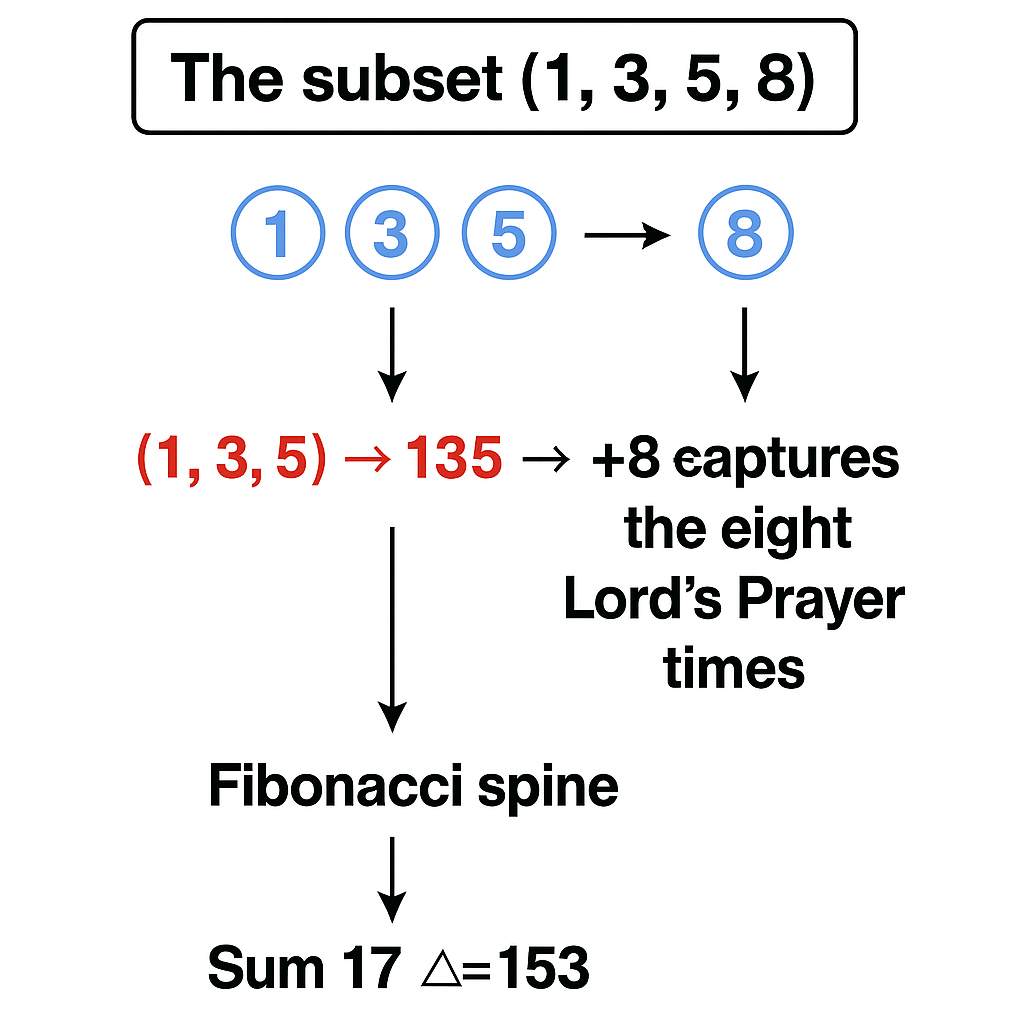
The identifier for the Lord’s Prayer (Luke 11:2–4) is 168.
5.2 Meaning
Thus, the inner life of Psalm 118 (its totient) = twelve cycles of the Lord’s Prayer.
Theologically:
Psalm 118 is the architectural praise;
the Lord’s Prayer is its daily covenant rhythm.
5.3 The Central Identifier: 153
Psalm 118:16 (the Right Hand verse) has identifier:
19 + 118 + 16 = 153
The same number appears in John 21:11, the miraculous catch of 153 fish.
This creates a prophetic–numerical bridge:
- Psalm 118:16 → the proclamation of the Right Hand
- John 21:11 → the manifestation of the Right Hand (the risen Christ)
6. Psalm 118 and the Lord’s Prayer: A Structural Mapping
| Psalm 118 Theme | Verses | Lord’s Prayer Petition | Theological Parallels |
|---|---|---|---|
| God’s enduring mercy | 1–4 | Our Father… hallowed be Your Name | Sanctification of the divine Name |
| Deliverance & trust | 5–9 | Your kingdom come; Your will be done | Divine rule replacing fear |
| Strength & salvation | 10–14 | Give us this day our daily bread | God sustains after deliverance |
| Gates of righteousness | 15–21 | Forgive us our sins… | Forgiveness opens covenant access |
| The Cornerstone | 22–25 | Deliver us from evil | Christ overcomes rejection and evil |
| Final doxology | 26–29 | Yours is the kingdom… | Eternal praise and covenant completion |
Psalm 118 contains the grand architecture;
the Lord’s Prayer delivers its distilled essence.
7. The Personal Dimension of Covenant Renewal
Psalm 118 is not only national and messianic—it is deeply personal.
7.1 The Psalmist’s Human Weakness
The psalmist confesses:
- distress (v. 5)
- fear (v. 6)
- falling (v. 13)
This mirrors Paul’s confession:
“The spirit is willing, but the flesh is weak.” (Matt 26:41)
7.2 The Right Hand Lifts the Fallen
Psalm 118:16 proclaims God’s strength, not ours.
Just as Peter—weak, impulsive, and fallen—was restored by Christ in John 21,
the believer finds that:
- we stumble daily,
- but His mercy endures daily,
- and His Right Hand lifts us daily.
7.3 Covenant Renewal for the Sinner
The refrain “His mercy endures forever” becomes the daily confession of the imperfect disciple.
Every time the believer prays the Lord’s Prayer,
every time he or she repents and returns,
Psalm 118 becomes personally true:
“Open to me the gates of righteousness;
I shall enter and give thanks.” (v. 19)
8. Psalm 118, John 21, and the Right Hand of God
The command in John 21:6—
“Cast the net on the right side”—
is deliberate theological symbolism.
- The right side corresponds to the Right Hand of God, the position of strength and favor (Ps 16:11; Ps 110:1).
- The full catch of 153 fish manifests the power proclaimed in Psalm 118:16.
- The unbroken net symbolizes the wholeness and security of the redeemed Church.
Thus, Christ—exalted to the Right Hand—fulfills the psalm by gathering the fullness of His people.
9. Conclusion
Psalm 118 is the Song of Final Victory because it celebrates the ultimate triumph of God’s Right Hand—fulfilled in Christ’s resurrection.
It is the Song of the Renewed Covenant because it was sung at the Last Supper, the threshold of the New Covenant.
Numerically, its inner life (2016) consists of twelve cycles of the Lord’s Prayer, and its centre (153) points directly to the risen Christ.
Personally, it is the song of every believer who:
- knows weakness,
- stumbles often,
- cries out in distress,
- rises by mercy,
- walks through the gates of righteousness,
- and gives thanks from the depths of a humbled heart.
Thus, Psalm 118 teaches us:
The flesh is weak,
but the Right Hand of the LORD does valiantly.
And therefore:
Give thanks to the LORD, for He is good;
His mercy endures forever.
Appendix A: Key Hebrew Terms
| Hebrew | Gematria | Transliteration | Meaning |
|---|---|---|---|
| יְמִין יְהוָה | 136 | yemîn YHWH | Right Hand of YHWH |
| חֶסֶד | 72 | ḥesed | Steadfast covenant-love, mercy |
| יָשׁוּעָה | 391 | yeshu‘ah | Salvation; root of “Yeshua” |
| אֶבֶן מָאֲסוּ הַבּוֹנִים | 273 | ʾeven maʾasu habbonîm | The stone the builders rejected |
Astonishingly, there are approximately 153 prime numbers less than or equal to 872, the sum of the alphanumeric values given in the table, that is, 136 + 72+391+273 = 872.
Appendix B: Identifier and Totient Calculations
Psalm 118: Identifier = 19 + 118 + verse number
Total: 4408
Euler’s Totient:
φ(4408) = 2016 = 168 × 12
Lord’s Prayer (Luke 11:2–4):
Sum of Identifiers = 168
Psalm 118:16 Identifier = 153


 The Lord's Prayer: A Mathematician's Creed