
Biblical Mathematics is a Christ-centered discipline in which, beginning from the axiom that Jesus Christ came in the flesh, defined mathematical methods are applied to Scripture and its numerical structures, and the results are accepted only if they remain consistent with that axiom and lead toward obedience to God.
This approach aims to highlight the internal coherence of the Bible. In particular, it supports the view that the Lord’s Prayer functions as a succinct and theologically concentrated summary of the Gospel of Jesus Christ, gathering into brief form many of the central themes of Jesus’ teaching and, more broadly, of the biblical message.

Axiom 1:1 Jesus Christ came in the flesh
1 John 4:1-3: Beloved, believe not every spirit, but try the spirits whether they are of God: because many false prophets are gone out into the world. 2 Hereby know ye the Spirit of God: Every spirit that confesseth that Jesus Christ is come in the flesh is of God: 3 And every spirit that confesseth not that Jesus Christ is come in the flesh is not of God: and this is that spirit of antichrist, whereof ye have heard that it should come; and even now already is it in the world.
Definition
Biblical Mathematics is the disciplined application of defined mathematical methods to the text, structure, and numerical features of Scripture, under ordinary mathematical reasoning and Axiom 1.1, in order to derive and evaluate results that are scripturally coherent and directed toward obedience to God.
Framework
The framework (see figure below) gives Biblical Mathematics both its doctrinal boundary and its intended spiritual outcome. Axiom 1.1 supplies the christological center of the framework, ensuring that acceptable results do not contradict the incarnation or the character of God revealed in Scripture. Deuteronomy 29:29 supplies the intended end of the framework, namely that what is revealed should lead to faithful obedience rather than mere curiosity or speculative numerology. Accordingly, a proposed mathematical result is not accepted simply because it is numerically interesting; it must also be scripturally coherent, consistent with Axiom 1.1, and spiritually edifying in the sense of Deuteronomy 29:29. In this way, the framework serves as a necessary filter that separates meaningful results from arbitrary or nonsensical ones.

Fig. 1:1 Let be a proposed result of Biblical Mathematics, such as a definition, lemma, theorem, corollary, or conjecture. The result is acceptable only if it is numerically sound, consistent with Axiom 1.1 (“Jesus Christ came in the flesh,” in the sense of 1 John 4), and directed toward the revealed end of Deuteronomy 29:29, namely obedience to God. Any result falling outside these conditions is rejected. This figure therefore functions as the governing filter of Biblical Mathematics.
Deuteronomy 29:29 The secret things belong unto the Lord our God: but those things which are revealed belong unto us and to our children for ever, that we may do all the words of this law.
The Three Main Methods of Biblical Mathematics
1. Method of Verse Identification
Let a verse in the Bible be identified by its canonical location ( 𝐵 , 𝐶 , 𝑉 ) , where 𝐵 is the book number, 𝐶 the chapter number, and 𝑉 the verse number. The verse identifier of that verse is defined by
I( 𝐵 , 𝐶 , 𝑉 ) = 𝐵 + 𝐶 + 𝑉
More generally, if 𝑄 is a set of verses, then the identifier of 𝑄 is the sum of the identifiers of all verses in 𝑄 . This identifier is not necessarily unique, but it provides a simple and useful numerical label for structural comparison.
For example, the identifier of the Lord’s Prayer in the Gospel of Luke is 168:
| Book | Chapter | Verse | Sum |
| 42 | 11 | 2 | 55 |
| 42 | 11 | 3 | 56 |
| 42 | 11 | 4 | 57 |
| 168 |
Similarly, the identifier of the Lord’s Prayer in the Gospel of Matthew is 285.
| Book | Chapter | Verse | Sum |
| 40 | 6 | 9 | 55 |
| 40 | 6 | 10 | 56 |
| 40 | 6 | 11 | 57 |
| 40 | 6 | 12 | 58 |
| 40 | 6 | 13 | 59 |
| 285 |
2. The Alphanumeric Method
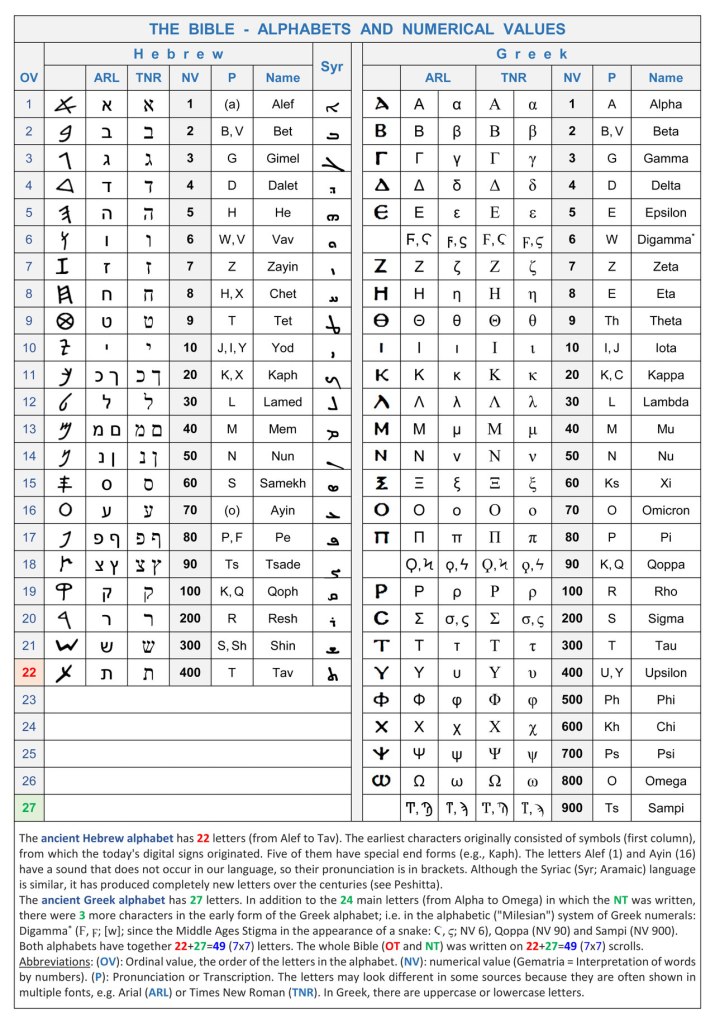
The second method in Biblical Mathematics is the use of well-known standard value of each Hebrew and Greek letter. The alphanumeric code of assigning a numerical value to a word, name, or phrase based on its letters is known as Gematria. Traditional Jewish Gematria focuses on the Hebrew language and is often used for interpreting Jewish texts, especially the Torah. The Greek alphabet, like the Hebrew, also has historical associations with numerical values. This system is known as Isopsephy in Greek. The assignment of numerical values to Greek letters allows for the practice of gematria with Greek words, which was used in various ancient Greek documents and inscriptions.
The following table, showing the Jewish Gematria and the Greek Isopsephy, is sourced from the website The Construction of the Menorah and the Bible.
Definition (Method of the Gematria)
The Method of Gematria assigns a numerical value to each letter of a Hebrew or Greek word and then adds those values together. The total is called the gematria of the word, phrase, or verse.
If is made up of letters , then its gematria is
where is the numerical value of the letter lk.
If two biblical expressions have the same gematria, this may point to a possible relationship between them. However, such a relationship is meaningful only if it is supported by scriptural context and by the framework of Biblical Mathematics.
Example (666)
One natural starting point for the Method of Gematria is Revelation 13:18, where the reader is expressly invited to calculate a number: “Let him that hath understanding count the number of the beast.” In the Greek manuscript tradition, given by
ὧδε ἡ σοφία ἐστίν. ὁ ἔχων τὸν νοῦν ψηφισάτω τὸν ἀριθμὸν τοῦ θηρίου· ἀριθμὸς γὰρ ἀνθρώπου ἐστί, καὶ ὁ ἀριθμὸς αὐτοῦ χξϛ,
the number 666 is represented by the numeral letters χξϛ, where χ = 600, ξ = 60, and ϛ = 6, so that χξϛ = 666. This is a notable feature of the verse, because it shows that numerical calculation is not being imposed upon the text from outside; rather, the text itself calls for it. For this reason, gematria— and, more precisely in Greek, isopsephy— provides a natural and legitimate point of departure for Biblical Mathematics, since it treats letters and words not only as carriers of meaning, but also as bearers of numerical value.
Example (153)
Simple
Both the New and Old Testaments have several words and expressions that carry the equivalent value of 153. For example, the expression “the Passover” in Hebrew is הַפֶּסַח. The value of each letter is: ה = 5, פ = 80, ס = 60, ח = 8. Hence, the sum is 153.
Mixture of both Advanced Mathematics and Gematria
The Hebrew phrase ישוע המשיח (read Yeshua HaMashiach) means “Jesus the Messiah“. Its value is 749, as shown below:
“ישוע” (Yeshua): י (Yod) = 10; ש (Shin) = 300; ו (Vav) = 6; ע (Ayin) = 70.
Hence, the sum is 10 + 300 + 6 + 70 = 386.
“המשיח” (HaMashiach): ה (He) = 5; מ (Mem) = 40; ש (Shin) = 300; י (Yod) = 10; ח (Chet) = 8.
Hence, the sum is 5 + 40 + 300 + 10 + 8 = 363.
Adding both sums together: 386 (Yeshua) + 363 (HaMashiach) = 749.
It is interesting that an estimation of the Prime Pi function at 749 is 135, a permutation of the numeral form of 153 referred to in John 21:11:
So Simon Peter climbed back into the boat and dragged the net ashore. It was full of large fish, 153, but even with so many the net was not torn.
It is also intriguing that another permutation of the digits of 153 is the isopsephy of the 7-letter word “ἰάσπιδι” (iaspidi), which means “jasper”, that describes the man who “sat on the throne” in Revelation 4:2-3 (KJV):
2 And immediately I was in the spirit: and, behold, a throne was set in heaven, and one sat on the throne. 3 And he that sat was to look upon like a jasper and a sardine stone: and there was a rainbow round about the throne, in sight like unto an emerald.
Using the standard alphabetic numeration of the Greek alphabet ( ἰ=10, ά=1, σ=200, π=80, ι=10, δ=4, ι=10 ), we find that the numerical value of “ἰάσπιδι” is 315. Hence, the one who sat on a throne is associated with the number 315. (Was it Jesus Christ who John the Apostle saw in his vision at Patmos, the one who sat on the throne, who looked like a jasper?)
Our book, The Lord’s Prayer: A Mathematician’s Creed, is all about an interpretation of John 21:11 and the number 153. The astonishing discovery about the number 153 is that it points to the Lord’s Prayer. Indeed, there are 6 permutations of {1, 5, 3}, namely, {1,3,5}, {1,5,3}, {3,1,5}, {3,5,1}, {5,1,3}, {5,3,1}. The digits of the permutations, in turn, produce the numerals in the following set:{135, 153, 315, 351, 513, 531}. The sum is 1988. There are 16 divisors of 1988, given in the set {1, 2, 3, 6, 9, 18, 27, 37, 54, 74, 111, 222, 333, 666, 999, 1998}. The sum is is 4560. Therefore, the arithmetic mean of the divisors is 4560/16=285. But as shown above in the second table, the number 285 is the identifier for the Lords’Prayer in the Gospel of Matthew.
In our book, we show that Jesus Christ died at precisely 3.15pm and His chest was pierced at precisely 5.31pm before Sabbath. Based on these, the time-equivalents of {135, 153, 315, 351, 513, 531} are therefore the elements of the following set {1.35pm, 1.53pm, 3.15pm, 3.51pm, 5.13pm, 5.31pm}. According to the Bible, Jesus Christ hung on the cross from 9am and was taken down before Sabbath. Therefore, in the 12-hour format, the only possible times with the digits {1,5,3} are in the set:
{10.35am, 10.53am, 1.35pm, 1.53pm, 3.15pm, 3.51pm, 5.13pm, 5.31pm}
These therefore are the eight daily prayer times of the Lord’s Prayer, and the numbers in the set {135, 153, 315, 351, 513, 531} indicate the Lord’s Prayer.
Richard Bauckham’s 2002 paper The 153 Fish and the Unity of the Fourth Gospel in the journal “Neotestamentica” marked a notable point in the discussion of gematria within biblical scholarship. Bauckham, a respected New Testament scholar, suggested that numerical techniques, including gematria, were more prevalent in biblical texts than previously acknowledged by mainstream scholarship:
NT scholars have rarely taken seriously the use of numerical techniques of literary composition by NT authors, but the evidence is mounting that such techniques were used in biblical and related literature. Three such techniques have been identified: (1) The best known is gematria, involving Hebrew or Greek letters. (In Hebrew and Greek the letters of the alphabet also serve as numerals, and so every word has a numerical value which is the sum of the numerical values of its letters.) (2) Another technique is the measurement of sections by counting the syllables or words. (3) The number of occurrences of a particular word within a literary work (or section of one) may be significant. Such techniques can be combined.
Bauckham’s work contributed to a broader recognition and discussion of these methods within academic circles. It suggested a more complex and nuanced understanding of the composition of biblical texts, proposing that authors might have employed these methods as part of their literary and theological expression.
Note though that traditional historical-critical methods and literary analysis remain the predominant tools for biblical interpretation in academic settings. Gematria and related techniques are often viewed more as a part of the history of interpretation or as ancillary to the main methods of textual analysis.
3. Biblical Numerology
Biblical Numerology is the interpretive study of the possible meaning or significance of a number on the basis of its repeated occurrence, thematic association, or prominent use in Scripture. Some numbers appear explicitly in the biblical text; these may be called biblical numbers. Over time, several writers have sought to study such numbers systematically. Ivan Panin (1855–1942) is widely associated with the numerical study of Scripture, especially its structural patterns, while notable studies on the symbolic meaning of numbers were produced by E. W. Bullinger (1837–1913) and Ed F. Vallowe (1919–2002). A more recent and accessible treatment is Stephen E. Jones’ The Biblical Meaning of Numbers from One to Forty (2008), which builds on earlier work by Bullinger and Vallowe. In the present work, when we refer to biblical numbers, we shall generally mean those numbers defined and expounded in Jones’ 2008 publication.
Biblical Numerology, as used here, does not assign meanings to numbers arbitrarily, but seeks meanings that arise from Scripture itself through repeated biblical usage and theological coherence.
[1] I. Panin. The Structure of the Bible: A Proof of the Verbal Inspiration of Scripture, Gospel of Christ Print, 1891. [2] E. W. Bullinger. Number in Scripture: Its Supernatural Design and Spiritual Significance, 4th Ed., Eyre & Spottiswoode, London, 1921. [3] Ed F. Vallowe, Biblical Mathematics: Keys to Scripture Numerics, Ed F. Evangelist Society, 1984 [4] S. E. Jones. The Biblical Meaning of Numbers from One to Forty, God’s Kingdom Ministries, Minnesota, USA, 2008.
Dr. Jito Vanualailai
 The Lord's Prayer: A Mathematician's Creed