How Do We Seek First the Kingdom of God and His Righteousness?

Matthew 6:33 gives us a powerful passage, for it tells us what to do in order to receive all what we need in this earthly life:

33 But seek ye first the kingdom of God, and his righteousness; and all these things shall be added unto you.

How do we seek first the Kingdom of God and His righteousness?

The context of this statement is given in Matthew 6:25-34:

Do Not Worry

25 Therefore I say unto you, Take no thought for your life, what ye shall eat, or what ye shall drink; nor yet for your body, what ye shall put on. Is not the life more than meat, and the body than raiment? 26 Behold the fowls of the air: for they sow not, neither do they reap, nor gather into barns; yet your heavenly Father feedeth them. Are ye not much better than they? 27 Which of you by taking thought can add one cubit unto his stature? 28 And why take ye thought for raiment? Consider the lilies of the field, how they grow; they toil not, neither do they spin:

29 And yet I say unto you, That even Solomon in all his glory was not arrayed like one of these. 30 Wherefore, if God so clothe the grass of the field, which to day is, and to morrow is cast into the oven, shall he not much more clothe you, O ye of little faith? 31 Therefore take no thought, saying, What shall we eat? or, What shall we drink? or, Wherewithal shall we be clothed? 32 (For after all these things do the Gentiles seek:) for your heavenly Father knoweth that ye have need of all these things.

33 But seek ye first the kingdom of God, and his righteousness; and all these things shall be added unto you.

34 Take therefore no thought for the morrow: for the morrow shall take thought for the things of itself. Sufficient unto the day is the evil thereof.

The Expanded Bible version expounds on God’s righteousness as what God wants us to do:

33 ·Seek first [Be concerned above all else with] God’s kingdom and ·what God wants [ his righteousness]. Then all ·your other needs will be met as well [ these things will be given to you].

GREEK VALUE ENGLISH
ζητειτε 635 Seek
δε 9 however
πρωτον 1400 first
την 358 the
βασιλειαν 309 kingdom
του 770 of
θεου 484 God
και 31 and
την 358 the WHAT 358
δικαιοσυνην 823 righteousness GOD 1181
αυτου 1171 of Him, WANTS 2352
και 31 and
ταυτα 1002 these
παντα 432 things
προστεθησεται 1288 will be added
υμιν 500 to you

The value of “His Righteousness”- what God wants – is 2352, and 2352 = 168 x 14, where 168 is the Lord’s Prayer in the Gospel of Luke.

168

And when we analyze the component, “the Kingdom of God”, we get the value 358+309+770+484=1921. It has 4 divisors, namely, {1, 17, 113, 1921}. The sum of divisors is 2052. Hence, the Arithmetic Mean of 1921 is 2052/4=513, the digits of which produce a permutation {1,5,3}. Thus, we get back the Lord’s Prayer prayer times.

Conclusion: The Lord’s Prayer is a means to seek first the kingdom of God and His righteousness.
Take My Yoke Upon You

In Matthew 11:28 – 30, we read:

28 Come unto me, all ye that labour and are heavy laden, and I will give you rest.

29 Take my yoke upon you, and learn of me; for I am meek and lowly in heart: and ye shall find rest unto your souls.

30 For my yoke is easy, and my burden is light.

These passages aptly describe the high standard of humanity and care of Jesus Christ. And for those who believe in Him, it is just a matter of taking on His yoke to lighten any heavy burden we may have in our lives and in our daily struggle with sin.

The pertinent question is then:    After we have accepted Him in our life, how do we take His yoke upon us?

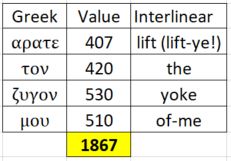
Biblical Mathematics provides a clear answer. If we take the original Greek text of “Take my yoke” in Matthew 11:29, its value is 1867.
yoke2
1867 is a prime number.  It is the 285th  prime number.   But 285 is precisely the identifier of Matthew 6:9-13:
 
 9 After this manner therefore pray ye: Our Father which art in heaven, Hallowed be thy name. 10 Thy kingdom come, Thy will be done in earth, as it is in heaven. 11 Give us this day our daily bread. 12 And forgive us our debts, as we forgive our debtors. 13 And lead us not into temptation, but deliver us from evil: For thine is the kingdom, and the power, and the glory, for ever. Amen.
 
The identifier of the Lord’s Prayer in Matthew 6:9 – 13 is 285
Book
Chapter
Verse
Sum
40
6
9
55
40
6
10
56
40
6
11
57
40
6
12
58
40
6
13
59
Total
285
CONCLUSION:   It is through the Lord’s Prayer that we take the yoke of our Lord and Savior Jesus Christ upon us!
 

The Prince of Peace of Isaiah 9.6

In Isaiah 9.6, we read (NIV):

For to us a child is born,
    to us a son is given,
    and the government will be on his shoulders.
And he will be called
    Wonderful Counselor, Mighty God,
    Everlasting Father, Prince of Peace.

The Hebrew version of Isaiah 9.6 yields the numerical value of 876 corresponding to “Prince of Peace.”

Prince_Peace

Using the Method of the Prime developed in our book (e-version), we see that the 876th prime number is 6803, which turns out to be the numerical equivalent of only two verses in the Bible: incredibly, Mark 10:47 and Luke 23:30.

47 When he heard that it was Jesus of Nazareth, he began to shout, “Jesus, Son of David, have mercy on me!”  (Mark 10:47, NIV)

30 Then “‘they will say to the mountains, “Fall on us!” and to the hills, “Cover us!”’ (Luke 23:30)

The first verse shows who the Prince of Peace is, and the event linked to the second verse shows why he is “prince” or “chief” of peace.

In Mark 10:47, the person acknowledging Jesus was a blind man, as we can gather from the neighboring verses:

46 Then they came to Jericho. As Jesus and his disciples, together with a large crowd, were leaving the city, a blind man, Bartimaeus (which means “son of Timaeus”), was sitting by the roadside begging. 47 When he heard that it was Jesus of Nazareth, he began to shout, “Jesus, Son of David, have mercy on me!”

48 Many rebuked him and told him to be quiet, but he shouted all the more, “Son of David, have mercy on me!”

49 Jesus stopped and said, “Call him.”

So they called to the blind man, “Cheer up! On your feet! He’s calling you.” 50 Throwing his cloak aside, he jumped to his feet and came to Jesus.

51 “What do you want me to do for you?” Jesus asked him.

The blind man said, “Rabbi, I want to see.”

52 “Go,” said Jesus, “your faith has healed you.” Immediately he received his sight and followed Jesus along the road.

Even the blind could “see” that the Prince of Peace of Isaiah 9.6 was “Jesus, the Son of David!”

Luke 23:30 is referring to the most important event in Jesus life, namely, His crucifixion. With Jesus’ death and resurrection, our fears in death are removed and replaced with the gift of internal life, as the Apostle Paul wrote in Romans 6:23:

23 For the wages of sin is death, but the gift of God is eternal life in Christ Jesus our Lord.

Jesus is the Prince of Peace because He alone is able to offer assurance of eternal life.

Did God Harden Pharaoh’s Heart?

In Exodus 7:3-4, we read (KJV):

3 And I will harden Pharaoh’s heart, and multiply my signs and my wonders in the land of Egypt. 4 But Pharaoh shall not hearken unto you, that I may lay my hand upon Egypt, and bring forth mine armies, and my people the children of Israel, out of the land of Egypt by great judgments.

Did God harden Pharaoh’s heart? Yes, He did.

However, verse 4 alludes to the fact that it is not in a manner understood by some, namely, that God violated free will and He was therefore unjust in punishing Pharaoh and Egypt.  Indeed, verse 3 means entirely the opposite of this faulty understanding.

Reading the entire chapter 7 and chapter 8, we realize that it was Pharaoh himself who hardened his heart. God knew Pharaoh would harden his heart. God would allow this to happen, just as He allows those who wants only to do evil continue their sinful ways (Romans 1: 24 – 32). God’s pronouncement in verse 3 “And I will harden Pharaoh’s heart” does not negate at all, or contradict, God’s intention to allow Pharaoh to continue with his wish; but rather it actually magnifies God’s intention, as we can conclude from Exodus 7:14, which does not make sense if God had actually hardened Pharaoh’s heart:

14 Then the Lord said to Moses, “Pharaoh’s heart is unyielding; he refuses to let the people go.

Biblical Mathematics unequivocally supports this view point. To determine God’s true intention when he proclaimed  “And I will harden Pharaoh’s heart” in Exodus 7:3, we look at the proclamation’s numerical equivalence. It is 1261.

1261

But the value 1261 refers to only two other verses in the Bible; Numbers 10:23 and Job 34:16. Of these, Job 34:16 (underlined below),  stunningly, in context, refers the true nature of God. He does no evil and does no wrong (Job 34:10) and does not pervert justice (Job 34:12).  He is not unjust!  Moreover, Job 34 reveals the true intention of God, namely, He will not destroy for its own sake (Job 34: 14-15) but He will “repay everyone for what they have done; He brings on them what their conduct deserves” (Job 34: 11), implying He will not interfere with free will:

10 “So listen to me, you men of understanding.
    Far be it from God to do evil,
    from the Almighty to do wrong.
11 He repays everyone for what they have done;
    he brings on them what their conduct deserves.
12 It is unthinkable that God would do wrong,
    that the Almighty would pervert justice.
13 Who appointed him over the earth?
    Who put him in charge of the whole world?
14 If it were his intention
    and he withdrew his spirit and breath,
15 all humanity would perish together
    and mankind would return to the dust.

16 “If you have understanding, hear this;
    listen to what I say.
17 Can someone who hates justice govern?
    Will you condemn the just and mighty One?
18 Is he not the One who says to kings, ‘You are worthless,’
    and to nobles, ‘You are wicked,’
19 who shows no partiality to princes
    and does not favor the rich over the poor,
    for they are all the work of his hands?

What Did Jesus Write on the Ground?

One of the most intriguing episodes in the Bible is the story of what Jesus did when He was confronted by the teachers of the law and the Pharisees who brought in a woman caught in adultery, demanding to know Jesus’ stance with respect to a Mosaic law that calls for death in such a situation.

The episode is narrated in John 8: 4 – 11 (KJV):

4 They say unto him, Master, this woman was taken in adultery, in the very act.

5 Now Moses in the law commanded us, that such should be stoned: but what sayest thou?

6 This they said, tempting him, that they might have to accuse him. But Jesus stooped down, and with his finger wrote on the ground, as though he heard them not.

7 So when they continued asking him, he lifted up himself, and said unto them, He that is without sin among you, let him first cast a stone at her.

8 And again he stooped down, and wrote on the ground.

9 And they which heard it, being convicted by their own conscience, went out one by one, beginning at the eldest, even unto the last: and Jesus was left alone, and the woman standing in the midst.

10 When Jesus had lifted up himself, and saw none but the woman, he said unto her, Woman, where are those thine accusers? hath no man condemned thee?

11 She said, No man, Lord. And Jesus said unto her, Neither do I condemn thee: go, and sin no more.

We therefore come to a very fascinating issue:   What did Jesus write on the ground? Here we put forth the argument that what Jesus wrote was a portion of His very own Prayer.

Using the Method of the Verse Identification (MVI) expounded in the book, let us look at the identity of the verses from 4 to 11, which provides a precise synopsis of the story of  the adulterous woman.

Book# Chapter# Verse# SUM TOTAL
43 8 4 55 55
43 8 5 56 111
43 8 6 57 168
43 8 7 58 226
43 8 8 59 285
43 8 9 60 345
43 8 10 61 406
43 8 11 62 468

And here we stumble across one of the most fascinating results of Biblical Mathematics.  The 6th verse and 8th verse read:

6 This they said, tempting him, that they might have to accuse him. But Jesus stooped down, and with his finger wrote on the ground, as though he heard them not.

8 And again he stooped down, and wrote on the ground.

The identifier of the verses up to the 6th verse is 168 and that of the verses up to the 8th verse is 285.

But 168 is the identifier of the Lord’s Prayer in the Gospel of Luke, and the 285 is the identifier of the Lord’s Prayer in the Gospel of Matthew!

Identifier of the Lord’s Prayer in Luke 11:2-4 is 168

Book#

Chapter# Verse# SUM
42 11 2 55
42 11 3 56
42 11 4 57
 

168

Identifier of the Lord’s Prayer in Matthew 6:9-13 is 285

Book Chapter Verse SUM
40 6 9 55
40 6 10 56
40 6 11 57
40 6 12 58
40 6 13 59
  285

CONCLUSION:   The only logical conclusion is that Jesus wrote the following:

  1. The first time He stooped down (John 8:6), He wrote:  “Forgive us our sins.”
  2. The second time He stooped down (John 8:8), He wrote: “As we forgive those who sinned against us.”

If one of the teachers of the law or Pharisees had bothered to read what Jesus had written, he would have come to realize that he was looking at the essence of the greatest prayer of all times, the prayer that is a mini-Gospel of Jesus Christ containing the Great Commandment of Jesus Christ:

“You shall love the Lord your God with all your heart and with all your soul and with all your mind. This is the great and first commandment. And a second is like it: You shall love your neighbor as yourself. On these two commandments depend all the Law and the Prophets.”  (Matthew 22:37-40).

For he who forgives seeks love (Proverbs 17:9):

9 He that covereth a transgression seeketh love; but he that repeateth a matter separateth very friends.

And in love, there is forgiveness (1 Peter 4:8):

8 And above all things have fervent charity among yourselves: for charity shall cover the multitude of sins.

Jesus Christ was telling the teachers of the law and Pharisees to follow His Great Commandment on which hangs all the Mosaic law and what the prophets have said!

If we love Jesus Christ (and therefore His Father), we follow His commandments (John 14:15) by daily repentance (Matthew 4:17) and denial of self (Matthew 16:24). Hence, the necessity to petition the Father to forgive us our sins.  And by forgiving those who sinned against us, we seek love (Proverbs 17:9).