The Lord Remembers Us in Our Wretched State

In Psalm 136:23, we read “The Lord remembered us in our wretched state, for his love endures forever.”

Since the Book of Psalms is the 19th book of the Bible, the identifier of Psalm 136:23 is 19+136+23=178.

The 178th prime number is 1061. Therefore the divisors of 1061 are the just the numbers 1 and 1061. The arithmetic mean of 1061 is therefore (1+1061)/2=531.

Conclusion: When we pray the Lord’s Prayer, we petition our Father to remember us in our wretched state, knowing that His love endures forever.

Discussions

The Lord’s Prayer and Psalm 136:23 share a connection in their acknowledgment of God’s enduring love and faithfulness, particularly in times of need and humility.

Acknowledgment of God’s Care

  • Psalm 136:23 states, “He remembered us in our low estate; His love endures forever.” This verse reflects on God’s compassionate remembrance and care for us in times of need and humility.
  • The Lord’s Prayer includes petitions like “give us this day our daily bread,” which similarly acknowledges our dependence on God for provision and care.

Divine Faithfulness and Enduring Love

  • The recurring refrain in Psalm 136, “His love endures forever,” emphasizes the everlasting and steadfast nature of God’s love, a theme that underlies the entire prayer.
  • In the Lord’s Prayer, while God’s love is not mentioned explicitly, the very act of turning to God in prayer and seeking His will (“your will be done, on earth as it is in heaven”) and provision reflects a trust in His unwavering love and faithfulness.

Human Vulnerability and Divine Response

  • Psalm 136:23 specifically mentions God’s remembrance of us in our “low estate,” highlighting God’s attentiveness and response to human vulnerability and need.
  • The Lord’s Prayer addresses human vulnerability through requests for daily sustenance, forgiveness, and deliverance from evil, implying a trust in God’s response to our humble state.

Gratitude and Worship

  • Psalm 136 is a hymn of thanksgiving, expressing gratitude for God’s enduring love through the recounting of His deeds.
  • The Lord’s Prayer, while a petition, is also an act of worship, beginning with the acknowledgment of God’s holiness and ending with a doxology in some traditions, thus aligning with the spirit of gratitude and reverence found in Psalm 136.

In summary, both the Lord’s Prayer and Psalm 136:23 are linked by their recognition of God’s enduring love, care, and faithfulness, especially in response to human vulnerability and need, and both reflect an attitude of humble dependence and gratitude towards God.
Our Righteousness Is from Yahweh, the Lord our God

In Isaiah 54:17, we read

17 No weapon formed against you shall prosper,
And every tongue which rises against you in judgment
You shall condemn.
This is the heritage of the servants of the Lord,
And their righteousness is from Me,”
Says the Lord.

The following table provides the equivalent values of the words in the last two lines:

HebrewValueEnglish
וְצִדְקָתָ֛ם
wə-ṣiḏ-qā-ṯām
640and their righteousness [is]
מֵאִתִּ֖י
mê-’it-tî
451from Me
נְאֻם־
nə-’um-
91says
יְהוָֽה׃
Yah-weh.
26Yahweh
1208

The sum 1208 has 8 divisors {1, 2, 4, 8, 151, 302, 604, 1208}. The sum of the divisors is 2208, so that the Arithmetic Mean is 2280/8=285. But 285 is the identifier of the Lord’s Prayer in the Gospel of Matthew.

Book#Chapter#Verse#Sum
406955
4061056
4061157
4061258
4061359
285
The identifier of the Lord’s Prayer in Matthew 6:9 – 13 is 285

CONCLUSION: When we pray the Lord’s Prayer, we receive our righteousness from Yahweh, the Lord our God.

The Words of our Mouth and the Meditation of our Heart

In Psalm 19:12-14, we read:

12 Who can understand his errors? cleanse thou me from secret faults.

13 Keep back thy servant also from presumptuous sins; let them not have dominion over me: then shall I be upright, and I shall be innocent from the great transgression.

14 Let the words of my mouth, and the meditation of my heart, be acceptable in thy sight, O Lord, my strength, and my redeemer.

The Book of Psalms is the 19th book of the Bible. So the identifier of Psalm 19:12-14 is 153.

Book#Chapter#Verse#Sum
19191250
19191351
19191452
153

CONCLUSION: When we pray the Lord’s Prayer, we petition our Father to forgive our secret and presumptuous sins, and to let the words of our mouth and the meditation of our heart be acceptable in His sight,

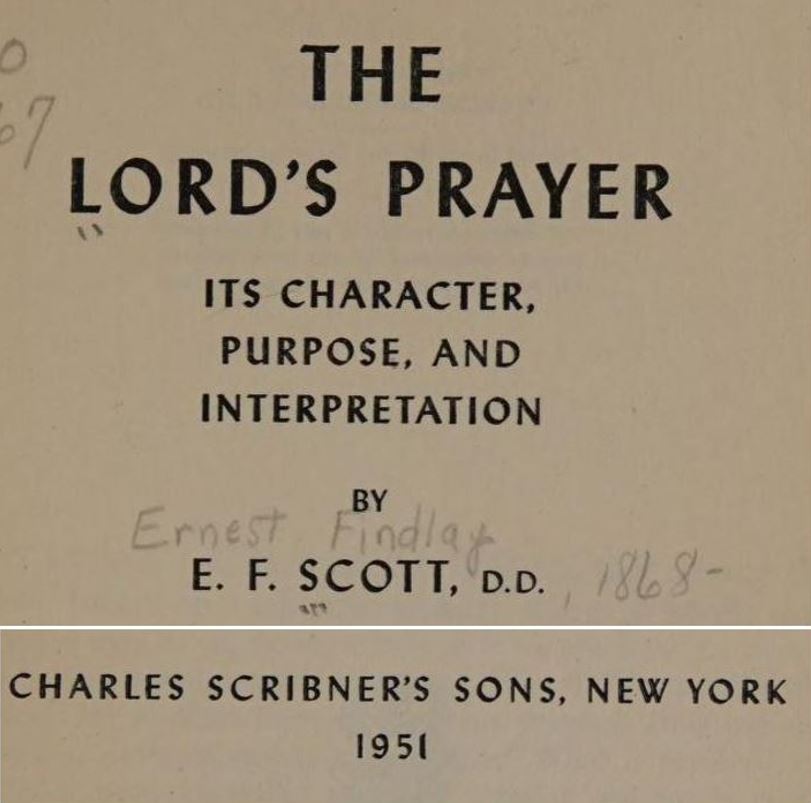
Quoting E. F. Scott, “The Lord’s Prayer: Its Character, Purpose, and Interpretation,” 1951

Two things in our religion have come to us directly from Jesus himself – the Lord’s Supper and the Lord’s Prayer. He bequeathed to them these two ordinances which they were to preserve just as they had come from his hands – the Supper which tells us what he did for us, and the Prayer which sums up what he taught us. These two acts of worship have a place by themselves in our religion, and are like the two poles of which it turns. A Christian service would be complete if it consisted only of an observance of the Supper and a repetition of the Lord’s Prayer. Between them they represent everything that we believe, and they are necessary to each other.  We cannot rightly say the Prayer without remembering the Cross, and we cannot celebrate the Supper unless we mean to follow the way of Jesus in our daily lives. In all times, men have been conscious that in these two gifts Jesus gave us everything, and the chief aim of Christian thought has been to discover the full significance of the Lord’s Supper and the Lord’s Prayer.

Ernest Findlay Scott (1868 – 1964) was “Professor Emeritus of Biblical Theology” of the Union Theological Seminary.

A Means to Fix Our Eyes on Jesus, the Author and Perfecter of Our Faith

Hebrews 12:1-4 give us the reasons to persevere in our fight against sin:

1 Therefore, since we are surrounded by such a great cloud of witnesses, let us throw off everything that weighs us down and the sins that so easily distract us and with perseverance run the race that lies ahead of us, 2 with our eyes fixed on Jesus, the author and perfecter of our faith. For the sake of the joy that lay before him, he endured the cross, ignoring its shame, and is now seated at the right hand of the throne of God.

3 Reflect on how he endured such great hostility from sinners so that you may not grow weary and lose heart. 4 In your struggle against sin, you have not yet resisted to the point of shedding your blood.

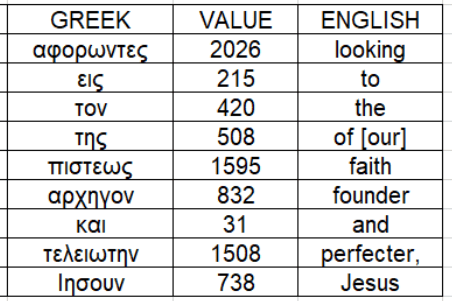
Verse 2 tells us how to persevere, and that is, by having our “eyes fixed on Jesus, the author and perfecter of our faith.” In the Greek version (Greek NT: Scrivener’s Textus Receptus 1894) the first 9 words correspond to “with our eyes fixed on Jesus, the author and perfecter of our faith.”

The total value is 7873, which is the 994th prime number. There are 167 prime numbers less than or equal to 994. The divisors of 167, which is also a prime number, are {1, 167}. Hence, the sum of divisors is 168, which is the identifier of the Lord’s Prayer in the Gospel of Luke.

SUMMARY: The Lord’s Prayer is a means to fix our eyes on Jesus, the author and the perfecter (finisher) of our faith.