“Take courage! It is I. Do not be afraid.”

At the time of writing of this article, on exhibition at the Museum of New Zealand (Te Papa Museum), Wellington, were giant wax figures of real men and women who served during the horrific Gallipoli military campaign in the First World War that took place on the Gallipoli peninsula (Gelibolu in modern Turkey), from 17 February 1915 to 9 January 1916.

The displays included war machines meant to maim and kill on one hand, and bunkers and every day survival kit meant to protect life to the maximum on the other hand. The exhibition told of the heroic New Zealanders who had to endure the unimaginable conditions at Gallipoli.

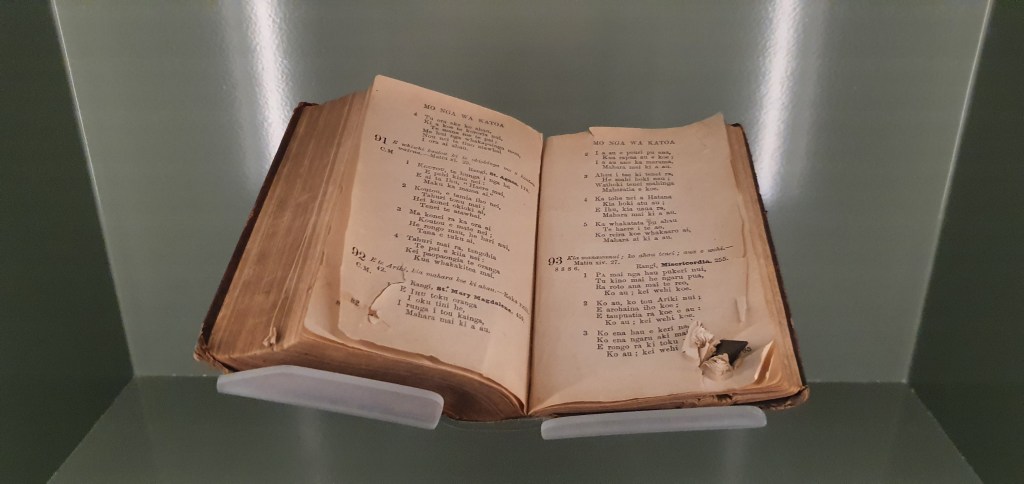
In an incredible story of survival, a Maori soldier, Private Hone Tahitahi, was thrown unconscious to the ground when a Turkish bullet hit him on the chest. At the point of impact, however, was a prayer book, presumably in Private Tahitahi’s shirt pocket. The prayer book was on display at the museum.

Picture of the Maori prayer book taken by the author on 22 August 2022 at the Te Papa Museum, Wellington, NZ

One can clearly see the bullet hole at the bottom right-hand corner. The bullet had gone through the prayer book at the page quoting Jesus’ words of encouragement in the biblical verse Matthew 14:27: “Take courage! It is I. Don’t be afraid.” The description of the display is as follows:

This prayer book saved the life of Private Hone Tahitahi literally. It stopped a Turkish bullet in its tracks. Tahitahi was struck above the chest and knocked unconscious. The bullet rested under this verse. ‘Take courage! It is I. Don’t be afraid.'”

Matthew 14:27 reads: But Jesus immediately said to them: “Take courage! It is I. Don’t be afraid.” In context, Jesus was reassuring His disciples, who were perturbed with fear when they saw Him walking on water.

GreekEnglishValue
Εὐθὺς
euthys
Immediately1014
δὲ
de
now9
ἐλάλησεν
elalēsen
spoke329
««ὁ
ho
70
Ἰησοῦς» ⇔
Iēsous
Jesus888
αὐτοῖς
autois
to them,981
λέγων
legōn
saying,888
Θαρσεῖτε,
Tharseite
Take courage!630
ἐγώ
egō
I808
εἰμι·
eimi
it is,65
μὴ
not48
φοβεῖσθε.
phobeisthe
fear.801
Values of the Greek words

The value of “Take courage! It is I. Do not be afraid.” is (630+808+65+48+801=2352). The Carmichael λ Function evaluated at 2352 is precisely 168, which is the identifier of the Lord’s Prayer in the Gospel of Luke.

We can hypothesize that since the book is a prayer book, it is must surely contain the Lord’s Prayer. Whether Private Tahitahi actually prayed the Lord’s Prayer when the bullet hit him, we will never know since the soldier had long passed on. But we can be certain that the soldier was very much afraid.

CONCLUSION. In times of fear, pray the Lord’s Prayer to find solace and peace.

Discussions

The link between the Lord’s Prayer and Matthew 14:27, where Jesus says, “Take courage! It is I. Don’t be afraid,” can be found in the themes of trust, divine presence, and reliance on God that permeate both.

  1. Invocation of God’s Presence: The Lord’s Prayer begins with “Our Father in heaven,” immediately invoking the presence of God. Similarly, in Matthew 14:27, Jesus’ assurance, “It is I,” is a declaration of His presence. In both instances, the presence of God or Jesus brings comfort and a sense of security.
  2. Reliance on God in Times of Need: The Lord’s Prayer includes requests for daily needs, forgiveness, and deliverance from evil. This reflects a reliance on God for both physical and spiritual sustenance. In Matthew 14:27, Jesus’ command to “take courage” and not be afraid is a call to trust in Him during challenging or frightening situations, mirroring the trust we express in the Lord’s Prayer.
  3. The Theme of Fearlessness: “Do not be afraid” in Matthew 14:27 is a direct command to cast aside fear because of Jesus’ presence. The Lord’s Prayer, while not explicitly mentioning fear, is an exercise in casting our cares and concerns upon God, implying a release of fear and anxiety as we depend on Him for “our daily bread,” forgiveness, and protection from evil.
  4. Manifestation of God’s Kingdom: The Lord’s Prayer seeks the establishment of God’s Kingdom on Earth as it is in Heaven. Jesus calming the storm and His presence with the disciples in Matthew 14 is a demonstration of the Kingdom of God in action—where fear is replaced with peace, and turmoil is calmed by His word.

In essence, both the Lord’s Prayer and Jesus’ words in Matthew 14:27 encourage believers to find courage and peace in the presence and providence of God, trusting in His sovereignty over all aspects of life.

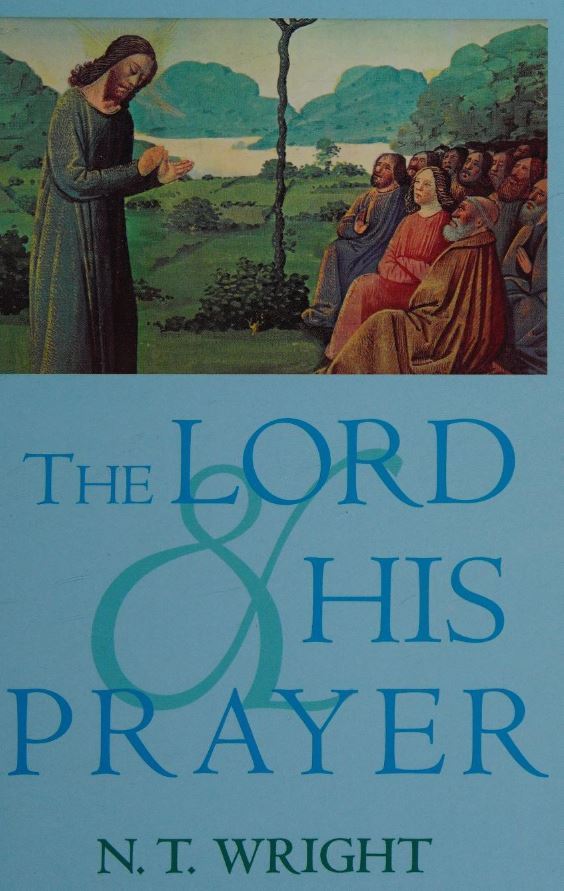
Quoting N. T. Wright, “The Lord & His Prayer”, 1996

We live, as Jesus lived, in a world all too full of injustice, hunger, malice and evil. This prayer cries out for justice, bread, forgiveness and deliverance. If anyone thinks those are irrelevant in today’s world, let them read the newspaper and think again.

The more I studied Jesus in his historical setting, the more it has become clear to me that this prayer sums up fully and accurately, albeit in a very condensed fashion, the way in which he read and responded to the signs of the times, the way in which he understood his own vocation and mission and invited his followers to share it. This prayer, then, serves as a lens through which to see Jesus himself, and to discover something of what he was about.

Nicholas Thomas Wright (born 1 December 1948), known as N. T. Wright, is an English New Testament scholar, is one of the world’s leading Bible scholars. He is research professor emeritus of New Testament and early Christianity at the University of St. Andrews and senior research fellow at Wycliffe Hall, Oxford.

Choosing the Way of Faithfulness and Setting Our Heart on His Laws

In Psalm 119:30, we read (NIV)

I have chosen the way of faithfulness;
    I have set my heart on your laws

Since the Book of Psalm is the 19th book of the Bible, the identifier of Psalm 119:30 is 19+119+30=168, which is also the identifier of the Lord’s Prayer in the Gospel of Luke.

Conclusion: The Lord’s Prayer is the foremost petition to the Father to help us choose the way of faithfulness and set our heart on His Son’s Greatest Commandment:

Matthew 22: 36-40

36 “Teacher, which is the greatest commandment in the Law?”

37 Jesus replied: “‘Love the Lord your God with all your heart and with all your soul and with all your mind.’ 38 This is the first and greatest commandment. 39 And the second is like it: ‘Love your neighbor as yourself.’ 40 All the Law and the Prophets hang on these two commandments.”

Jesus, the Light of the World

In John 8:12, we read:

12 Then Jesus spoke to them again, saying, “I am the light of the world. He who follows Me shall not walk in darkness, but have the light of life.”

The Greek for “I am the Light of the World” has the value 4,313, as shown in the following table.

GREEKENGLISHGREEK VALUE
Ἐγώ
Egō
I808
εἰμι
eimi
am65
τὸ
to
the370
φῶς
phōs
light1500
τοῦ
tou
of the770
κόσμου·
kosmou
world;800
4313

There are 590 prime numbers less than or equal to 4313. There are 8 divisors of 590, namely, {1, 2, 5, 10, 59, 118, 295, 590}. The sum of the divisors is 1080. So, the arithmetic mean of 590 is 1080/8 = 135.

Conclusion. When we pray the Lord’s Prayer, we acknowledge that Jesus Christ is the Light of the World.

Overcoming Temptation Through the Lord’s Prayer

The Gospels’ account of Jesus’ temptations by Satan and how He overcomes them during His 40 days and nights of fasting in the Judaean Desert reveals to us practical ways to overcome our own temptations. Among the three Gospels that provide the account – Matthew, Mark and Luke – the narration in Mark is a single-sentence report of the incidence (Mark 1:12-13 12 At once the Spirit sent him out into the wilderness, 13 and he was in the wilderness forty days, being tempted by Satan. He was with the wild animals, and angels attended him.) The detailed account of how Jesus repels Satan are given in the Gospels of Matthew and Luke.

Matthew 4: 1 – 11

Then Jesus was led up by the Spirit into the wilderness to be tempted by the devil. And when He had fasted forty days and forty nights, afterward He was hungry. Now when the tempter came to Him, he said, “If You are the Son of God, command that these stones become bread.”

But He answered and said, “It is written, ‘Man shall not live by bread alone, but by every word that proceeds from the mouth of God.’ ”

Then the devil took Him up into the holy city, set Him on the pinnacle of the temple, and said to Him, “If You are the Son of God, throw Yourself down. For it is written:

‘He shall give His angels charge over you,’

and,

‘In their hands they shall bear you up,

Lest you dash your foot against a stone.’ ”

Jesus said to him, “It is written again, ‘You shall not tempt the Lord your God.’ ”

Again, the devil took Him up on an exceedingly high mountain, and showed Him all the kingdoms of the world and their glory. And he said to Him, “All these things I will give You if You will fall down and worship me.”

10 Then Jesus said to him, “Away with you, Satan! For it is written, ‘You shall worship the Lord your God, and Him only you shall serve.’ ”

11 Then the devil left Him, and behold, angels came and ministered to Him.

The verses 4, 7 and 10 are the responses that Jesus gave to repel Satan. Surprisingly, the sum of identifiers of these verses is exactly 153:

Matthew 4Book#Chapter#Verse#Sum
But He answered and said, “It is written, ‘Man shall not live by bread alone, but by every word that proceeds from the mouth of God.’ ”404448
Jesus said to him, “It is written again, ‘You shall not tempt the Lord your God.’ ”404751
10 Then Jesus said to him, “Away with you, Satan! For it is written, ‘You shall worship the Lord your God, and Him only you shall serve.’ ”4041054
153

Luke 4: 1 – 13

Then Jesus, being filled with the Holy Spirit, returned from the Jordan and was led by the Spirit into the wilderness, being tempted for forty days by the devil. And in those days He ate nothing, and afterward, when they had ended, He was hungry.

And the devil said to Him, “If You are the Son of God, command this stone to become bread.”

But Jesus answered him, saying, “It is written, ‘Man shall not live by bread alone, but by every word of God.’ ”

Then the devil, taking Him up on a high mountain, showed Him all the kingdoms of the world in a moment of time. And the devil said to Him, “All this authority I will give You, and their glory; for this has been delivered to me, and I give it to whomever I wish. Therefore, if You will worship before me, all will be Yours.”

And Jesus answered and said to him, “Get behind Me, Satan! For it is written, ‘You shall worship the Lord your God, and Him only you shall serve.’ ”

Then he brought Him to Jerusalem, set Him on the pinnacle of the temple, and said to Him, “If You are the Son of God, throw Yourself down from here. 10 For it is written:

‘He shall give His angels charge over you,

To keep you,’

11 and,

‘In their hands they shall bear you up,

Lest you dash your foot against a stone.’ ”

12 And Jesus answered and said to him, “It has been said, ‘You shall not tempt the Lord your God.’ ”

13 Now when the devil had ended every temptation, he departed from Him until an opportune time.

The identifiers of the verses 4, 8 and 12 corresponding to Jesus’ responses give the sum 162.

Luke 4Book#Chapter#Verse#Sum
But Jesus answered him, saying, “It is written, ‘Man shall not live by bread alone, but by every word of God.’ ”424450
And Jesus answered and said to him, “Get behind Me, Satan! For it is written, ‘You shall worship the Lord your God, and Him only you shall serve.’ ”424854
12 And Jesus answered and said to him, “It has been said, ‘You shall not tempt the Lord your God.’ ”4241258
162

Astonishingly, when we add 153 from the Gospel of Matthew to 162 from the Gospel of Luke, we get 315. We have therefore the direct proof that when we are tempted, we pray the MOST POWERFUL prayer that carries the POWER that Jesus has to repel Satan!

Conclusion. When we pray the Lord’s Prayer. we have the POWER of Jesus Christ to overcome temptation and repel Satan.