
Abstract
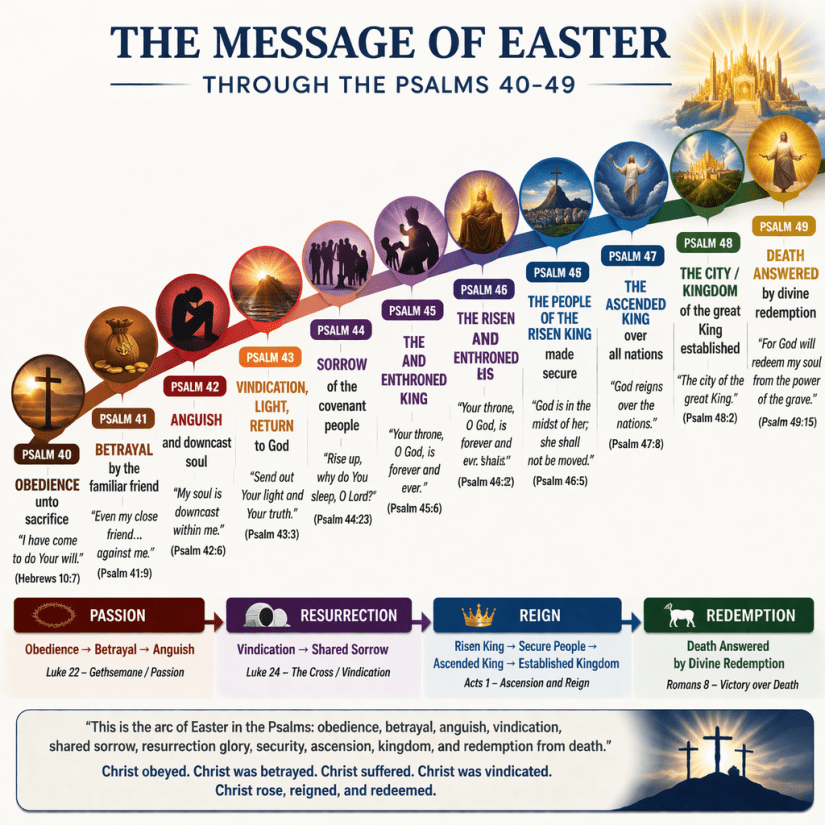
This paper argues that Psalms 40–49 may be read, from a Christian theological perspective, as a coherent Easter-shaped sequence. The movement begins with Psalm 40’s obedience to the will of God, passes through betrayal, anguish, vindication, and communal sorrow in Psalms 41–44, and then turns decisively in Psalms 45–49 toward resurrection glory, security, ascension, kingdom, and redemption from death. The argument is not that each psalm is an isolated predictive prophecy in the narrowest sense, but that taken together they form a canonical arc that aligns strikingly with the Passion, Resurrection, and Reign of Christ.
Within the framework of Biblical Mathematics, this sequence is further illuminated by the claim that the number 153 signifies the fulfillment of the will of the Father in His Son, and that the Lord’s Prayer is the foremost proclamation of faith in that fulfillment.
1. Introduction
The primary case for linking Psalms 40–49 to Easter is theological and textual. The numerical framework serves only as a confirming witness, never as the main engine of interpretation. In that spirit, this paper proceeds first by canonical and theological reading, and only then by modest numerical corroboration.
The central claim is that Psalms 40–49 form a sustained movement from willing obedience unto sacrifice to divine redemption over death. The sequence is not random. Psalm 40 is explicitly applied to Christ in Hebrews 10:5–10. Psalm 41 is applied by Jesus to the betrayal scene in John 13:18. Psalms 42–43 form a tightly linked pair of lament and hoped-for vindication. Psalm 44 broadens the suffering from the righteous individual to the covenant community. Psalm 45 is explicitly applied to the Son in Hebrews 1:8–9. Psalms 46–49 then unfold what may be called the consequences of Easter: security, reign, Zion, and redemption from Sheol.
Within the wider framework of Biblical Mathematics, this movement connects directly to two further claims. First, the number 153 is understood to signify the fulfillment of the will of the Father in His Son, Jesus Christ. Second, the Lord’s Prayer is understood to be the foremost proclamation of faith in that fulfillment. The Psalm cycle narrates; the Lord’s Prayer confesses.
2. Hermeneutical Method
This reading is best described as a canonical Christian reading rather than a claim that every verse in Psalms 40–49 is a direct prediction of Easter in isolation. Some psalms in this cluster are more explicitly messianic than others. Psalm 40 and Psalm 45 stand out in that regard. Others, such as Psalms 42–44, are more accurately understood as Davidic or communal laments that, in Christian reading, participate in the wider pattern of the suffering righteous one and the suffering covenant people.
That distinction matters. It preserves the historical integrity of the psalms while also allowing the Church to hear them in the light of Christ. In other words, the original setting is not denied; it is taken up into a fuller canonical horizon.
The numerical method used here is also modest. Numeric structures and identifiers may serve as secondary witnesses of remnant, fullness, structure, and evaluative support. They may confirm a reading already grounded in the text; they should not drive the reading independently.
3. Psalm 40: Obedience Unto Sacrifice
Psalm 40 is the true beginning of the Easter arc. Its center is not merely deliverance from trouble, but the willing heart of the servant: “Lo, I come… I delight to do thy will, O my God.” Hebrews 10:5–10 interprets this psalm christologically and sacrificially. The Son comes in a body prepared for obedience; that obedience culminates in self-offering.
Thus Psalm 40 supplies the theological foundation for the whole sequence. Easter begins here, not at the empty tomb, but at the willing acceptance of the Father’s will. The Son’s journey to resurrection begins in obedience.
This also links directly with the 153 framework. Psalm 40 gives the will, while 153 gives the fulfilled form of that will in death and resurrection.
4. Psalm 41: Betrayal by the Familiar Friend
Psalm 41 sharpens the sequence from obedience to betrayal. The climactic line, “mine own familiar friend… hath lifted up his heel against me,” is taken by Jesus in John 13:18 as fulfilled in Judas. This is why Psalm 41 belongs so naturally near Maundy Thursday and the Last Supper.
Theologically, Psalm 41 shows that the path of the obedient Son is not abstract. Obedience enters history through the wound of treachery. The Passion is not only Roman violence or priestly hostility; it is also the pain of betrayal at the table.
Hence the movement from Psalm 40 to Psalm 41 is exact and severe: willing obedience leads into intimate rejection.
5. Psalms 42–43: Anguish, Vindication, Light, and Return
Psalms 42 and 43 are best read together. Psalm 43 has no superscription and repeats the refrain of Psalm 42, suggesting that the two were originally, or functionally, one composition.
Psalm 42 gives the inward world of suffering: thirst, tears, taunts, and the downcast soul. It is the language of pressure, bewilderment, and spiritual depth. In Christian reading, it resonates powerfully with Gethsemane, the Passion, and the sorrow of the suffering Messiah.
Psalm 43 continues the same lament but adds a decisive turn. Now the prayer is: “Judge me, O God”; “Send out thy light and thy truth”; “Let them lead me”; “Then will I go unto the altar of God.” This is not yet a full resurrection narrative, but it is clearly the turning point beyond sorrow. Darkness is no longer the last word.
Psalm 42: anguish and the downcast soul.
Psalm 43: vindication, light, truth, and restored approach to God.
The textual logic is deeply important. Easter is not merely reversal; it is vindication. The suffering righteous one is not abandoned forever. He is led again by divine light and truth into the presence of God.
6. Psalm 44: The Sorrow of the Covenant People
Psalm 44 broadens the lens. The suffering is no longer framed only as the cry of the righteous individual but as the lament of the covenant community. The people remember God’s former acts and yet now feel cast off, scattered, and humiliated.
This psalm fits Easter theology in an important way. It is the communal echo of the Passion. If Psalms 40–43 center on the obedient sufferer and the first movement of vindication, Psalm 44 shows what the suffering means for those who belong to him. They too feel the reproach. They too cry out in bewilderment.
This is strengthened by the New Testament use of Psalm 44:22 in Romans 8:36: “For thy sake we are killed all the day long.” Paul reads the psalm as the experience of the suffering people of God. Thus Psalm 44 is not peripheral to Easter; it is the Church-with-the-Crucified.
7. Psalm 45: The Risen and Enthroned King
Psalm 45 is the great Easter unveiling.
Historically, it is a royal wedding psalm. Canonically and christologically, it becomes far more than that. Hebrews 1:8–9 applies its royal center directly to the Son: “Thy throne, O God, is for ever and ever.” Thus the New Testament itself authorizes a messianic reading here.
In the Easter arc, Psalm 45 is where suffering gives way to royal manifestation. The one who obeyed, was betrayed, suffered, and was vindicated is now seen in majesty. The atmosphere is no longer lament but beauty, righteousness, enthronement, and joy.
This is why Psalm 45 fits Easter Sunday so well. Easter is not only that Christ lives again. It is that the crucified one is revealed as King.
A modest numerical corroboration may be noted. Psalm 45 has 17 verses, and 17 is associated in the biblical number tradition with victory. This harmonizes well with a psalm whose theme is the victorious and enthroned King.
8. Psalm 46: The People of the Risen King Made Secure
If Psalm 45 reveals the King, Psalm 46 reveals the consequence of His reign for His people. “God is our refuge and strength”; “God is in the midst of her”; “she shall not be moved.”
This is resurrection confidence. Chaos may rage, mountains may shake, nations may roar, but the city of God stands because God Himself is present. Psalm 46 is therefore not simply about danger; it is about security after divine reversal.
In Easter terms: because the King is risen and enthroned, His people are no longer defined by fear. They are held by presence.
9. Psalm 47: The Ascended King Over All Nations
Psalm 47 extends the Easter arc upward. “God is gone up with a shout, the LORD with the sound of a trumpet.” Christian interpretation has long heard ascension in this language, and rightly so.
Theologically, the sequence is exact. Resurrection in Psalm 45, security in Psalm 46, ascension and universal kingship in Psalm 47. The King’s vindication is now public and cosmic. He reigns not only over Israel, but “over all the earth.”
Psalm 47 is also an enthronement psalm, and so it marks the widening of Easter into kingdom proclamation.
10. Psalm 48: The City and Kingdom of the Great King Established
Psalm 48 celebrates Zion: “Beautiful for situation, the joy of the whole earth, is mount Zion… the city of the great King.” In the present sequence, this is the established dwelling of the risen and ascended Lord.
Where Psalm 46 speaks of God in the midst of her, Psalm 48 contemplates the beauty and permanence of that reality. The city is no longer merely hoped for; it is confessed and admired.
This points naturally toward ecclesial and eschatological fulfillment: the Church as the people gathered under the great King, and the New Jerusalem as the final perfected city of divine presence.
11. Psalm 49: Death Answered by Divine Redemption
Psalm 49 closes the sequence by addressing the final enemy directly. Wealth cannot redeem a brother. Human power cannot prevent death. Yet the psalm declares: “But God will redeem my soul from the power of the grave.”
This is a fitting conclusion to the Easter arc. The sequence began with obedience unto sacrifice; it ends with divine redemption from death. Psalm 49 does not narrate Easter morning, but it articulates its deepest theological result: death does not finally own the people whom God redeems.
The psalm’s twenty verses are also suggestive in the biblical number tradition, where twenty is commonly associated with redemption. Here again, the numerical witness confirms what the text already proclaims.
12. The Lord’s Prayer, 153, and Easter as Confession
At this point the connection to the Lord’s Prayer becomes decisive.
Within the Biblical Mathematics framework, 153 is the signature of the fulfillment of the Father’s will in the Son. The Lord’s Prayer is the foremost proclamation of faith in that fulfillment. It is therefore not merely a devotional form, but a creed—a daily confession of the accomplished work of Christ.
This means that the Easter message of Psalms 40–49 is not merely contemplated; it is confessed. Psalm 40 gives the will of the Father in the obedient Son. Psalm 45 reveals the risen King. Psalm 49 answers death by redemption. The Lord’s Prayer gathers this whole theology into the worshipping mouth of the believer.
13. Conclusion
A coherent Christian reading of Psalms 40–49 reveals a powerful Easter arc.
Psalm 40 gives obedience unto sacrifice.
Psalm 41 gives betrayal.
Psalms 42–43 give anguish, then vindication and return.
Psalm 44 gives the sorrow of the covenant people.
Psalm 45 gives the risen and enthroned King.
Psalm 46 gives the security of His people.
Psalm 47 gives His ascended universal reign.
Psalm 48 gives the established city of the great King.
Psalm 49 gives redemption over death.
The sequence is not mechanically imposed. It arises from strong textual and canonical links, and it is reinforced—though never controlled—by the Biblical Mathematics framework, especially the claims that 153 signifies the fulfillment of the Father’s will in the Son and that the Lord’s Prayer is the foremost proclamation of faith in that fulfillment.
Psalms 40–49 do not merely surround Easter; they narrate its shape.
They move from the will of God, through the suffering of Christ and His people, into resurrection, reign, Zion, and redemption. In that sense, they do not stop at the empty tomb. They carry Easter forward into the life, security, worship, and hope of the covenant people.
Appendix: Psalm-Level Identifier Summary
| Psalm | Verses | Identifier Range | Total Identifier Sum | Brief Reflection |
|---|---|---|---|---|
| 40 | 17 | 60–76 | 1156 | Obedience unto sacrifice begins the arc |
| 41 | 13 | 61–73 | 871 | Betrayal enters the Passion sequence |
| 42 | 11 | 62–72 | 737 | Anguish and the downcast soul |
| 43 | 5 | 63–67 | 325 | Grace-shaped turning toward vindication |
| 44 | 26 | 64–89 | 1989 | Communal sorrow widens the suffering |
| 45 | 17 | 65–81 | 1241 | Victory-shaped unveiling of the King |
| 46 | 11 | 66–76 | 781 | Secure people under divine presence |
| 47 | 9 | 67–75 | 639 | Universal kingship and ascent |
| 48 | 14 | 68–81 | 1043 | Deliverance-shaped established city |
| 49 | 20 | 69–88 | 1570 | Redemption over death |
Psalm 40 gives the will.
153 gives the fulfillment.
The Lord’s Prayer gives the confession.
Psalms 40–49 give the unfolding of Easter.

 The Lord's Prayer: A Mathematician's Creed