
The Harmony of Infinite Love and Finite Will
Abstract
This article explores the profound interrelation between God’s sovereign will and human freedom through five interconnected biblical motifs: the dual will of God, the paradox of Judas, the hardening of Pharaoh’s heart, the divine “giving up” in Romans 1:24–32, and the infinite depth of God’s love and judgment as expressed in the Psalms. The argument contends that divine sovereignty and human responsibility are not conflicting but complementary truths, united in the mystery of divine love that both respects and redeems human choice.
1. The Twofold Will of God: Decretive and Moral
Classical Christian theology has long recognized a distinction within the divine will.
- The Decretive (or Sovereign) Will—that which God ordains and brings unfailingly to pass (Ephesians 1:11).
- The Moral (or Preceptive) Will—that which God commands and desires from His creatures (Deuteronomy 10:12–13).
While the decretive will concerns God’s eternal purpose, the moral will concerns human obedience within time. The crucifixion epitomizes their intersection: foreordained by God yet carried out by human sin (Acts 2:23). As Augustine observed, “That men by sin should do what God by His goodness has willed should be done is an astonishing depth of wisdom.” God’s sovereignty thus includes rather than excludes free agency.
2. The Paradox of Judas: Foreknowledge and Freedom
Nowhere is this harmony more mysterious than in the betrayal of Christ. Jesus declares,
“The Son of Man goes as it has been determined, but woe to that man by whom He is betrayed.” — Luke 22:22
This single sentence encapsulates both divine determination and human accountability.
- Foreknowledge does not cause: God’s knowing Judas’s act did not compel it.
- Freedom remains real: Judas acted from greed and deceit (John 12:6).
- Providence remains sovereign: God incorporated Judas’s free rebellion into redemption’s design.
Thus Judas was not created for betrayal but fitted for it by his own choices. When Scripture says “Satan entered into him” (John 13:27), it signals a will surrendered to darkness, not overridden by God.
The tragedy of Judas is not his sin but his despair—his refusal to believe that grace could reach him. Peter, who also betrayed, repented; Judas despaired. The difference reveals that damnation arises not from sin alone but from rejecting mercy. Hence the Judas Paradox: God’s foreknowledge embraces human freedom without annulling it.

3. Pharaoh’s Hardening: Divine Permission and Judicial Consequence
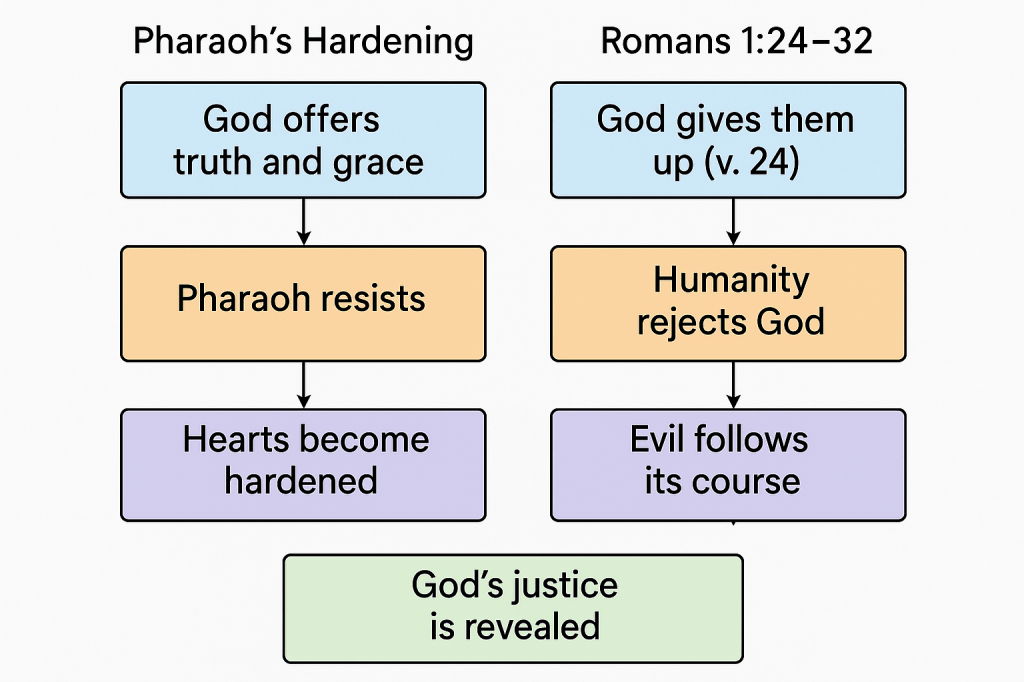
In Exodus the narrative alternates between “Pharaoh hardened his heart” (Exod 8:15) and “the LORD hardened Pharaoh’s heart” (Exod 9:12). This dual authorship expresses judicial hardening—God confirming a will already chosen in rebellion.
God’s act is therefore permissive, not coercive. He does not implant evil but withdraws restraining grace, allowing Pharaoh’s pride to crystallize. As Augustine phrased it, “God hardens by deserting, not by compelling.” Divine judgment here respects human freedom: Pharaoh is strengthened in the direction he insists upon.
In this, God reveals both His patience and His justice: Pharaoh’s resistance magnifies divine power and makes Israel’s deliverance unmistakably an act of grace (Romans 9:17).
4. Romans 1:24–32 — “God Gave Them Up”
Paul universalizes Pharaoh’s pattern to describe humanity’s moral collapse. Three times he repeats:
“Therefore God gave them up…” (Romans 1:24, 26, 28).
The Greek verb paradidōmi means “to hand over” or “to release.” This is passive judgment, not active cruelty: God allows people to experience the consequences of their self-chosen path. Love, rejected, becomes liberty without grace—a freedom that enslaves.
The wrath of God, then, is not a temperamental outburst but the truth of love unreceived. As C. S. Lewis famously wrote, “The doors of hell are locked from the inside.” When humanity insists on autonomy, God’s last act of respect is to let it have what it wants—life without Him.
5. The Infinite Depth of Divine Love and Judgment
The Psalms portray the scope of divine love in cosmic dimensions:
“Your steadfast love, O LORD, extends to the heavens; your faithfulness to the clouds.
Your righteousness is like the mighty mountains; your judgments are like the great deep.” — Psalm 36:5-6
“For as high as the heavens are above the earth, so great is His steadfast love toward those who fear Him;
as far as the east is from the west, so far does He remove our transgressions from us.” — Psalm 103:11-12
Here, love and judgment share the same infinite scale—the heavens and the deep. Divine wrath and mercy are not opposites but facets of the same holy love. Because God’s love is infinite, it must confront evil absolutely; to ignore sin would be unloving.
When God “hardens” or “gives up,” He does not cease to love; His love simply changes form. To the receptive, it is mercy; to the resistant, it is judgment. Love’s infinite persistence becomes, for the unrepentant, infinite distance—“as far as the east is from the west.”
6. Synthesis: The Architecture of Freedom and Providence
| Axis | Divine Action | Human Response | Theological Outcome |
|---|---|---|---|
| Will | Decretive (ordains salvation) | Moral (chooses obedience or sin) | Providence integrates both in one purpose. |
| Example: Judas | God foreknew betrayal | Judas chose greed and despair | Redemption through betrayal—evil turned to good. |
| Example: Pharaoh | God withdrew restraining grace | Pharaoh persisted in pride | Judgment magnified God’s power. |
| Universal Pattern (Romans 1) | God “gave them up” | Humanity rejected truth | Wrath as freedom without grace. |
| Underlying Nature | Infinite love and justice | Finite will and accountability | Love respects and redeems freedom. |
This synthesis reveals that divine sovereignty and human freedom are asymmetrical but compatible: God’s will is ultimate, yet human choice remains morally real. Divine decrees never compel sin; they simply ensure that no human act can thwart divine purpose.
7. Conclusion: Infinite Love, Finite Freedom
The scriptural narrative—from Pharaoh’s court to Judas’s betrayal—displays a consistent logic:
God’s will is sovereign, yet His creatures are free; His love is infinite, yet it honors the liberty of rejection.
When Scripture speaks of God “hardening,” “giving up,” or “allowing betrayal,” it describes love’s final act of respect for freedom, not its withdrawal. The God who “desires all to be saved” (1 Timothy 2:4) also refuses to coerce salvation. His patience, “as high as the heavens,” persists until it becomes judgment, “as deep as the great waters.”
Thus, divine sovereignty is not tyranny but the orchestration of freedom toward redemption. The cross stands as its supreme symbol: human sin at its worst and divine love at its fullest. In that intersection—where will and grace meet—we find the mystery of a God who rules without violating, loves without condition, and redeems without forcing.
References
- Augustine, Enchiridion, chs. 98–103.
- Thomas Aquinas, Summa Theologiae I, Q. 23, a. 5–8.
- C. S. Lewis, The Great Divorce, Preface and ch. 9.
- The Holy Bible, ESV translation.
Postscript: The Numerical Seal of Romans 1:24–32
Applying the Verse Identifier method (Book No. + Chapter No. + Verse No.) to Romans 1:24–32, where Romans is the 45th book of Scripture, yields an astonishing numeric symmetry.
For each verse, the identifier is 45 + 1 + v = 46 + v, and the sequence of values runs from 70 through 78.
| Verse | Identifier | Running Sum |
|---|---|---|
| 1:24 | 70 | 70 |
| 1:25 | 71 | 141 |
| 1:26 | 72 | 213 |
| 1:27 | 73 | 286 |
| 1:28 | 74 | 360 |
| 1:29 | 75 | 435 |
| 1:30 | 76 | 511 |
| 1:31 | 77 | 588 |
| 1:32 | 78 | 666 |
Sum = 666
Mathematically, the total confirms a perfect arithmetic progression:
average = (70 + 78)/2 = 74; 9 verses × 74 = 666.
The three refrain verses—those in which “God gave them up” (vv. 24, 26, 28)—correspond to identifiers 70 + 72 + 74 = 216 = 6³, the cubic signature of the same symbolic number. The central verse (v. 28) bears identifier 74, precisely the mean of the nine identifiers, forming the numerical axis around which the entire passage turns.
Theologically, this is profoundly fitting. Romans 1:24–32 depicts the full descent of humanity once divine restraint is lifted: God’s permissive judgment allowing sin to spiral into its own futility. The total 666, traditionally the number of man exalted without God, thus becomes an arithmetic mirror of Paul’s argument—a humanity that, having rejected the image of God, is handed over to the image of itself.
Far from coincidence, the numeric seal reinforces the message of the text: divine wrath is not arbitrary destruction but the moral geometry of freedom misused. Where grace is refused, order collapses into repetition—six without seven, labor without rest, man without God. In this sense, Romans 1:24–32 stands as the numerical and theological archetype of the truth Paul later summarizes:
“Having loved their own way, they were given over to it.”

 The Lord's Prayer: A Mathematician's Creed