
Abstract
Both Job 28:28 and Proverbs 29:25 share the same biblical verse identifier: 74. This numerical convergence highlights a profound theological contrast between two kinds of fear: the fear of the Lord, which leads to wisdom and freedom, and the fear of man, which entraps and enslaves. By examining this contrast, and by tracing the numeric journey from 74 to 153, we see that prayer—especially the Lord’s Prayer—becomes the Spirit-led path from bondage to freedom, from snare to safety, from fear to fullness.
The Verse Identifier: Definition and Calculation
A verse identifier is a numeric value assigned to a verse using the formula:
Identifier=Book Number+Chapter Number+Verse Number
- Job 28:28
- Book of Job = 18th book of the Bible
- Chapter = 28
- Verse = 28
- Identifier = 18 + 28 + 28 = 74
- Proverbs 29:25
- Book of Proverbs = 20th book of the Bible
- Chapter = 29
- Verse = 25
- Identifier = 20 + 29 + 25 = 74
Thus, both verses—though separated by context and content—share the same identifier, pointing us to a deeper thematic connection.
The Two Fears in Contrast
1. Fear of the Lord (Job 28:28 – Identifier 74)
And to man He said, ‘Behold, the fear of the Lord, that is wisdom, And to depart from evil is understanding.’ ” (Job 28:28, NKJV)
In Job’s wisdom poem, human ingenuity in mining the earth’s treasures is contrasted with the inaccessibility of wisdom. True wisdom cannot be mined; it is given by God. Its essence is captured in the phrase, “The fear of the Lord—that is wisdom.” This fear is reverence, awe, and holy submission. It liberates because it orients life toward God’s sovereignty, resulting in discernment and moral clarity.
2. Fear of Man (Proverbs 29:25 – Identifier 74)
The fear of man brings a snare, But whoever trusts in the Lord shall be safe. (Proverbs 29:25, NKJV)
In Proverbs, the “fear of man” is described as a trap, a snare that entangles the soul. This fear is rooted in the quest for human approval, the dread of rejection, or the anxiety of opposition. Unlike the fear of the Lord, it enslaves, leading to compromise, silence, and insecurity. The proverb immediately offers its counterbalance: “But whoever trusts in the Lord shall be safe.” Trust displaces fear.
The Unity of the Identifier (74)
That both verses share the number 74 is more than coincidence. In biblical mathematics, numbers often serve as thematic bridges. Here, 74 unites two opposites:
- Fear of the Lord (wisdom, freedom, safety).
- Fear of man (folly, bondage, danger).
Thus, the shared identifier sets before us a stark spiritual choice: Which fear will rule our hearts? The same number that binds the verses calls us to discern between life-giving reverence and soul-ensnaring anxiety.
From 74 to 153: The Harmonic Path to the Lord’s Prayer
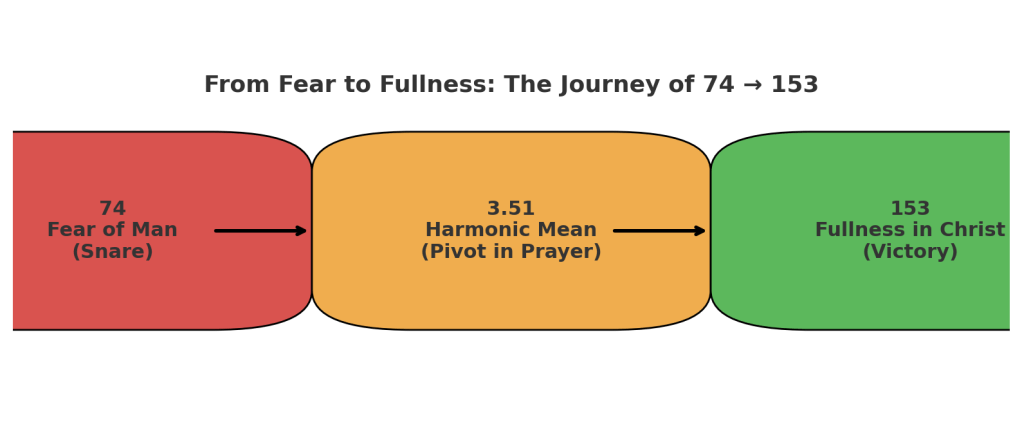
The number 74 does not stand alone; it carries within it a hidden journey. Its divisors are {1, 2, 37, 74}. The harmonic mean of these divisors is 3.51.
On the surface, this is a simple mathematical property. Yet its digits [3-5-1] conceal a hidden key: a permutation to [1-5-3], pointing directly to 153.
- 74 – the snare of fearing man (Proverbs 29:25).
- 3.51 – the pivot, the crossing point, the hidden code.
- 153 – the fullness of victory in Christ, the number of fish in John 21:11 symbolizing the gathered Church.
In prayer practice, this pattern unfolds in sacred time. In the rhythm of the Lord’s Prayer, daily prayers are offered at 1:53 pm and 3:51 pm. The digits of the harmonic mean thus become embodied in prayer:
- 1:53 pm → the fullness of the net (153): “Your kingdom come.”
- 3:51 pm → the reversal of 153 (351): “Deliver us from evil.”
This shows that the fear of man (74) is not overcome by willpower, but by stepping into the victory of Christ (153), made present through the Lord’s Prayer. The journey of numbers thus becomes the journey of the soul: from fear → to fullness, from snare → to deliverance, from 74 → 153.
Overcoming the Fear of Man: Practical Pathways
- Re-anchor Identity in God
Fear of man thrives when self-worth rests on others’ opinions. Meditating on God’s declaration—“You are accepted in the Beloved” (Ephesians 1:6)—shifts the foundation of identity from human applause to divine approval. - Reorder Your Fears
Jesus said: “Do not fear those who kill the body…but rather fear Him who can destroy both soul and body in hell” (Matthew 10:28). Perspective frees us: man’s power is limited; God’s power is ultimate. - Practice Trust Daily
Proverbs 29:25 emphasizes that trust in the Lord brings safety. Each decision to honor God over pleasing people strengthens spiritual courage. Trust becomes the antidote to entrapment. - Seek God’s Vision
Without prophetic vision, people drift into conformity (Proverbs 29:18). Fixing our eyes on God’s call clarifies which voices matter. - Rely on Prayer and the Spirit
The numeric arc from 74 → 153 reveals that prayer is the Spirit’s appointed path out of fear. The harmonic mean (3.51) points to times of prayer that lead from snare to safety, from bondage to deliverance. The Lord’s Prayer, prayed faithfully at sacred times, becomes the doorway into Christ’s fullness.
Conclusion
The number 74 binds together two verses that illuminate the two fears vying for mastery over human hearts. Job 28:28 calls us into the liberating fear of the Lord, the beginning of wisdom. Proverbs 29:25 warns against the fear of man, a snare that robs us of freedom.
Yet the journey does not end there. Through the harmonic path of 74 → 153, mathematics itself testifies to the gospel: fear of man is overcome not by suppression but by substitution—by trusting in God, praying in the Spirit, and stepping into the completeness of Christ. The Lord’s Prayer thus becomes the pivot point where fear turns into freedom, and where the soul moves from snare into safety.

 The Lord's Prayer: A Mathematician's Creed