
1. Introduction
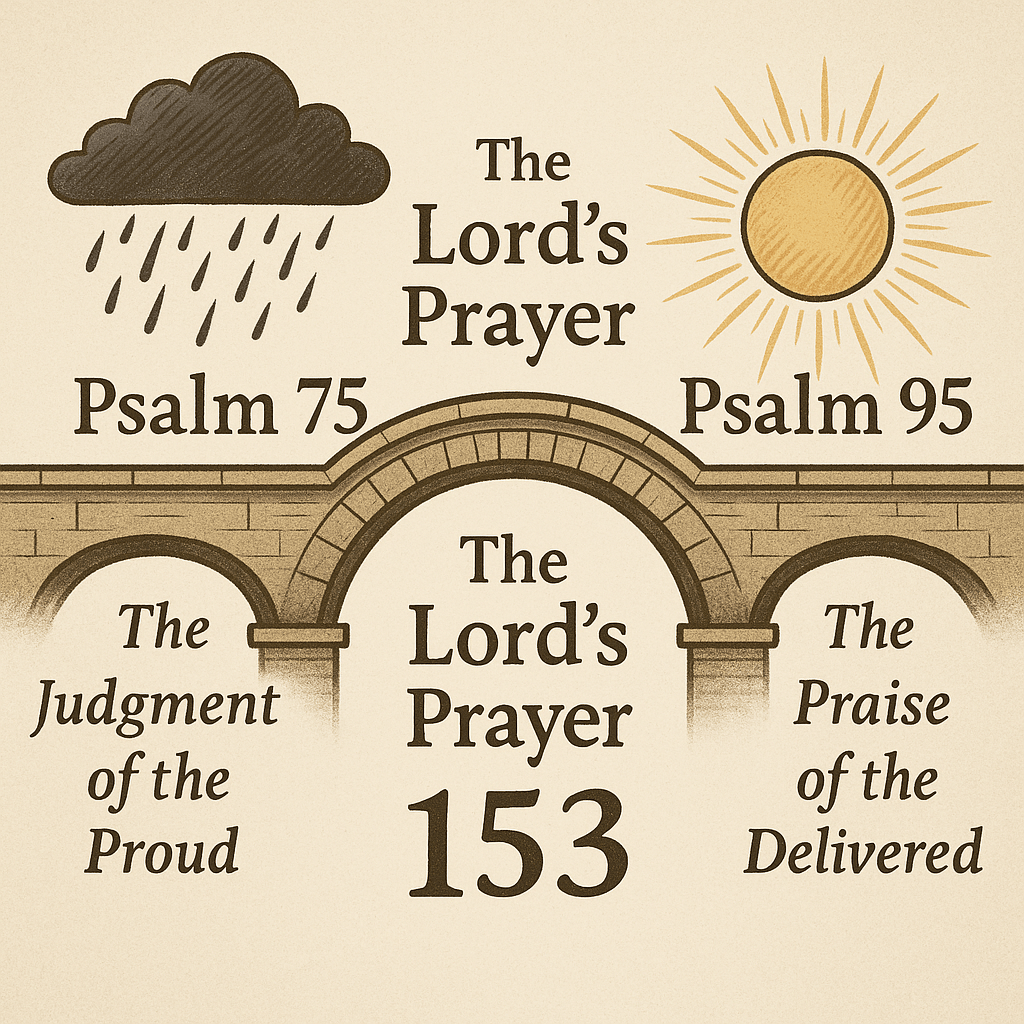
In the biblical narrative, God is not indifferent to injustice. Psalm 75 is a vivid declaration of divine judgment against prideful, oppressive, and paranoid rulers. Psalm 95, on the other hand, is a communal invitation to joyful worship and reverent obedience.
This paper contends that the Lord’s Prayer, embedded within the very fabric of Scripture, functions as the theological and numerical bridge between these two psalms. It facilitates the cry for justice and the praise of deliverance. The mathematical structure of these psalms affirms the Lord’s Prayer as a divine key.
2. Psalm 75: The Judgment of the Proud
Psalm 75 announces God as the ultimate judge who “puts down one, and sets up another” (v.7). The psalm speaks directly to arrogant and power-obsessed individuals: “Lift not up your horn on high: speak not with a stiff neck” (v.5). It offers assurance to the oppressed that justice will be served.
- Total Identifier of Psalm 75: 995
Computed as the sum of verse identifiers (Book 19 + Chapter 75 + Verse Number) - Divisors of 995: [1, 5, 199, 995]
Geometric Mean ≈ 31.54 → digits: 3, 1, 5 → permutation of 153
This reveals that divine judgment in Psalm 75 is numerically tethered to the number 153, long recognized as a symbolic number of fullness, divine order, and the Lord’s Prayer itself.
3. Psalm 95: The Praise of the Delivered
Psalm 95 represents the spiritual condition of a community that has witnessed the fall of injustice. It begins with a call to thanksgiving and ends with a sober reminder not to repeat the errors of rebellion. It is the natural response after God has fulfilled the promise declared in Psalm 75.
- Total Identifier of Psalm 95: 1320
- Divisors of 1320: 32 in total
Sum of Divisors: 4320 → Arithmetic Mean = 4320 / 32 = 135 → another permutation of 153
Again, we see the numerical resonance with 153, suggesting a hidden unity with Psalm 75 and a full-circle return to divine order through worship.
4. Theological Function of the Lord’s Prayer
The Lord’s Prayer operates on two planes simultaneously:
- As Petition for Judgment and Deliverance
- “Thy kingdom come, Thy will be done on earth as it is in heaven” (Matthew 6:10) aligns with the themes of Psalm 75.
- “Deliver us from evil” speaks directly to the plea against oppressive and paranoid leadership.
- As Praise for Redemption and Rest
- “Give us this day our daily bread” and “Forgive us our trespasses” echo the spirit of Psalm 95—communal thanksgiving, humility, and worship.
These dual functions mirror the movement from Psalm 75 to Psalm 95, confirming the Lord’s Prayer as a spiritual bridge.
5. The Mystery of 153 and the Net of Prayer
The number 153 is most famously associated with John 21:11, the miraculous catch of fish. It symbolizes fullness, the gathering of the elect, and the net of divine calling.
In the framework discussed:
- Psalm 75’s Geometric Mean (31.5) → 153
- Psalm 95’s Arithmetic Mean (135) → 153
These findings show that the Lord’s Prayer, encoded in 153, is the sanctified net through which the justice of Psalm 75 is drawn into the praise of Psalm 95.
6. Conclusion: Sanctifying Time and Order through the Lord’s Prayer
The Lord’s Prayer is more than a petition; it is the divine engine that moves history from oppression to order, from sorrow to song. The numerical revelations encoded in Psalms 75 and 95 are not random coincidences but holy signatures of the spiritual transformation initiated by this prayer.
Thus, whether confronting the horns of the wicked or entering the rest of the righteous, we are called to pray:
“Thy kingdom come, Thy will be done… For Thine is the kingdom, and the power, and the glory forever. Amen.”
🙏 Theological Implication
The Lord’s Prayer can and should be:
- Prayed during times of oppression as a petition for righteous judgment (Psalm 75).
- Prayed after vindication as a song of thanks and renewed worship (Psalm 95).
It becomes the spiritual Net of 153:
- Gathering the humble,
- Separating the wicked,
- Restoring the soul,
- And sanctifying the time and the people.

 The Lord's Prayer: A Mathematician's Creed